Most dental practices asking “how do we get more new patients” are asking the wrong question. The right question is: where are the patients we’re already losing — and how do we stop losing them?
The average dental practice in the US spends $3,200 per month on marketing and books fewer than 20 new patients from it. That math only makes sense if you assume the patients they’re not booking are simply not interested. They’re not. They called after hours. They filled out the web form and waited 36 hours for a callback that never came. They Googled “dentist near me” and clicked on a competitor who showed up in the Google AI Overview. They got a voicemail on a Saturday and never called back.
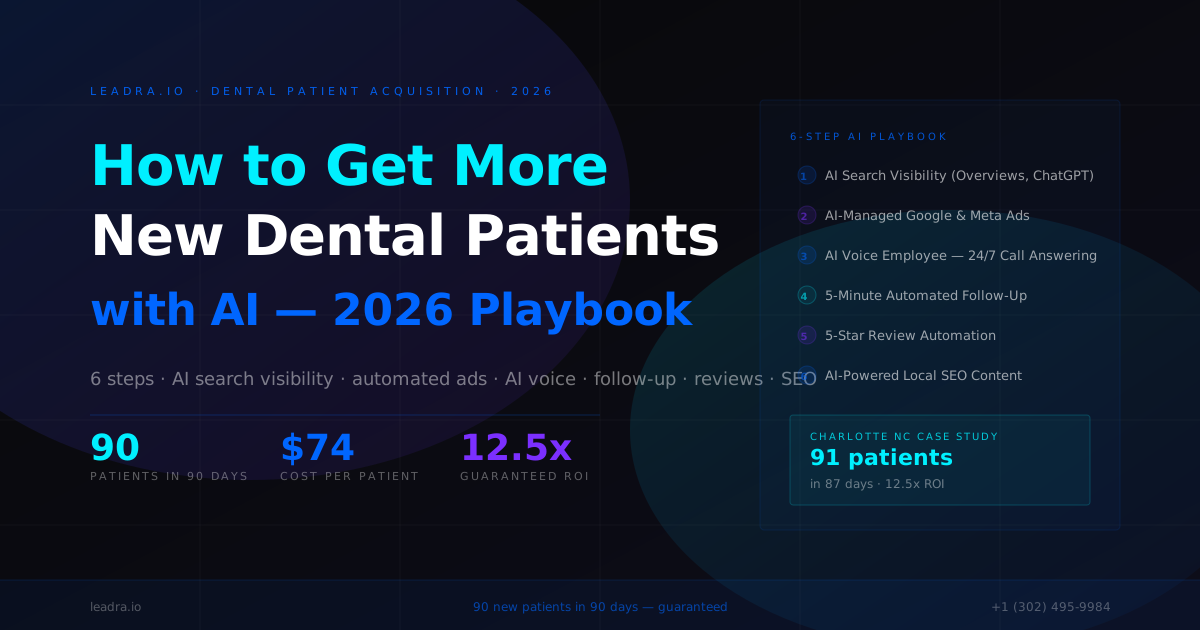
AI doesn’t just generate more leads for dental practices — it closes the conversion gaps that existing marketing spend is already creating. At Leadra.io, every dental practice we deploy on the full AI acquisition system hits a guaranteed 90 new patients in 90 days— or they don’t pay. This is how the system works, step by step.
If your practice is already spending on Google Ads or running social campaigns and still not filling your schedule, this playbook is exactly for you. The problem is almost certainly in one of the six stages below.
Why AI Outperforms Traditional Dental Marketing in 2026
Traditional dental marketing has three structural failures. AI eliminates all three.
Traditional marketing is slow to respond
Ad agencies review campaigns monthly. Web leads go into a spreadsheet someone checks on Tuesday morning. The practice that responds first gets the patient — but traditional systems are built around business hours, not patient timing. AI operates 24/7/365 and responds within minutes, not days.
Traditional marketing ignores new search channels
In 2026, a meaningful percentage of dental searches never reach the traditional blue-link results at all. Google AI Overviews, ChatGPT, and Perplexity pull answers from practices with structured schema markup and FAQ content. Most dental websites have neither — making them invisible to this growing segment of patient searches.
Traditional marketing can't optimize in real time
A human ad manager can adjust campaigns once a week at best. AI-managed campaigns adjust hourly — shifting budget between ad groups, swapping in new creative variants, and adjusting bids based on what's converting right now. This continuous optimization is why AI campaigns consistently outperform human-managed campaigns on cost per acquired patient.
The result is a consistent 50-65% reduction in cost per acquired patient and 3-5x more new patients from the same or smaller marketing budget. Here’s exactly how to deploy it. For the full Leadra.io AI patient acquisition system — see our services page.
The 6-Step AI Playbook for Getting More New Dental Patients
These six steps are not optional add-ons. They are the complete system. Practices running all six consistently hit 70-120 new patients in 90 days. Practices running three or four typically see partial results — because the missing steps are where the conversion leaks are.
Get found in AI search — Google AI Overviews, ChatGPT, and Perplexity
In 2026, a growing share of dental searches end with an AI-generated answer at the top of Google — not a list of ten blue links. When someone types "best dentist near me" or "dental implants Charlotte NC" into Google, ChatGPT, or Perplexity, AI pulls from practices that have structured FAQ content, schema markup, and local authority signals. Practices without this are invisible to the fastest-growing search channel. Building AI-optimized content — specifically FAQ-structured posts targeting the questions your ideal patients actually ask — is what gets you cited in these answers. This is the channel most dental practices are completely ignoring in 2026.
Run AI-managed Google and Meta ads that self-optimize daily
Traditional dental ad campaigns are set up once by an agency and reviewed monthly. AI-managed campaigns adjust bids, swap creatives, and shift budget between audiences every day based on what's converting. The practical result: your cost per lead drops 30-50% in the first 60 days as the AI eliminates underperforming ad variants and doubles down on the audiences booking appointments. Google Search captures active searchers — "emergency dentist Charlotte" or "Invisalign near me." Meta captures passive demand — people in your service area who match the profile of your highest-value existing patients. Both channels running simultaneously, self-optimizing, is the baseline for any serious new patient strategy.
Answer every call — including nights and weekends — with an AI Voice Employee
This is the single highest-impact change most dental practices can make. Between 40% and 60% of dental inquiries arrive outside business hours. Voicemail has a callback rate under 20% in 2026 — because by the time someone calls back the next morning, the prospect has already booked with a competitor who answered. An AI Voice Employee answers every call in under two rings, 24 hours a day. It handles new patient inquiries in natural conversation, answers questions about services and pricing, verifies insurance coverage, and books the appointment directly into your practice management system. The AI integrates with Dentrix, OpenDental, Eaglesoft, and most other PMS platforms. Practices deploying this layer typically capture 40-60% more inbound leads from day one.
Follow up with every lead within 5 minutes — automatically
Speed-to-lead is the most important conversion variable in dental patient acquisition. A 2024 study found that leads contacted within 5 minutes are 100 times more likely to convert than leads contacted after 30 minutes. Most practices respond in 24-48 hours. The fix is automated: every form fill, chat inquiry, and ad click triggers an instant personalized text message with a direct booking link. If the prospect doesn't book, a 14-day SMS and email sequence follows — with varied touchpoints including a patient story, a limited-availability nudge, and a re-engagement offer at day 10. This sequence alone recovers 25-35% of leads that traditional practices permanently lose after the first missed follow-up.
Build a 5-star Google review machine that compounds your local ranking
Google Maps ranking for dentists in 2026 is driven primarily by review volume, review recency, and review response rate. Most practices get 3-8 new reviews per month because they ask inconsistently and patients forget. Automated post-appointment review requests — sent by text 2-3 hours after every completed visit when satisfaction peaks — push this to 18-30 new five-star reviews per month. Happy patients get a one-tap Google Review link. Unhappy patients get routed to an internal feedback form so you resolve issues before they become public complaints. Within 90 days, a practice running this system will typically outrank most local competitors on Google Maps purely on review velocity.
Publish AI-powered local SEO content targeting the questions patients ask
Consistent local SEO content — blog posts targeting specific questions like "what does a dental implant cost in Charlotte" or "how long does Invisalign take" — builds topical authority that compounds over time. AI generates this content at scale: a full 2,000-word, schema-marked post in the time it used to take a copywriter a full day. Each post captures long-tail search traffic from patients actively researching treatments, builds the E-E-A-T signals Google rewards, and feeds the structured data that AI Overviews pull from. Practices publishing 4-8 posts per month using this system consistently see organic search traffic grow 3-5x within six months.
The Step Most Practices Skip First
Step 1 — AI search visibility — is the most commonly skipped because it takes 30-60 days to see results. But it’s also the only channel that compounds indefinitely: every piece of structured FAQ content you publish builds authority that makes the next piece rank faster. Practices that start this step on day one are miles ahead of those who add it later.
AI vs. Traditional Dental Marketing: What the Numbers Show
These are averages across Leadra.io dental practice deployments in 2025-2026. The difference in new patient volume at 90 days reflects the cumulative effect of all six AI steps running simultaneously versus the fragmented, manual approach most practices use:
| Metric | Traditional | AI System |
|---|---|---|
| Visibility in Google AI Overviews | None (no schema/FAQ) | Cited in AI answers |
| Ad campaign optimization | Monthly manual review | Daily self-optimization |
| After-hours call handling | Voicemail (20% callback) | AI answers — books live |
| Speed to first follow-up | 24-48 hours | Under 5 minutes |
| New Google reviews/month | 3-8 | 18-30 |
| SEO content published/month | 0-2 posts | 4-8 posts |
| Cost per new patient acquired | $180-$320 | $65-$110 |
| New patients in 90 days | 15-30 | 70-120+ |
The “visibility in Google AI Overviews” row is the one that surprises most dentists. This is a channel that didn’t meaningfully exist two years ago and now accounts for a significant share of new patient searches. The practices that move first on AI search visibility are building an advantage that will compound for years.
Case Study: Dilworth Family Dental Adds 91 New Patients in 87 Days
Client Story — Charlotte, NC
A single-dentist general practice in Charlotte’s Dilworth neighborhood came to Leadra.io averaging 14 new patients per month. They were spending $2,400/month on a Google Ads campaign managed by a national dental marketing company, getting monthly PDF reports, and using no follow-up system beyond a front desk that tried to return calls the next business day. Their Google Business Profile had 31 reviews total, accumulated over four years.
Leadra.io deployed all six playbook steps over 9 days. The AI Voice Employee went live on day 3 and immediately started answering the 35-40% of calls arriving after 5 PM that had been going to voicemail. Automated follow-up launched for all web leads within minutes of inquiry. The Google Ads account was rebuilt with AI creative rotation and daily optimization. Review automation started capturing post-visit feedback. The first three FAQ-structured SEO posts went live on day 9.
By day 87, the practice had booked 91 net new patients. The AI Voice Employee handled 284 calls and booked 61 appointments — 42 of them outside business hours. The Google Business Profile went from 31 to 67 reviews, averaging 4.9 stars. One SEO post ranked on page one of Google for “Invisalign Dilworth Charlotte” by day 45. Ad cost per conversion dropped from $181 to $74 over the first 60 days as the AI optimized.
New patients/mo (before)
14
New patients in 87 days
91
After-hrs calls booked
42
New Google reviews
36
Average new patient value: $1,350/yr · 91 new patients = $122,850 first-year patient revenue. System cost over 87 days: $9,800. ROI: 12.5x.
The dentist’s biggest surprise was the after-hours call volume. He had assumed those calls were mostly existing patients with questions. They weren’t — 42 of the 61 AI-booked appointments were net-new patients who had called after 5 PM, gotten an immediate professional response from the AI Voice Employee, and booked before the competition could even return their missed call the next morning.
What to Expect Week by Week When You Deploy AI Patient Acquisition
Realistic expectations matter. Some layers produce results in days. Others compound over weeks. Here is the actual progression for a dental practice deploying the full system:
First booked appointments
AI Voice Employee live — captures after-hours calls immediately. Automated follow-up fires on all existing leads. First appointments typically booked within 72 hours of launch.
20-35 new patients booked
Ad campaigns in active optimization phase — cost per lead dropping. Review automation running. First SEO content posts indexed. AI search visibility building.
Full-velocity month — 30-45 new patients
Ads fully optimized, CPL at lowest point. Google Maps ranking rising from review velocity. Organic search traffic growing. Follow-up sequences have touched every lead in the pipeline.
90-patient milestone reached
SEO content generating passive inbound leads. Review moat building competitive advantage. AI search citations driving credibility. System self-sustaining and compounding.
The Compounding Effect
At month 3, the system is producing maximum results. By month 6, it’s compounding — SEO content is ranking, reviews are driving organic trust, and AI search visibility is generating leads that cost nothing per click. The practices that stay on the system past 90 days typically see their cost per new patient drop another 30-40% in months 4-6 as the organic and review channels take over from paid acquisition.
Getting New Dental Patients in Charlotte, NC: What Makes This Market Different
Charlotte added over 40,000 new residents in 2024 — a pace that continued through 2025 and into 2026. Every new household is actively looking for a primary dentist within 60-90 days of moving in. These patients Google “dentist near me,” ask ChatGPT “best family dentist in Charlotte,” and check Google Maps reviews. The practice that shows up in all three channels first wins the patient before they’ve even heard of anyone else.
In growth corridors like Steele Creek, Ballantyne, University City, and Huntersville, dental demand consistently outpaces supply. The practices deploying AI patient acquisition systems now are building review moats, SEO authority, and AI search visibility that will take slower-moving competitors 12-18 months to match — if they start today.
Leadra.io is based in Charlotte and has deployed patient acquisition systems for dental practices across Mecklenburg and Cabarrus counties. We know which zip codes are growing fastest, what the insurance mix looks like in each corridor, and which AI search queries your ideal patient types at 9 PM on their phone. That local context is built into every campaign we run.
Frequently Asked Questions
How does AI help a dental practice get more new patients?
AI helps dental practices get more new patients by automating every step of the acquisition funnel: appearing in Google AI Overviews and ChatGPT answers so patients find you first, running self-optimizing Google and Meta ads to generate inbound leads, answering every call 24/7 with an AI Voice Employee that books appointments on the spot, sending automated follow-up within 5 minutes of any inquiry, and building Google reviews automatically after every visit. Together these steps typically deliver 90+ new patients within 90 days.
How quickly can AI start bringing in new dental patients?
Most dental practices deploying a full AI patient acquisition system see their first booked appointments within 7-14 days — primarily from the AI Voice Employee capturing calls that would have gone to voicemail and from immediate follow-up on existing web leads. By day 30, ad targeting has optimized and new patient volume typically reaches 20-35 per month. The full 90-patient milestone typically lands between days 60 and 90.
What is the cost to get new dental patients with AI marketing?
AI patient acquisition for a dental practice typically costs $2,500 to $4,500 per month for a full system — including AI Voice Employee, automated follow-up, Google and Meta ad management, SEO content, and review automation. The average cost per new patient acquired is $65 to $110, versus $180 to $320 with traditional dental marketing. At $1,200 to $2,500 average annual patient value, the ROI is typically 4x to 8x within the first 90 days.
Does AI work for dental practices in competitive markets like Charlotte, NC?
Yes — competitive markets like Charlotte, NC are where AI patient acquisition delivers the strongest results because the speed and visibility advantages are most pronounced. Charlotte added over 40,000 new residents in 2024 alone, meaning constant demand for a primary dentist. AI-managed ads respond to competitor moves in real time, the AI Voice Employee captures every call competitors send to voicemail, and AI SEO content captures the AI Overview placements that most practices are not yet targeting. Early adopters in Charlotte are building compounding advantages that are very difficult for slower-moving competitors to close.
The Practices Filling Their Schedules in 2026 Are Not Spending More — They’re Converting Better
Getting more new dental patients with AI is not about finding a magic traffic channel. It’s about removing every barrier between a prospective patient and a booked appointment. The six-step playbook above eliminates the six most common barriers: invisibility in AI search, slow ad optimization, after-hours call loss, slow follow-up, weak reviews, and absent organic content.
Most practices are only missing two or three of these. Fixing them doesn’t require a bigger marketing budget — it requires a smarter conversion infrastructure. That’s what AI provides.
Leadra.io guarantees 90 new patients in 90 days for every dental practice we work with — or you don’t pay. That guarantee exists because the system is repeatable across markets, practice sizes, and competitive environments.
Free New Patient Acquisition Audit
Find Out Exactly How Many New Patients You’re Losing — and How to Get Them
30-minute audit. We’ll map every conversion leak in your current acquisition funnel and show you a concrete 90-day projection for the full AI system.
Leadra.io
AI marketing agency — Charlotte, NC · Published May 29, 2026