HVAC AI Voice Agent for Emergency Calls Overnight: Never Lose a $500 Job to Voicemail Again (2026)
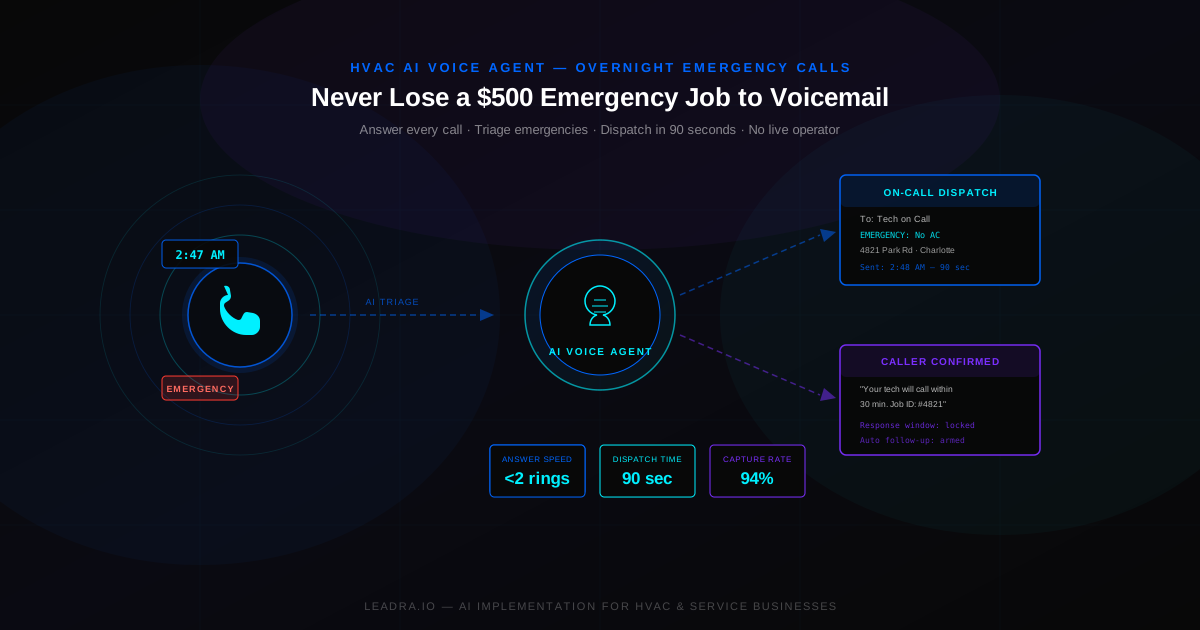
It's 11:47 PM on a July night in Charlotte. A homeowner's AC unit just stopped working. The house is 86 degrees. There's a baby in the back bedroom. He picks up his phone and calls three HVAC companies. Two go to voicemail. One picks up — and books a next-morning emergency call for $575 plus an after-hours fee.
That third company runs an HVAC AI voice agent for emergency calls overnight. The homeowner never knew he was talking to a machine. The tech got a text at 11:48 PM with the address, the issue, and a confirmed callback window. The job was done by 7 AM.
The two companies that sent him to voicemail lost a $575 job, a 5-star review, and a maintenance contract. That happens multiple times per week during peak season. By the end of July, those two companies have given away $8,000-$12,000 in emergency revenue to whoever picked up the phone.
This guide breaks down how an HVAC AI voice agent handles overnight emergency calls, what the triage logic looks like, what it costs, and how Charlotte HVAC companies are using it to capture emergency revenue competitors leave on the table.
Why Overnight HVAC Emergencies Are Different
Not every after-hours call is an emergency. A homeowner noticing their unit is making a new noise at 9 PM can wait until morning. But a homeowner with no heat when it's 28 degrees outside cannot wait — and that caller will book the first company that answers.
Overnight HVAC emergency calls have two traits that make them different from standard after-hours calls:
- →High urgency, low patience. Callers who need heat or AC restored overnight will call 3-5 companies in under 10 minutes. The first live response wins the job, period. Every second your phone rings without an answer costs you money.
- →High ticket value. Emergency HVAC calls typically run $350-$800 for the visit alone, before parts. A no-heat call in January with a failed heat exchanger can be a $2,000-$4,000 job. These are not the calls to lose to voicemail.
- →Decision made before morning. Unlike routine service calls that a homeowner will shop around for, overnight emergencies are solved by whoever shows up. Once your competitor books it, that customer is gone — and they'll leave that competitor a 5-star review.
An HVAC AI voice agent for emergency calls overnight solves all three. It answers in 1-2 rings. It gathers the job details and confirms a response window. And it does this at 2 AM without you paying a live operator.
How an HVAC AI Voice Agent Handles Overnight Emergency Calls: The 5-Step Flow
A properly configured AI voice agent for HVAC emergency calls runs a specific sequence every time a call comes in after hours. Here's what that looks like in practice:
Step 1: Instant Answer (Under 2 Rings)
The AI picks up immediately — no hold music, no menu tree, no "our offices are currently closed." It greets the caller with your company name and asks what's going on. Response time under 10 seconds builds caller confidence before a word about the problem is spoken.
Step 2: Problem Triage (60-90 Seconds)
The agent asks 4-5 targeted questions: What system is affected? What's the problem? How long has it been down? Is anyone in the home with health or age-related vulnerabilities? What's the address? This takes 60-90 seconds and generates the full job intake a technician needs to prepare before arrival.
Step 3: Emergency vs. Standard Routing
Based on the triage, the AI routes the call one of two ways. True emergencies (no heat below 40°F, no AC above 95°F, water leaking from unit, smell of refrigerant or carbon monoxide) trigger immediate on-call dispatch. Standard after-hours calls (noise complaints, high bills, minor issues) are routed to first-available next-morning booking — no dispatch fee, no disrupting your tech's sleep.
Step 4: On-Call Tech Dispatch (Under 90 Seconds After Call Ends)
For emergency-flagged calls, your on-call technician gets an SMS within 90 seconds. The text includes: caller name, phone number, address, problem summary, and the response window the AI confirmed with the homeowner. The tech doesn't need to call in to get briefed — they have everything to respond immediately.
Step 5: Automatic Follow-Up
If the tech hasn't called the homeowner back within the confirmed window (typically 20-30 minutes), the AI sends a second alert to the on-call tech and a reassurance SMS to the homeowner. This prevents the scenario where a caller feels abandoned after a late-night emergency call and starts dialing competitors again.
Voicemail vs. Live Answering Service vs. AI Voice Agent: Real Cost Comparison
Most HVAC companies are currently using one of three approaches for overnight emergency calls. Here's what each actually costs and delivers:
| Factor | Voicemail | Live Answering Service | AI Voice Agent |
|---|---|---|---|
| Monthly Cost | $0 | $1,800-$3,500 | $700-$1,400 |
| Answer Speed | Never (they hang up) | 3-6 rings, sometimes hold | 1-2 rings, always |
| Emergency Triage | None | Basic script, inconsistent | Structured 5-question triage |
| Tech Dispatch Speed | Morning (if they call back) | 3-8 min after call | Under 90 sec after call |
| Call Capture Rate | ~15% (most hang up) | ~70% | ~94% |
| Consistent Quality | N/A | Variable (staff turnover) | Identical every call |
| Scales During Heat Waves | No | Limited (costs spike) | Yes, no extra cost |
The math is straightforward. If you lose 3-4 emergency calls per week to voicemail at an average ticket of $550, that's $1,650-$2,200 per week in missed revenue — $7,000-$9,500 per month in peak season. An AI voice agent costs $700-$1,400 per month and captures most of those jobs. The ROI on the first month covers the first year of service.
Case Study: Charlotte HVAC Company Adds $18,400/Month in Emergency Revenue
A Charlotte HVAC company with 6 technicians was running a voicemail system for after-hours calls. During the summer of 2025, they tracked 47 missed calls in a single month — calls that went to voicemail between 9 PM and 7 AM. They estimated 60-65% of those callers had true emergencies (AC failures during a heat wave). At an average emergency ticket of $595, that was roughly $16,700-$18,200 in jobs they had sent to competitors every month during peak season.
They deployed an HVAC AI voice agent for emergency calls overnight through Leadra.io in June 2025. Setup took 9 days: 3 days configuring the triage script and emergency escalation rules, 4 days of test calls and script refinement, and 2 days of live call monitoring before full handoff.
Results after 60 days:
- →After-hours call capture rate went from 17% to 91%
- →Emergency jobs booked overnight: 9/month → 31/month
- →Average overnight job ticket: $594
- →Added monthly revenue from overnight emergency calls: $18,400
- →Monthly system cost: $1,100
- →ROI in month 1: 16.7x
The owner reported that his on-call technician's first comment after week one was: "I'm getting better dispatch texts from the AI than I ever got from our old answering service." The triage quality meant every overnight job showed up with a complete picture — no arriving blind to a job that turned out to be something completely different than described.
What to Look For in an HVAC AI Voice Agent for Overnight Emergency Calls
Not every AI voice product is built to handle HVAC emergencies properly. Here are four things that separate a real emergency-capable system from a basic call-capture bot:
1. True Emergency Triage Logic
The system must distinguish between an AC making a new noise and an AC that has completely stopped functioning during a 97-degree night. If the triage doesn't ask severity-level questions and adapt the routing based on answers, it's not a real emergency system — it's a lead form with a voice interface.
2. Sub-90-Second Tech Dispatch
The value of capturing an emergency call disappears if your tech doesn't know about it for 20 minutes. The AI should send an SMS to your on-call tech within 90 seconds of the call ending — not after a human reviews a queue in the morning. Every minute of dispatch delay gives the homeowner more time to call competitor number two.
3. Escalation Fallback
If your on-call tech doesn't respond within the confirmed window, the system needs an escalation path — a second SMS to the tech, an alert to the owner's cell, and a reassurance message to the homeowner. Single-alert systems leave you exposed when a tech is unavailable or misses the text.
4. Next-Day Booking for Non-Emergencies
A system that dispatches your on-call tech for every after-hours call will burn out your technician in two weeks. Proper AI voice agents handle low-priority after-hours calls — noise complaints, maintenance requests, billing questions — without triggering dispatch. This protects your on-call resource for calls that actually require it.
What Does an HVAC AI Voice Agent Cost? (2026 Pricing Breakdown)
| Tier | Monthly Cost | What's Included |
|---|---|---|
| Core | $700-$1,000/mo | 24/7 call answering, emergency triage, on-call SMS dispatch, next-day booking for non-emergencies. Best for solo operators and 2-3 tech companies. |
| Growth | $1,000-$1,800/mo | Everything in Core + field service software integration (ServiceTitan, Housecall Pro, Jobber), multi-technician dispatch routing, call recording and quality review. |
| Enterprise | $1,800-$3,000/mo | Everything in Growth + multi-location support, custom escalation trees, live performance dashboards, dedicated account manager, and quarterly script optimization reviews. |
Add $100-$300/month for voice call minutes and SMS credits depending on call volume. Most HVAC companies with 3-8 technicians land in the $900-$1,400/month all-in range and recover the cost within 30 days from emergency job capture alone.
Compare this to a live answering service: at 200-400 HVAC calls per month at $1.50-$2.25 per minute (average HVAC call is 3-5 minutes), you're spending $900-$4,500 per month. The AI is cheaper and answers faster with better triage.
When Should an HVAC Company Deploy an AI Voice Agent for Overnight Emergency Calls?
If you're answering less than 100% of your after-hours calls live today, the answer is now. But here are the specific signals that make overnight emergency call handling a priority:
- →You have an on-call tech but no reliable way to reach them. The AI is the bridge between an incoming emergency call and your tech's SMS. It makes the handoff reliable and fast every time.
- →You're in a market with hard winters or hot summers. Charlotte's temperature swings create true overnight emergencies from November through March (no heat) and May through September (AC failure). Either season generates emergency calls worth $400-$800 each.
- →Your competitors have live answering and you don't. If a homeowner with a 2 AM emergency can reach your competitor live and gets your voicemail, that job is gone before the sun comes up.
- →You want to offer emergency service without paying live staff overnight. A live operator handling 8 hours of overnight coverage costs $80-$160 per night — $2,400-$4,800/month for 30 days. An AI voice agent costs $700-$1,400/month and handles every call without breaks or call-outs.
An HVAC AI voice agent for emergency calls overnight pairs naturally with a full AI dispatching system. If you want the complete picture of how AI handles the entire call-to-dispatch flow — not just overnight emergencies — read our breakdown of the best AI dispatcher for HVAC companies.
Frequently Asked Questions
What is an HVAC AI voice agent for emergency calls overnight?
An HVAC AI voice agent for emergency calls overnight is a software system that answers your business phone 24/7 using a human-sounding AI voice. When a homeowner calls at 2 AM with a failed AC or no heat, the agent gathers the problem details, triages the severity, sends an immediate text alert to your on-call technician with the job address and issue summary, and gives the caller a confirmed callback window. No live operator, no voicemail, no lost job.
How does an AI voice agent triage HVAC emergencies vs. standard service calls?
AI voice agents use keyword and intent detection to separate true emergencies from routine requests. Emergency flags include: no heat when outdoor temperatures are below 40°F, no AC when temperatures exceed 95°F, water actively leaking from a unit, carbon monoxide or refrigerant smell, or a system that will not power on at all. These calls trigger an immediate on-call text dispatch. Standard calls (maintenance, noisy unit, high bills) are routed to next-day scheduling with no after-hours dispatch fee to the customer.
How much does an AI voice agent for overnight HVAC emergency calls cost?
A dedicated HVAC AI voice agent for overnight emergency calls costs $700-$1,400 per month, depending on call volume and integration depth. This covers 24/7 call answering, emergency triage logic, on-call technician SMS dispatch, and next-day job booking for non-emergencies. Compare that to a live answering service ($1.20-$2.50 per minute, often $1,800-$3,500/month at HVAC call volumes), and most HVAC companies save $600-$2,000 per month while getting faster, more consistent after-hours coverage.
Can an AI voice agent handle overnight HVAC emergency calls without a technician on standby?
Yes. Many HVAC companies configure their AI voice agent to handle true emergencies by alerting the on-call tech via SMS and confirming a callback window with the caller, while routing lower-priority overnight calls to first-thing-morning booking. The AI sets realistic expectations with the caller ('Our on-call tech will contact you within 30 minutes') and follows up automatically if the tech hasn't called back within that window. This protects emergency revenue without forcing owners to staff a live line all night.
Stop Losing Emergency Jobs to Voicemail
Leadra.io deploys HVAC AI voice agents for overnight emergency calls in 7-10 days. Setup includes emergency triage scripting, on-call dispatch integration, and 30 days of live call monitoring. Most HVAC companies recover the first month's cost in the first week of peak season.