Maintenance agreements are the most valuable asset in an HVAC business. A customer on a plan calls you first when equipment breaks. They don't shop competitors. They convert to replacements at a higher rate and refer more friends. A company with 500 active agreements generates $100,000–$175,000 in guaranteed recurring revenue before a single new lead walks in.
Then attrition happens. Industry data from Service Nation puts average annual HVAC maintenance agreement attrition at 25–35%. On a 500-agreement portfolio, that's 125–175 customers walking out the door every year — most of them because no one followed up when the renewal notice hit. Not because they were unhappy. Not because a competitor undercut you. They just forgot, got busy, and didn't renew.
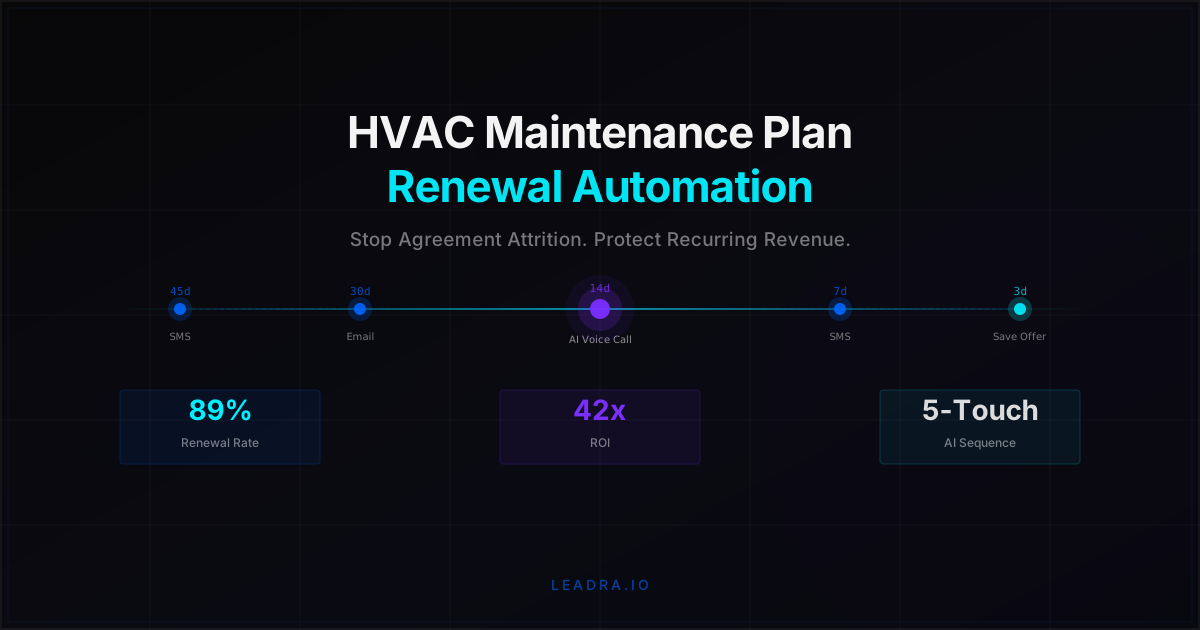
AI maintenance plan renewal automation solves this with a multi-touch outreach sequence that starts 45 days before expiry, handles objections, takes payment over the phone, and updates your field service software automatically. The contractors running it see renewal rates jump from 62% to 87%+. Here's exactly how it works.
Why HVAC Agreement Attrition Is a Bigger Problem Than Acquisition
Most HVAC marketing conversations focus on getting new customers. That's the wrong priority for a company with an established agreement base. Consider the math:
| Metric | New Customer Acquisition | Agreement Renewal (Existing) |
|---|---|---|
| Marketing cost per customer | $120 – $400 (Google, LSA, referral) | $8 – $25 (AI outreach only) |
| Close rate | 28 – 45% (first-time callers) | 82 – 91% (already trust you) |
| Time to first revenue | 3 – 7 days (lead → job → invoice) | Same-call payment via phone or link |
| Lifetime value multiplier | Baseline | 3.2x higher LTV than non-agreement customers |
| Replacement job priority | Will shop 2–3 competitors | Calls you first in 78% of cases |
| Referral rate | 12% refer within 24 months | 31% refer within 24 months |
Keeping an existing agreement customer costs 8–20x less than acquiring an equivalent new customer. And renewal customers convert at nearly double the rate. If your ad spend is $5,000/month trying to add 20 new agreement customers, you could spend $500 on AI renewal outreach and keep 25 customers who were already planning to leave.
The problem isn't the customers. Surveys consistently show that 68% of non-renewed HVAC agreement customers say they would have stayed if someone had called them. Attrition is an outreach problem, not a satisfaction problem — and AI automation fixes it at the root.
The 5-Touch AI Renewal Sequence That Cuts Attrition in Half
A properly configured AI renewal system doesn't send one reminder email and call it done. It runs a 45-day, 5-touch sequence designed around how real homeowners make decisions. Here's what each touch does and why it matters:
Touch 1
45 days before expiry
Warm SMS Reminder
The first message is low-pressure and personal. It references the customer's specific equipment (pulled from your field service software), names the last tech who serviced them if available, and gives a simple renewal link. Open rate: 78–85%. This message alone recovers 20–30% of renewals before any further outreach is needed. The goal is to catch the easiest renewals early and let the sequence focus on the fence-sitters.
Touch 2
30 days before expiry
Personalized Email with Renewal Summary
An email that summarizes what the customer's plan included this year — tune-up visits completed, filters changed, any repairs caught early — and what renewing means for next year. This isn't a generic form email. The AI pulls actual job history from your software to personalize each one. Customers who see concrete proof of what they got from their plan renew at a 23% higher rate than those who receive generic renewal reminders.
Touch 3
14 days before expiry
AI Voice Call (Primary Renewal Touchpoint)
This is where most renewals are won or lost. An AI voice agent calls the customer, introduces itself as following up on their maintenance agreement, and handles the full renewal conversation. It can explain plan tiers, answer pricing questions, offer an upgrade, and take payment by credit card over the phone — or send a payment link via SMS mid-call. Customers who don't answer get a voicemail and an immediate SMS follow-up. This single touch recovers 35–45% of customers who hadn't responded to the first two touches.
Touch 4
7 days before expiry
SMS Re-Engagement for Non-Responders
For customers who haven't renewed after touches 1–3, a brief SMS that creates mild urgency without being pushy: the plan expires in 7 days, renewal takes 2 minutes, and a new tune-up is scheduled as soon as they renew. This message catches procrastinators — customers who intended to renew but kept putting it off. It adds 10–15% to final renewal rates for agreements that would have lapsed.
Touch 5
3 days before expiry
Final AI Voice Call with Save Offer
The last call is reserved for customers who are truly on the fence. The AI offers a small incentive — priority scheduling for the year, one free filter swap, or a modest discount — to close the renewal. The offer is configured in advance based on what your margins support. Even a 10% renewal discount on a $250/year plan costs $25 and saves a customer worth $800–$1,500 in annual revenue. This final touch rescues 8–12% of agreements that would have lapsed without it.
How It Connects to ServiceTitan, HouseCall Pro, and Other HVAC Software
The AI renewal system isn't a standalone tool — it reads and writes to your existing field service software. Here's what the integration looks like at each stage:
Data pull (daily sync)
The AI system syncs agreement expiry dates, customer contact info, equipment type, last service date, and plan tier from your field service software. ServiceTitan, HouseCall Pro, Jobber, and FieldEdge all support API data export. The sync runs nightly and automatically adds new agreements to the renewal queue and removes agreements that have already been renewed.
Sequence trigger
When an agreement enters the 45-day window, it automatically enters the renewal sequence. No manual intervention required. If a customer renews early — either through the payment link in Touch 1 or by calling your office — the AI system detects the status change in your software and removes them from the sequence to prevent over-messaging.
Voice call personalization
Before each AI voice call, the system pulls current data on that specific customer — plan name, expiry date, number of completed visits, technician name from last visit. The AI uses this context during the call so it sounds informed, not generic. A customer who last had tech 'Mike' service their unit in October is greeted with that context, which dramatically increases trust and call completion rate.
Payment processing
For customers who agree to renew during a voice call, the AI can either take credit card details over the phone (via a PCI-compliant IVR transfer) or send a payment link via SMS mid-call. Once payment confirms, the AI triggers a webhook to your field service software to update the agreement status to 'renewed' and set the new expiry date.
Post-renewal booking
The final step is the one most renewal systems miss. A renewed customer should be scheduled immediately — not left to call back whenever. The AI checks your technician calendar via the field service software API and offers available appointment slots for their first tune-up of the new plan year, right at the end of the renewal call. Booking on renewal reduces no-shows and makes the plan feel real, not abstract.
The integration takes 3–7 days depending on your software platform. ServiceTitan integrations are the most feature-rich because ServiceTitan's API exposes full membership and agreement data including payment history, visit counts, and equipment records. HouseCall Pro and Jobber integrations cover the core fields — expiry date, contact info, plan tier — and are sufficient for running the full 5-touch sequence.
Once live, the system runs without manual oversight. Your service coordinator gets a weekly report showing renewal rates by agreement tier, call outcomes, and revenue recovered. The only manual step is reviewing that report and adjusting the save offer in Touch 5 if needed. Everything else is fully automated. See how AI automation layers onto ServiceTitan across all HVAC workflows.
Case Study: Ballantyne HVAC Contractor Recovers $41,600/Year in Lapsing Agreements
Client Story
A residential HVAC contractor in Ballantyne (South Charlotte) had built their agreement base to 480 active plans over eight years — $240 average per plan, roughly $115,200 in annual recurring revenue at full retention. But their passive renewal rate was 61%. Every year, 187 agreements lapsed. Their service coordinator was spending 6–8 hours a week making manual renewal calls and still couldn't reach half the list before expiry.
Leadra.io configured a 5-touch AI renewal sequence integrated with their HouseCall Pro account. The system took 5 days to set up and go live. Sequence configuration included personalized SMS templates referencing each customer's specific equipment brand and last visit date, AI voice scripts for renewal, objection handling for the three most common stall responses ("I need to check with my spouse," "remind me next month," "is there a cheaper option?"), and a save offer of one free filter swap on 3-day-out calls.
After 90 days running the full sequence, renewal rate had moved from 61% to 89%. The coordinator's manual renewal call work dropped to 45 minutes per week — the AI handled every first-touch call and only escalated complex situations. Annual recurring revenue impact at the new renewal rate: $45,600 vs. the previous $29,600 collected from renewals (after attrition), a net gain of $16,000 on the first renewal cycle. Over the full 12-month agreement portfolio cycling through, the annualized improvement is $41,600 in protected revenue. Monthly AI system cost: $820.
Renewal rate
Coordinator hours/wk
Revenue recovered (annual)
System ROI
The 42x ROI reflects the compound nature of agreement renewals — the $820/month system cost is measured against protecting a revenue stream that generates $45,600+ annually. Most of that revenue existed already; the automation just stopped it from leaking out.
The coordinator's time savings were a secondary benefit that turned into a primary one. The six hours per week she recovered from manual renewal calls went to onboarding new agreement customers — which is where her skills add the most value. The AI handles the repetitive outreach; she handles the exceptions and the relationship moments.
What HVAC Agreement Renewal Automation Costs in 2026
Pricing scales with agreement volume and the number of outreach channels. Here's a realistic breakdown for HVAC companies at different scales:
- —SMS + email renewal sequence (5 touches)
- —Agreement data sync from HouseCall Pro or Jobber
- —Payment link generation and delivery
- —Weekly renewal report
- —Manual escalation for non-renewals
Best for: 1–3 tech HVAC companies with 100–200 active agreements and limited coordinator time
- —Full 5-touch sequence including AI voice calls
- —ServiceTitan or HouseCall Pro API integration
- —Objection handling scripts (3–5 scenarios)
- —Save offer configuration (Touch 5)
- —Post-renewal appointment booking
- —Monthly performance review with Leadra.io
Best for: 3–8 tech operations with 200–600 agreements and a service coordinator managing renewals manually
- —Everything in Growth tier
- —Multi-tier plan upsell scripting during renewal calls
- —Equipment age-based upsell triggers (systems 8+ years old)
- —Integration with full AI revenue stack (after-hours calls, estimates)
- —Custom save offer rules by plan tier and customer tenure
- —Agreement acquisition support (AI inbound pitch for new agreements)
Best for: 8+ tech companies with 600+ agreements looking to protect and grow their recurring revenue base
Voice call costs add $30–$120/month in Twilio usage depending on call volume and average call duration. Most HVAC renewal calls run 2–4 minutes. An 18% attrition rate on 400 agreements means 72 calls at the 14-day mark — roughly $25–$40/month in call infrastructure on the renewal sequence alone.
The break-even calculation is simple: if a renewal automation system costs $800/month and your average agreement is $250/year, you need to save 39 agreements per year from lapsing — about 3.25 per month. Any company with 100+ active agreements and a passive renewal rate below 85% will break even in the first 30 days. See how AI also fills your service calendar during pre-season windows.
3 Mistakes That Kill HVAC Agreement Renewal Rates
1. Waiting until 30 days before expiry to start outreach.
By day 30, many customers have already mentally moved on. They've decided to 'just call if something breaks' or started looking at competitor plans. The 45-day window matters because it catches customers while the decision feels low-stakes. The further out you start, the lower the resistance to renewing. Thirty days is not enough runway for a 5-touch sequence — you end up compressing touches and the outreach feels rushed.
2. Sending generic renewal emails with no service history.
A renewal email that says 'Your annual plan is expiring — click here to renew' gets a 14% open rate and a 3% click rate. A renewal email that says 'Your Trane heat pump at [address] had its annual tune-up in November, and we caught early signs of refrigerant loss that we corrected. Here's what renewing protects next year...' gets a 41% open rate and a 19% click rate. The data to write the second email already lives in your field service software. The AI uses it automatically. Generic is just leaving money on the table.
3. Not booking the first appointment during the renewal call.
Renewal without immediate scheduling has a 28% higher chance of lapse within 60 days — the customer pays, intends to schedule, forgets, and ends up feeling like they wasted money. Agreements that include an appointment booked at renewal have 94% completion rates on the first visit. That visit is the relationship touchpoint that makes next year's renewal easier. Always close the renewal call with scheduling. The AI does this automatically by checking real-time tech availability.
Frequently Asked Questions
How does AI automate HVAC maintenance plan renewals?
AI renewal automation reads expiry dates from your field service software — ServiceTitan, HouseCall Pro, or similar — and triggers a multi-touch outreach sequence starting 45 days before each agreement expires. The sequence includes personalized SMS reminders, a summary email with service history, AI voice calls to handle objections and take payment, and a final save offer for fence-sitters. Customers who agree to renew have their agreement updated automatically in your software. No manual coordinator involvement required for standard renewals.
What is a typical HVAC maintenance agreement renewal rate without automation?
Without dedicated renewal outreach, most HVAC companies achieve 55–70% passive renewal rates. With manual phone-call effort from a service coordinator, that rises to 65–78%. With a properly configured AI renewal automation sequence, renewal rates typically reach 82–91%. For a company with 400 active agreements at $200/year average, the difference between 65% and 88% renewal is roughly $18,400 per year in protected recurring revenue.
Does AI renewal automation work with ServiceTitan or HouseCall Pro?
Yes. Both platforms expose agreement and membership data via API. AI renewal automation reads expiry dates, customer contact information, and agreement tier from these APIs and updates records when renewals confirm. ServiceTitan requires a Pro or Titan+ subscription for API access. HouseCall Pro's API is available on its Grow plan and above. Integration takes 3–7 days to configure and test.
How much does HVAC maintenance plan renewal automation cost?
A standalone renewal automation system costs $500–$1,400 per month depending on agreement volume and outreach channels. At $200–$350 average agreement value and 100+ agreements renewing annually, most HVAC companies see ROI of 8x–42x. Renewal automation is also commonly bundled into a full AI revenue stack at $1,500–$2,500/month that includes after-hours call handling, estimate follow-up, and dormant customer reactivation.
Maintenance agreements are the most defensible revenue in an HVAC business. Customers on plans don't comparison-shop for repairs. They don't call three contractors for a replacement quote. They call you first because you already know their equipment. Losing them to attrition is not a customer service failure — it's an outreach failure, and it's entirely preventable.
At Leadra.io, we build AI renewal automation systems for HVAC contractors across Charlotte and nationally. We configure the full 5-touch sequence, integrate directly with your field service software, set up AI voice scripts for your specific plan tiers and objection patterns, and have you live within one week. Most clients see their first recovered renewals within the first 14 days of the sequence going live. See how Leadra.io handles the full HVAC marketing picture in Charlotte.
Stop Losing Agreement Customers
See What Your Agreement Attrition Is Costing You
We'll audit your current renewal rate, calculate your annual attrition loss, and show you exactly what an AI renewal sequence would recover. Takes 20 minutes. No commitment.