A studio-based trainer loses a lead to slow response time. A mobile or in-home trainer loses the same lead two ways: slow response time, and a wasted reply to someone who lives 40 minutes outside their service area. Mobile personal training is the fastest-growing segment of the fitness coaching market, but most mobile trainers are still running lead generation built for a fixed studio location — one that never asks the single question that determines whether a lead is even workable: where do they live?
The math of in-home training makes the problem worse than it looks. A mobile trainer who books a client 35 minutes outside their normal service zone doesn't just lose time — they lose the ability to stack a second session nearby, turning one appointment into a wasted half-day of driving. Studio trainers never deal with this. Every lead a mobile trainer generates needs to be filtered by geography before it's filtered by anything else.
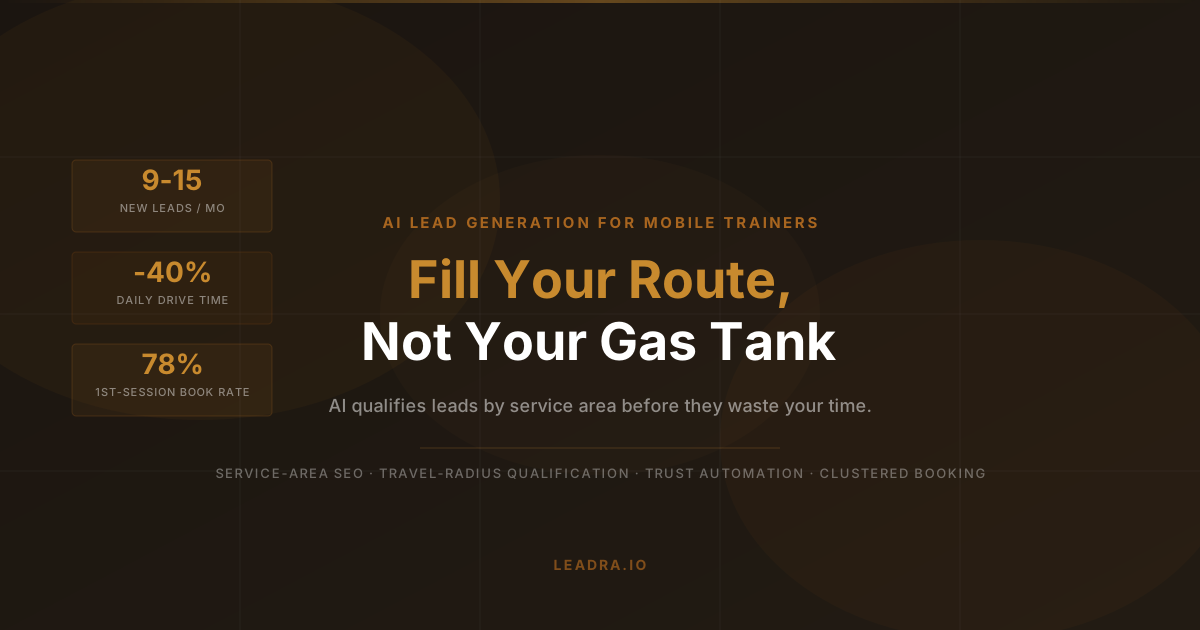
AI lead generation systems built specifically for mobile and in-home trainers solve this by qualifying travel distance in the first exchange, automating the trust signals that in-home training uniquely requires, and clustering new bookings geographically so a trainer's schedule fills in efficient routes instead of scattered pins on a map. Trainers running this system report 9-15 new qualified leads per month, with first-session booking rates 20-30% higher than a plain contact form.
This guide breaks down the 5-component system built for mobile and in-home trainers, and results from a Charlotte-area mobile training business that used it to consolidate four scattered service zones into two tight, profitable routes.
Why Generic Lead Generation Fails Mobile & In-Home Trainers
Most fitness marketing advice — and most AI lead gen tools — are built with a fixed location in mind: one address, one Google Business Profile, one service radius baked into the map listing. Mobile and in-home trainers don't have that anchor, and it breaks three parts of the standard playbook.
No single service-area anchor for local SEO
A studio trainer ranks for '[city] personal trainer' around one fixed pin on Google Maps. A mobile trainer might cover five or six neighborhoods with no physical storefront to anchor a Google Business Profile listing the same way. Without content built around each specific service zone, mobile trainers show up nowhere in local search — even though they're actively working in the area someone just searched.
Geography gets filtered too late, or not at all
A prospect fills out a contact form. The trainer replies with availability and pricing. Three messages in, the prospect mentions they live in a suburb 45 minutes away — and the entire conversation was wasted. Without an upfront address check, mobile trainers spend real qualification time on leads that were never workable, and often don't find out until the exchange is nearly done.
The in-home trust barrier goes unaddressed
Letting a trainer into your home is a bigger ask than showing up to a gym. Certifications, insurance, and background-check status matter more here than in any other fitness vertical, but most trainers only mention them if directly asked. Prospects who have the objection but never voice it simply go quiet — and the trainer never learns why the lead went cold.
The financial cost compounds fast. In-home session rates typically run 15-25% above studio rates ($90-$130 per session in most mid-market metros), which makes each booked client more valuable — but wasted drive time to a poorly qualified, out-of-range lead costs a mobile trainer 60-90 minutes of unbillable time they can never recover. A system that filters geography first protects both the pipeline and the calendar.
The 5-Component AI System for Mobile & In-Home Trainers
This is the system Leadra.io deploys for mobile and in-home personal training clients. It leads with geography, then layers in the trust-building and route-clustering logic that a studio-based playbook doesn't need but a mobile business can't skip.
Service-area SEO content by zip code and neighborhood
Mobile trainers don't compete for one city-wide keyword — they compete neighborhood by neighborhood. The content engine publishes articles targeting searches like 'in-home personal trainer [neighborhood],' 'mobile fitness coach near [zip code],' and '[suburb] at-home workout trainer,' with each article naming the specific streets, parks, and communities inside that service zone. A trainer covering five Charlotte-area suburbs needs five distinct content clusters, not one generic page — Google rewards the specificity with local pack visibility that a single studio location doesn't need.
AI capture with automatic travel-radius qualification
Every new inquiry is asked for a zip code or address within the first exchange, before goals or budget. The AI checks it against your predefined service zones instantly. In-range leads move straight into the standard qualification flow (goals, schedule, session format). Out-of-range leads get a same-second redirect — either to a referral partner trainer covering that area, or to a virtual/hybrid coaching offer if you provide one. Nothing sits in an inbox waiting for a human to realize the address doesn't work.
Automated trust-signal delivery
In-home training carries a trust hurdle studio training doesn't: a stranger coming into someone's house. The AI proactively sends certification credentials, liability insurance confirmation, and background-check status alongside 2-3 recent reviews from clients in the prospect's specific neighborhood — before the prospect has to ask. A free 15-minute video call option is offered as a lower-commitment step before committing to an in-home session. This sequence answers the unspoken objection instead of letting it kill the inquiry silently.
Geo-clustered booking automation
Instead of offering every open calendar slot, the booking flow prioritizes times that cluster new sessions near existing same-day clients in the same neighborhood. A prospect in South End sees morning slots grouped with other South End sessions; a prospect in Ballantyne sees a different clustered window. This reduces backtracking across the metro area between appointments — the single biggest hidden cost in mobile training that a plain calendar link never accounts for.
Post-session referral trigger by neighborhood
After a new client's third session, the AI sends an automatic referral request — specifically framed around their neighborhood ('know a neighbor who could use this?'). Because mobile trainers depend on density within a service area to keep drive time low, neighborhood-specific referrals are worth more than generic ones: each new client from an existing cluster adds revenue without adding meaningful travel time.
Why geography-first qualification matters most
Every other component in this system depends on the first one working correctly. If travel-radius qualification fails, the trust automation gets sent to unworkable leads, the booking clustering has nothing efficient to cluster, and the referral engine compounds density in the wrong places. Mobile trainers who fix geographic qualification first see the rest of the system perform 30-40% better than trainers who bolt it on after the fact.
Manual Outreach vs. AI System: Head-to-Head for Mobile Trainers
Here's how a typical manual process for mobile and in-home trainers compares to a fully deployed AI system across the factors specific to a route-based business:
| Factor | Manual Approach | AI System |
|---|---|---|
| Address/service-area check | Asked mid-conversation, often after several replies | Captured and verified in the first exchange |
| Out-of-range lead handling | Ignored or awkwardly declined by text | Instant redirect to partner or virtual offer |
| Trust-signal delivery | Only if the prospect thinks to ask | Sent automatically with neighborhood-specific reviews |
| Daily drive time | Unmanaged, scattered across the metro area | Clustered scheduling cuts drive time 25-40% |
| Response time to new inquiry | Hours, often after a session ends | Under 60 seconds, 24/7 |
| Monthly new qualified leads | 2-4, mostly word-of-mouth | 9-15 from service-area SEO and AI capture |
| First-session booking rate | Baseline, no trust automation | 20-30% higher with automated trust sequence |
| Referral targeting | Generic ask, unrelated to routing | Neighborhood-specific, density-aware |
The drive-time row is the one manual processes never fix. A trainer can be excellent at qualifying leads by phone and still end up with a schedule scattered across an entire metro area, because nothing in a plain calendar link accounts for geography. Clustering is the difference between a full calendar and a full, profitable calendar.
Case Study: Charlotte Mobile Trainer Cuts Drive Time, Doubles Bookings
Client Story — Charlotte, NC
A mobile personal trainer covering South End, Dilworth, Ballantyne, and Steele Creek came to Leadra.io in April 2026 running $95/session in-home training out of his car. He was booking 10-12 sessions a week but spending nearly 90 minutes a day driving between scattered appointments across four spread-out neighborhoods. His lead source was almost entirely Instagram DMs and word-of-mouth, with no way to tell before a conversation whether a new inquiry lived anywhere near his existing clients.
Leadra.io deployed the 5-component system in May 2026. Service-area content was published for each of the four neighborhoods individually. The AI capture widget asked for a zip code first, before anything else, and flagged three inquiries in the first two weeks as out of range — each redirected instantly to a video-coaching offer instead of an in-person reply that would have gone nowhere. The booking flow began clustering new client slots into South End/Dilworth mornings and Ballantyne/Steele Creek afternoons.
By day 90: daily drive time dropped from roughly 90 minutes to 35, freeing capacity for 2 additional sessions per day. Weekly bookings grew from 11 to 21. Trust-signal automation — insurance confirmation and neighborhood-specific reviews sent automatically on first contact — lifted his first-session booking rate from an estimated 55% to 78%. Monthly revenue moved from roughly $4,200 to $8,600.
Weekly sessions booked
11
21
Daily drive time
~90 min
~35 min
First-session booking rate
~55%
78%
Monthly revenue
$4,200
$8,600
System cost: $950/month · Revenue increase: +$4,400/month · 90-day ROI: 4.6x. Out-of-range leads redirected instead of wasted: 11 over 90 days. Two of those became paying virtual-coaching clients — revenue the trainer would previously have lost entirely.
The clearest result wasn't new leads — it was recovered time. The trainer didn't add hours to his week; he removed nearly an hour of unbillable driving from most days and converted that directly into billable sessions. For a route-based business, that's often a bigger lever than lead volume alone.
He also stopped losing out-of-range leads outright. Redirecting unworkable inquiries to a virtual coaching offer turned what used to be a dead end into a secondary revenue stream — two new virtual clients in the first quarter, at no additional drive-time cost.
What AI Lead Generation Costs for Mobile & In-Home Trainers
Pricing scales with the number of service zones a trainer or mobile team covers. Here's how Leadra.io structures it:
Solo Mobile Trainer
$750-$1,100/moService-area content for 1-3 neighborhoods, AI capture with travel-radius qualification, trust-signal automation, and geo-clustered booking. Best for a single trainer covering a defined metro subsection. Typical results: 6-10 new qualified leads/month, drive time reduced 20-35%.
Multi-Zone Mobile Trainer
$1,200-$1,900/moEverything in Solo, scaled across 4-6 service zones, with out-of-range redirect logic to a virtual coaching offer or referral partner. Best for a single trainer or duo covering a spread-out metro area. Typical results: 9-15 new qualified leads/month, 20-30% higher first-session booking rate.
Mobile Training Team
$1,800-$2,600/moFull system for 2-5 mobile trainers sharing a brand, with per-trainer service-zone routing, team-wide trust automation, and cross-trainer referral logic when one trainer's zone overlaps another's capacity. Best for mobile training businesses scaling past one trainer's personal calendar.
Because in-home rates typically run 15-25% above studio pricing, the revenue math tends to favor mobile trainers who fix qualification and routing early. A trainer on the $950/month tier who books 4-6 additional sessions per week from recovered drive time and better-qualified leads adds $1,500-$3,000 in monthly revenue at $95-$125/session — often a 3-5x return before counting the compounding effect of neighborhood-specific referrals.
How to Launch AI Lead Generation for Your Mobile Training Business: 3 Steps
Setup with Leadra.io is built around defining your service zones first — everything else follows from that.
Map your service zones and travel-radius rules
The first call covers exactly which neighborhoods or zip codes you're willing to serve, any zones you'd rather redirect elsewhere, and whether you offer a virtual/hybrid fallback for out-of-range leads. This becomes the qualification logic the AI checks on every new inquiry. Most trainers have never formalized this — it usually lives in their head as a rough sense of 'too far' — so this call alone often reveals gaps in current lead handling.
Deploy AI capture, trust automation, and clustered booking
Leadra.io installs the AI capture flow on your website, Instagram bio link, and any lead form you're already running, with the zip-code check as the very first question. Trust-signal delivery (credentials, insurance, background-check status, neighborhood reviews) and the geo-clustered booking calendar go live in the same deployment — typically within 48-72 hours of kickoff.
Launch service-area content and let route density compound
The content engine publishes neighborhood-specific articles for each zone you defined in step 1, written for 8th-grade reading level and structured for local search visibility. As leads convert within a zone, the referral trigger targets that same neighborhood specifically — building the density that keeps drive time low and each new client's marginal cost near zero.
AI lead generation for mobile trainers pairs naturally with Leadra.io's broader AI lead generation system for personal trainers and our AI lead generation framework for local businesses. The service-area qualification layer described here sits on top of that broader system — the geography filter that studio-based trainers don't need but mobile businesses can't operate without.
Frequently Asked Questions
How is AI lead generation different for mobile personal trainers than studio trainers?
Studio trainers qualify leads on goals and budget. Mobile and in-home trainers need a third filter first: is the prospect's address inside a workable travel radius? An AI system built for mobile trainers captures the zip code or address on first contact, checks it against your defined service zones, and only routes in-range leads to booking. Out-of-range leads get redirected to a partner trainer or a virtual coaching offer instead of wasting a reply. This single filter step is what studio-focused lead gen tools miss entirely.
How does AI help overcome the trust barrier of having a stranger train in someone's home?
The AI qualification conversation automatically surfaces trust signals before a prospect ever has to ask: certification credentials, insurance coverage, background-check status, and recent client reviews from their specific neighborhood. It also offers a free 15-minute video consultation as a lower-commitment step before the first in-home session, which cuts hesitation significantly. Trainers using this sequence report first-session booking rates 20-30% higher than a plain contact form, because the objection gets answered automatically instead of sitting unaddressed in the prospect's head.
Can AI help route sessions to reduce a mobile trainer's drive time?
Yes. Once a lead is qualified and inside your service radius, the booking automation offers available slots grouped by geographic cluster rather than pure calendar availability — nudging new clients toward time windows that keep same-day sessions in the same neighborhood. Trainers who adopt clustered scheduling typically cut daily drive time by 25-40%, turning that recovered time into 1-2 additional billable sessions per day without adding hours to the workday.
What does AI lead generation cost for a mobile or in-home personal trainer?
Leadra.io builds mobile and in-home personal trainer lead generation systems starting at $750-$1,100/month for a single-trainer service area, and $1,400-$2,600/month for multi-trainer mobile teams covering several zip codes. Pricing includes service-area SEO content, AI capture with travel-radius qualification, trust-signal automation, and clustered booking. Most mobile trainers recover the monthly cost within the first 2-3 new clients acquired, given average in-home session rates run 15-25% higher than studio rates.
A Full Calendar Isn't the Goal — A Full, Nearby Calendar Is
Mobile and in-home training demand keeps growing as clients look for convenience over gym membership. That demand only turns into revenue if a trainer's lead generation accounts for the one variable studio-based systems never had to think about: where the client actually lives.
An AI system built for route-based fitness businesses filters geography first, answers the in-home trust objection automatically, and books new clients into windows that keep a trainer's day tight instead of scattered across a metro area. The result isn't just more leads — it's more billable hours out of the same working day.
Leadra.io deploys AI lead generation systems for mobile and in-home personal trainers across the U.S. — service-area content, geography-first qualification, trust automation, and clustered booking, live within a week. We back every engagement with a results commitment: measurable new leads in 30 days or we make it right.
Free Lead Generation Audit
See How Much Drive Time You're Wasting on Bad Leads
30-minute audit. We'll map your service zones, analyze your current lead qualification process, and project how many qualified leads and recovered driving hours an AI system would generate for your specific coverage area.
Leadra.io
AI marketing agency — Charlotte, NC · Published August 29, 2026