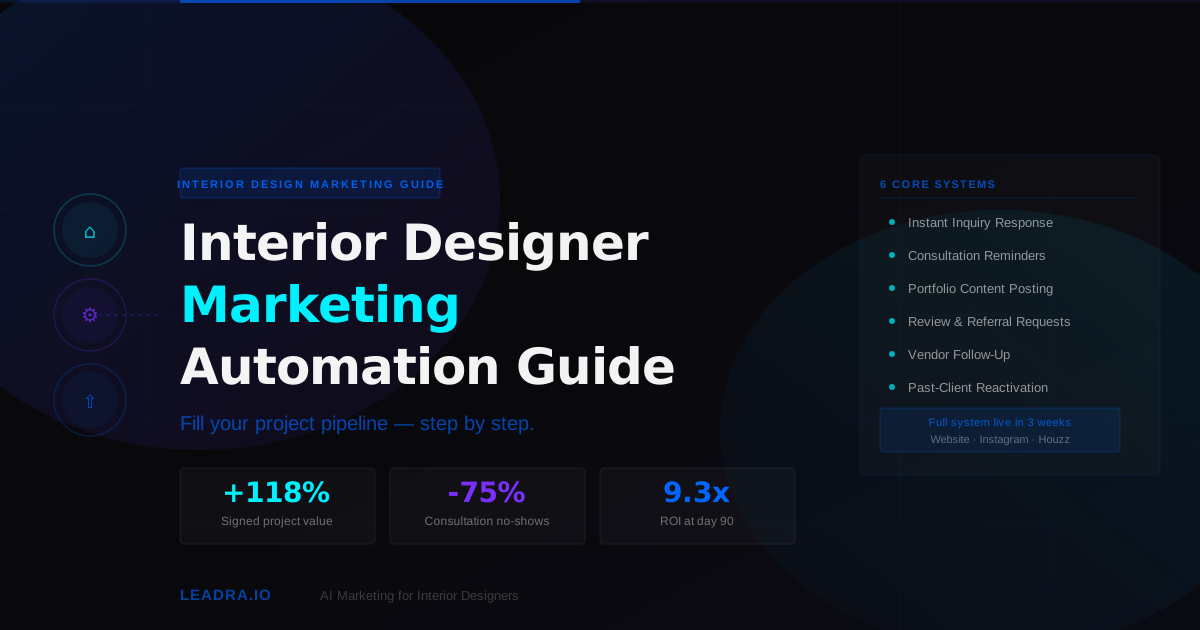
Interior Designer Marketing Automation Guide: Fill Your Project Pipeline Without Chasing Leads (2026)
By Leadra.io Team · July 10, 2026 · 9 min read
Interior designer marketing automation is a set of connected tools that handle inquiry follow-up, consultation scheduling, portfolio posting, referral requests, and past-client reactivation automatically. The right stack keeps a studio's pipeline full without a dedicated marketing hire — most studios recover the setup cost within 60 to 90 days through projects that would otherwise go to a faster-responding competitor.
Interior designers are some of the busiest business owners in any creative field. Between site visits, vendor coordination, and project management, marketing is almost always the first task pushed to “whenever there's time.” But prospective clients researching designers do not wait — if nobody responds within a reasonable window, they move to the next name on their list.
The studios growing fastest in 2026 solved this without adding headcount. They built systems that handle the repetitive work — replying to inquiries instantly, filling consultation slots, reminding clients before appointments, asking happy clients for referrals and reviews — and freed the team to focus on the work that generates revenue: design.
This interior designer marketing automation guide walks through exactly which systems work, what each costs, and how to implement them step by step.
Why Interior Design Studios Lose Projects to Manual Marketing
Interior design has a longer, higher-trust sales cycle than most local service businesses. A client is not booking a $150 haircut — they are considering handing someone $30,000 to $150,000 and access to their home for months. That trust has to be earned quickly, and manual marketing almost always earns it too slowly:
- A prospect fills out a website contact form Friday evening. Nobody sees it until Monday afternoon — by then they have already booked with another designer.
- Someone DMs a finished project photo on Instagram asking “do you work in my area?” The message sits unread for three days between site visits.
- A past client who loved their kitchen renovation two years ago would gladly refer three friends and revisit for a primary bedroom — but nothing ever prompts them to.
- Google and Houzz reviews sit in the teens even after dozens of completed projects, because no one systematically asks satisfied clients to leave one.
None of these are effort problems. They are system problems, and automation solves them by replacing easy-to-forget manual tasks with automatic triggers.
If your studio already uses an AI voice agent to answer calls, pair it with the systems below — see our guide on AI receptionists for interior designers.
The 6 Core Systems in an Interior Designer Marketing Automation Stack
You do not need a dozen disconnected tools. The fastest-growing studios run six interconnected systems, each closing a specific gap between a prospective client and a signed project.
1. Instant Inquiry Response Across Every Channel
The speed of your first reply determines whether you get the consultation more than almost any other factor. Businesses responding within 5 minutes are 100 times more likely to convert a lead than those responding within 30 minutes, per a 2024 Harvard Business Review study.
Inquiries arrive from a website form, Instagram and Facebook DMs, Houzz messages, and phone calls — often all in the same week. Automated response means every channel triggers an immediate reply: confirming receipt, setting a realistic timeline for follow-up, and asking two or three qualifying questions upfront (project type, timeline, budget range). This keeps the lead warm while you finish the site visit you are already in. Studios fielding 15+ inquiries a month typically hand this to an AI voice or chat agent that handles the qualifying conversation and books the consultation directly. See Leadra.io's AI lead generation system for local businesses.
2. Consultation Scheduling With Automated No-Show Reduction
A booked consultation that never shows up is worse than no lead at all — it burns a slot that could have gone to someone serious. Interior design consultations get missed at a higher rate than most service appointments because they are booked further in advance and often require 45 to 60 minutes of client time.
An automated confirmation and reminder sequence fixes most of this: instant booking confirmation by text and email, a reminder 48 hours out, and a same-morning reminder with a one-tap reschedule link. A short pre-consultation questionnaire (style preferences, inspiration links, rough budget) also raises show-up rates, because clients who invest five minutes upfront are more committed to keeping the appointment. Studios running this sequence typically cut no-show rates by more than half within the first month.
3. Automated Portfolio and Before/After Content Posting
Consistency on Instagram, Pinterest, and Houzz is the single most reliable driver of inbound inquiries for interior designers. A studio that posts finished-room reveals twice a week, every week, will out-perform one that posts 15 times right after a big project wraps and then goes quiet for two months.
The workflow that works: batch-photograph completed rooms during final walkthroughs, then load the images into a scheduling tool like Later or Planoly with a saved caption template that fills in room type, style, and a call to action. The week's posts go live automatically — even during a busy install week. Designers posting consistent before/after content typically see 35–55% more profile visits and DMs than designers posting irregularly, based on client-reported data.
4. Past-Client Referral and Review Request Sequences
Your past clients are your best source of new business — interior design has one of the highest referral rates of any home-services category, since clients who love their finished space talk about it constantly. Most studios know this and still have no system to act on it.
An automated sequence closes that gap. Two weeks after completion, a message thanks the client and asks for a Google and Houzz review with a direct link. Sixty days later, a separate message asks whether they know anyone starting a renovation who could use a referral, with a simple incentive attached (a design credit or gift card). Studios running this system typically see review counts triple within 90 days and referral-sourced inquiries become a meaningfully larger share of the pipeline.
5. Vendor, Showroom, and Trade Event Follow-Up
Every showroom visit, trade event, or vendor meet-and-greet where you collect a business card is a lead that goes cold within days if nobody follows up. Most designers collect these contacts and never systematically reach out. An automated sequence changes that: a same-day thank-you email referencing the event, a short portfolio link, and an invitation to book a discovery call — built once as a template and triggered automatically whenever new contacts are added after an event.
6. Past-Project Reactivation for New Rooms and Phases
A client who hired you for a kitchen renovation two years ago is a strong candidate for a primary bedroom refresh or a home office — but only if something reminds them you exist. A quarterly reactivation email to past clients, showing recent work in a similar style and offering a complimentary consultation, keeps your studio top of mind. Response rates on these campaigns consistently run higher than campaigns to cold prospects, because the relationship and trust are already established.
| Client Segment | Automated Sequence | Timing |
|---|---|---|
| New inquiries (all channels) | Instant reply, qualifying questions, consultation booking link | Immediate |
| Booked consultations | Confirmation, 48-hour reminder, morning-of reminder | Triggered on booking |
| Completed projects (0–2 weeks) | Thank you + Google/Houzz review request | Day 14 post-completion |
| Completed projects (60+ days) | Referral request with incentive | Day 60 post-completion |
| Past clients (12+ months) | Reactivation email — new room/phase offer | Quarterly |
Real Example: A Lake Norman Studio Nearly Doubling Signed Project Value in 90 Days
(This example represents the type of results our clients achieve.)
A three-person interior design studio near Lake Norman, NC (Cornelius) had a strong portfolio and years of happy clients — but inquiries came in unevenly, consultation no-shows were common, and past clients rarely heard from the studio again after their project wrapped. The owner was personally handling every DM, form submission, and follow-up between site visits. We built a full automation stack over three weeks:
- Connected website, Instagram, and Houzz messages to one automated response system with qualifying questions
- Set up consultation booking with automated confirmation and reminders
- Built a two-step post-project sequence: review request at day 14, referral request at day 60
- Scheduled twice-weekly before/after portfolio posts from a backlog of completed projects
- Added a quarterly reactivation email to the studio's past-client list
Results after 90 days: monthly inquiries went from 11 to 24, consultation no-shows dropped from 24% to 6%, reviews went from 19 to 57, and referral-sourced inquiries rose from 3 to 9 per month. Signed project value for the quarter went from $58,000 to $121,000 — a 9.3x return on implementation cost.
I was doing great design work and losing clients to slower follow-up, not worse portfolios. The system fixed the part of the business I never had time for.
How to Build Your Interior Designer Automation Stack in 5 Steps
Step 1: Connect every inquiry channel to one inbox. Route your website form, Instagram and Facebook DMs, and Houzz messages into a shared CRM inbox or a chat platform like ManyChat. You cannot automate a response to a message you never see.
Step 2: Build your instant-response templates. Write a short, warm automated reply for each channel that confirms receipt and asks two or three qualifying questions (project type, timeline, budget range). This single step recovers leads you would otherwise lose to slow response times.
Step 3: Turn on consultation reminders. Connect your booking calendar (Calendly, Acuity, or your CRM's scheduler) to an automated confirmation and reminder sequence — instant, 48-hour, and morning-of. This alone typically cuts no-shows by more than half.
Step 4: Build your post-project sequence. Create a two-email template: a day-14 thank-you and review request, and a day-60 referral request with a small incentive attached.
Step 5: Schedule your portfolio content. Batch-photograph two to three completed rooms per month and load them into a social scheduler with a saved caption template. Aim for two posts per week, regardless of how busy the install calendar is.
If you want the full stack built and managed for you, Leadra.io handles implementation end to end. Call +1 (864) 721-8384 or visit our contact page to book a free strategy session.
Tools for Interior Designer Marketing Automation
The right tools depend on your studio's size and how many channels you field inquiries from:
- Inquiry routing and CRM: HubSpot free tier, Houzz Pro (built-in lead tracking), Dubsado or HoneyBook (popular for proposals plus automation)
- Consultation scheduling: Calendly or Acuity Scheduling for automated confirmations and reminders
- Instant inquiry response: ManyChat for Instagram and Facebook DM automation, Leadra.io's AI voice agent for phone inquiries and after-hours coverage
- Social scheduling: Later or Planoly (built for visual portfolios), Meta Business Suite (free)
- Review and referral automation: Podium or Birdeye, or a simple automated flow in Klaviyo or Mailchimp
A complete stack for a small to mid-size studio runs $150–$400 per month in software. The value comes from integrating the tools so information flows automatically — a completed project triggers the review request, a new inquiry triggers the instant reply. Disconnected tools just recreate the manual process in digital form.
Frequently Asked Questions
What is interior designer marketing automation?
It is the use of connected software tools to handle repetitive marketing tasks automatically — replying instantly to inquiries across your website, Instagram, and Houzz, sending consultation reminders, posting portfolio content on a schedule, requesting reviews and referrals after project completion, and reactivating past clients for new rooms or phases. You configure these systems once, and they run on triggers without requiring manual attention each time.
How much does marketing automation cost for an interior design studio?
Software costs run $150–$400 per month depending on project volume and tools chosen. Professional setup by an agency like Leadra.io typically ranges from $1,200–$3,000 as a one-time investment. Most studios recover that cost within 60–90 days through projects that would otherwise have gone to a faster-responding competitor. For a broader breakdown, see our AI implementation cost guide for small businesses.
Do small interior design studios really need marketing automation, or just larger firms?
Small studios benefit disproportionately. A solo designer or small team has the least spare time to manually respond to every inquiry and follow up with every past client — exactly what automation is built to handle. Losing even one large project to a slow response has a much bigger relative impact on a small studio, which makes the case stronger, not weaker, at smaller scale.
How long before interior designer marketing automation shows results?
Consultation no-show reduction is typically visible within two to three weeks. Review volume climbs within 30 days of turning on post-project requests. Portfolio content consistency usually shows a measurable lift in inquiries within 4–6 weeks. Referral-sourced projects and full pipeline impact are generally clearest at the 60–90 day mark. If you are weighing whether to build this in-house or bring in an agency, our guide on how to choose an AI marketing agency walks through that decision.
- 6 core systems — inquiry response, consultation reminders, portfolio posting, review/referral sequences, vendor follow-up, and reactivation — cover every major revenue leak.
- Automated consultation reminders typically cut no-show rates by more than half within the first month.
- Post-project review and referral sequences turn happy past clients into a studio's most cost-effective lead source.
- A full automation stack costs $150–$400 per month and requires no marketing hire to maintain.
What to Do Next
The biggest mistake interior designers make with marketing automation is assuming it only makes sense for large firms with dedicated marketing staff. The opposite is true. The relationship-driven, referral-heavy nature of interior design is exactly what automation is built to support — and small studios benefit most, since every recovered inquiry represents a larger share of monthly revenue.
Start with Step 2 above: write your instant-response templates for every inquiry channel. That single system stops the most expensive leak in interior design marketing — the prospective client who never hears back in time. For more on how AI handles the full intake process, see our guide on the best AI tools for interior designers in 2026.
At Leadra.io, we build and manage the full interior designer marketing automation stack. Call +1 (864) 721-8384 or visit our contact page to schedule a free strategy call. We audit your marketing setup, show you the top 3 gaps, and give you a written plan — no obligation.
Ready to automate your studio's marketing?
Get a free interior design marketing audit from Leadra.io.
30-minute strategy call — we review your current marketing process, identify the top 3 revenue leaks, and show you exactly what to automate first. No obligation. You leave with a written plan.
Charlotte NC · serving interior designers and small businesses nationwide
Written by the Leadra.io Team. Leadra.io is an AI marketing and automation agency helping interior designers, dental practices, and small businesses grow with AI-powered systems. Based in Charlotte, NC — serving clients nationwide.