Med Spa Dormant Client Reactivation: The Exact AI Text Scripts That Bring Botox and Filler Patients Back
August 27, 2026 · 9 min read
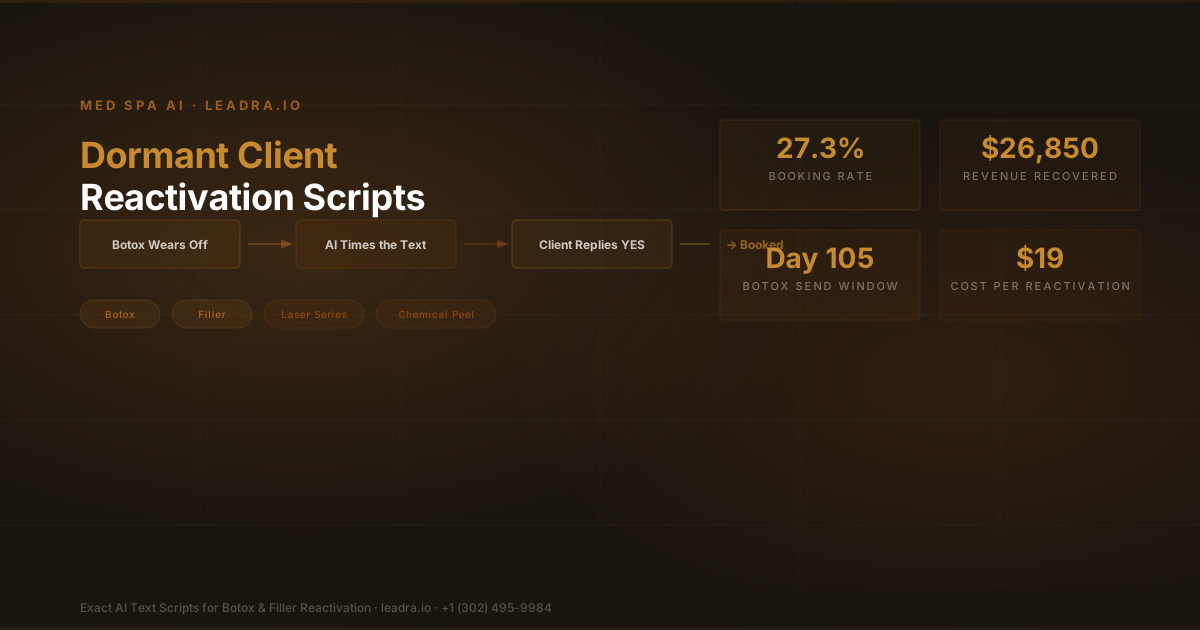
Most med spa recall texts fail because they ignore the one thing that actually drives a rebooking decision: whether the treatment has worn off yet. "We miss you — come see us!" gets ignored by a Botox client whose results are still holding at day 60. The same client at day 105, when movement is just starting to return, responds to a message that names the treatment and the timing. This post breaks down the exact scripts, the treatment-cycle windows for Botox, filler, peels, and laser series, the A/B data, and how AI pulls this timing automatically from Boulevard, Zenoti, or Vagaro to send the right message the week it actually matters.
Why Most Med Spa Recall Texts Get Ignored
The channel isn't the problem. SMS open rates for med spa clients run above 95%, well ahead of email. Clients are seeing your recall texts. They're just not responding, because most recall texts carry zero information tied to why that specific client would want to come back right now.
"We miss you! Book your next appointment." tells the client nothing about what treatment they had, how long it's been, or why now is the right moment. It reads as a mass text, because it is one — sent to every dormant client on the same day regardless of whether their Botox wore off last week or six weeks from now.
The single biggest lever in med spa reactivation is timing the message to the treatment's actual wear-off window— not a fixed 30/60/90-day calendar rule that treats a Botox client the same as a filler client. Botox fades in 3-4 months. Cheek filler can hold for a year. A message that ignores that difference either arrives too early, while results are still holding and there's no urgency, or too late, after the client has already forgotten they were ever a patient.
The data gap:Your POS or EHR already stores the treatment type and date for every client. Boulevard, Zenoti, and Vagaro all track this. The reason most med spas still send generic monthly blasts instead of treatment-timed messages is that pulling per-client wear-off windows manually across hundreds of records isn't practical for a front desk team. AI removes that constraint by reading treatment history directly from the POS and calculating the right send date per client, per treatment.
The A/B Data: What Treatment-Specific Timing Does to Response Rates
The table below compares message variants sent to the same dormant Botox client segments — same clients, same channel, different content and timing. Each variant ran across a minimum of 150 clients per med spa.
| Message Variant | Response Rate | Booking Rate |
|---|---|---|
| Generic: 'We miss you — book your next appointment' | 5.4% | 3.1% |
| Name only: 'Hi Jessica — time to book your next visit' | 8.7% | 4.6% |
| Treatment named: 'Hi Jessica — following up on your Botox' | 16.2% | 10.9% |
| Treatment + wear-off timing: 'It's been 3 months since your Botox' | 21.8% | 16.4% |
| Treatment + timing + direct ask: Full template above | 27.3% | 22.1% |
Naming the treatment alone triples the response rate over a generic message. Adding wear-off timing on top of that nearly doubles it again. The direct scheduling ask at the end — "Reply YES" — closes the gap between a client who's interested and one who actually books, by removing every step between reading the text and confirming.
Wear-Off Windows by Treatment Type
Every treatment category has a different reactivation window based on how long results actually last. AI calculates each client's send date from their last-treatment date in the POS, not a one-size-fits-all calendar rule.
Botox / Neuromodulator
Results visibly fade around week 12-14. Messaging while movement is just returning creates the strongest urgency of any treatment category.
Dermal Filler (Lips)
Lip filler metabolizes faster than structural filler. Clients notice volume loss and are highly receptive to a well-timed reminder.
Dermal Filler (Cheek / Jaw)
Structural filler lasts longer, so the window is later. Messaging too early wastes the touch — wait until the client can feel the difference.
Chemical Peel / Facial Series
Series-based treatments lapse fast. A missed next-session reminder inside the 4-6 week window recovers most series dropouts.
Laser Hair Removal / IPL
Series completion drives results. Clients who skip a session are the highest-value reactivation target since they've already paid for a package.
The 4-Touch Sequence: Full Message-by-Message Breakdown
When a client crosses their treatment's wear-off window, AI launches a 4-touch sequence across SMS, email, and voice. The Botox example below applies the same structure to filler, peels, and laser — only the treatment name and timing change.
"Hi [Name] — it's been about 3 months since your Botox with us, and most clients start noticing movement returning around now. Want to grab a spot this week before it fully wears off? Reply YES and we'll find a time."
"Hi [Name] — following up on your touch-up. We have a few openings this week and next before things get busy. Reply YES or call us at [phone] and we'll get you booked."
"Subject: Time for your next Botox session — [Practice Name] Hi [Name], It's been about 3 months since your last treatment. Most clients maintain their results best with a touch-up every 3-4 months rather than waiting until the effect is fully gone. Here's a quick before/after from a recent client on a similar schedule: [image]. Click here to pick a time: [booking link]"
"Hi, this is the scheduling assistant from [Practice Name]. I'm calling about a touch-up for [Name] — it's been about 3 months since their last Botox visit. If [Name] would like to book, please press 1 to connect, or call us back at [phone]. We have appointments available this week."
The sequence stops the instant a client books, so no one gets all four touches if they convert early. Voice is reserved for higher-ticket treatments — filler packages and laser series — where a missed text is more likely to mean a missed hundreds-of-dollars appointment, not a low-value single service.
How AI Times These Messages from Your POS
Doing this manually means a front desk team pulling a treatment history report, calculating each client's individual wear-off date by treatment type, writing a personalized message, and tracking who's responded — across hundreds of dormant clients. Most med spas skip this and send one blast text a month instead, which is why generic recall converts at 3-5%.
AI connects to Boulevard, Zenoti, Vagaro, or PatientNow through their API and runs a daily check for clients crossing their treatment-specific window — day 100 for Botox, month 6 for lip filler, six weeks post-session for a peel series. For each client, it pulls name, treatment type, last visit date, and provider, then builds the message from the matching template and sends it automatically.
When a client responds, the AI handles the conversation — confirming availability, answering "is [provider] still there?" or "do you have evening appointments?", and booking directly into the calendar. Front desk staff get notified only once the appointment is confirmed, not for every message sent.
On compliance:Every first message in a sequence includes opt-out language ("reply STOP to unsubscribe"), and clients who opted out of marketing texts at intake are excluded automatically. All sends and responses are logged for audit purposes, consistent with TCPA requirements for commercial SMS.
Case Study: SouthPark Med Spa, 214 Dormant Clients, 60 Days
Client Profile
Practice type
Med spa, injectables + laser
Location
SouthPark, Charlotte NC
POS system
Boulevard
Dormant client pool
214 clients past treatment window
This med spa had been sending one monthly promo text to its entire dormant list — same message, same day, regardless of what treatment each client had or when it actually wore off. Average response rate: 4.2%. They were booking 6-9 reactivation appointments per blast.
Leadra.io connected to Boulevard, segmented the 214 dormant clients by treatment (98 Botox, 61 filler, 38 laser series dropouts, 17 peel series), and launched treatment-timed sequences based on each client's actual wear-off window. Botox clients received their first text at day 100-110, filler clients at month 6-10 depending on area treated, and laser or peel clients within two weeks of missing their next scheduled session.
214
Clients contacted
89
Responses received
58
Appointments booked
27.1%
Reactivation rate
$26,850
Revenue recovered
$19
Cost per reactivation
Botox clients converted highest at 29.6% (29 of 98), followed by laser series dropouts at 28.9% (11 of 38) — these clients had already paid for a package, making them the easiest recovery. Filler clients converted at 21.3% (13 of 61), and peel series clients at 29.4% (5 of 17).
The AI voice call on day 9 accounted for 14 of the 58 bookings, mostly from filler and laser clients who hadn't responded to text or email but picked up the phone. Without the voice layer, the reactivation rate would have dropped from 27.1% to roughly 20.5%.
How to Start: 3-Step Implementation
Pull your dormant list segmented by treatment
Export a report from Boulevard, Zenoti, or Vagaro of clients with no visit in the last 90+ days, sorted by their most recent treatment type. You need the volume in each category — Botox, filler, laser, peel — before building templates, since treatment mix determines which scripts matter most and which segment to launch first.
Build treatment-specific message libraries
Write or have AI generate a message set for each of your top 3-4 treatment categories, each tuned to that treatment's actual wear-off window. This is roughly 12-16 messages total across all categories and channels, but once built they run automatically for every client who crosses that window going forward.
Connect sequences to your POS
AI monitors Boulevard, Zenoti, or Vagaro daily for clients crossing each treatment's wear-off threshold and launches the matching sequence without a manual list pull. It also handles responses — booking, rescheduling, and objections — and only flags staff when a booking needs confirmation. Setup typically takes 5-10 business days including POS integration and message testing.
Frequently Asked Questions
What should a med spa dormant client reactivation text say?
A high-converting med spa reactivation text names the client, references their specific treatment (Botox, filler, laser, peel), and times the message to when results are fading. Example: 'Hi [Name] — it's been about 3 months since your Botox with us, and most clients start noticing movement returning around now. Want to grab a spot this week before it fully wears off? Reply YES.' Avoid generic 'we miss you' texts — treatment-timed messages convert at 4-6x the rate of generic recall blasts.
When should med spas send reactivation texts to Botox and filler clients?
Timing should follow the treatment's actual wear-off window, not a fixed calendar date. Botox lasts 3-4 months, so the highest-converting text goes out around day 100-110. Filler lasts longer and varies by area — lip filler around month 6, cheek or jaw filler around month 9-10. Chemical peels and laser series lapse if a client misses the next session within a 4-6 week window. Sending before the result is fully gone converts far better than waiting until the client has forgotten they were ever a patient.
How many messages should a med spa reactivation sequence include?
A high-performing sequence uses 3-4 touches: an SMS at the treatment-cycle window, a follow-up SMS with availability framing, an email with before/after context, and an AI voice call for non-responders on higher-value services like filler or laser packages. The sequence stops the moment a client books. This structure converts 4-6x better than a single monthly blast sent to the entire dormant list at once.
Does treatment-specific timing really improve response rates for med spas?
Yes. A/B data across med spa reactivation campaigns shows a generic 'we miss you, book now' text converts dormant clients at 3-5%. The same list, segmented by treatment and messaged at the exact wear-off window with treatment-specific language, converts at 20-27%. Botox and filler clients respond best because the message lands while they can feel or see the difference fading, which creates urgency a generic message never can.
Related Guides
Best AI for Med Spa Dormant Client Reactivation
The full buyer's guide to AI-driven dormant patient reactivation software for med spas.
High-Value Treatment Upsell Automation for Med Spas
How AI identifies and upsells existing clients into higher-ticket treatment packages.
AI Booking Automation for Botox and Filler Med Spas
Automating new consultation and treatment bookings end to end with AI.
Client Reactivation System: Step-by-Step
The same reactivation framework applied across service businesses — benchmarks and strategy.
Want AI to Write and Send These Scripts for Your Med Spa?
Leadra.io builds treatment-timed reactivation sequences from your Boulevard, Zenoti, or Vagaro data and runs the full text, email, and voice cadence automatically. Most med spas recover $15,000-$45,000 from their first dormant client campaign. We set it up in under two weeks.