Salon groups rarely plan to end up on two different booking platforms. It happens by accident — you acquire a location that was already running Vagaro, you open a second chair in a building where the previous tenant left Booksy set up, or a franchisee joins the group with their own system already in place. A year later, you're running a multi-location business with two logins, two calendars, and two completely disconnected views of your clients.
The instinct is to force everything onto one platform. That migration is expensive, slow, and risky — client history, service notes, and years of purchase data can get lost or mangled in the move. There is a faster fix that doesn't touch either platform: an AI receptionist layer that connects to both systems at once and presents one unified experience to clients and staff.
This guide walks through exactly how that works — what the AI actually does behind the scenes, what a real multi-platform rollout looks like, and what it changes for a salon group running Booksy at one address and Vagaro at another.
Why Multi-Location Salon Groups End Up Split Across Platforms
It is rarely a deliberate choice. The most common paths into a split-platform setup:
Acquisition or buyout
You buy an existing salon to expand the group, and it comes with an established client base already booked through whatever platform the previous owner chose. Forcing an immediate switch risks losing loyal clients who are used to their existing booking flow.
Franchise or licensing structure
Individual franchisees or licensees often choose their own booking software before joining a larger group, and standardizing after the fact means retraining staff and risking downtime at a location that was already running fine on its own system.
New location, new vendor relationship
A second or third location opens and, whether by a manager's preference or a promotional deal from a software vendor, ends up on a different platform than the flagship location. Nobody notices the mismatch is a problem until reporting time.
None of these are mistakes. They're just how multi-location businesses actually grow. The problem only shows up later, when ownership tries to get one clear picture of how the group is performing — or when a client calls the wrong location looking for a stylist who actually works at the other one.
Fragmented Systems vs. One AI Receptionist: What Actually Changes
Here is what running two disconnected booking platforms costs a salon group in practice, compared to what changes once an AI layer unifies them:
| Feature | Fragmented (Booksy + Vagaro Separately) | With One AI Receptionist |
|---|---|---|
| Phone number clients call | A different number for each location, or one number nobody answers after hours | One number, one AI, routes correctly by location every time |
| Booking calendar access | Front desk logs into two separate dashboards to check availability | AI reads both Booksy and Vagaro calendars in real time, no manual checking |
| Client history | A client's Location A visits are invisible from Location B's system | One combined profile built from both platforms, referenced in every call |
| No-show and cancellation handling | Each location runs its own reminders, if any, with no shared standard | Same reminder cadence and cancellation-fill logic applied everywhere |
| Reporting for ownership | Two exports, two spreadsheets, manually combined at month-end | One dashboard showing bookings, no-shows, and revenue across every location |
| Staff training | New hires learn whichever platform their location happens to use | Staff interact with one AI-supported workflow regardless of backend platform |
The Takeaway
The platforms themselves don't need to match. What clients and ownership actually feel is whether the experience is consistent — one number to call, one standard for reminders and cancellation fill, and one report at the end of the month. AI delivers that consistency without a single calendar migration.
This isn't limited to Booksy and Vagaro specifically. The same unification applies to any combination a growing salon group ends up with — one location on Fresha, another on Square Appointments, a third on Mindbody. The AI layer doesn't care which platform each location runs. It cares about answering the phone, checking the right calendar, and keeping client history consistent no matter how the group got assembled.
How the AI Unification Actually Works
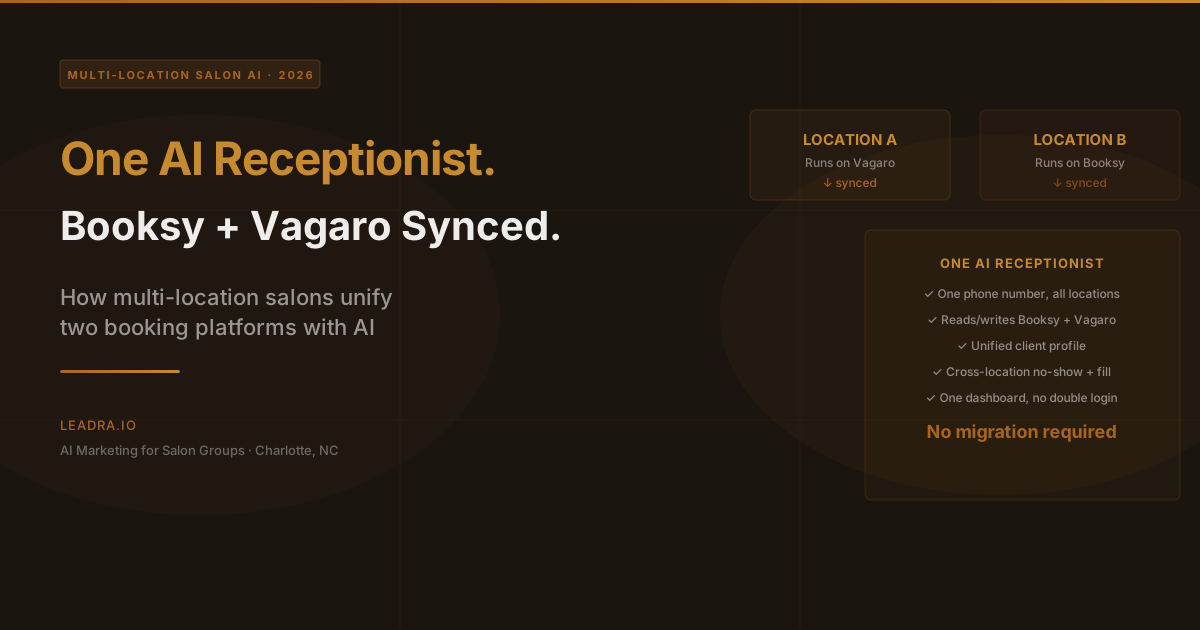
The AI receptionist Leadra.io deploys for multi-location salon groups sits on top of whatever each location already runs. It does not merge the platforms into one database — it connects to each independently and presents one seamless experience on the surface. Here is what that looks like broken down:
One phone number and text line in front of every location
Instead of each location publishing its own number — or worse, sharing one number that only rings at whichever location happens to be fully staffed — the AI receptionist becomes the single point of contact for the entire group. It answers by asking which location the caller wants, or infers it from caller ID history, then pulls live availability from that location's specific platform. A caller who says "I want to rebook with Jamie at the South End location" gets checked against that location's actual calendar, not a guess.
Simultaneous read/write access to Booksy and Vagaro, no migration
The AI connects to Booksy's API for locations still running it and Vagaro's API for locations that switched, or that came in through an acquisition already running Vagaro. Both connections run at the same time, independently, so a booking made through the AI writes directly into the correct platform's calendar — the same calendar your stylists already check every morning. Nothing about how each location operates day-to-day has to change.
A unified client profile built across both platforms
Multi-location groups lose the most value when a client's history is trapped in one location's system. The AI matches clients by phone number and name across both platforms, then references the combined history in every interaction — regardless of where the visit happened. A client who colors her hair at the Vagaro-run flagship and gets a blowout at the Booksy-run second location is recognized as the same person at both, with both service histories informing what the AI offers her next.
Consistent no-show prevention and cancellation fill at every location
Without unification, each location's no-show rate and cancellation-fill process depends on whichever front desk habits developed locally — usually inconsistent. The AI applies the same three-touch reminder sequence and the same automatic waitlist-texting on cancellation to every location, whether the underlying calendar is Booksy or Vagaro. Owners stop seeing one location with a 22% no-show rate and another with 9% for no reason other than staff habits.
One dashboard for ownership, regardless of platform count
The owner or operations manager gets a single view of bookings, no-shows, cancellation fill, and reactivation performance across every location — even though the data is being pulled from two or three different booking platforms behind the scenes. There is no more month-end process of exporting two spreadsheets and manually reconciling them to see how the group performed as a whole.
Case Study: 3-Location Charlotte Salon Group Running Two Different Platforms
Client Story — Charlotte, NC
A salon group with a flagship location in South End had run Vagaro for six years, with deep client history and 380 active records. When the owner acquired a second location in Ballantyne, it came with an existing client base already booked through Booksy — switching would have meant re-entering years of client notes by hand. A third location opened in NoDa a year later and, following the Ballantyne setup, also launched on Booksy. The result: one location on Vagaro, two on Booksy, three separate phone numbers, and a front desk team that had to check two different dashboards to answer a simple availability question.
Combined across all three locations, 29% of inbound calls went unanswered during business hours because staff were mid-service, and virtually every after-hours call went to voicemail. Clients who had visited the flagship location sometimes called the newer locations asking for the same stylist, and staff had no way to see that history. Ownership was manually combining two platform exports every month just to see total revenue.
Leadra.io deployed a single AI receptionist across all three locations, connected to Vagaro at the flagship and Booksy at the other two. One phone number now fronts the entire group. The AI checks the correct calendar based on which location the caller wants, books directly into that platform, and references a unified client profile built from matching records across both systems.
Missed calls (all locations)
29%
4%
Cross-location bookings/mo
0
31
Combined monthly revenue
$61.4k
$74.8k
Owner reporting time/mo
6 hrs
20 min
System cost: $1,600/month across three locations on two platforms. Revenue increase: +$13,400/month. The 31 monthly cross-location bookings came from clients the AI recognized across both systems and offered an earlier opening at a different location — bookings that would previously have been missed entirely because neither front desk could see the other platform's calendar.
None of the three locations changed their underlying booking software. The Vagaro location still runs Vagaro. Both Booksy locations still run Booksy. The only thing that changed is what clients and ownership experience on top of those systems. Staff at each location kept using the same dashboard they were already trained on — the AI simply became the front door that every call and text passes through before reaching whichever calendar applies.
How to Set This Up Across Your Locations: 3 Steps
Unifying multiple locations on different platforms is a configuration project, not a migration project. Here is what the rollout actually involves:
Map every location's platform, phone number, and staff roster
Before connecting anything, document which platform each location runs, its current phone number, service menu, pricing, and stylist roster. For groups with three or more locations, this also means identifying any client overlap — regulars who visit more than one location — since that overlap is where the unified profile creates the most value.
Connect each platform's API independently and configure the shared AI
Leadra.io connects to each location's platform separately — Booksy for some, Vagaro for others, Fresha or Square if applicable. The AI is then configured once with the full group's combined service menus and routing logic, so it knows to check the right calendar based on which location a caller names. A single new phone number is provisioned to front the entire group, with call routing and text response unified from day one.
Launch with a 30-day calibration window, then run across all locations
The first 30 days focus on confirming the AI routes correctly between locations, that no-show and cancellation-fill sequences match across every calendar, and that the unified client matching is accurate. Ownership gets one dashboard from day one, even while the underlying platforms stay untouched. Most multi-location groups need 2-3 small routing adjustments in the first two weeks, then the system runs on its own.
Related reading: Booksy vs. Vagaro — which platform gives AI the best foundation and how AI fills salon cancellations automatically on Vagaro and Fresha.
Frequently Asked Questions
Can one AI receptionist really answer for a salon that runs Booksy at one location and Vagaro at another?
Yes. The AI connects to both platforms through their separate APIs at the same time, so it always knows which location a caller is asking about and which calendar to check. A single phone number and text line front both systems — the AI reads live availability from Vagaro for one location and Booksy for another, then books directly into whichever calendar applies. Callers never know two different platforms are running behind the scenes.
Do we need to migrate every location onto the same booking software first?
No. That is the main advantage of an AI layer over a platform migration. Migrating a location's calendar, client history, and stylist logins to a new platform typically takes 60-90 days and risks losing historical client data. The AI layer connects to whatever each location already runs — Booksy, Vagaro, Fresha, Square, or Mindbody — and unifies the experience on top without touching the underlying systems or requiring staff retraining.
How does the AI keep client records consistent when a client has visited locations on different platforms?
The AI builds a unified client profile by matching phone number and name across both platforms' records, then layers that combined history into every conversation. If a client who normally visits the Vagaro location calls asking about the Booksy location, the AI still recognizes them, references their service history, and can offer to book at either location. Each platform's own database stays untouched — the AI simply reads from both and presents one consistent picture.
What does it cost to add a unified AI receptionist across multiple salon locations on different platforms?
Pricing scales with the number of locations and call volume, typically $600-$2,800 per month for a 2-4 location group, regardless of how many different booking platforms are involved. Connecting a second or third platform does not multiply the cost — it is a configuration step, not a separate system. Most salon groups see the setup pay for itself within 60 days from recovered after-hours calls and reduced no-shows alone.
You Don't Need One Platform. You Need One Experience.
Salon groups that grow through acquisition, franchising, or simple expansion almost never end up perfectly standardized on one booking platform — and forcing that standardization usually costs more in migration risk than it saves in convenience. The actual problem worth solving isn't which software each location runs. It's whether a client calling any location gets the same fast, informed response, and whether ownership can see the whole group's performance in one place.
An AI receptionist layer solves both without a single migration. It answers for every location from one number, books directly into whichever platform that location runs, and gives ownership one dashboard instead of two or three disconnected exports.
Leadra.io builds these unified AI systems for salon groups running any combination of Booksy, Vagaro, Fresha, Square Appointments, and Mindbody across their locations. Implementation typically takes 5-7 business days for a 2-4 location group. Results are measurable within the first 30 days — and guaranteed over 90.
Free Multi-Location Revenue Audit
See What Running Two Platforms Is Costing Your Salon Group
30-minute audit. We map every location's platform, missed-call rate, and no-show rate, then project what one unified AI receptionist would recover across the whole group.
Leadra.io
AI marketing agency — Charlotte, NC · Published August 29, 2026