You searched “Pipedrive vs Close vs Zoho CRM for small business” because GoHighLevel, HubSpot, and Salesforce either cost too much or felt like overkill. These three platforms are the ones that look reasonable in demos — and then turn into a part-time job once you actually try to run your business through them.
The short answer: Pipedrive wins for simple pipeline visibility with low setup overhead, Close wins for outbound sales teams that live on the phone, and Zoho wins on paper but loses in practice for most small business owners who don't have a dedicated CRM admin. But there's a more important question: are any of these platforms actually built for local service businesses where lead speed, SMS, and automated follow-up drive revenue?
At Leadra.io, we've worked with dental practices, law firms, HVAC contractors, and other service businesses across Charlotte and the US who cycled through Pipedrive, Close, and Zoho before realizing the tool wasn't the problem — the model was. Here's what we found.
If you want us to cut through the comparison and tell you what will actually generate more clients for your business, book a free 30-minute audit at Leadra.io. But first — the full breakdown.
Pipedrive: The Cleanest Pipeline View, With a Hard Automation Ceiling
Pipedrive launched in 2010 as a sales CRM built by salespeople who were frustrated with Salesforce. Its core product is exactly what the name suggests: a visual, drag-and-drop pipeline. Deals move across stages. Activities get logged. The interface is clean and fast to learn — most small business owners are functional within a day.
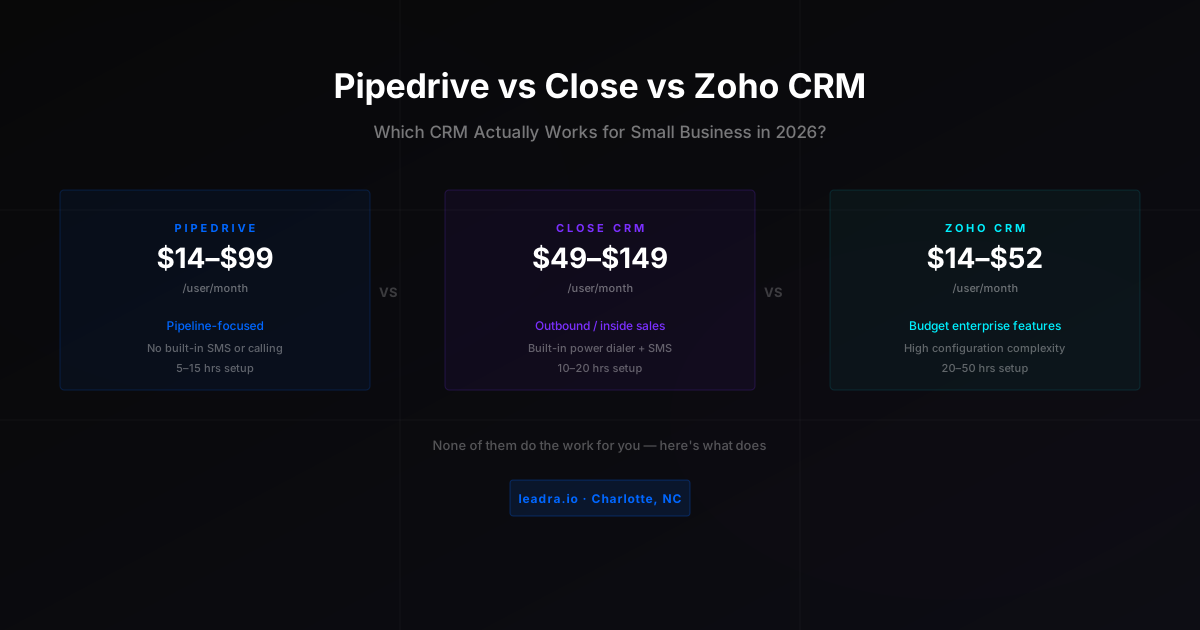
Pricing starts at $14/user/month and scales to $99/user/month on the Power plan. For a solo owner or team of two, the Essential or Advanced plan ($14-$34/user/month) covers the basics: contact management, email sync, deal tracking, and simple workflow automations. That's genuinely useful.
The limitation shows up the moment you need real automation. Pipedrive does not have built-in SMS. There is no native calling feature. Lead response automation — sending a text the second a form fills, routing to a calendar, triggering a multi-day follow-up sequence — requires third-party tools like Zapier, Twilio, or an add-on service. Each integration adds cost, adds a failure point, and adds something else you have to maintain.
For a service business where 78% of customers choose the first company that responds (according to Harvard Business Review), Pipedrive's lack of native SMS and instant lead response is a real competitive gap.
Pipedrive — Bottom Line
Best for small sales teams that need clean pipeline visualization and basic activity tracking. Not the right tool for service businesses where SMS, instant lead response, and automated booking sequences are the primary revenue drivers.
Close CRM: The Best Outbound Tool That Most Service Businesses Misuse
Close is the CRM that inside sales teams actually love. It was built around the phone call — its power dialer lets reps make 50-100 calls per day with automatic logging, recording, and outcome tracking. It also includes built-in SMS sequences, email cadences, and call coaching tools that competing platforms charge extra for.
Pricing starts at $49/user/month (Startup plan) and climbs to $149/user/month on the Business plan, which includes the power dialer and predictive dialing. For a three-person inside sales team doing 60 calls a day, that cost is justified. For a dental practice or HVAC company that gets 30-50 inbound leads per month and needs automated follow-up, Close is a lot of tool pointed in the wrong direction.
Close is designed for outbound. Its sequences assume your team is initiating contact. Most service businesses are primarily inbound — someone fills out a form, calls the office, or sends a message on Google. Those inbound lead flows work in Close, but you're using maybe 20% of what you're paying for. The power dialer is irrelevant if you're not doing outbound volume. The predictive dialing features require data volume most small businesses don't have.
Close — Bottom Line
Excellent for B2B service businesses, coaching programs, and SaaS companies with inside sales reps making high-volume outbound calls. Overkill and misaligned for local service businesses where inbound lead management, automated booking, and review collection are the primary growth levers.
Zoho CRM: Maximum Features, Maximum Configuration Headache
Zoho CRM is the most feature-complete platform on this list at the lowest per-user price. At $14-$52/user/month, you get AI-powered lead scoring, advanced workflow automation, multi-channel communication (email, phone, SMS, social), canvas customization, and territory management. On a spec sheet, it beats HubSpot at half the price.
In practice, Zoho CRM is one of the hardest platforms to implement correctly. The interface carries the weight of a decade of feature additions. Finding the right module, configuring the right automation, and connecting the right integration requires significant technical patience. Most small business owners who buy Zoho spend 3-5 hours in the platform, get frustrated by the setup complexity, and quietly go back to managing leads in spreadsheets or their inbox.
Zoho's SMS and calling features exist but come as add-ons or require integration with Zoho Telephony or a third-party connector. The automation builder — called Workflow Rules and Blueprint — is powerful but has a learning curve that most small business owners never fully climb.
A 2025 G2 survey found that Zoho CRM users report an average implementation time of 3-6 weeksfor a functional small business setup — compared to 1-2 weeks for Pipedrive and 2-3 weeks for Close. That's weeks where leads are not being properly followed up.
Zoho — Bottom Line
Best fit for tech-comfortable small business teams that want enterprise-grade automation at budget pricing and are willing to invest 30-60 hours in configuration. Not recommended for service business owners who need results in weeks, not months.
Pipedrive vs Close vs Zoho CRM: Full Comparison Table
| Metric | Pipedrive | Close | Zoho CRM |
|---|---|---|---|
| Starting price | $14/user/mo | $49/user/mo | $14/user/mo |
| Full feature cost | $49–$99/user/mo | $99–$149/user/mo | $40–$52/user/mo |
| Setup time | 5–15 hours | 10–20 hours | 20–50 hours |
| Built-in SMS | No (integration) | Yes (included) | Yes (add-on cost) |
| Built-in calling | No (integration) | Yes (power dialer) | Yes (add-on cost) |
| Workflow automation | Basic | Moderate | Advanced (complex) |
| Reputation management | Not included | Not included | Not included |
| Best fit | Pipeline-driven sales | Outbound / inside sales | Budget-focused teams |
| Learning curve | Low | Medium | High |
The table shows the feature comparison. What it doesn't show is the time cost. Pipedrive requires roughly 2-4 hours of weekly maintenance to stay useful — updating deal stages, logging activities, checking pipeline health. Close requires more if you're not running it actively. Zoho CRM can consume a full day per week for a non-technical owner keeping automations running correctly. For a small business owner billing $100-$300/hour in their core service, that time cost is real money.
The Real Problem: None of These Platforms Do the Work for You
Pipedrive, Close, and Zoho are all tools. They give you a structure for managing sales activity — but they don't generate leads, write follow-up sequences, respond to new inquiries automatically, or optimize what's working and cut what isn't. That work still falls on you, your team, or an agency you hire to manage the platform.
This is the gap most small business owners don't see until they're already six months into a CRM subscription. The platform is set up. The pipeline stages exist. But leads are still falling through because nobody wrote the SMS sequence for new inquiries. Nobody built the follow-up cadence for proposals that didn't close. Nobody set up the review request automation that runs after a job completes.
According to Forrester Research, only 33% of CRM users actively use the platform's automation features after six months. The rest use it as a contact list. That means two-thirds of small businesses paying for Pipedrive, Close, or Zoho are getting maybe 20% of the value they purchased.
The businesses that break this pattern aren't doing it with a better CRM. They're doing it by offloading the execution — the sequences, the follow-up, the lead response — to a system that runs without their daily involvement. See how our AI marketing automation approach addresses this specific gap.
Case Study: Charlotte Dental Practice Replaces Pipedrive with AI Automation
Client Story — Charlotte, NC
A Charlotte dental practice had been using Pipedrive for 14 months to track new patient inquiries. The pipeline stages were clean. The deal cards looked organized. But when we audited their actual lead-to-appointment conversion rate, it was 18% — meaning 82% of people who expressed interest in becoming patients never booked.
The problem was response time and follow-up consistency. Leads came in through their website contact form and Google profile. The front desk responded when they had time — usually 3-8 hours later. There was no SMS outreach. No follow-up sequence for leads that didn't respond to the first call. Pipedrive logged everything correctly. It just didn't do anything with the information.
We replaced their Pipedrive workflow with Leadra.io's AI system: an AI voice agent that responded to new inquiries within 60 seconds, a 7-touch SMS and email sequence over 10 days for non-responders, and automated review requests after every appointment. We also built their local SEO content engine to increase inbound volume. Monthly cost: $1,600 — versus $42/month for Pipedrive they were barely using.
Lead-to-appt rate
18%
41%
New patients/mo
11
26
Avg response time
4.5 hrs
52 sec
Days to ROI
24
15 additional new patients/month at $800 average first-year value = $12,000 additional monthly revenue run rate. Monthly Leadra.io cost: $1,600. ROI: 7.5x by month 2.
Pipedrive wasn't failing this practice. The practice was failing to use it actively enough to close the gap. That's not a CRM problem — it's a bandwidth problem. The right answer isn't a different CRM. It's a system that removes the need for daily manual follow-up.
Pipedrive vs Close vs Zoho: Which to Choose
Here is a direct framework for the Pipedrive vs Close vs Zoho decision for small business:
Choose Pipedrive if:
You have a predictable, multi-stage sales process with 10-50 active deals at a time
Your team needs visual pipeline management and basic activity tracking
You have budget for separate SMS and calling integrations (Twilio, Aircall, etc.)
You can invest 5-15 hours in setup and 2-4 hours/week in ongoing pipeline management
Choose Close if:
Your sales model is outbound — your reps initiate contact and make 30+ calls per day
You run a B2B business, coaching program, or SaaS with inside sales
Call recording, power dialing, and call coaching are core to how your team sells
You have a dedicated sales manager who will review call data and optimize sequences
Choose Zoho if:
You need enterprise-level features (multi-channel, AI scoring, territory management) at budget pricing
You have a technically proficient team member who can own and maintain the configuration
You are comfortable with a 3-6 week implementation timeline before the system is functional
Your budget for CRM software is under $200/month and you cannot afford HubSpot or GoHighLevel
Consider done-for-you AI instead if:
You want automated lead response under 60 seconds without building it yourself
You need multi-touch SMS, email, and voice follow-up that runs without daily management
You want appointment booking, review collection, and SEO content in one managed system
Your time is worth more than the hours a DIY CRM requires to maintain
The fourth option exists because most service businesses don't actually need to become CRM administrators. They need results: more leads converted, faster response times, consistent follow-up, more five-star reviews. A done-for-you AI system delivers those outcomes directly. See what AI implementation actually costs for a small business to understand the full picture before committing to any platform.
Frequently Asked Questions
Is Pipedrive good for small service businesses?
Pipedrive is a solid pipeline management tool for small businesses that need visual deal tracking and basic automation. It works well for sales-led businesses with clear, predictable deal stages. The limitation is automation depth — Pipedrive's workflow automations are simpler than Close or Zoho, and it lacks built-in SMS and voice for local service businesses where follow-up speed is critical. Most service businesses outgrow Pipedrive's automation ceiling within 12-18 months.
What is Close CRM best used for?
Close CRM is purpose-built for inside sales teams that do high-volume outbound calling and emailing. Its built-in power dialer, call recording, and SMS sequences are the best in class among mid-tier CRMs. It is a strong fit for B2B service businesses, coaching programs, and SaaS companies where the sales rep makes 30-80 calls per day. It is not a good fit for local service businesses where inbound lead handling, automated booking, and reputation management are the primary needs.
How does Zoho CRM compare to Pipedrive and Close for small business?
Zoho CRM has the broadest feature set of the three at the lowest entry price, but small businesses consistently struggle with implementation complexity. The platform requires significant configuration to get working automations, and the interface is less intuitive than Pipedrive or Close. Zoho makes sense for tech-comfortable teams that want enterprise features at budget pricing. Most service business owners find Zoho overwhelming and end up using a fraction of what they paid for.
What CRM do most small local service businesses actually use?
Most local service businesses — dental practices, HVAC companies, law firms, med spas — either use a basic CRM like Pipedrive for pipeline tracking or move to a done-for-you AI platform that handles lead capture, follow-up sequences, appointment booking, and reputation management without requiring internal configuration. Leadra.io is built for this use case, combining AI voice agents, automated follow-up, and local SEO into a single managed system for service businesses in Charlotte NC and across the US.
The Honest Answer for Service Business Owners
Comparing Pipedrive vs Close vs Zoho CRM for small business is ultimately a question about how much time you have to run a CRM versus running your business. All three platforms work. None of them work without active management. The companies getting real ROI from Pipedrive, Close, or Zoho are the ones with someone dedicated to making the system run — a sales coordinator, an operations manager, or an agency partner.
If that person exists in your business, Pipedrive is the easiest starting point for inbound lead management under $50/month. If they don't, the smarter investment is a done-for-you AI system that generates results without requiring a platform expert on your payroll.
Leadra.io builds and runs these systems for service businesses across Charlotte and the US. We back every engagement with a simple guarantee: 90 new patients or clients in 90 days, or you don't pay. See what ROI to expect from AI marketing automation to understand what the numbers look like in practice.
Free CRM Audit
Not Sure Which System Fits Your Business?
30-minute call. We'll look at your current lead volume, close rate, and tool stack — then tell you exactly what will generate the best ROI. No pitch. No obligation.
Leadra.io
AI marketing automation — Charlotte, NC · Published July 5, 2026