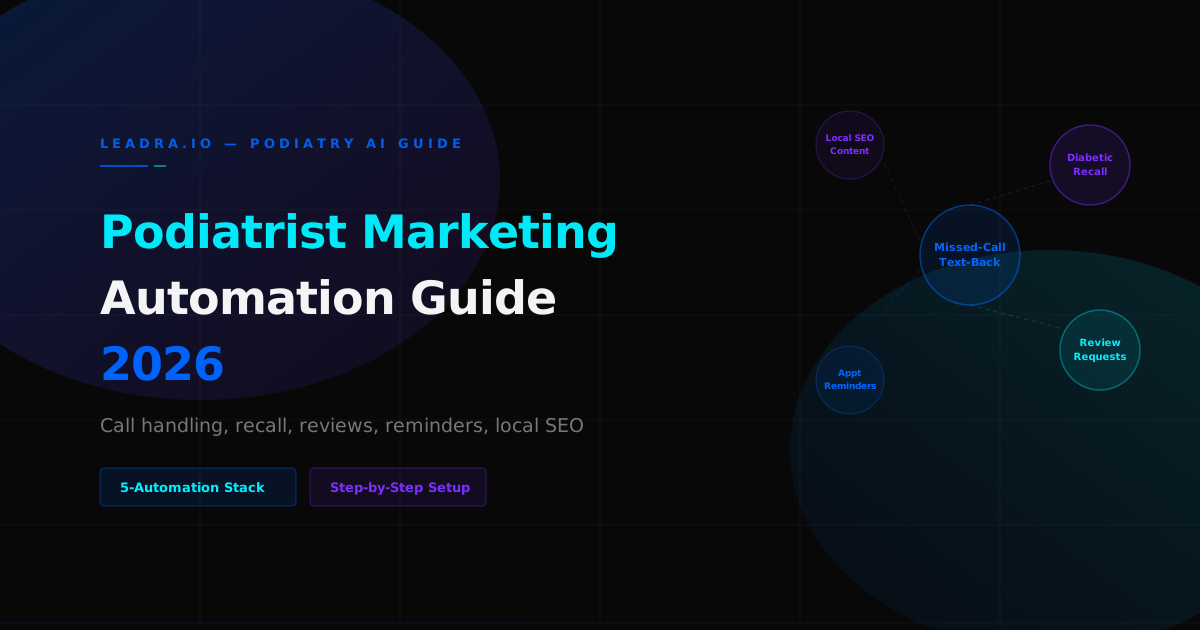
Most podiatry practices run marketing as a list of one-off tasks: someone remembers to text a missed call back, someone remembers to ask for a review after a good visit, someone remembers which diabetic patients are due for a recheck. When that someone gets busy, sick, or leaves, the whole list stops.
Marketing automation for a podiatry practice replaces that list with a set of workflows that run on their own. A missed call gets a text back in seconds, not whenever the front desk has a free minute. A diabetic patient gets a recall reminder on their actual due date, not a generic yearly postcard. A good visit turns into a review request automatically, instead of relying on staff to ask.
This guide breaks down the automations that matter most for a podiatry practice, what order to build them in, what each one costs, and how to set the whole stack up without overwhelming your team.
What Marketing Automation Actually Means for a Podiatry Practice
Marketing automation is not one tool. It is a set of connected workflows, each tied to something that already happens in the practice — a missed call, a completed visit, a recall window closing in. The workflow runs the same way every time, whether the front desk is slammed or the practice is short-staffed that week.
Manual Marketing
- Depends on someone remembering each task
- Falls apart during busy weeks or staff turnover
- Recall and review requests happen inconsistently
- No record of what was sent to whom, or when
Automated Marketing
- Triggers off real events — a missed call, a visit, a due date
- Runs the same way every day, staffed or not
- Every patient gets the same consistent follow-up
- Full record of every message sent, for compliance and review
The 5 Automations Every Podiatry Marketing Stack Needs
Not every practice needs all five on day one. Most start with the first two, since they work off patients and calls the practice already has, and add the rest as the system proves itself.
The first two automations work off patients and calls the practice already has, which is why they usually come first. See a full breakdown of what an AI receptionist does on a real call.
How to Build the Stack — Step by Step
Building all five automations at once overwhelms most front desk teams. A staged rollout gets each piece working correctly before adding the next.
Step 1: Turn on missed-call text-back
This is the fastest to set up and the easiest to measure. Connect it to the practice's existing phone line so every missed call gets an immediate text, and track how many of those texts turn into booked appointments in the first month.
Step 2: Layer in diabetic recall automation
Pull the diabetic patient list from the practice management system and set the 61-day recall window with billing. This automation usually produces the clearest return, since it re-engages patients the practice has already treated.
Step 3: Add review requests and appointment reminders
Once call handling and recall are running smoothly, add automated review requests after visits and two-stage appointment reminders. Both connect to the same scheduling system already feeding the first two automations.
Step 4: Bring in local SEO content
With call handling, recall, reviews, and reminders live, add ongoing local SEO content to bring in new patients while the first four automations keep existing patients engaged and coming back.
What This Looks Like in Practice
Single-Location Practice, 90-Day Rollout
A single-location podiatry practice with a part-time front desk staffer rolled out missed-call text-back and diabetic recall automation in the first two weeks, then added review requests and appointment reminders over the following month.
By day 90, the practice had a working system covering the four core automations, with local SEO content added as the final piece. Staff time spent on manual follow-up dropped, while patient touchpoints that used to get missed happened consistently every day.
Missed calls recovered
Google reviews/mo
No-show rate
At Leadra.io, this staged rollout pattern repeats across the podiatry practices we work with. The practices that build call handling and recall first, then layer in reviews, reminders, and content, see the system stick because each stage proves value before the next one is added. See how AI-driven lead capture compounds on top of this stack.
Marketing Automation for Podiatrists in Charlotte, NC
Charlotte's podiatry market is competitive across Uptown, SouthPark, Ballantyne, and the broader metro, with multiple practices often serving the same neighborhood. Automation that keeps existing patients engaged, rather than only chasing new ones, gives a practice a steadier base to compete from.
For Charlotte practices specifically, pairing recall and review automation with local search visibility tends to compound faster than either alone, since new patients who find the practice through search often check reviews before calling. Read the full local map-pack strategy for Charlotte podiatry practices.
What a Marketing Automation Stack Costs
Starting Point — One Automation
$300 – $600/mo
Missed-call text-back or diabetic recall alone, for a practice testing automation before committing to a full stack. Setup time: 1-2 weeks.
Core Stack — Call, Recall, Reviews, Reminders
$1,200 – $2,500/mo
The four patient-retention automations bundled together, connected to the practice's existing scheduling system. The most common setup for single-location practices. Setup time: 3-5 weeks.
Full System — Stack Plus Local SEO Content
$2,200 – $4,000/mo
Everything in the core stack plus ongoing local SEO content and Google Business Profile management, for practices ready to grow new-patient volume alongside retention. Setup time: 4-6 weeks.
Pricing tiers vary based on patient volume and how many systems need to connect to the practice's scheduling software. See the full AI cost breakdown for small healthcare businesses.
What to Do Next
If you would rather not piece this together on your own, that is exactly what Leadra.io is built for. We handle the full marketing automation stack for podiatry practices, from call handling to recall to local SEO, so your team can focus on patients instead of follow-up lists. Learn how a free AI business audit finds your practice's biggest automation gap.
FAQ: Podiatrist Marketing Automation
What is marketing automation for a podiatry practice?
Marketing automation for a podiatry practice is a set of connected workflows that run without staff manually triggering each one — missed-call text-back, diabetic recall reminders, review requests after visits, appointment confirmations, and local SEO content. Instead of one-off tasks, each patient interaction moves through a system built once and running continuously.
How much does a full marketing automation stack cost for a podiatry practice?
A single-automation starting point, like missed-call text-back, typically runs $300-$600 per month. A fuller stack combining call handling, recall, review generation, and reminders runs $1,200-$2,500 per month. Adding local SEO content and ongoing optimization brings a complete system to $2,200-$4,000 per month depending on practice size.
Which automation should a podiatry practice set up first?
Missed-call text-back and diabetic recall automation deliver the fastest return because they work off patients the practice already has, rather than requiring new patient acquisition. Both can be live within one to two weeks and typically pay for themselves through rebooked appointments before other automations are added.
Will marketing automation feel impersonal to patients?
Not when it is set up correctly. Good automation uses the practice's own scheduling data and recall windows so messages arrive at the right time with specific, relevant information, like a diabetic foot check reminder timed to a real due date. Patients generally notice faster responses and fewer missed reminders, not a robotic experience.
Built for Podiatry Practices
Ready to Build Your Marketing Automation Stack?
Leadra.io builds call handling, recall, review, and local SEO automation for podiatry practices. Tell us where your follow-up is falling through and we will map out a 90-day rollout plan.