Pressure Washing Customer Reactivation Automation: Turn Your Old Customer List Into Recurring Revenue
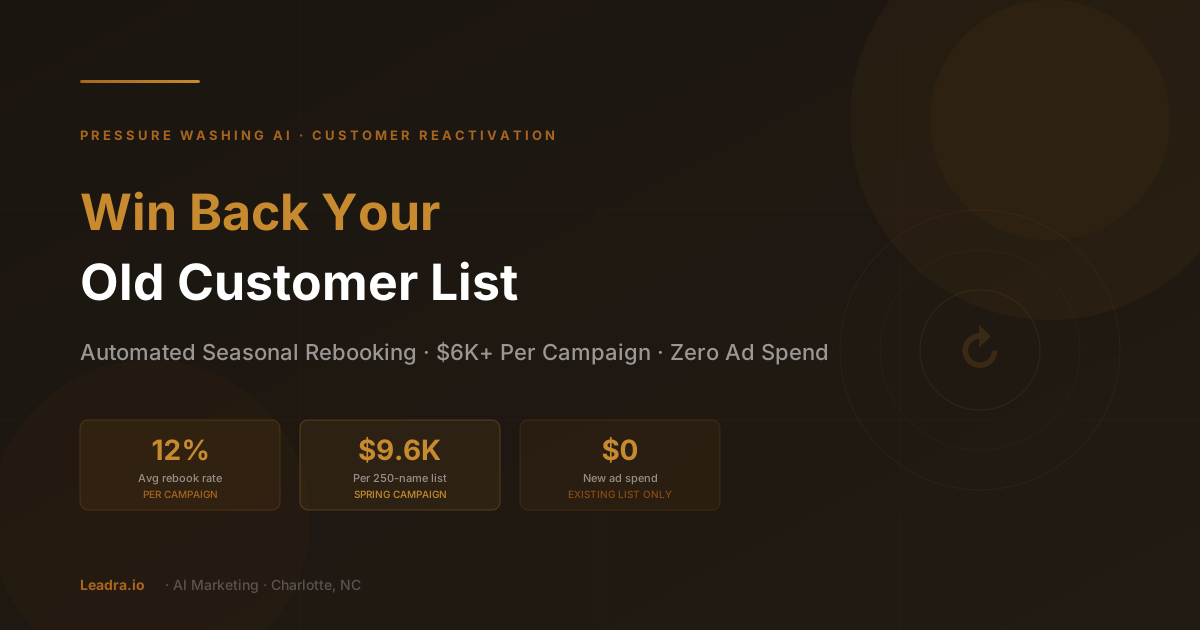
Somewhere on your hard drive or inside your route software is a spreadsheet of every customer who ever paid you for a wash. Most pressure washing owners look at that list once — when they built it — and never again. That list is not dead data. It is unclaimed revenue sitting in a folder, and for a company with 200 to 300 past customers, it is worth $6,000 to $11,000 per season if someone actually reaches out at the right moment.
The problem is not that pressure washing customers do not want to rebook. It is that nobody asks them to. A homeowner who paid $340 for a driveway wash last April is not thinking about pressure washing in February — until a text arrives reminding them the demand season is 30 days out and the same crew that did a good job last time is available. That single message, sent automatically at the right moment, is the entire mechanism behind reactivation automation.
This guide covers why pressure washing customers go dormant without ever deciding to leave, the actual revenue math behind a reactivation campaign, how AI automation runs the entire sequence without manual follow-up, and the mistakes that cause most win-back attempts to underperform. By the end, you will know exactly what a reactivation system should look like for your customer list size.
Why Pressure Washing Customers Go Dormant Without Ever Churning
Pressure washing is not a subscription business by default — it is event-driven. A customer books because something triggered the need, not because they are on a recurring plan. That creates a specific dormancy pattern most owners misread as customer loss:
- 01.The trigger event passed, and so did the memory. A homeowner washed the driveway to sell the house, host a graduation party, or clear up algae staining that finally got noticed. Once the event passes, the service leaves top-of-mind awareness entirely — not because the customer was dissatisfied, but because nothing is prompting them to think about it again.
- 02.They forgot who they used. Unlike a dentist or a hair stylist, most homeowners have no ongoing relationship with a pressure washing company. If a year passes without contact, a name search or a new Google search is more likely to produce results than remembering a business card from last spring.
- 03.Nobody ever asked them to come back. Most pressure washing companies send a receipt and nothing else. There is no seasonal reminder, no rebooking prompt, no touchpoint at all after the invoice clears. A customer who had a great experience with zero reason to reach out again simply does not — not out of dissatisfaction, but out of default.
None of these three reasons involve the customer being unhappy. That is exactly why reactivation campaigns consistently outperform new-customer acquisition on cost per booked job — you are not persuading a stranger to trust you, you are reminding someone who already does.
The Revenue Sitting in Your Customer List Right Now
Run this math against your own numbers. A company with 250 past customers and a $320 average job that reactivates even 10% of that list in a single seasonal campaign books 25 jobs — $8,000 in revenue from a list that already existed, at essentially zero acquisition cost per job. Run that same campaign twice a year, once in spring and once in fall, and the same 250-name list is generating $14,000 to $18,000 annually without a single new lead purchased.
Most companies never see this number because the list sits untouched in Jobber, Housecall Pro, or a spreadsheet nobody opens between jobs. The revenue is not hypothetical — it requires one thing: a system that reaches out automatically, at the right seasonal moment, with a message specific enough to feel like a genuine reminder instead of a mass blast.
How AI Reactivation Automation Actually Works
A real reactivation system is not a single blast text sent to everyone at once. It runs as a continuous, segmented sequence:
Customer list segmentation by service and timing.
The system tags every past customer by service type (driveway, house wash, roof, deck), job date, and job value. This lets campaigns target the exact right audience — driveway customers get spring messaging, roof customers get fall messaging — instead of one generic offer sent to everyone regardless of relevance.
Seasonal trigger windows, not calendar blasts.
Messages go out 30 days ahead of each demand peak, timed to reach customers before the problem becomes visible to them, not after. This is the single biggest driver of response rate — a message that arrives right as pollen season starts or right before holiday guests arrive lands as helpful, not as a sales pitch.
Personalized reference to the prior job.
"It's been about a year since we washed your driveway" converts at a meaningfully higher rate than "Book your pressure washing today." The AI system pulls the actual service and date from job history so every message feels like it came from someone who remembers the customer, because it did.
A simple, low-friction booking path.
The message includes a direct link or a reply-to-book option — no phone tag required. Customers who are ready to rebook in the moment they read the text convert immediately; the ones who reply with a question get routed to an AI or human follow-up within minutes.
A second touch for non-responders.
Customers who do not respond to the first message get one follow-up 10 to 14 days later with a slightly different angle — often a small seasonal incentive. This second touch typically adds another 3 to 5 percentage points of rebooking on top of the first message alone.
The Pressure Washing Reactivation Calendar
Reactivation performs best when it is tied to real seasonal demand, not sent on an arbitrary schedule. Here is how the calendar typically breaks down for a residential-focused pressure washing business:
| Season | Trigger Timing | Campaign Focus | Typical Rebook Rate |
|---|---|---|---|
| Spring (Feb–Apr) | Sent 30 days before peak driveway/house-wash demand | Driveway, siding, and house wash refresh before the season's first outdoor events | 9% – 15% |
| Early Summer (May–Jun) | Sent to customers who booked a house wash 10–14 months prior | Deck, patio, and fence wash tied to outdoor entertaining season | 6% – 10% |
| Fall (Sep–Oct) | Sent 30 days before roof/gutter demand peaks ahead of winter | Roof soft-wash and gutter clearing before winter weather arrives | 8% – 13% |
| Pre-Holiday (Nov) | Sent to customers who booked any exterior job in the last 12 months | Exterior refresh before holiday guests and family photos | 5% – 9% |
ROI Example: A 250-Customer List Running Full Reactivation
The following projection is based on a company with 250 past customers and a $320 average job value running both a spring and fall campaign plus an ongoing 12-month lapse trigger.
These are realistic ranges based on observed reactivation campaign performance across home-service businesses. Individual results vary by list quality, market, and message timing.
| Campaign | Assumption | Revenue |
|---|---|---|
| Spring reactivation campaign | 250 past customers, 12% rebook rate, $320 avg job | $9,600 |
| Fall roof and gutter reactivation | 250 past customers, 10% rebook rate, $310 avg job | $7,750 |
| Ongoing 12-month lapse trigger | 15–20 customers per month crossing the 12-month mark, 20% respond | $960 – $1,280 |
| Referral prompt attached to win-back message | 5% of reactivated customers refer one new customer at $340 avg | $680 – $1,020 |
| Annual estimated total | Spring + fall + ongoing lapse trigger + referrals | $19,000 – $23,500 |
Against a reactivation automation cost of roughly $150 to $400 per month, that annual return is the highest-ROI marketing line item most pressure washing companies have — higher than paid ads, because the audience already converted once and the acquisition cost is already sunk.
Common Mistakes That Kill Reactivation Response Rates
Sending one generic blast to the entire list at once.
A driveway customer does not care about a roof-wash offer, and a customer who just booked three weeks ago does not need a reactivation message. Blasting the full list with no segmentation wastes the highest-value message you send all year and trains customers to ignore future texts.
Timing the campaign after demand has already peaked.
By the time everyone's driveway is visibly green with algae in late spring, competitors have already been marketing for a month. Reactivation messages sent 30 days ahead of the season, not during it, are what capture the customer before they start searching Google for someone new.
Making the customer do the work to rebook.
A message that says "call us to schedule" converts far worse than one with a direct booking link or a simple reply-to-confirm option. Every extra step between reading the text and being booked loses a percentage of respondents.
Running the campaign once and never repeating it.
A one-time win-back blast recovers a slice of the list and then goes quiet again. Automated seasonal triggers that run every year without manual setup are what turn this into a permanent revenue channel instead of a single spring project.
Reactivation Automation for Charlotte, NC Pressure Washing Companies
Charlotte's pollen season alone creates one of the most predictable reactivation windows in the country — driveways and siding across South Charlotte, Ballantyne, Huntersville, and Matthews visibly yellow every spring, and homeowners who washed last year are primed to book again the moment a reminder lands.
Charlotte pressure washing companies sitting on a customer list of even 150 to 200 names are leaving thousands in seasonal rebooking revenue unclaimed every year simply because nobody sends the reminder. Leadra.io builds reactivation automation systems for pressure washing and exterior cleaning businesses in Charlotte and nationwide. Book a free strategy call or call +1 (302) 495-9984 to see what your list is worth.
Your Next Steps — What to Do This Week
Pull your full customer list and count it.
Export every customer from your route software or spreadsheet going back 24 months. That number, multiplied by an 8–12% seasonal rebook rate and your average job value, is the revenue currently sitting untouched.
Segment by service type and last job date.
Even a basic spreadsheet sort by service and date is enough to send a relevant campaign instead of a generic blast. This one step alone typically doubles response rate over a mass message.
Time your first campaign 30 days ahead of the next seasonal peak.
Do not wait until demand is already visible. The companies that win the reactivation game every year are the ones reaching out before the algae is visible, not after.
Automate it so it runs every year without manual work.
A campaign you have to remember to send manually will get skipped the first busy season. Automated seasonal triggers turn this into a permanent revenue channel instead of a one-time project.
Frequently Asked Questions
What is customer reactivation automation for a pressure washing business?
Customer reactivation automation is a system that automatically re-contacts past customers who have not booked a job in a set period — usually 9 to 18 months — with a timely, personalized offer to rebook. For pressure washing, this means an AI-driven SMS or email sequence that goes out ahead of each seasonal demand window (spring driveway and house wash, fall roof and gutter cleaning) referencing the specific service the customer had done before. It runs automatically off your customer list without a staff member manually calling anyone.
How much revenue can reactivation automation generate for pressure washing companies?
A pressure washing company with 250 past customers and an average job of $320 typically rebooks 8% to 14% of that list per seasonal campaign using automated reactivation. That is 20 to 35 rebooked jobs generating $6,400 to $11,200 in revenue from a single campaign, run with no new ad spend and no cold outreach — just past customers who already trust the business getting a well-timed reminder.
Why do pressure washing customers stop booking without churning on purpose?
Most pressure washing customers do not consciously decide to leave. They book once for a specific event — selling a house, hosting an event, a dirty driveway that finally bothered them — and then simply forget the service exists until the problem is visible again. Without a reminder, that gap between visible need and remembering who to call stretches for years. Reactivation automation closes that gap by reaching out before the customer notices the problem, not after.
Is reactivation automation better than running Google or Facebook ads for new customers?
Reactivation is not a replacement for new-customer acquisition, but it is almost always the higher-ROI move first because past customers already know and trust the business, converting at a far higher rate than cold ad traffic and at a fraction of the cost per booked job. Most pressure washing companies running ads while ignoring their existing customer list are paying to acquire people they already had. The highest-performing marketing stacks run reactivation automation continuously and layer paid ads on top once the existing list is being worked systematically.
See What Your Customer List Is Worth
Leadra.io builds AI reactivation automation for pressure washing and exterior cleaning businesses. We will show you the exact rebooking math for your customer list — free, no obligation.
Written by the Leadra.io Team. Leadra.io is an AI marketing agency helping pressure washing and home-service businesses grow using AI-powered automation, booking capture, and lead generation systems. Based in Charlotte, NC — serving clients nationwide.