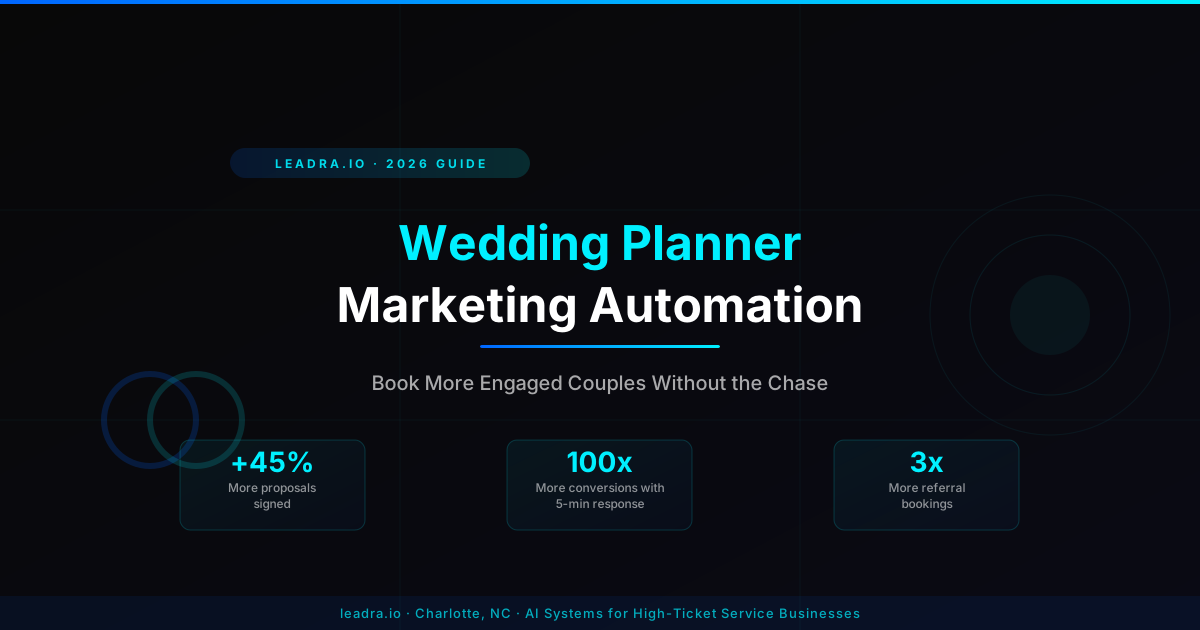
Wedding Planner Marketing Automation Guide: Book More Engaged Couples Without the Chase in 2026
By Leadra.io Team · July 10, 2026 · 9 min read
Wedding planner marketing automation is a set of connected tools that handle inquiry replies, proposal follow-ups, client onboarding, vendor coordination reminders, and review requests automatically. The right stack captures every engaged couple who reaches out, keeps them warm through a long decision cycle, and turns past clients into referrals — without a full-time marketing hire.
Wedding planners run one of the hardest marketing calendars in small business. Engagement season spikes inquiries for six to eight weeks a year, couples take weeks to compare planners before committing, and the entire relationship depends on trust built through fast, personal-feeling communication. Meanwhile the planner is on-site at Saturday weddings, deep in vendor calls, or heads-down on a floor plan — not sitting by the inbox.
The planners booking full calendars in 2026 have solved this the same way: they stopped relying on manual follow-up. They built systems that respond to every inquiry within minutes, keep proposals from going cold, and reach back out to past clients and their engaged friends automatically. That frees the planner to spend their working hours on design and coordination instead of chasing replies.
This wedding planner marketing automation guide walks through exactly which systems work, what each one costs, and how to set them up step by step.
Why Wedding Planners Lose Bookings to Manual Follow-Up
Wedding planning has a marketing challenge most service businesses do not face: the buying cycle is long, emotional, and almost entirely inquiry-driven. A couple finds you on Instagram or The Knot, submits an inquiry, and then compares you against two or three other planners over the next several weeks. Whoever responds fastest and stays most present during that window usually wins the booking — even if their portfolio is not the strongest.
Manual marketing cannot keep that pace. Here is what it looks like in practice:
- An inquiry comes in from The Knot at 9 PM on a Friday. The planner is at a rehearsal dinner and does not see it until Monday. The couple has already booked someone else.
- A detailed proposal goes out, and then nothing. No one follows up, so the couple assumes the planner is too busy or loses momentum during a stressful decision period.
- A past client whose wedding was a dream come true never gets asked to leave a review or refer engaged friends — even though referrals are the single best lead source in this industry.
- Vendor confirmations, final headcounts, and timeline sign-offs get tracked in scattered email threads, creating stress and errors in the final weeks before a wedding.
None of these are effort problems. They are system problems. Marketing automation fixes each one by replacing manual follow-up with triggers that fire automatically, every time.
For a broader look at how automated nurture sequences work across service businesses, see our guide on automated lead nurture sequence best practices — the same principles apply directly to wedding inquiries.
The 6 Core Systems in a Wedding Planner Marketing Automation Stack
You do not need a dozen tools. The planners seeing the fastest growth run six interconnected systems. Each one closes a specific gap between an interested couple and a signed contract.
1. Instant Inquiry Response Across Every Channel
The speed of your first reply determines whether you get a consultation call more than any other single factor. A 2024 Harvard Business Review study found that businesses responding within 5 minutes are 100 times more likely to convert a lead than those responding within 30 minutes.
Wedding inquiries come in from The Knot, WeddingWire, Instagram DMs, your website contact form, and referrals through text message — often all in the same week. Automated inquiry response means every one of those channels triggers an immediate reply confirming receipt, sharing your availability and starting price range, and offering a link to book a discovery call. This keeps the couple engaged while you finish your current wedding weekend.
For planners fielding 15+ inquiries a month during peak season, an AI voice or chat agent can handle the full initial conversation, qualify the couple on date, budget, and guest count, and book the discovery call directly onto your calendar. See how Leadra.io's client acquisition system handles this end-to-end.
2. Proposal Follow-Up Sequences That Never Go Cold
Sending a beautiful proposal and then waiting is the single biggest reason planners lose bookings to competitors. Couples are comparing three planners at once, and the one who stays present without being pushy wins the decision.
An automated follow-up sequence solves this: two days after the proposal, a check-in email answering common questions (payment plans, what is included, how many hours you spend on-site). One week later, a text or email sharing a recent real wedding in a similar style or venue. Two weeks later, a soft close: “Your date is still open — want to hop on a quick call this week to finalize details?” Every message is pre-written once and fires automatically on schedule.
Planners running structured proposal follow-up typically convert 30–45% more inquiries into signed contracts than planners who send one proposal and wait, based on client-reported data from planners running this system.
3. Automated Client Onboarding and Timeline Sequences
Once a couple signs, the marketing relationship becomes an operations relationship — and the same automation principles apply. A welcome sequence triggered at contract signing sends the client questionnaire, introduces your planning portal, and sets expectations for your communication style and timeline milestones.
From there, automated check-ins at 9 months, 6 months, 3 months, and 6 weeks out prompt the couple for the next round of decisions — vendor selections, final guest count, seating chart. This keeps the planning process moving without you manually tracking dozens of client timelines in your head, and it makes the experience feel more organized to the couple, which drives referrals later.
4. Vendor Coordination Reminders
The final six weeks before a wedding involve dozens of vendor confirmations: florist delivery windows, catering headcounts, DJ timeline hand-offs, rental pickup times. Tracking these manually across email is where mistakes happen — and mistakes in the final weeks are the ones couples remember.
An automated reminder system, built once in a tool like Aisle Planner, HoneyBook, or a connected Zapier workflow, sends confirmation requests to every vendor on a fixed schedule (60 days, 30 days, 7 days) and flags any vendor who has not responded. This turns a stressful manual chase into a background process that runs itself.
5. Automated Review Request Sequences
Reviews on The Knot, WeddingWire, and Google directly determine how many new inquiries you get, since nearly every engaged couple reads reviews before reaching out. A planner with 60 reviews at 4.9 stars gets found and booked far more often than a planner with 8 reviews, regardless of portfolio quality.
Most planners rely on couples remembering to leave a review in the exhausted, honeymoon-bound weeks after their wedding — which rarely happens without a nudge. An automated sequence sends a heartfelt thank-you message one week after the wedding, followed by a direct review link two weeks later, and a final gentle reminder at the four-week mark if no review has been left.
Planners running this system typically see their review count double within the first two wedding seasons of operation, directly increasing inbound inquiry volume.
6. Past-Client and Referral Nurture Campaigns
Your best lead source is not Google or Instagram — it is the engaged friends of couples you have already planned weddings for. Referrals close faster and negotiate less than cold inquiries because trust is already established.
A quarterly automated email or text to past clients keeps you top of mind: “Know anyone newly engaged? We would love to help plan their day — refer them and you both get a thank-you gift.” Pair this with a request to tag you in their wedding photos and reviews. For a full framework on turning past clients into a recurring pipeline, see our client reactivation system guide.
| Client Stage | Automated Sequence | Timing |
|---|---|---|
| New inquiry | Instant confirmation + availability + discovery call link | Within minutes |
| Proposal sent, no reply | 3-touch follow-up: FAQ, real wedding, soft close | Day 2, day 7, day 14 |
| Signed client | Welcome sequence + milestone check-ins | 9mo / 6mo / 3mo / 6wk out |
| Post-wedding (0–4 weeks) | Thank you + review request + referral ask | Week 1, 2, 4 |
| Past clients (annual) | Referral nurture + engaged-friend prompts | Quarterly |
Real Example: A Charlotte Wedding Planner Booking 12 Extra Weddings in One Season
(This example represents the type of results our clients achieve.)
A boutique full-service wedding planning studio in Charlotte, NC was booking 18–20 weddings a year but losing an estimated third of qualified inquiries to slower-responding competitors. Their proposals went out promptly, but follow-up after that point was inconsistent — dependent entirely on the owner remembering to check back in during the busiest season of the year.
We built a full marketing automation stack over three weeks:
- Connected The Knot, WeddingWire, Instagram, and their website form to a single inbox with an instant automated reply
- Built a 3-touch proposal follow-up sequence deployed automatically after every proposal sent
- Set up milestone-based client onboarding check-ins tied to each wedding date
- Added automated post-wedding thank-you, review request, and referral-ask messaging
- Configured a quarterly past-client nurture campaign highlighting recent real weddings
Results after one full wedding season: booked 12 additional weddings compared to the prior year on the same inquiry volume. Review count on The Knot and Google nearly tripled. Referral bookings — clients who came from a past couple — went from roughly 2 per year to 9. The planner reported feeling “actually present” during wedding season for the first time in years.
We were not losing couples because they did not like us. We were losing them because we replied a day too late. The system fixed that.
How to Build Your Wedding Planner Automation Stack in 5 Steps
Step 1: Centralize every inquiry channel into one inbox. Connect The Knot, WeddingWire, Instagram DMs, and your website form to a single CRM inbox like HoneyBook or Dubsado. You cannot automate what lives in five separate places.
Step 2: Build your instant-reply and proposal follow-up templates. Write one confirmation reply and a 3-message proposal follow-up sequence once inside your CRM's automation builder. From now on, every new inquiry and every sent proposal triggers the sequence without you touching it.
Step 3: Map your client onboarding milestones. Build a single onboarding workflow tied to wedding date that fires check-ins at 9, 6, and 3 months out, plus a final 6-week pre-wedding checklist. Apply it to every signed client going forward.
Step 4: Turn on post-wedding review and referral automation. Set up a three-message sequence (thank you, review link, referral ask) that fires automatically starting one week after each wedding date. This single step is the fastest way to grow both reviews and referral volume.
Step 5: Schedule your quarterly past-client nurture send. Build one email template highlighting recent real weddings and a referral incentive, and schedule it to go to your full past-client list every quarter. This keeps you top of mind with the people most likely to send you your next booking.
If you want the full stack built and managed for you, Leadra.io handles implementation end to end. Call +1 (864) 721-8384 or visit our contact page to book a free strategy session.
Tools for Wedding Planner Marketing Automation
The right tools depend on your booking volume, team size, and how hands-on you want the automation to be. Here is a practical breakdown by function:
- CRM and inquiry management: HoneyBook (best all-in-one for inquiries, proposals, contracts, and payments), Dubsado (deepest workflow customization), Aisle Planner (built specifically for wedding planning workflows and vendor coordination)
- Instant inquiry response: HoneyBook or Dubsado auto-replies for form and email inquiries, ManyChat for Instagram DM automation, Leadra.io's AI voice agent for phone inquiries during peak season
- Email and nurture sequences: Flodesk (best for visually branded emails to couples), Klaviyo (best for detailed past-client segmentation), Mailchimp (simplest to start)
- Review and referral automation: Podium or Birdeye (automated review requests across The Knot, WeddingWire, and Google), a simple Zapier trigger from your CRM at wedding-date-plus-7-days for smaller studios
- Vendor coordination: Aisle Planner or HoneyBook shared timelines, Zapier workflows to auto-send confirmation requests on a fixed schedule before each wedding
A complete functional stack for a solo or small-team wedding planning business runs $150–$400 per month in software. The key is connecting the tools so a signed contract automatically triggers onboarding, and a wedding date automatically triggers the post-wedding review and referral sequence — instead of relying on memory during your busiest months.
Frequently Asked Questions
What is wedding planner marketing automation?
Wedding planner marketing automation is the use of connected software tools to handle repetitive marketing and client communication tasks automatically — replying instantly to inquiries, following up on sent proposals, onboarding signed clients, coordinating vendor confirmations, and requesting reviews and referrals after each wedding. You configure these systems once, and they run on triggers tied to inquiry date, proposal date, contract date, and wedding date.
How much does marketing automation cost for a wedding planner?
Software costs for a complete stack run $150–$400 per month for a solo or small-team planning business, depending on booking volume and tools chosen. Professional setup by an agency like Leadra.io typically ranges from $1,200–$2,500 as a one-time investment. Most planners recover that in the first booking season through inquiries that would otherwise have been lost to slow follow-up.
Will automated messages make my communication feel less personal to couples?
No — done correctly, automation makes your communication feel faster and more attentive, not less personal. The goal is to automate the timing and delivery of messages, not the warmth of them. Write every sequence in your real voice, personalize with the couple's names and wedding date, and reserve automation for the repetitive touchpoints (confirmations, reminders, check-ins) so you have more time for the calls and meetings that actually need your personal attention.
How long before wedding planner marketing automation shows results?
Inquiry response time and consultation booking rate improve immediately once instant-reply automation is live. Proposal-to-signed-contract conversion typically improves within 4–8 weeks as the follow-up sequence runs across your active inquiries. Review volume and referral bookings take a full wedding cycle to show their full impact — usually 6–12 months — since they depend on weddings actually taking place and the post-wedding sequence firing. Planners who start before their next peak inquiry season see the fastest compounding results.
- The 6 core systems — instant inquiry response, proposal follow-up, client onboarding, vendor reminders, review requests, and referral nurture — address every major revenue leak in wedding planner marketing.
- Structured proposal follow-up sequences convert 30–45% more inquiries into signed contracts than a single proposal with no follow-up, based on client-reported data.
- Automated post-wedding review and referral requests are the fastest way to grow both your inquiry volume and your highest-converting lead source: past-client referrals.
- A full automation stack costs $150–$400 per month in software and requires no marketing hire to maintain after setup.
What to Do Next
The biggest mistake wedding planners make with marketing automation is assuming it will strip the personal touch out of an inherently emotional, relationship-driven business. The opposite is true. Automating the repetitive timing of your communication frees up the energy you need to be genuinely present in the calls, meetings, and wedding days that actually build the relationship — and referrals — that grow your business.
Start with Step 2 from the guide above: build your proposal follow-up sequence before your next inquiry season ramps up. That single system is usually the highest-leverage change a planner can make, because it recovers bookings you are currently losing to competitors who simply stay in touch longer.
At Leadra.io, we build and manage the full wedding planner marketing automation stack. Call +1 (864) 721-8384 or visit our contact page to schedule a free 30-minute strategy call. We audit your current inquiry-to-booking process, show you the top 3 gaps, and give you a written implementation plan — no obligation.
Ready to automate your wedding planning business?
Get a free wedding planner marketing audit from Leadra.io.
30-minute strategy call — we review your current inquiry-to-booking process, identify the top 3 revenue leaks, and show you exactly what to automate first. No obligation. You leave with a written plan.
Charlotte NC · serving wedding planners and small businesses nationwide
Written by the Leadra.io Team. Leadra.io is an AI marketing and automation agency helping wedding planners, dental practices, and small businesses grow with AI-powered systems. Based in Charlotte, NC — serving clients nationwide.