Somewhere inside your EMR is a list of patients who spent real money with your clinic and haven't booked in months. They already trust your injector, already know your front desk, and already know what a treatment costs. Nobody is calling them.
Most medical aesthetic clinics treat dormant patients as a spreadsheet problem — an export somebody runs during a slow week, worked down a list for a few days, then forgotten until the next slow week. The patient data already lives in the EMR, sorted by last-visit date and treatment history. The gap isn't information. It's a workflow that reads that data continuously and acts on it before the list goes stale again.
This guide covers how an AI system connects directly to a clinic's EMR to identify, score, and route dormant patients automatically, what that costs, and what it looked like inside a Charlotte-area clinic that put it in place.
Why Dormant Patient Recovery Has to Start in the EMR, Not a Spreadsheet
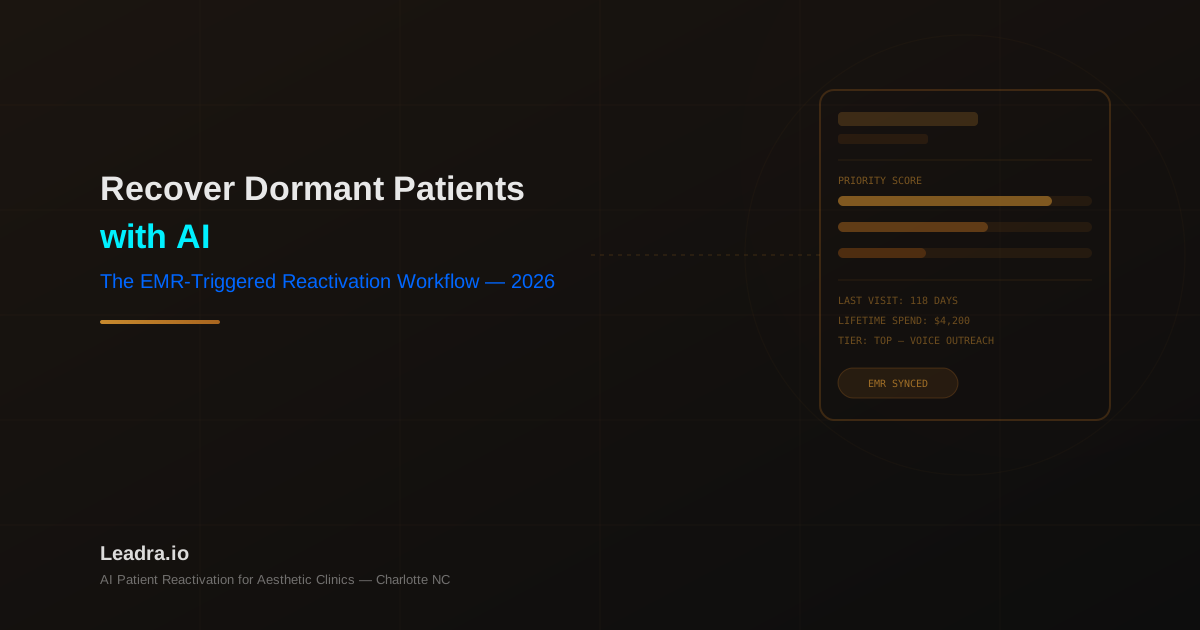
A spreadsheet export is a snapshot — accurate the day it's pulled, wrong a week later as new patients quietly cross the dormant threshold. It also treats every dormant patient the same, when a patient who spent $4,200 on filler and Botox over two years is worth a very different outreach than someone who came in once for a $150 consultation.
An EMR-triggered workflow fixes both problems. It reads last-visit date and treatment history continuously instead of on a manual export cycle, and it ranks every dormant patient before a single message goes out, so the clinic's limited outreach time and top-tier voice calls go to the patients most likely to actually rebook.
This workflow sits underneath the outreach itself. For the exact message sequences and offer copy timed to when a treatment actually wears off, see the AI text scripts for dormant Botox and filler reactivation. For the full reactivation system and Charlotte case study, see the complete guide to AI dormant client reactivation.
Manual List-Working vs. EMR-Triggered AI Recovery
| Factor | Manual | AI Automation |
|---|---|---|
| List identification | Manual EMR export, run when someone remembers | Continuous, triggered per-treatment threshold |
| Prioritization | Worked top-to-bottom or alphabetically | Scored by lifetime spend, recency, treatment type |
| Outreach consistency | Depends on which staff member makes the call | Medical-director-approved templates every time |
| Channel used | Phone calls only, when there's time | Voice, SMS, and email routed by patient score |
| List cleanliness | Re-contacts patients who already responded | Outcomes write back to the EMR automatically |
| Staff time required | 4-8 hours/week of list-building and calling | Under 1 hour/week reviewing top-tier flags |
EMR-Triggered Reactivation Pricing for Aesthetic Clinics
Cost depends on whether AI voice outreach is included for top-tier patients. Pricing runs higher than lower-ticket local services because a single reactivated patient often represents $500-$4,000+ in treatment revenue, and the EMR integration itself is a one-time technical lift.
EMR/CRM integration, continuous dormant-patient identification, the priority scoring model, and automated SMS/email sequences by score tier. No AI voice calling.
Best for: Single-location clinics that want the list worked consistently without adding call volume. Setup time: 2-3 weeks including EMR integration.
Everything in Tier 1, plus AI voice outreach for top-tier scored patients and retargeting ads to lapsed segments who don't respond to SMS or email.
Best for: Multi-provider clinics with a large enough dormant list that top-tier patients justify a live voice touch. Setup time: 3-4 weeks.
Case Study: Ballantyne Aesthetic Clinic, Full Dormant List Coverage in 30 Days
Client Story
A physician-owned aesthetic clinic in Charlotte's Ballantyne area, running three injectors on Aesthetic Record, had a front desk coordinator working the dormant list maybe once a quarter — usually around 40 patients called in a scramble before it got deprioritized again for weeks of walk-in scheduling and phones.
Leadra.io connected Tier 2 directly to their Aesthetic Record instance. The system began reading last-visit and treatment data continuously, scoring the full dormant list, and routing top-tier patients to AI voice outreach while mid-tier patients moved through an SMS and email sequence. Total cost: $1,850/month.
Within 30 days the clinic had continuous coverage of its entire dormant list instead of a quarterly scramble through 40 names, and the top-tier voice outreach converted at a far higher rate than the old cold call list ever had.
Dormant list coverage
Reactivation rate (top tier)
Patients rebooked (60 days)
Front desk hours/week on list
For the treatment-specific message copy used inside sequences like this one, see the exact AI text scripts for Botox and filler reactivation.
What to Do Next
Pull your actual dormant list from the EMR this week.
Don't estimate. Export every patient past your clinic's dormant threshold by treatment type and see how many names are on it. Most clinics are surprised how large it is.
Sort it by lifetime spend before anyone makes a call.
Not every dormant patient deserves the same outreach. Ranking by treatment history takes 20 minutes and tells you exactly who a live voice call is worth calling first.
Get medical-director sign-off on outreach templates once.
Approve message copy and offer thresholds a single time so outreach can run consistently without a bottleneck on every individual message.
Set a refresh cadence, not a one-time push.
A dormant list worked once and abandoned goes stale again in weeks. The list needs to be read continuously, not exported quarterly.
If you'd rather not build the EMR integration and scoring logic yourself, that's exactly what Leadra.io sets up — connected directly to the system your clinic already runs.
FAQ: AI Dormant Patient Recovery for Aesthetic Clinics
What counts as a "dormant" patient for an aesthetic clinic?
Most clinics define dormant by treatment type rather than one fixed window: 100-120 days past due for Botox, 6-9 months for filler, 60-90 days for a stalled laser or peel series, and 12 months with no visit for a general patient. An EMR-triggered system applies the right window per treatment automatically.
Does this replace the front desk calling dormant patients?
It replaces the manual list-building and lower-value outreach, not the relationship. The system scores the list and handles SMS/email plus AI voice for lower and mid-tier patients. Top-tier patients get routed to front desk or provider follow-up with full context already attached.
Which EMR and CRM systems does this integrate with?
Leadra.io has built integrations for Aesthetic Record, PatientNow, Symplast, and Boulevard. The system reads last-visit date and treatment history to build the dormant list, and writes booked appointments and opt-outs back into the same EMR.
How much does AI dormant patient recovery cost for an aesthetic clinic?
EMR sync, scoring, and SMS/email sequencing typically runs $500-$1,100/month. Adding AI voice outreach for top-tier patients and retargeting ads brings most clinics to $1,200-$2,800/month.
Related Reading
For Aesthetic Clinics
Stop Losing Patients You Already Won Once
Leadra.io connects directly to your EMR to score and reactivate your dormant patient list automatically. Tell us which system you run — we'll show you exactly how many dormant patients are sitting in it right now.