The first question every small business owner asks before investing in AI automation is the right one: "How long before this pays for itself?" Not "what does it do" — but "when will I see the money back?"
It's a better question than most vendors want you to ask, because the honest answer varies. A dental practice with 20 missed calls per week has a very different AI automation payback period than a law firm with a 90-day sales cycle. An HVAC company losing $4,000 in jobs every weekend to voicemail will hit breakeven faster than a restaurant building organic reviews from scratch.
At Leadra.io, we've built AI automation systems for small businessesacross dozens of verticals — dental, HVAC, roofing, fitness, legal, and more. The payback period data below comes from real deployments, not projections. Here's what the numbers actually look like in 2026, what drives fast payback versus slow, and a four-step calculator you can run on your own business today.
How AI Automation Payback Period Is Actually Calculated
Payback period is simple math: divide your total automation investment by the monthly revenue (or cost savings) it generates. If you pay $1,000/month and the system adds $4,000/month in new revenue, your payback period is roughly 7-8 weeks once the system ramps.
The complication is that "revenue generated by AI automation" has three distinct sources — and most business owners only count one of them.
Lead leakage recovery.
Most service businesses lose 30-50% of inbound leads to slow response times, after-hours gaps, or ignored web form submissions. AI voice employees and instant SMS follow-up recover those leads in real time. For a business with 40 inbound calls per month missing 15 of them, recovering just 8 into booked jobs at $900 average adds $7,200/month immediately. This is the fastest payback driver.
Dormant customer reactivation.
The average small service business has 2-5 years of past customers sitting in a CRM or booking system who have never been followed up on. AI-powered reactivation sequences — personalized SMS and email outreach — convert 8-15% of dormant customers into repeat buyers. For a business with 400 past customers who haven't been contacted in a year, a 10% reactivation rate at $600 average value is $24,000 in one campaign. This is often the single biggest revenue event in the first 60 days.
Compounding SEO and review revenue.
Automated post-service review requests generate 4-8x more Google reviews than manual asks. More reviews improve local search ranking, which drives organic call volume without paid media cost. This revenue takes 60-180 days to materialize but compounds indefinitely. A business that moves from 3.8 stars and 22 reviews to 4.7 stars and 140 reviews sees a 25-40% increase in organic call volume — which at $1,000 average job value can mean $3,000-$6,000/month in new revenue on top of the lead recovery numbers.
Most vendors calculate ROI using only lead recovery. That understates the total return by 40-60%. Businesses that understand all three levers routinely find their actual payback period is 20-30 days faster than their initial estimate.
AI Automation Payback Period by Industry: Real Benchmarks
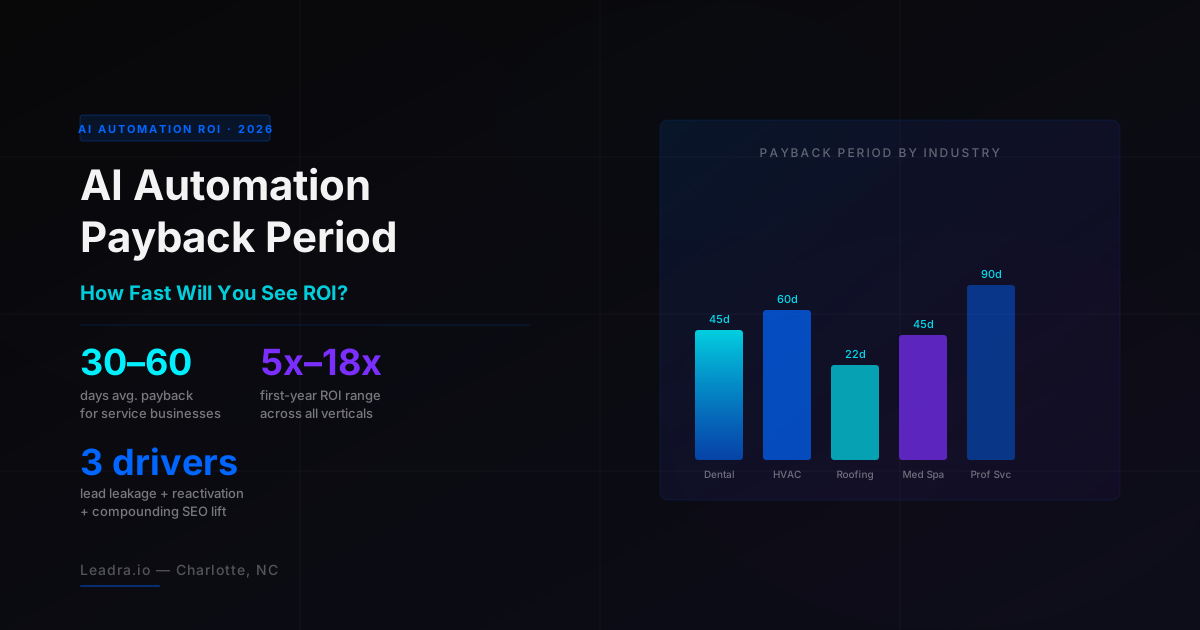
Industry matters because payback period is a function of average transaction value, purchase frequency, and how much revenue is currently leaking through operational gaps. Here are the benchmarks Leadra.io sees consistently across verticals.
| Industry | Avg. Job Value | Monthly Cost | Payback Period | Primary Driver |
|---|---|---|---|---|
| Dental Practices | $1,200-$2,800 | $800-$1,200 | 30-60 days | After-hours call recovery |
| HVAC / Home Services | $900-$3,500 | $900-$1,500 | 45-75 days | Speed-to-response + reactivation |
| Roofing Contractors | $6,000-$18,000 | $900-$1,800 | 14-30 days | Storm lead capture |
| Med Spas / Aesthetics | $400-$1,800 | $800-$1,400 | 30-60 days | Dormant client reactivation |
| Plumbing / Electrical | $400-$2,200 | $700-$1,200 | 45-75 days | After-hours emergency capture |
| Professional Services | $2,000-$15,000 | $1,000-$1,800 | 60-120 days | Nurture sequences + follow-up |
| Gyms / Fitness Studios | $60-$200/mo | $600-$1,200 | 60-90 days | Cancellation saves + reactivation |
Roofing contractors show the shortest payback period of any vertical — because a single storm event handled by AI can generate $50,000-$200,000 in booked pipeline against a $1,200/month investment. It's an outlier, but it illustrates the core principle: payback speed is driven by how expensive each lost lead is, not by how many leads you have.
5 Factors That Cut AI Automation Payback Period in Half
The businesses that hit payback in 30-45 days share five characteristics. If your business has three or more of these, your payback period is likely shorter than the industry benchmark.
High after-hours call volume.
If 20%+ of your inbound calls happen outside business hours, an AI voice employee generates revenue from day one. A dental practice receiving 8 after-hours calls per week — with a 50% booking rate and $1,400 patient lifetime value — recovers $5,600/week in pipeline that was previously going to voicemail. At $1,000/month in automation cost, that's a 5-day payback period on the call recovery component alone.
Existing CRM or booking history.
The faster a reactivation campaign can launch, the faster payback hits. Businesses with 200+ past customers in a CRM or booking system can run an AI reactivation campaign in week one — generating bookings before the first invoice arrives. No existing list means reactivation revenue is deferred 60-90 days while the system builds a database.
High average job value.
A single recovered lead worth $4,500 covers 4-5 months of automation cost. A recovered lead worth $150 takes 6-7 leads to cover one month. Businesses with average job values over $800 see faster payback math regardless of volume — because the denominator (monthly cost) stays fixed while the numerator (revenue per recovered lead) is high.
Low current Google review count.
Businesses with under 40 Google reviews or below a 4.2 star rating have significant organic call volume to recover. Automated review generation lifts ratings and drives more organic inbound within 60-90 days — adding a third revenue channel that compounds over time and continues generating ROI long after the investment is recovered.
Slow current follow-up speed.
If your current lead response time is measured in hours or days, the payback from AI automation is almost immediate. Harvard Business Review research confirms that companies responding to leads within one hour are 7x more likely to qualify the lead than those responding after one hour. For businesses manually checking email twice a day, instant AI follow-up converts 20-30% more leads from the same ad spend — with zero increase in marketing budget.
Case Study: Charlotte, NC HVAC Company — 38-Day Payback Period
Client Story — Charlotte, NC
A 6-year-old HVAC company in Charlotte's Ballantyne area came to Leadra.io doing $640,000 in annual revenue with 4 technicians. They were running $1,800/month in Google Ads and generating roughly 55 inbound calls per month — but their owner was handling all after-hours calls personally, and averaging a 3-hour response time on web form inquiries.
Lead audit: 18 of their 55 monthly calls came in after 6pm. Of those, the owner estimated he was actually calling back 11 — the rest he "got to when he could." Web form submissions were checked once daily. Their close rate on web leads was under 20%. They had 380 past customers who had never received a follow-up outreach of any kind.
Leadra.io deployed three systems: an AI voice employee for after-hours call handling and booking, an instant SMS + email follow-up sequence for all web form inquiries, and a reactivation campaign to their 380-customer database offering a pre-season AC tune-up at $149. Total monthly investment: $1,050.
Week 1 results: 6 after-hours bookings captured, 4 web leads converted via SMS follow-up. The reactivation campaign — launched on day 3 — generated 31 booked tune-ups in the first 10 days at $149 each. Revenue from that single campaign: $4,619. The automation investment paid for itself at day 38 of the first month. By month 3, monthly revenue had increased from $53,000 to $74,000.
Payback period
Monthly revenue
After-hours bookings
12-month ROI
The 38-day payback was driven almost entirely by the reactivation campaign, not the ongoing automation. That's the pattern Leadra.io sees most often with businesses that have an existing customer base: the first campaign covers months of investment cost, and the ongoing automation systems then run at 10x-20x annual ROI on top of that. See full AI marketing automation ROI benchmarks by industry.
4-Step AI Automation Payback Period Calculator
Run this against your own numbers. It takes 10 minutes and produces a reliable payback estimate for your specific business.
Calculate monthly lead leakage value.
Total inbound leads per month (calls + web forms + DMs). Multiply by your estimated miss rate (businesses with no after-hours coverage: 25-40%; businesses with slow manual follow-up: 20-35%). Multiply missed leads by average job value. Example: 40 leads/month × 30% miss rate × $900 average = $10,800/month in recoverable revenue.
Calculate reactivation revenue potential.
Count past customers in your CRM or booking system who haven't purchased in 12+ months. Apply a 10% reactivation rate (conservative). Multiply by average job value. This is typically a one-time campaign revenue event in month 1. Example: 300 dormant customers × 10% × $600 average = $18,000 in first-month reactivation revenue.
Estimate your monthly automation cost.
Basic AI automation for a small service business runs $700-$1,500/month depending on the number of systems deployed (voice, SMS, review generation, follow-up sequences). Use $1,000/month as a baseline for this calculation.
Calculate payback period.
Divide total investment cost (typically $1,000-$2,500 for first month including setup) by monthly revenue generated. If your lead recovery adds $6,000/month and reactivation adds $15,000 in month 1, your $2,000 total investment has a payback period of under 4 days. For ongoing payback (excluding reactivation): divide monthly cost by monthly lead recovery revenue alone.
What Slows Down AI Automation Payback Period
Most payback delays trace back to one of three root causes. Understanding them helps you set realistic expectations — and choose the right automation components to deploy first.
Long sales cycle.
Professional services firms, B2B businesses, and high-ticket consultants have 30-90 day decision windows. AI automation still generates strong ROI here — but payback doesn't hit until those deals close. The automation cost accumulates for 2-3 months before the revenue flows. Budget for a 90-120 day payback period and focus initial ROI measurement on pipeline built, not revenue received.
Low average transaction value.
A coffee shop or pizza restaurant generates $15-$40 per transaction. AI automation for review generation and loyalty campaigns still provides positive ROI — but payback takes 3-6 months because each transaction covers a small fraction of monthly cost. For low-ticket businesses, measure payback against total monthly revenue impact across repeat visit frequency, not individual transaction recovery.
No existing customer data.
Businesses without a CRM, booking history, or customer list can't run reactivation campaigns. They lose the fastest and largest payback driver. For these businesses, start by deploying AI lead capture and voice agents — which build the database over 60-90 days — before expecting reactivation revenue. First-year payback will be 90-150 days, second-year will drop to 30-60 days once the database is built.
Frequently Asked Questions
How long does AI automation take to pay for itself for a small business?
Most small businesses hit payback on AI automation within 60-90 days. Dental practices and HVAC companies — where the average job value is $800-$2,500 and the primary win is capturing leads already being generated but lost — often reach breakeven in 30-60 days. Professional services firms with longer sales cycles typically see payback in 90-120 days. The key variable is how much revenue is currently leaking through missed calls, slow follow-up, and dormant customer lists.
What factors affect AI automation payback period the most?
Three factors dominate AI automation payback speed: average transaction value (higher value = faster payback), lead leakage rate (businesses losing 30-50% of inbound leads to slow response or after-hours gaps see the fastest recovery), and existing customer database size (reactivation campaigns generate revenue in weeks, not months). Businesses with all three present — high job value, significant lead leakage, and a dormant customer list — routinely see payback in under 45 days.
Which types of businesses see the fastest AI automation payback?
Dental practices, HVAC companies, and home service businesses (plumbers, electricians, roofers) see the fastest AI automation payback periods — typically 30-75 days. These businesses share three traits: high per-transaction value, urgent buying decisions that reward the first responder, and significant revenue leakage from missed after-hours calls. Med spas and aesthetics clinics also hit fast payback through dormant client reactivation campaigns.
Is AI automation worth the investment for a small business doing under $500k per year?
Yes — businesses under $500k annual revenue are often the best candidates because their lead leakage rate is typically higher. A business generating $350k/year that recovers just 3 additional jobs per month at $800 average value adds $28,800 in annual revenue against a $900/month automation investment. That's a 2.7x return in year one, growing as the review base and reactivation pool compound over time.
The Bottom Line on AI Automation Payback
The AI automation payback period for small businessesis shorter than most owners expect — because the revenue being recovered already exists inside the business. Missed after-hours calls, ignored web form submissions, dormant customer lists, slow follow-up sequences — these are all revenue channels that are generating leads and losing them before the sale. AI automation captures that revenue. It doesn't manufacture new demand.
The fastest payback periods (30-60 days) come from businesses with three ingredients: an existing lead flow, at least one significant gap in after-hours or follow-up coverage, and a past-customer database of 100 or more. If you have all three, your first month of AI automation will likely cover your investment before the invoice arrives.
At Leadra.io, we build AI automation systems for small businesses across the US — with a 90-client-in-90-days guarantee for qualifying practices or you don't pay. Start with a free 30-minute audit where we map your lead leakage, reactivation pool, and give you a written payback estimate specific to your business. See what AI implementation costs for Charlotte NC small businesses.
Find out your payback period
Get a Free AI Automation ROI Estimate
We'll audit your current lead volume, after-hours gap, and reactivation pool — then give you a written payback timeline for your business specifically. 30 minutes, no obligation, no pitch.
Last updated: June 3, 2026 | Leadra.io — AI Automation Payback Period for Small Businesses