A facilities manager sends an office relocation RFP to four moving companies. Two send generic PDF quotes and never follow up. One sends a voicemail three days later. The fourth sends a proposal confirmation email within two hours with a customized move timeline, calls the office manager on day 5 with a question about elevator access, and emails the CFO a cost-per-employee summary on day 9. The fourth company wins a $28,000 contract — without being the cheapest bid.
Commercial office relocation is the highest-value segment in the moving industry, and it rewards process over price. B2B buyers are not making impulsive decisions — they are managing risk on behalf of their company. The moving firm that follows up consistently, reaches the right stakeholders, and demonstrates professional responsiveness before the move begins signals that it can handle a complex, time-sensitive project. That signal wins contracts that better follow-up from competitors would have taken.
The numbers make the stakes clear. Commercial office relocations average $12,000–$45,000 for mid-size businesses moving 20–100 employees. A corporate account — a company that reconfigures, expands, or relocates offices quarterly — generates $45,000–$150,000 in annual contract value once won. Most commercial moving companies carry 3–8 of these accounts. Losing one to a competitor with better proposal follow-up costs more than a full year of marketing spend. Winning one adds recurring revenue that compounds with every satisfied relocation.
This guide covers exactly how AI proposal follow-up works for commercial moving companies — the five-component system, a Charlotte case study with real numbers, and how to deploy it without disrupting your existing proposal process.
Why B2B Office Relocation Proposals Fail Without Automated Follow-Up
Commercial moving proposals sit in inboxes longer than residential quotes — and they involve more people. A facilities manager who requested your quote may need sign-off from a CFO, HR director, and building manager before awarding the contract. If your follow-up only touches the facilities manager, you have no visibility into whether the proposal is stuck at an internal approval stage or simply forgotten in a busy inbox. Most commercial moving companies make one or two follow-up attempts, hear nothing back, and mark the lead as lost. Three weeks later, the same client awards the contract to the mover who kept showing up.
Three patterns cause most commercial moving companies to lose winnable B2B proposals:
Single-contact follow-up misses the actual decision makers
Corporate office moves involve an average of 2.8 stakeholders with approval authority. A follow-up sequence that only contacts the person who filled out the form reaches one node in a multi-person decision tree. AI proposal automation identifies every contact associated with the inquiry and runs stakeholder-specific sequences — logistical details for the facilities manager, cost documentation for the CFO, employee planning resources for HR. Reaching all three stakeholders with relevant content doubles the probability that your proposal reaches an approval decision before competitors do.
Short follow-up windows abandon proposals at internal approval stages
Corporate procurement cycles average 2–5 weeks from initial RFP to signed contract. A follow-up sequence that ends at day 10 abandons most commercial proposals before the internal approval process concludes. The facilities manager may love your proposal, but it takes three weeks to schedule the budget committee meeting where it gets approved. Extending your follow-up to 21 days with persistent, value-adding touchpoints keeps your proposal visible and top-of-mind until the decision actually gets made — not just until you run out of patience.
No corporate account nurture loses repeat business to competitors
Companies that relocate also reconfigure, expand into new floors, move satellite offices, and send employees on corporate relocations. A completed office move with no post-project nurture is a single transaction. A completed move followed by a 90-day relationship sequence is the start of a corporate account that generates $30,000–$80,000 annually without competitive bidding. Most commercial moving companies have no structured post-move communication — which means their best clients are actively courted by competitors while the relationship sits dormant.
AI proposal follow-up automation closes all three gaps. It reaches every identified stakeholder with content relevant to their role. It runs a 21-day sequence that covers the full B2B decision window. And it transitions seamlessly from proposal follow-up to corporate account nurture the moment a contract is signed — building the recurring revenue base that separates commercial moving companies with stable growth from those constantly prospecting for their next job.
How AI Proposal Follow-Up Works for Commercial Moving Companies — 5 Components
Here is the five-component system Leadra.io deploys for commercial and corporate moving companies. Each component is designed specifically for B2B proposal cycles — not adapted from residential moving workflows.
Proposal delivery confirmation with custom move summary
Within two hours of sending a commercial moving proposal, the AI fires a personalized confirmation to the primary contact: a PDF summary email that restates the move date, scope, crew size, equipment plan, and quoted investment — formatted for easy internal forwarding to other decision makers. This immediate follow-through does two things: it signals your operational competence before the move begins, and it gives the facilities manager an asset to present to their CFO or HR director without having to summarize your proposal from memory. Most competing commercial moving companies send a PDF and wait. The confirmation email starts the relationship before anyone else does.
Multi-stakeholder follow-up sequences
Commercial office relocations rarely involve a single decision maker. A facilities manager, office manager, CFO, and HR director may all have approval roles — and each has different concerns. The AI identifies every contact associated with the proposal (from your CRM or the initial inquiry) and sends stakeholder-specific follow-up messages. The facilities manager gets logistical details: floor plans, elevator reservations, IT equipment handling protocol. The CFO gets cost-per-employee breakdowns and insurance documentation. The HR director gets an employee communication template and FAQ for staff. By the time your competitor sends a single follow-up email to one person, your proposal is already inside the organization from three directions.
6-touch, 21-day sequence calibrated to B2B buying cycles
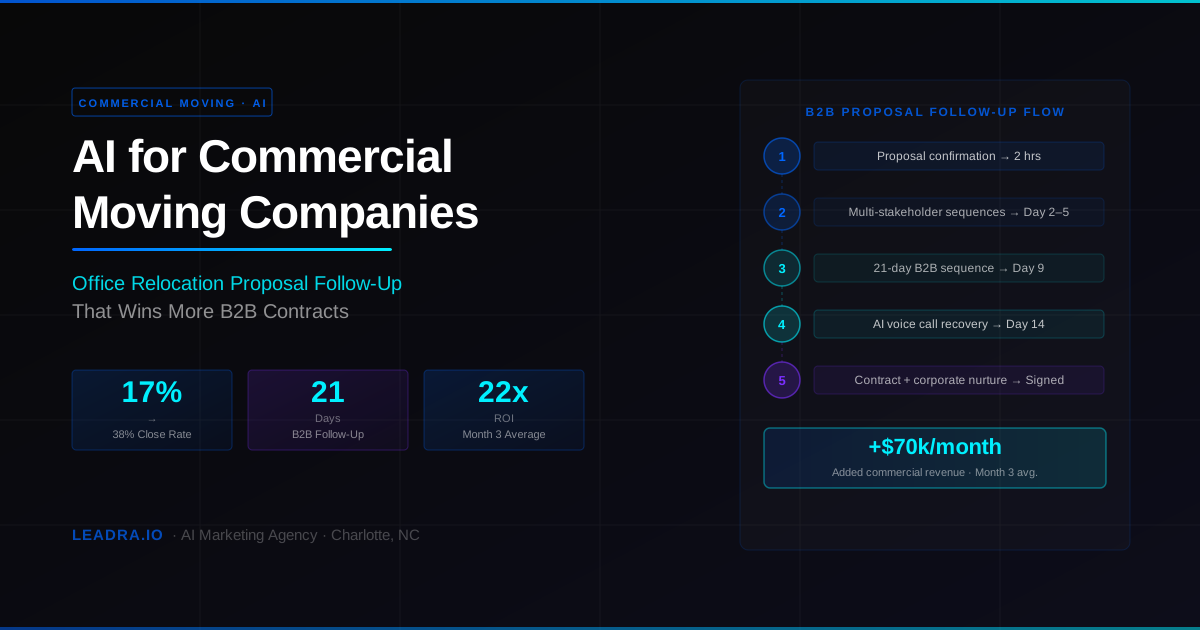
Corporate procurement doesn't move at the speed of a homeowner comparing movers on a Thursday evening. Internal approval cycles, budget reviews, and competing priorities can push a decision 2–4 weeks after the initial proposal. A residential moving follow-up sequence that ends at day 14 misses most commercial contracts. Leadra.io's B2B sequence runs 21 days with six touchpoints: proposal confirmation at hour 2, move-timeline email at day 2, facilities check-in at day 5, cost summary PDF at day 9, AI voice call to the primary decision maker at day 14, and a final stakeholder summary at day 20. Non-responsive proposals at day 14 get an AI voice call — not a generic follow-up script, but a call that references the specific move date, office size, and any concerns raised in earlier communication.
Contract delivery, e-signature, and deposit automation
When a commercial client says yes, speed matters. A signed contract in 24 hours confirms the booking and blocks your crew and equipment before competing movers have a chance to re-pitch. The AI sends a DocuSign or PandaDoc contract link within 15 minutes of verbal or written approval, pre-populated with the move date, scope, and payment terms from the original proposal. If the contract isn't signed within 48 hours, the AI follows up automatically with a gentle reminder tied to crew availability for their move date. Once signed, it triggers a deposit invoice and creates the job in your moving management software. Commercial clients who sign and deposit cancel at a fraction of the rate of those left with an unsigned proposal in their inbox.
Post-move corporate account nurturing
A completed commercial move is the beginning of a relationship, not the end of a transaction. Companies that relocate once often reconfigure, expand, or move again within 12–24 months — and they will call the mover they trust first. The AI runs a 90-day post-move nurture sequence: a day-3 quality check-in via email, a day-14 Google review request, a day-60 'How is the new space?' relationship email, and a day-90 corporate account introduction offering priority scheduling and recurring-client rates. This sequence costs nothing per touch and consistently generates repeat bookings worth $15,000–$50,000 per reactivated account — with no competitive bidding required because the relationship is already established.
Key Insight
The 21-day follow-up window is calibrated to the reality of corporate procurement. Internal approval processes, competing budget priorities, and stakeholder scheduling conflicts routinely push commercial moving decisions past the two-week mark — long after most moving companies have stopped following up. Commercial movers that extend their follow-up cadence from 2 touches to 6 touches over 21 days see proposal-to-contract conversion rates increase by 15–22 percentage points. That lift comes almost entirely from proposals that went dark at day 5 and were recovered by a personalized day-14 outreach.
Manual Proposal Follow-Up vs. AI Automation: Commercial Moving Edition
The gap between manual and automated B2B proposal follow-up shows up clearly in close rate, contract speed, and long-term account value. Here is how every critical metric compares for commercial moving companies:
| Factor | Manual Process | AI Automation |
|---|---|---|
| Proposal confirmation speed | Next-day email, if remembered | Formatted summary within 2 hours |
| Stakeholder reach per proposal | Primary contact only | All identified decision makers |
| Follow-up touches per proposal | 1–2 average | 6 touches over 21 days |
| Proposal close rate (commercial) | 14–20% | 32–42% |
| Contract delivery speed | Manual, 24–72 hours | Auto-sent within 15 min of approval |
| Contract signing rate (30 days) | 55–65% | 85–92% |
| Corporate account repeat rate | Ad hoc, relationship-dependent | Systematic 90-day nurture |
| CRM engagement tracking | Manual notes, often missed | Auto-logged, real-time updates |
The contract signing rate row is worth pausing on. A manual process that sends a contract and waits sees 35–45% of commercial clients stall between verbal approval and signed paperwork — often long enough for a competitor to re-engage and submit a counter-proposal. Automated contract delivery within 15 minutes of approval, combined with a 48-hour signing reminder tied to crew availability, captures momentum before procurement inertia sets in. Moving companies that automate contract delivery report that signed contracts come back 2.3x faster on average — reducing the gap between "they said yes" and "the job is locked."
Case Study: Charlotte Commercial Mover More Than Doubles B2B Close Rate in 90 Days
Client Story — Charlotte, NC
A 3-truck commercial moving company in Charlotte came to Leadra.io in Q1 2026 with a specific problem: they were winning residential work but struggling to convert the commercial proposals they were sending. Of 18–22 commercial proposals sent per month — for office relocations ranging from $9,000 to $38,000 — they were closing 3–4. A 17% close rate on proposals averaging $16,000 each. The sales process was entirely manual: one estimator sent the proposal, made a follow-up call two days later, and if he got voicemail twice, moved on. There was no visibility into whether proposals were being reviewed internally, no way to reach the CFO or HR director who sometimes held approval authority, and no system for nurturing past commercial clients into repeat accounts.
Leadra.io deployed the five-component commercial follow-up system over a 96-hour setup period. The AI connected to their HubSpot CRM, website contact form, and business phone line. When a commercial proposal was created in HubSpot, the system automatically pulled the company name, move date, scope, and all associated contact records to launch personalized sequences for each stakeholder. We configured the 6-touch, 21-day sequence using their estimator's voice and added a day-14 AI voice call for proposals with no engagement at the 2-week mark.
In month one, the AI followed up on 19 commercial proposals. The day-14 AI voice call recovered 4 proposals that had gone dark — including a $22,000 office move for a financial services firm where the proposal was sitting in the facilities manager's inbox waiting for a budget committee meeting. The estimator would have abandoned that lead at day 7. The AI call surfaced it, and the job was booked the following week. Commercial close rate moved from 17% to 34% in 30 days. By month three, they were closing 7–9 commercial contracts per month from the same proposal volume. Two of those new clients became recurring corporate accounts.
Commercial close rate
17%
38%
Contracts won/month
3–4
7–9
Monthly commercial revenue
$54k
$124k
Corporate repeat accounts
0 new
2 added
System cost: $1,800/month · Average contract value: $16,400 · Net new contracts: +4.5/month = $73,800 added MRR. Two new corporate accounts: estimated $65,000–$90,000 annual recurring value. Month-3 ROI: 22.1x.
The estimator's workload profile changed significantly. Manual proposal follow-up dropped from roughly 90 minutes per day — calls, emails, CRM updates — to 20 minutes reviewing the AI activity summary and handling direct responses from engaged prospects. He redirected that time to site visits for larger commercial proposals, which improved the quality of estimates and created a differentiation point that competitors conducting remote-only assessments could not match.
The two corporate accounts added in month three collectively booked four additional office moves in the 90 days after the initial job — at zero additional acquisition cost. Those repeat bookings generated $78,000 in revenue against a combined acquisition cost of one initial proposal follow-up sequence. The post-move nurture component made that possible.
How to Deploy AI Proposal Follow-Up for Your Commercial Moving Company: 3 Steps
Getting the system live requires no technical background. Here is how Leadra.io implements AI commercial proposal follow-up for moving companies:
Audit your current commercial proposal pipeline and identify decision-maker gaps
Before configuring automation, we map your existing commercial proposal flow: how many B2B proposals you send monthly, the average contract value, your current close rate, and how many stakeholders you typically contact per proposal. We also audit your CRM to identify how many commercial prospects have gone dark at various follow-up stages — most commercial moving companies have 20–40 dormant proposals that closed within the last 6 months that could be reactivated with a single well-timed message. This audit defines your baseline and informs how we configure the stakeholder-specific sequences for your client profile.
Connect your CRM, moving software, proposal tool, and communication channels
Leadra.io integrates with Salesforce, HubSpot, Pipedrive, Zoho, and most CRMs. We also connect your moving management software (MoveitPro, Supermove, Oncue), your e-signature tool (DocuSign, PandaDoc), and your business phone line and email. Setup takes 72–96 hours. Once connected, every commercial proposal created or updated in your CRM automatically triggers the correct follow-up sequence — no manual enrollment required. The system reads your active crew calendar to reference booking availability accurately in follow-up messages, and it logs every AI touchpoint back into the CRM contact record so your estimator has full visibility into the engagement history before any live call.
Configure stakeholder sequences, proposal tone, and corporate account rules — then launch
You define the communication tone (formal for enterprise clients, direct for SMB), the specific objection-handling language for your most common pushbacks (price, timeline, insurance), and the threshold for escalating a prospect to a live sales rep call. Leadra.io recommends the 6-touch, 21-day sequence as the default starting configuration — most commercial moving companies see the largest gains from the day-14 voice call, which recovers stalled proposals at a 22–28% conversion rate. You also set the rules for triggering the corporate account nurture sequence: which client types qualify for recurring-account follow-up, how frequently the AI stays in contact between projects, and what offers or rate structures to reference for repeat clients. Most commercial moving companies are fully live within five business days of kickoff.
For moving companies that also handle residential volume alongside commercial work, see AI quote follow-up automation for residential moving companies — a separate system calibrated to the shorter 14-day residential buying window. For the full picture of building an AI-powered lead generation and follow-up stack for service businesses, see how to build an AI lead generation system for local service businesses.
The ROI Math: What One Additional Commercial Contract Is Worth
Commercial moving economics are fundamentally different from residential. A single additional contract won per month from better proposal follow-up generates more revenue than 8–12 additional residential bookings. And a converted one-time commercial client that becomes a recurring corporate account generates 4–6x the annual contract value of the initial job. Here is what the numbers look like for a commercial moving company generating 20 proposals per month:
Commercial Mover ROI Calculation
The corporate account ARR figure deserves emphasis. Two new corporate accounts won through better proposal follow-up — accounts that would have been lost to competitors without the day-14 AI voice call or the stakeholder-specific email sequences — can add more annual recurring revenue than the entire commercial pipeline improvement. Those accounts self-renew, refer peer companies, and rarely request competitive bids once a relationship of operational trust is established. The AI system does not just close more proposals. It changes the revenue structure of the company.
Frequently Asked Questions
How is AI follow-up for commercial moving companies different from residential moving follow-up?
Commercial moving proposal follow-up targets multiple stakeholders — a facilities manager, HR director, office manager, and sometimes a procurement team — rather than a single homeowner. The decision window is 2–6 weeks instead of 1–2 weeks, and contract values run $12,000–$65,000 instead of $900–$2,500. AI follow-up for commercial movers runs a 6-touch, 21-day sequence personalized to each decision maker's specific concerns. The system also tracks proposal status across multiple contacts at the same company so no stakeholder falls through the cracks.
How long should a commercial moving company follow up after sending an office relocation proposal?
Commercial office relocation proposals have a 2–6 week decision cycle, so follow-up should extend at least 21 days. The optimal cadence is: proposal confirmation within 2 hours, move-timeline email at day 2, facilities check-in at day 5, cost summary PDF at day 9, AI voice call to the primary contact at day 14, and a final stakeholder summary at day 20. Corporate procurement processes often stall at internal approval stages — persistent follow-up surfaces those stalls before the window closes.
What is the average commercial office relocation contract value for a moving company?
Commercial office relocation contracts typically range from $8,000 for small office moves (under 20 employees) to $65,000+ for large multi-floor corporate relocations. The median for a local commercial moving company serving businesses with 20–100 employees is $12,000–$28,000. Corporate accounts generate $45,000–$150,000 in annual contract value once won. Winning one corporate account with better proposal follow-up is worth more than 30–40 residential bookings.
Can AI proposal follow-up integrate with CRM tools that commercial moving companies use?
Yes. Leadra.io's commercial moving AI integrates with Salesforce, HubSpot, Pipedrive, Zoho, and most CRMs via API or webhook. When a proposal is logged in your CRM, the AI triggers the follow-up sequence automatically, updates contact engagement records in real time, and flags hot prospects for immediate sales rep outreach. For commercial moving companies managing 15–40 active proposals simultaneously, CRM-connected AI follow-up eliminates the manual tracking overhead that causes proposals to go dark at approval stages.
The Proposals Are Good — The Follow-Up System Is What's Missing
Most commercial moving companies lose B2B contracts they should win. Not because their proposals are weak or their pricing is off — but because they follow up once, reach one person, and walk away at day 7 when the decision is still 2 weeks from being made. The contract goes to the mover who kept showing up with relevant information for the right people at the right time.
AI commercial proposal follow-up closes that gap permanently. It confirms every proposal within two hours. It reaches every stakeholder with content tailored to their role. It runs 21 days of persistent, personalized follow-up without a single manual task. And it converts completed commercial clients into recurring corporate accounts that generate predictable revenue every quarter.
Leadra.io deploys AI proposal follow-up automation for commercial moving companies across the U.S. Call +1 (864) 721-8384 or book a free commercial proposal audit below — we will review your current follow-up process and project the revenue impact of automation for your specific monthly proposal volume before you commit to anything.
Free Commercial Proposal Audit
See How Many B2B Contracts Your Current Follow-Up Is Losing
30-minute audit. We will review your commercial proposal pipeline, identify which stakeholders your current follow-up misses, and project how many additional contracts AI automation would close at your specific proposal volume.
Leadra.io
AI marketing agency — Charlotte, NC · Published July 3, 2026