AI Cost for Limo Service Business: Full Pricing Guide, ROI Math, and What You'll Actually Get Back
Limo service owners ask the wrong question when they look at AI. They want to know what it costs per month. The right question is what running without it is already costing — because that number is almost always three to five times the monthly subscription, and it never shows up on a P&L.
A 10-vehicle limo operation running standard business hours misses roughly 30–40% of booking inquiries. Those are not low-value calls. The bride who searched "limo service near me" at 9 PM, found your site, called, got voicemail, and booked a competitor by 9:15 — that is a $1,800 wedding booking that cost you nothing to attract and everything to lose. Add corporate accounts that never got a follow-up after their first ride, reviews that were never requested and therefore never written, and a dispatcher spending half their week on calls that AI could answer in 45 seconds — and the real monthly revenue leak for a typical 10-vehicle operator runs $5,000 to $12,000. It shows up as flat growth and a nagging sense that the phone could be busier.
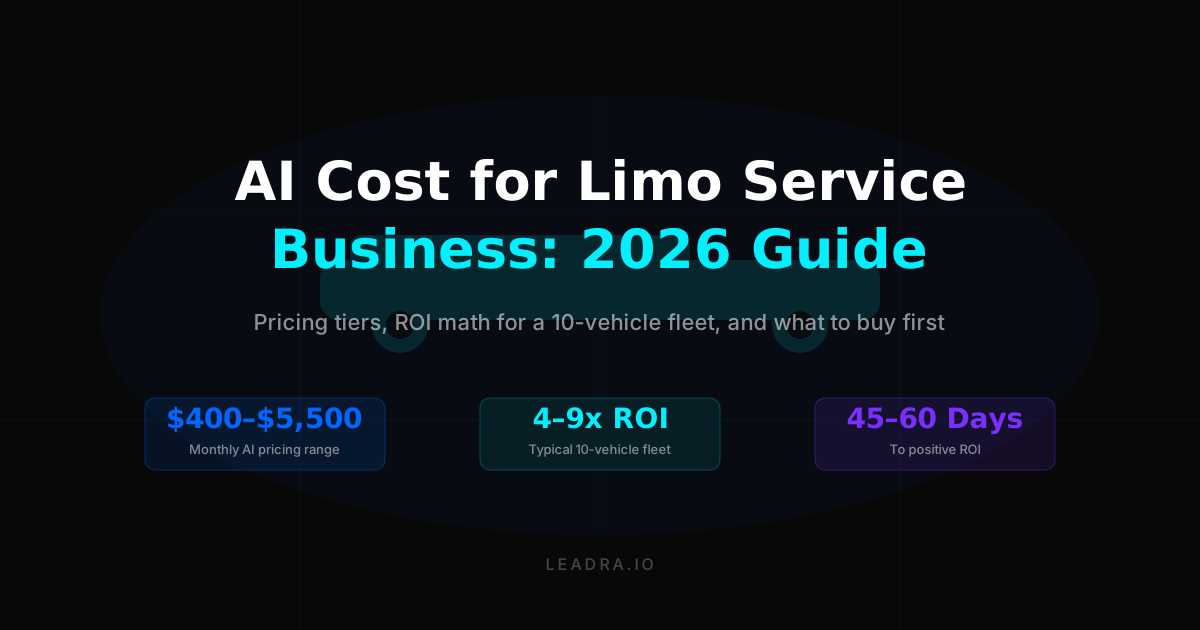
AI for limo service businesses costs between $400 and $5,500 per month depending on fleet size, what you automate, and how aggressively you want to build corporate account volume. This guide covers every pricing tier with what it actually includes, ROI math for a real 10-vehicle operation, setup fees to budget for, red flags to watch when comparing vendors, and how to pick the right entry point for where your business is today.
What Drives AI Cost for a Limo Service Company
Limo AI pricing varies because the work varies. Vendors price based on five core variables:
- 01.Fleet size and call volume. A 3-vehicle operator receives 40–80 booking inquiries per month. A 15-vehicle fleet handles 200–400. AI systems priced per call minute or per active contact can multiply fast at real fleet volumes. Always get a quote against your actual monthly call volume — not a base plan that looks affordable at 30 calls and becomes expensive at 250.
- 02.Voice vs. SMS-only coverage. An AI that only texts cannot answer the corporate travel manager who calls at 7 AM to book a same-day airport transfer. Voice capability — real AI that answers the phone, confirms availability, and quotes a price — is what captures the revenue that texts cannot. For any limo fleet generating more than $40k/mo in bookings, voice coverage is not optional.
- 03.Dispatch system integration depth. Sending a booking confirmation email is not dispatch AI. Real integration reads your live availability from Limo Anywhere or LMN Connect, confirms the vehicle in real time, and writes the booking directly into the dispatch system without a human intermediary. Vendors who skip that two-way sync will show a clean demo and deliver a manual process with a chatbot in front of it.
- 04.Corporate account acquisition scope. The difference between a Tier 1 and Tier 3 system is largely the proactive component. Tier 1 handles inbound calls you already get. Tier 3 identifies executive assistants, HR managers, and corporate travel coordinators within your service area, outreaches to them with a corporate rate offer, and nurtures them through an automated sequence before your first human conversation. That outbound work is what builds a book of recurring corporate accounts — the only bookings with predictable volume and higher margins than single-event rides.
- 05.Event and seasonal pricing automation. Prom season, New Year's Eve, NASCAR race weekends, and major conventions change demand by 3x–5x overnight. A static rate structure on those dates leaves significant margin on the table. AI dynamic pricing alerts — which flag high-demand windows and suggest or automatically apply surge pricing — protect revenue during the exact windows when price sensitivity drops and willingness to pay peaks.
Why Limo Service Has Unique AI Economics
The limo service model has three characteristics that make AI both more valuable and more specific than in most service businesses:
The highest-value bookings arrive at the worst hours.
Wedding and event inquiries peak between 7 PM and 11 PM on weekday evenings and throughout weekends — exactly when limo operators are on a run, at dinner, or asleep. A bride researching vendors on a Tuesday night sends three inquiry texts, calls two numbers, and books whoever responds first. The operator who responds in 90 seconds captures the booking. The one who calls back the next morning gets a polite 'we already found someone.' An AI voice agent that responds instantly at any hour is not a convenience feature — it is what decides who gets the event contract worth $1,500–$4,000.
Corporate accounts have compounding value that single-event rides do not.
A wedding is a one-time booking worth $1,200–$3,000. A corporate account at a mid-size law firm or financial services company generates 8–20 rides per month at $200–$350 each, every month, on predictable schedule. The total annual value of a single corporate account runs $19,000–$84,000. The operators who grow these accounts systematically — through automated outreach to executive assistants, follow-up after the first ride, quarterly rate review calls, and loyalty incentives — build revenue that does not fluctuate with event seasonality. AI corporate acquisition is what separates a lifestyle operator from a scalable business.
Reputation is the primary booking driver for first-time clients.
A prospective limo client Googles the company name before booking 73% of the time, according to BrightLocal's 2025 Local Consumer Review Survey. If the Google Business Profile shows 4.1 stars from 18 reviews, they call the competitor with 4.7 stars from 140 reviews. Getting reviews requires asking — and asking within 4 hours of a completed ride, while the experience is still memorable. An AI post-ride sequence that sends a personalized review request within 30 minutes of drop-off captures 3–5x more reviews than a manual follow-up that happens when the dispatcher remembers. Those reviews compound into a closed loop: more reviews bring higher rankings, higher rankings bring more inbound calls, more calls bring more rides and more reviews.
AI Pricing Tiers for Limo Service Businesses
Here is how the market breaks down across three tiers. Most operators move from Tier 1 to Tier 2 within 45–60 days once they see how much revenue Tier 1 leaves unconverted from cold quotes and dormant client lists.
Basic Booking AI
- ✓24/7 AI voice agent for inbound booking calls and availability checks
- ✓After-hours inquiry capture — responds to booking requests within 90 seconds at any hour
- ✓Automated booking confirmation and pre-trip reminder SMS sequence
- ✓Basic missed-call follow-up within 5 minutes of a missed ring
- ✓Quote request intake and instant ballpark pricing delivery
Best for
Small operators with 2–5 vehicles where the owner also dispatches and answers phones
ROI timeline
20–35 days from after-hours event booking capture and missed-call recovery
Standard Revenue Stack
- ✓Everything in Tier 1
- ✓Corporate account discovery and outreach targeting businesses in your service area
- ✓Automated quote follow-up at 24h, 72h, and 7 days for cold inquiries
- ✓Limo Anywhere or LMN Connect integration for real-time availability and booking sync
- ✓Post-ride review request automation (Google and Yelp)
- ✓Dormant client reactivation for customers inactive 90+ days
- ✓Chauffeur introduction message and real-time tracking link delivery
Best for
5–12 vehicle fleets ready to build recurring corporate accounts and automate client communication
ROI timeline
30–45 days — corporate account onboarding and quote follow-up conversion pay fast
Full Revenue Engine
- ✓Everything in Tier 2
- ✓AI-powered corporate client acquisition — outreach to HR, exec assistants, and travel managers
- ✓Dynamic pricing automation for prom season, NYE, and major local events
- ✓Wedding and event venue partnership outreach for referral channel development
- ✓Reputation management — review response, competitive monitoring, Google Business Profile updates
- ✓Monthly revenue attribution reporting by booking channel
- ✓Dedicated account manager and bi-weekly optimization reviews
Best for
10+ vehicle fleets or operators aggressively scaling corporate accounts and event bookings
ROI timeline
15–25 days — multiple revenue streams activate simultaneously at launch
Setup Fees and Onboarding Costs
Every real AI system requires upfront configuration work. Budget these beyond the monthly subscription:
| Tier | Setup fee range | What it covers |
|---|---|---|
| Basic | $0 – $500 | Voice agent configuration, booking intake scripting, call routing setup, dispatcher training |
| Standard | $700 – $1,800 | Limo Anywhere or LMN Connect integration, quote follow-up sequence build, corporate outreach list setup, review automation configuration |
| Full Stack | $1,800 – $3,500 | Full CRM build, corporate acquisition workflow, dynamic pricing configuration, venue partnership outreach setup, reporting dashboard |
Annual contracts regularly waive or reduce setup fees. Monthly contracts run 15–25% higher per month but give flexibility to exit if results don't materialize within 90 days. Any vendor quoting zero setup on a Tier 2 or Tier 3 system without explanation is skipping the integration work somewhere — the dispatch system sync and corporate acquisition build is real configuration, and if it is not being charged upfront, it is either being skipped or delivered at a quality that fails within 30 days.
ROI Breakdown for a 10-Vehicle Fleet
This is what a 10-vehicle limo fleet averaging 18 rides per vehicle per month at a $320 blended average booking value typically recovers with a full AI stack in the first 90 days. These numbers are conservative — most operators report faster results in after-hours capture and corporate account growth.
| Revenue category | Assumption | Monthly recovery |
|---|---|---|
| After-hours booking capture | 10-vehicle fleet, 35% of inquiries arrive after 6 PM, AI captures 8–14 additional bookings/mo at $350–$550 avg | $1,200 – $3,000 |
| Corporate account growth | AI onboards 3–6 new corporate accounts/mo at 4 rides/account/mo avg at $280 per ride | $2,000 – $4,500 |
| Review volume lift → booking rate increase | Reviews triple in 90 days, organic booking conversion improves 12–18% from reputation credibility | $800 – $2,000 |
| Ride upgrade and add-on upsell | AI pre-trip sequence offers vehicle upgrades and champagne packages — 20–30% conversion on 60 rides/mo | $500 – $1,200 |
| Dispatcher labor savings | AI handles 55–65% of routine booking and status calls — saves 10–18 hrs/wk at $18–$26/hr | $900 – $1,800 |
| Total monthly recovery | Conservative blended estimate — 10-vehicle fleet | $5,400 – $12,500 |
A full-stack plan at $2,500–$4,000/mo against $5,400–$12,500/mo in recovered revenue is a 1.4x to 5x monthly return — and that math understates the compounding effect. Corporate accounts onboarded in month one are still generating rides in month twelve. Reviews earned in month two are still closing bookings in month eight. The AI cost stays flat. The revenue it produces compounds.
The corporate account category deserves specific attention. Most limo operators think about corporate accounts as something that happens organically — a finance company calls, they like the service, they keep calling. That model works, slowly, and stops at whatever level of organic awareness the operator has already built. AI corporate acquisition changes the math by identifying the companies within your service radius that book ground transportation regularly, finding the right decision-maker (executive assistant, office manager, or travel coordinator), and reaching out with a corporate rate structure before a competitor does. Onboarding 3–6 new corporate accounts per month — each worth $1,100–$2,800/mo in recurring rides — is the category that turns a 10-vehicle operator into a 20-vehicle operator within 18 months.
The Limo Service Revenue Leaks That AI Closes
Limo companies have specific revenue leak patterns that generic scheduling tools cannot address. AI built for the limo service model closes all of them:
The event inquiry that called after hours and never heard back.
A corporate client's assistant calls at 7:30 PM to book airport transfers for a team of six executives flying in Friday. The limo company's phone goes to voicemail. The assistant sends one follow-up text, gets no response, and books a competitor before 8 PM. That is a $1,400 booking lost in 30 minutes. An AI voice agent that picks up at 7:30 PM, confirms availability, quotes the rate, and sends a booking confirmation email captures that contract. It does not require a night dispatcher — it requires a correctly configured AI system that already knows your vehicle availability and rate structure.
The cold quote that went silent after day one.
A client emails for a wedding quote on a Saturday in October. You send pricing Monday. They never respond. The wedding is 4 months away and they are comparing three companies. An automated quote follow-up sequence — a personalized text at 24 hours, a call from the AI at 72 hours asking if they have questions on the package, and a final offer with a hold-date incentive at 7 days — converts 25–40% of cold quotes that would otherwise die in the inbox. On a limo company quoting 15–25 events per month, that is 4–10 additional bookings from outreach that costs nothing incremental after setup.
The client who rode once, loved it, and was never asked back.
Your client database almost certainly contains 200–500 people who used your service once, had a good experience, and then booked a competitor for their next event because no one reached out. A dormant client reactivation sequence — a personal-sounding message that acknowledges the gap, references their previous booking, and offers a returning client incentive — reactivates 10–18% of lapsed contacts within 45 days. On a list of 300 dormant clients, that is 30–54 reactivated bookings at your average rate. That revenue comes from relationships that already trusted you — and costs nothing in new customer acquisition.
Peak pricing left at standard rates during demand spikes.
Prom season in May and NYE bookings in December represent 2–3x normal demand in every limo market. Many operators quote standard rates during these windows because manually updating pricing across all booking channels is cumbersome. AI dynamic pricing automation identifies high-demand windows — local school prom dates, major concerts, corporate events, holidays — and adjusts rates accordingly across your booking channels. A 10-vehicle fleet capturing 20% higher rates during 6 weeks of peak demand adds $8,000–$15,000 annually from the same rides it was already going to make.
What to Watch Out For When Comparing AI Vendors
The transportation AI market has grown fast. Several vendors sell demos that work and live products that don't. Watch for these red flags:
No real dispatch system integration — just email confirmations.
If the vendor cannot show you a live two-way connection to Limo Anywhere or LMN Connect that reads real-time availability and writes bookings directly — it is not a booking AI system. It is an auto-responder with a booking form attached. Ask for a live demo of availability confirmation against a real dispatch environment. If they cannot do it live, the integration does not function the way the demo implies.
SMS-only with no inbound voice capability.
An AI that only texts cannot answer a corporate client who calls. Ground transportation runs on phone calls — particularly for same-day bookings and group travel coordination. Confirm that the system handles inbound calls with a real AI voice agent that can quote pricing, confirm availability, and send a booking confirmation before the call ends. A missed-call text-back feature is not voice AI.
Per-booking or per-minute pricing that balloons with volume.
Some vendors quote a flat base price and charge per confirmed booking or per call minute beyond a cap. A 10-vehicle fleet at full capacity can exceed those caps within two weeks. Always ask for pricing at 2x your current booking volume. A plan at $500/mo for 30 bookings can become $1,800/mo at 80 bookings if the per-booking charge is not disclosed upfront.
No measurable performance commitment in the contract.
Any vendor confident in their product commits to measurable outcomes. Ask for a written benchmark: minimum reduction in after-hours missed bookings, minimum quote follow-up response rate, minimum number of new corporate accounts activated in 60 days. If they decline to put outcomes in writing, they are not confident the product delivers them.
Which Tier Is Right for Your Fleet?
A direct guide based on fleet size and current booking mix:
If: 2–5 vehicles, owner answering phones, mostly event and wedding bookings
→ Start with Tier 1. Protect every after-hours event inquiry and eliminate missed calls. One captured wedding booking per week at $1,500 average pays for Tier 1 four times over. Upgrade to Tier 2 when you want to start building corporate accounts and running quote follow-up — typically within 45 days once you see how many cold quotes Tier 1 still leaves unconverted.
If: 5–12 vehicles, dedicated dispatcher, mix of events and corporate rides
→ Tier 2 is the right entry point. Corporate account outreach and quote follow-up automation produce measurable results within 30 days. Most fleets in this range onboard 3–5 new recurring corporate accounts per month from the outbound sequences alone. The combined revenue from those accounts typically covers the monthly AI cost within the first two months.
If: 12+ vehicles or aggressively scaling toward recurring corporate revenue
→ Tier 3. At this fleet size, corporate acquisition at scale and dormant account reactivation compound the returns. A fleet that adds 6 corporate accounts per month for 12 months builds a recurring revenue base of $750,000–$1,600,000 annually from accounts that were not customers 12 months earlier. The Tier 3 system is what makes that systematic rather than occasional.
How Leadra.io Builds AI Systems for Limo Service Companies
Leadra.io builds AI revenue systems for limo service companies, transportation businesses, and local service operations across the United States. Our pricing is built around what moves bookings and grows your client base — not a generic SaaS subscription that charges for features a limo operator never uses.
Every engagement starts with a free 30-minute audit. We calculate the exact monthly revenue your fleet is losing to after-hours missed bookings, cold quote attrition, dormant clients, and dispatcher time spent on routine call handling. If the math does not show a clear path to ROI-positive within 60 days, we say that before you spend anything.
We build real Limo Anywhere and LMN Connect integration — not email workarounds. We build outbound AI voice capability that can call a corporate contact, deliver a rate introduction, and handle questions in natural conversation. We do not lock operators into 12-month contracts when the booking numbers don't move in the first 90 days.
According to the National Limousine Association, the limo and ground transportation industry generates over $14 billion annually in the U.S., with corporate ground transportation representing the highest-margin segment. The operators capturing that corporate volume are the ones with systems — not just good vehicles and reliable chauffeurs. Explore our best AI tools for limo service companies, see how our AI receptionist for limo service handles booking calls 24/7, or read our limo service marketing automation guide for the full corporate account acquisition playbook.
Frequently Asked Questions
How much does AI cost for a limo service business?
AI for a limo service business typically costs $400 to $5,500 per month. A basic Tier 1 setup with 24/7 AI voice booking and after-hours inquiry capture runs $400–$900/mo. A standard Tier 2 system adding corporate account outreach, quote follow-up automation, and Limo Anywhere integration runs $1,000–$2,200/mo. A full Tier 3 revenue stack with corporate client acquisition, dynamic pricing, and dormant account reactivation runs $2,500–$5,500/mo. Setup fees range from $0 to $3,500 depending on integration depth.
What is the ROI of AI for a limo service company?
For a 10-vehicle limo fleet averaging 18 rides per vehicle per month, a full AI stack typically recovers $5,400 to $12,500 per month across five categories: after-hours booking capture ($1,200–$3,000/mo), corporate account growth from automated outreach ($2,000–$4,500/mo), review automation driving booking lift ($800–$2,000/mo), ride upgrade upsell conversion ($500–$1,200/mo), and dispatcher labor savings ($900–$1,800/mo). Against a full-stack cost of $2,500–$4,000/mo, most 10-vehicle operators see 4x to 9x monthly ROI within 60–90 days.
What does AI for a limo company actually include?
A limo service AI system typically includes a 24/7 AI voice agent for inbound booking calls and availability checks, automated booking confirmation and pre-trip reminder sequences, corporate account discovery and outreach, dormant client reactivation for customers inactive 90+ days, Google review request automation, and dynamic pricing alerts for high-demand periods. Higher-tier systems add dispatch system integration with Limo Anywhere or LMN Connect, corporate rate negotiation sequences, venue partnership outreach, and monthly revenue attribution reporting.
Is AI worth it for a small limo company with 3–5 vehicles?
Yes. A 5-vehicle limo company misses 30–40% of booking inquiries that arrive after standard business hours — often the highest-value event and wedding bookings worth $800–$2,500 each. A basic AI voice agent at $400–$700/mo captures 6–10 of those additional bookings per month at an average of $400–$600 each. That is $2,400–$6,000 in recovered monthly revenue against a $400–$700 AI cost. Most 3–5 vehicle operators reach positive ROI within 30 days of launch, often from a single captured event booking in the first week.
See the exact ROI number for your fleet
We run a free 30-minute audit and calculate exactly how much your fleet is losing monthly to after-hours missed bookings, cold quote attrition, dormant clients, and dispatcher time spent on routine calls — before you spend a dollar.