AI for Auto Repair Shop Booking: Fill Your Bay Calendar and Stop Missing Service Calls (2026 Guide)
It was 11:14 AM on a Tuesday and the phone at a 6-bay independent auto repair shop in east Charlotte rang six times. The service advisor was under a hood with a customer walking through a brake job estimate. The owner was on a parts call. The phone went to voicemail.
The caller — a Fleet Manager at a local logistics company looking to schedule quarterly oil changes and inspections for 14 vehicles — left no message. He called the next shop on Google Maps. That shop answered. Signed a $4,200 quarterly contract before lunch.
That story is not unusual. It plays out dozens of times a week in independent auto repair shops across every market in the country. The shop is good at fixing cars. It is bad at capturing the calls that come in while the team is focused on the cars already in the bays. The result: revenue that should be yours ends up at a competitor who picked up the phone.
This guide covers exactly how AI for auto repair shops booking works, what a complete system looks like, what real numbers look like for an independent shop that deploys it, and how to pick the right system for your business.
The Two Booking Problems That Drain Auto Repair Shop Revenue
Most auto repair shops lose revenue in two places they never see clearly because there is no visible record of the loss:
Problem 1: Missed calls during peak hours. Auto repair shops have a fundamental staffing problem. Your best service hours — 8 AM to 5 PM Monday through Friday — are the same hours your team is busiest. Advisors are with customers, walking through estimates, running the back office. When a new customer calls during that window and no one picks up, they call the next shop. Industry research on inbound call handling for auto repair puts the missed call rate at 30-48% during peak service hours. For a shop doing $70,000 per month, recovering even 15% of those missed calls typically represents $8,000-$14,000 in bookable work that currently goes elsewhere every month.
Problem 2: No-shows that kill bay utilization. An empty bay is pure lost revenue. You have already allocated the technician time, the bay slot, and the parts availability for a job that does not show up. Average no-show and same-day cancellation rates for auto repair shops without automated reminders run 18-28%. On a $480 average repair ticket with 8 bays booked, a 22% no-show rate means roughly 1.8 empty bays per day — or $864 in daily revenue that evaporated even though the customers had already said yes to the appointment.
A complete AI booking system for auto repair shops solves both problems simultaneously — capturing calls that your front desk would miss and reducing no-shows through automated confirmation and reminder sequences that run without any staff involvement.
What AI Booking for Auto Repair Shops Actually Includes: 5 Components
A complete AI booking system for an independent auto repair shop runs five connected components. Each one addresses a specific gap in the typical shop's booking and retention workflow:
Component 1: 24/7 AI Voice Agent for Inbound Booking
The AI answers every call your team misses — during repairs, at lunch, after closing. It greets callers with your shop name, captures the service request (oil change, brake job, diagnostic, alignment, tire swap), asks for the vehicle year/make/model, checks real-time availability in your shop management software, and confirms the appointment while the caller is still on the phone. Callers hear a live-sounding voice and book instantly rather than hunting for the next shop that picks up.
Component 2: Automated No-Show Prevention Sequences
Every confirmed appointment triggers a three-step reminder sequence. A text confirmation goes out immediately after booking with the date, time, and service. A second text or call fires 24 hours before the appointment asking the customer to confirm or reschedule. A final reminder text arrives 2 hours before the appointment time. This sequence consistently reduces no-show rates from the industry average of 18-28% down to 4-8%, recovering the bay time your technicians need to stay productive through the day.
Component 3: Estimate Follow-Up Automation
When a customer walks in, gets a multi-point inspection, and receives an estimate for additional work they did not approve during that visit, most shops send them home and hope they call back. Most do not call back. An automated 5-day follow-up sequence sends a text on day 1, an email on day 2, and a voice call on day 4 referencing the specific vehicle and service estimate — with a direct link to book the appointment. Auto repair shops see 20-35% of previously cold estimates convert through this sequence. On a $580 average deferred service ticket, recovering 5-8 estimates per month adds $2,900-$4,640 in revenue from work the customer already agreed they needed.
Component 4: Dormant Customer Reactivation
Every auto repair shop has a database of past customers who have not returned in 6-18 months. These are people who already trust your work — they are the lowest-cost customers you can reacquire. An AI-powered reactivation sequence identifies customers overdue for their next oil change or service interval, sends a personalized outreach text referencing their vehicle and last service date, and books them directly into your calendar. Most shops see 15-25% reactivation rates on dormant customers contacted this way, with no ad spend required.
Component 5: Post-Visit Review Generation
After every completed repair, the AI sends a text to the customer with a direct Google review link — one tap, no extra steps. Auto repair shops that automate this request see 5-9x the review volume of shops that rely on asking in person. For an independent shop competing against Jiffy Lube, Midas, or Firestone, a higher Google review count is one of the highest-leverage competitive advantages available. Customers searching “auto repair near me” in your area see review count and star rating before they see your name.
Manual vs. AI-Assisted Auto Repair Booking: By the Numbers
Here is what these five components translate to in measurable business terms for a typical 4-8 bay independent auto repair shop:
| Metric | Manual (Today) | With AI System |
|---|---|---|
| Inbound call capture rate | 52-70% | 90-96% |
| No-show / same-day cancel rate | 18-28% | 4-8% |
| Deferred estimate close rate | 8-14% | 28-44% |
| Dormant customer reactivation rate | 2-5% | 15-25% |
| Monthly Google reviews added | 2-6 | 16-34 |
| After-hours booking rate | ~5% (voicemail bookback) | ~88% |
| Staff time on booking admin | 6-12 hrs/week | Under 1 hr/week |
| Cost per booked vehicle (blended) | $45-$120 | $11-$28 (month 4+) |
The highest-ROI improvements come from no-show reduction and after-hours call capture. No-show reduction recovers bay time you already paid for. After-hours call capture grabs customers who are searching at 9 PM and booking the first shop that responds — usually before your competitors open in the morning.
Case Study: Charlotte Auto Repair Shop Grows from $62k to $94k/Month in 90 Days
A 4-bay independent auto repair shop in the University City area of Charlotte had been operating for nine years and had built a loyal customer base on quality transmission and brake work. Monthly revenue had plateaued around $62,000 for four consecutive quarters. The owner had one service advisor handling the front desk, phones, and customer walkouts simultaneously — a setup that worked fine for managing current customers but left significant gaps for new ones.
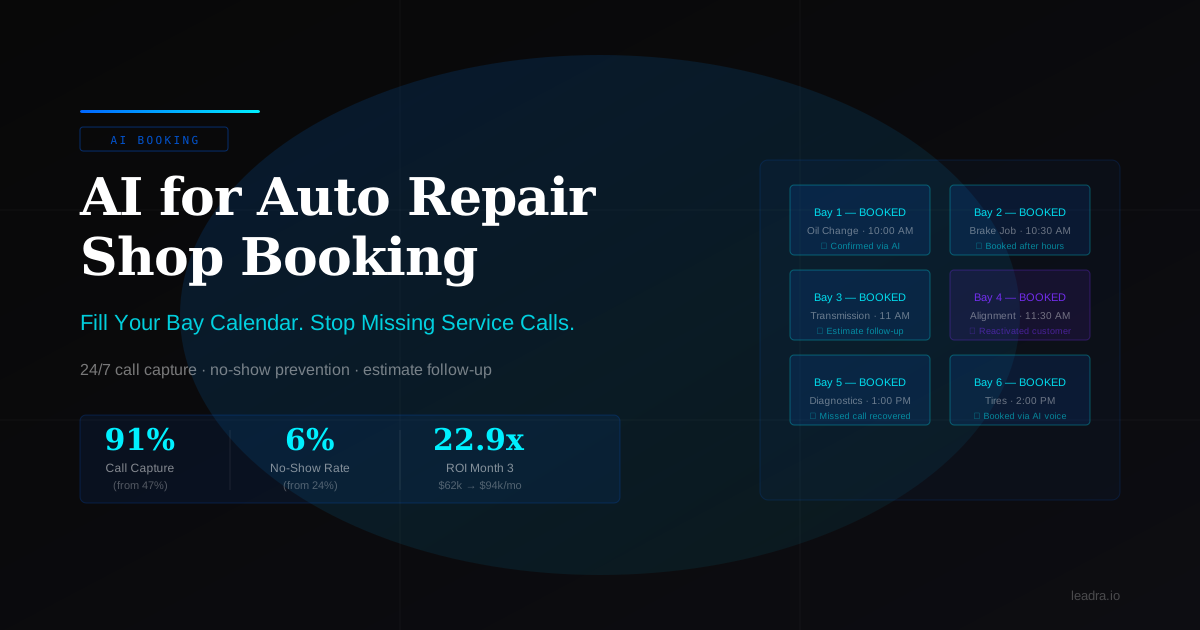
Their specific problems: a 47% inbound call capture rate during peak hours, a 24% no-show rate on booked appointments, and zero follow-up system for customers who received multi-point inspection estimates but did not approve the additional work before leaving. They had 18 Google reviews after nine years in business.
Leadra.io deployed a 5-component AI booking system in 7 days: 2 days for AI voice agent configuration with auto repair-specific service intake scripts, 3 days for Tekmetric integration and no-show reminder sequence build, and 2 days of live call monitoring before handoff.
Results after 90 days:
- →Inbound call capture rate: 47% to 91%
- →No-show rate: 24% to 6%
- →Deferred estimate close rate: 9% to 36%
- →Dormant customers reactivated in 90 days: 41
- →Google reviews: 18 to 61 (43 new reviews in 90 days)
- →After-hours appointments booked: 0 to 22/month
- →Monthly revenue: $62,000 to $94,000
- →Monthly system cost: $1,400
- →ROI in month 3: 22.9x
The owner noted that the biggest surprise was not the call capture improvement — it was the deferred estimate follow-up. “We were leaving $3,000-$4,000 a month on the table from customers who came in, got a quote for additional work, drove out, and never called back. The AI was texting them on day 1 and calling on day 4 and booking them back in. That alone paid for the whole system.”
What AI Booking for Auto Repair Shops Costs in 2026
Pricing depends on shop size, bay count, and which components you deploy. Here is what you should expect at three common levels:
Tier 1 — Core Call Capture + Reminders: $600-$1,000/month
24/7 AI voice agent, appointment booking into shop management software, 3-step no-show prevention sequence. Right for solo-advisor shops or those just starting with AI. Typically delivers positive ROI in the first 30 days from no-show reduction alone.
Tier 2 — Full Booking Automation: $1,000-$2,200/month
Everything in Tier 1 plus deferred estimate follow-up sequences, dormant customer reactivation campaigns, and automated review generation. Right for 4-8 bay shops with an active customer database. Most independent shops in this tier see $18,000-$40,000 in recovered monthly revenue within 90 days.
Tier 3 — Full Growth System: $2,200-$4,500/month
Everything in Tier 2 plus local SEO content engine targeting repair keywords in your city, Google Business Profile automation, and fleet/commercial account outreach sequences. Right for shops pursuing aggressive growth targets or multi-location operators. Includes organic lead channel development that reduces paid ad dependency over 6-12 months.
The math is simple at any tier. A 4-bay shop with a $460 average ticket that reduces no-shows from 22% to 6% recovers roughly 1.5 additional appointments per day — $690 per day or $17,250 per month. That number alone exceeds the cost of even a Tier 2 system. Everything else the AI captures — missed calls, cold estimates, dormant customers — is additional.
4 Things to Evaluate When Choosing an AI Booking System for Your Auto Repair Shop
Not every AI booking product works equally well for auto repair. Here are the four criteria that matter most:
1. Shop Management Software Integration
The AI needs to read your open bay slots in real time and write new appointments directly into your system — Mitchell 1, Tekmetric, Shop-Ware, RepairShopr, Jobber, Bolt On, or whichever platform you use. If the AI books into a separate calendar that your advisor has to manually transfer, you will create more work, not less. Confirm the specific integration before signing anything.
2. Auto Repair-Specific Service Intake Logic
The AI voice agent needs to handle auto repair booking vocabulary — oil change, brake inspection, tire rotation, check engine diagnostic, transmission service, alignment — not just generic appointment booking. Generic booking systems will frustrate customers who expect the voice on the phone to understand what they are asking for. Ask for a demo call that walks through a brake job inquiry and an after-hours transmission diagnostic call.
3. Multi-Step Reminder Sequences (Not Single Texts)
A single reminder text reduces no-shows by 25-35%. A three-step sequence — immediate confirmation, 24-hour reminder with confirm/reschedule option, 2-hour same-day text — reduces them by 65-80%. The difference between a 22% no-show rate and a 6% one comes from the multi-step approach. Single-text reminder tools are not the same product.
4. Deferred Estimate Follow-Up Capability
Most shops have a large, untapped revenue pool in unaccepted estimates sitting in their shop management software right now. A system that only captures new calls misses this entirely. Make sure the AI can pull unresponded estimates from your SMS and email the customer on day 1, 2, and 4 with a direct booking link. This is often the highest-ROI component for shops that have been operating for 3+ years.
Frequently Asked Questions
How does AI booking work for auto repair shops?
AI booking for auto repair shops works through three connected systems. A 24/7 AI voice agent answers calls your front desk misses and books appointments directly into your shop management software. An automated reminder sequence sends confirmation texts and calls before every appointment to cut no-shows by 60-80%. A quote follow-up system contacts customers who received an estimate but never scheduled, recovering 20-30% of those jobs that would otherwise go cold.
What is the average no-show rate for auto repair appointments?
The average no-show and same-day cancellation rate for auto repair shops without automated reminders runs 18-28%. For a shop with 6-8 bays doing $400-$600 average repair tickets, that translates to $3,000-$8,000 in lost revenue per week — bay time that cannot be recovered. AI-powered reminder sequences consistently reduce no-show rates to 4-8%.
How much does AI for auto repair shop booking cost?
Core AI booking systems for auto repair shops run $600-$1,000/month for call capture and no-show prevention. A full system with shop management software integration, estimate follow-up, dormant reactivation, and review generation typically runs $1,000-$2,200/month for most independent shops. At $460 average repair tickets, recovering 4-5 no-shows per month pays for the service. Most shops hit positive ROI within the first 30 days.
Can AI integrate with auto repair shop management software?
Yes. AI booking systems integrate with Mitchell 1, Tekmetric, Shop-Ware, RepairShopr, Bolt On Technology, and Jobber. The integration reads your open bay slots in real time and writes new appointments directly into your system when the AI books a call. Your front desk sees every AI-booked appointment in the same software they already use — no separate calendar, no manual entry, no double-bookings.
Ready to Stop Losing Bookings to Voicemail?
Leadra.io builds and manages complete AI booking systems for independent auto repair shops. We handle setup, shop management software integration, reminder sequences, and ongoing optimization — so your team focuses on the cars, not the calendar.
Most shops see no-show rates drop in the first two weeks. Missed call capture improves within 48 hours of go-live. Deferred estimate recovery typically produces the first converted job within the first 7 days.