A homeowner requests a lawn care quote on a Thursday evening. You send it Friday morning. They get two more quotes from competitors by noon — one of them with an automated text that hit their phone 90 seconds after they submitted the form. By Friday afternoon, while your team is in the field, that homeowner has already signed with someone else.
This is the most common revenue leak in the landscaping industry. Not a leads problem. Not a pricing problem. A follow-up speed and consistency problem. Landscaping customers request quotes from 3-5 companies at the same time and commit to whoever responds fastest and follows up most persistently. The company with the best-looking truck doesn't win. The company that reaches out five times over two weeks does.
Research from Harvard Business Review on lead response time shows that companies contacting prospects within 5 minutes convert at 9x the rate of companies that wait 30 minutes or more. For landscaping, where a prospect is actively comparing options across a 1-2 week window and the recurring contract value can exceed $3,000 per year, follow-up speed and persistence are the biggest variables in your close rate — not your price.
This guide covers how AI quote follow-up automation works for landscaping companies, what a complete five-component system does end to end, and what a Charlotte landscaping company produced after deploying the system for 90 days.
Why Landscaping Quotes Die Without Automated Follow-Up
Landscaping has a specific follow-up challenge that other trades don't face at the same scale: the recurring contract structure makes every lost quote a multi-year revenue miss. A residential lawn care client worth $180/month is worth $2,160/year. Lose that quote to a competitor because you followed up once and they followed up four times, and you don't just lose a job — you lose years of predictable recurring revenue.
Three specific failures cause most landscaping companies to lose quotes they should have closed:
One-touch follow-up abandons 70% of closable contracts
Industry data shows that 80% of sales require five or more follow-up contacts, but 92% of salespeople give up after four attempts — and most landscaping company owners or office staff give up after one or two. A prospect who doesn't respond to your initial quote email isn't saying no. They're busy. They got a call during dinner. They're still comparing three other bids. A systematic 5-touch sequence over 14 days recovers 25-35% of leads that went quiet after the first outreach — contracts that a one-touch process permanently writes off.
Slow response gives competitors the first impression advantage
When a homeowner submits a landscaping quote request on a Saturday morning, they want a response that same day — ideally within the hour. Every hour between their inquiry and your reply is an hour a faster competitor has to build rapport. Landscaping companies using AI auto-response report that 30-40% of their new contracts come from prospects who explicitly chose them because they were the first to respond with a specific quote and a professional follow-up. Being first doesn't require the cheapest price or the nicest equipment — it requires speed.
No system for seasonal urgency leaves install revenue on the table
Landscaping has natural urgency windows — spring cleanups, summer installations, fall seeding, winter prep. A quote follow-up system that references the prospect's specific season and schedule fills gaps in your calendar that would otherwise go unbooked. An automated message at day 12 saying 'We have 3 slots left for May installs in your neighborhood' converts undecided prospects at 2-3x the rate of a generic check-in. Most landscaping companies miss this entirely because their follow-up, when it happens at all, is generic rather than property- and season-specific.
AI quote follow-up automation closes all three gaps simultaneously. It responds to every inquiry in 90 seconds regardless of time of day. It runs a five-touch, 14-day sequence for every quote sent with no human memory required. And it converts more of the booked contracts into higher-value accounts through automated upsell sequences that fire at exactly the right moment in the client relationship.
How AI Quote Follow-Up Works for Landscaping Companies — 5 Components
Here's the five-component system Leadra.io deploys for landscaping companies. Each component connects to the next — from first inquiry to active recurring client and Google review.
24/7 AI intake for landscape service requests across every channel
The system monitors your website contact form, inbound phone line, Google Business Profile messages, and SMS number simultaneously. When a prospect reaches out — at noon on a Tuesday or 9pm on a Sunday — the AI responds within 90 seconds and starts the qualification conversation. For landscaping companies, after-hours inquiries make up 35-45% of total lead volume. Homeowners and property managers research and request quotes during evenings and weekends when they're actually looking at their yard. Without 24/7 intake, that entire segment routes to whichever competitor replies first. The AI collects property address, service type (lawn care, landscaping install, cleanup, irrigation), lot size or service area, and target start date before routing to your estimator or triggering a quote from your rate cards.
Instant quote confirmation with property-specific personalization
The moment your crew produces a quote — or the AI estimates from your pricing table — the system fires a personalized confirmation text within 60 seconds: 'Hi [Name], your quote for [Services] at [Address] is [Price]/month. Reply YES to schedule your first visit or call us at [Phone] with any questions.' That immediacy sets a professional tone and keeps the prospect engaged while they're still comparing options. Landscaping customers shopping multiple companies typically commit to the first company that delivers a clear, specific number with a fast response. The personalized address reference in the message signals that this isn't a bulk form reply — it's a response specific to their property.
5-touch follow-up sequence over 14 days
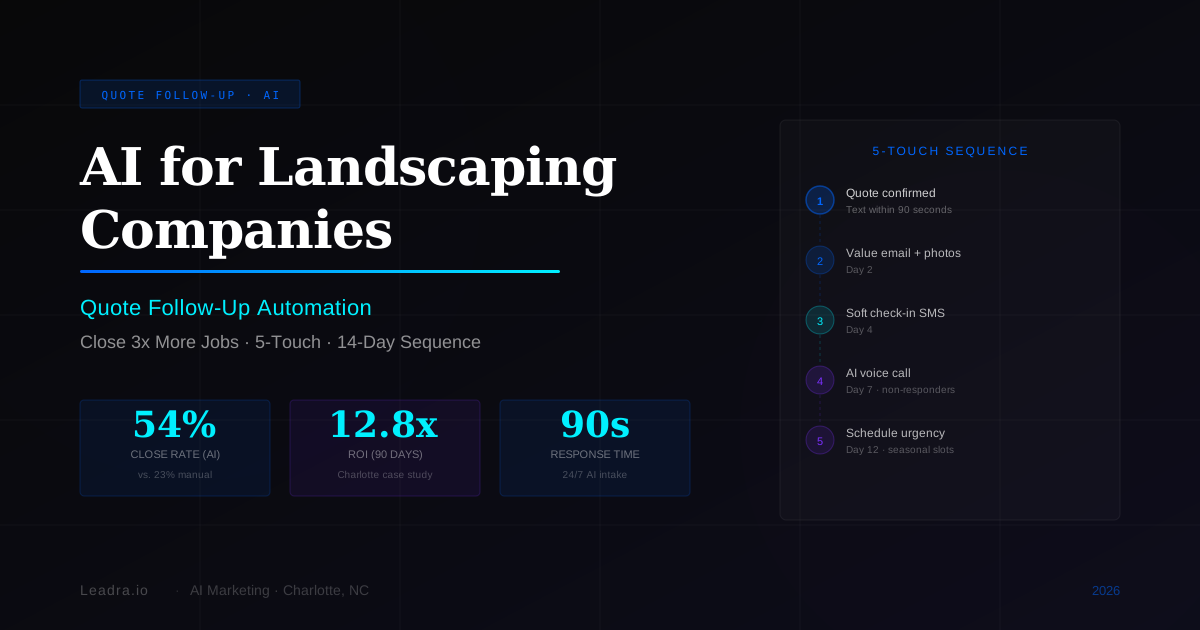
Most landscaping companies follow up once — maybe twice — before moving to the next lead. That habit loses the majority of closable contracts. AI follow-up runs a five-touch sequence timed to the landscaping customer's buying window: a quote confirmation text at hour 1, a value-add email at day 2 with photos of similar properties you maintain and a Google review from a comparable client, a soft check-in SMS at day 4 ('Still planning your [Season] landscaping?'), an AI voice call at day 7 for non-responders, and a final urgency message at day 12 ('Our [Month] schedule is filling — we have [X] slots left for your area'). Each message references the specific property address and services quoted. This sequence recovers 25-35% of leads that went cold — leads that a two-touch process permanently abandons.
Automated booking confirmation and deposit collection
When a prospect approves the quote — via text reply, form click, or voice confirmation — the AI immediately sends a service agreement summary with your cancellation terms and a deposit link. It creates the job in your field service software (Jobber, LMN, Service Autopilot), assigns the property to the right crew route, and sends a calendar confirmation with the scheduled first visit date. No manual data entry. No double-booked routes. For one-time projects like installs or seasonal cleanups, the AI sends a Stripe or Square deposit link with a 48-hour deadline, automatically following up if the deposit isn't received. Landscaping jobs without deposits cancel at 3-4x the rate of deposited work — this component alone reduces your cancellation rate by 25-40%.
Service upgrade upsell + Google review generation
After a recurring lawn care contract is active, the AI runs a two-part value sequence. First, 30 days into service, it sends a property improvement offer: 'Your lawn is looking great — want us to add a mulch refresh and bed edging for [Price]? Most clients who add this in spring see it make a real difference.' Add-on services carry 40-55% margins and require no additional lead generation. Second, after each completed service visit or the end of a project, the AI sends a review request via SMS linking directly to your Google Business Profile. Landscaping companies with 4.7+ star ratings on 60+ reviews close quotes at 18-25% higher rates than competitors with thin review profiles. Every review generated today makes every future quote cheaper to close.
Key Insight
The 14-day follow-up window is calibrated to landscaping's buying cycle. Homeowners requesting quotes for recurring lawn care typically decide within 10-14 days. For landscape installs, the window can stretch to 3-4 weeks. A sequence that stops at day 5 or 7 abandons prospects who were still deciding — the day-12 touchpoint is one of the highest-converting messages in the entire sequence because it reaches people who genuinely forgot to respond and needed one more nudge. Landscaping companies that extend from 2 touches to 5 touches over 14 days see quote-to-booking conversion rates increase by 20-30 percentage points.
Manual Quote Follow-Up vs. AI Automation: The Numbers
The performance gap between manual follow-up and AI-driven automation isn't incremental. It's the difference between a landscaping company closing 1 in 4 quotes and one closing more than 1 in 2. Every metric that drives contract revenue shifts materially:
| Factor | Manual Process | AI Automation |
|---|---|---|
| Response to new service request | 4-24 hours (callback) | 90 seconds, 24/7 |
| After-hours lead capture | Missed or voicemail | 100% captured, instant reply |
| Quote confirmation speed | Sent when staff remembers | Personalized text in 60 seconds |
| Follow-up attempts per quote | 1-2 on average | 5 touches over 14 days |
| Quote close rate | 20-28% | 48-58% |
| Deposit collection | Manual link or call | Auto-sent with 48hr deadline |
| Service upgrade attach rate | Occasional mention | Automated 30-day sequence |
| Post-service review requests | Rare, inconsistent | 100% of completed visits |
The service upgrade and review rows compound the economics beyond the close rate lift. A landscaping company with 80 recurring clients that converts add-on services on 20% of them at $250 average generates an additional $4,000 per month from accounts already on the schedule — no additional lead generation required. And a Google Business Profile with 100+ reviews averaging 4.8 stars generates 20-30% more organic quote requests than a profile with 30 reviews at 4.1 — reducing paid acquisition cost per lead for every future job.
Case Study: Charlotte Landscaping Company Doubles Monthly Revenue in 90 Days
Client Story — Charlotte, NC
A 5-crew residential landscaping company in Charlotte — covering Ballantyne, Waxhaw, Matthews, and the Mint Hill corridor — came to Leadra.io in early 2026 with a problem that looked like a pricing problem but turned out to be a follow-up problem. They were generating 60-70 quote requests per month from their website, Google Business Profile, and yard sign referrals — but closing only 23% of them, roughly 15 new contracts per month. The owner handled all follow-up himself between jobs. Most quotes got a single follow-up call. If the prospect didn't pick up or call back, the lead was abandoned. Monthly recurring revenue was flat at $58,000-$65,000 despite consistent lead flow into peak season.
Leadra.io deployed the five-component AI quote follow-up system over a 96-hour setup window. The AI connected to their Jobber account, website contact form, inbound phone number, and Google Business Profile. When a quote was created in Jobber, the system automatically pulled the property address, services included, quoted price, and target service start date to personalize every follow-up message. We configured the 5-touch, 14-day sequence in their voice, added a day-30 service upgrade sequence for active clients, and activated the post-visit Google review request.
In month one, the AI handled follow-up on 64 quotes. Of the 38 leads that had gone dark after the first outreach, 14 booked after receiving a day-4 SMS and day-7 AI voice call — leads the manual process had already written off. Close rate jumped from 23% to 51% in the first 30 days. By month three, the company was consistently booking 33-38 new contracts per month from the same lead volume. They added a sixth crew in month four to handle capacity.
New contracts/month
14-16
33-38
Quote close rate
23%
54%
Monthly revenue
$62k
$134k
Google reviews (90 days)
22 reviews
69 reviews
System cost: $1,400/month · Average recurring contract: $195/month ($2,340/year) · Net new contracts: +20/month = $46,800 added ARR. Service upgrades: 22% attach on 80 active clients at avg $240 = $4,224 added/month. Month-3 ROI: 12.8x.
The owner's daily routine shifted significantly. Quote follow-up dropped from 90+ minutes of phone calls to 15 minutes reviewing the AI's activity log and handling the occasional edge-case response. He redirected that time to crew oversight, client relationship calls for high-value accounts, and expanding into commercial maintenance contracts — which now represent 30% of total revenue versus zero before the system was deployed.
The review generation component added 47 new Google reviews in 90 days, moving their profile from 4.2 stars on 22 reviews to 4.8 stars on 69 reviews. That improvement drove a 28% increase in organic quote requests in month three — a flywheel effect that compounded the close rate gains without any additional advertising spend.
How to Deploy AI Quote Follow-Up for Your Landscaping Company: 3 Steps
Getting the system live doesn't require technical knowledge or changes to how your crews operate. Here's how Leadra.io implements AI quote follow-up for landscaping companies:
Audit your quote-to-booking funnel and measure current close rate
Before configuring the automation, map your current process: how many quotes go out per month, how many follow-up attempts your team makes per quote on average, what your current close rate is, and which service categories (weekly lawn care vs. installs vs. seasonal cleanups) close at the highest rate. This audit — which takes about an hour — consistently reveals that 40-60% of sent quotes received zero follow-up after the initial email or call. Those are recoverable contracts. The audit also tells us how to configure the AI's timing and messaging for your specific customer profile and your seasonal scheduling constraints.
Connect your landscaping software, channels, and crew calendar
Leadra.io integrates with Jobber, LMN, Service Autopilot, ServiceTitan, HouseCall Pro, and most landscaping business management platforms. Setup takes 72-96 hours. You provide access to your quoting system, the phone number you want the AI to monitor, and your website contact form details. Once connected, the AI reads live crew availability from your scheduling calendar so it can reference accurate booking windows in follow-up messages — 'We have crew availability in your neighborhood starting May 12' — without overpromising capacity. Google Business Profile messaging also routes into the intake system so no lead source falls outside the automated sequence.
Set your follow-up sequence, deposit policy, and launch
You define the follow-up tone (friendly, direct, or professional), any seasonal offers to include (spring cleanup bundles, summer irrigation packages, fall aeration + seeding specials), and your deposit requirements for installation projects. Leadra.io recommends the 5-touch, 14-day sequence as a starting point — landscaping companies consistently see the biggest gains from the day-7 AI voice call, which recovers non-SMS-responders at a 15-20% rate. For the first 30 days, review the weekly follow-up activity report to see which touchpoints drive the most responses. Most landscaping companies are fully live within one week of kickoff and see measurable close rate improvement in the first month.
For a deeper look at how AI fits into a full landscaping marketing system, see landscaping seasonal reminder automation for repeat customer rebooking and how to build an AI lead generation system for local service businesses.
The ROI Math: What One Additional Landscaping Contract Is Worth
For landscaping companies with recurring revenue models, the economics of improving close rate are powerful because every gained contract compounds over time. A weekly lawn care client at $180/month stays an average of 2.5-3 years — representing $5,400-$6,480 in lifetime revenue from a single quote conversion. A landscape install at $4,500 plus a subsequent lawn care contract is worth $10,000+ over three years. Every quote that closes instead of going to a competitor isn't just one-time revenue — it's years of predictable, recurring cash flow.
Quick ROI Calculation
The calculation above uses a conservative $195/month average contract and doesn't include landscape install revenue (which averages $2,500-$8,000 per project), the referral multiplier from positive reviews generated by the post-service sequence, or the reduced cancellation rate from automated deposit collection on installation jobs. It also doesn't account for the compounding nature of recurring revenue — 20 new contracts per month at $195 average adds $46,800 in annual recurring revenue each month, not a one-time figure.
Landscaping companies generating 40+ quote requests per month are losing significant predictable revenue with every contract that goes unbooked. Most of those lost jobs weren't lost on price — they were lost because a competitor with a better follow-up system reached the prospect one more time. AI automation fixes that permanently, at a cost that most landscaping companies recoup within the first two or three new contracts signed each month.
Frequently Asked Questions
How does AI quote follow-up work for landscaping companies?
AI quote follow-up for landscaping companies works by triggering an automated sequence the moment a prospect receives their estimate. The AI sends a personalized confirmation text within 90 seconds of quote delivery, then follows up via SMS, email, and AI voice call across a 14-day window — referencing the specific property address, services quoted, and estimated start date. Each touchpoint is timed to match the prospect's buying window: immediate confirmation, day 2 value-add email with photos and reviews, day 4 soft check-in SMS, day 7 AI voice call for non-responders, and a day 12 urgency message about seasonal scheduling availability. The system handles objections and scheduling questions automatically, then routes hot responses to your calendar.
How many times should a landscaping company follow up after sending a quote?
Landscaping companies should follow up at least five times over a 14-day window after sending a quote. The optimal cadence is: within 90 seconds of quote delivery (text confirmation), 48 hours later (value-add email with photos or reviews), day 4 (soft check-in SMS), day 7 (AI voice call for non-responders), and day 12 (urgency message about schedule availability). Industry data shows 80% of sales require five or more follow-up contacts, but most landscaping companies give up after one or two attempts. Moving from 1-2 touches to 5 touches over 14 days recovers 25-35% of quotes that went cold and directly increases close rates by 20-30 percentage points.
How much does AI quote follow-up automation cost for a landscaping company?
AI quote follow-up automation for landscaping companies typically costs $800 to $3,500 per month depending on monthly quote volume, whether you add AI voice calling, and whether you include booking integration with your field service software. For a landscaping company generating 50-80 quotes per month at an average recurring contract of $200/month ($2,400/year), closing 10 additional contracts per month from better follow-up adds $24,000 in annual recurring revenue — covering the system cost many times over. Most landscaping companies at that volume see full ROI within the first 30-45 days of deployment.
Does AI follow-up automation integrate with landscaping software like Jobber or LMN?
Yes. Leadra.io's AI quote follow-up system integrates with Jobber, LMN (Landscape Management Network), Service Autopilot, ServiceTitan, HouseCall Pro, and most landscaping business management platforms via API or webhook. When a quote is created in your field service software, the AI automatically pulls the property address, services quoted, estimated price, and target start date to personalize every follow-up message. When a prospect approves the quote, the AI creates the job in your scheduling software, assigns a crew, and triggers a deposit request — no manual data entry. Setup takes 72-96 hours.
The Leads Are Coming In — The Follow-Up Is What's Missing
Most landscaping companies don't have a lead generation problem. They have a lead conversion problem. Quote requests come in. Estimates go out. Then the follow-up falls apart — one call, no answer, move on. The prospect signs with a competitor who sent three texts and a voicemail. That contract is gone — and so is every seasonal renewal and referral it would have generated over the next three years.
AI quote follow-up automation closes that gap permanently. It responds in 90 seconds to every request — at any hour of the day. It runs a personalized, five-touch sequence for every quote sent without requiring your office staff or owner to track anything manually. It collects deposits on installation jobs, reducing cancellations. It upsells service upgrades to active clients at exactly the right moment. And it generates Google reviews after every completed visit, building the reputation that makes every future quote easier to close.
Leadra.io deploys AI quote follow-up automation for landscaping companies across the U.S. See what AI implementation actually costs for small businesses — or call us directly to talk through your quote volume and close rate.
Free Quote Funnel Audit
See How Many Contracts Your Current Follow-Up Is Losing
30-minute audit. We'll review your current response time, follow-up cadence, and quote close rate — then project the revenue impact of AI automation for your specific monthly quote volume before you commit to anything.
Leadra.io
AI marketing agency — Charlotte, NC · Published July 1, 2026