Every March, pool service company owners watch their competitors' trucks appear in neighborhoods they serviced last year. Customers who spent $1,200 with them last season are now scheduling with someone else — not because they were unhappy, but because the other company called first.
Pool service is one of the most repeat-customer-dependent businesses in home services. According to the Pool & Hot Tub Alliance, a residential pool owner who books with a company for spring opening has a 65-75% probability of rebooking for fall closing and the following spring — if that company maintains contact. The problem is that "maintaining contact" in practice means one email blast in March, a Facebook post the owner forgets to make, and hoping the customer remembers the number from last year.
AI seasonal automation solves this problem at the system level. The platform connects to your pool service software, segments every past customer by service type and history, and sends personalized multi-touch outreach — SMS, email, and AI voice calls — triggered automatically by calendar dates and live weather forecasts. Spring opening campaigns fire in late February before customers start shopping. Fall closing campaigns fire in late September before the first cold front. Weather triggers accelerate campaigns when conditions create urgent demand. Pool service companies running this system rebook 60-70% of prior-year customers before peak season starts — compared to 25-35% for companies relying on manual outreach or no proactive contact at all.
This guide covers exactly how AI seasonal automation works for pool service companies, the 5-component system behind it, and the results a Charlotte-area pool company produced in its first full season running AI-driven outreach.
Why Pool Service Seasonal Outreach Fails Without Automation
Pool service companies have a structural revenue problem that looks like a marketing problem. They do excellent work, customers are satisfied, and yet 40-60% of them don't rebook the following season. It's not price sensitivity — it's timing and visibility. Here's where the system breaks down:
The timing window is narrow
Residential pool owners don't think about their pool from November through February. The decision window for spring opening typically opens in late February and closes in April — a 6-8 week period when every pool company in town is competing for the same customers. The companies that reach out first get the bookings. The companies that wait for the phone to ring lose 40-50% of their prior-year base to competitors who sent one text or made one call two weeks earlier. Manual outreach timing is reactive; AI outreach is proactive and consistent every year.
The demand spike problem
Pool service demand doesn't follow a smooth seasonal curve — it spikes. The first week after the last frost, every pool owner who hasn't scheduled an opening suddenly wants one. A pool company with 200 past customers and a 3-tech operation gets 80 calls in 7 days. The owner can't handle volume and convert simultaneously. The result: 30-40 interested customers leave voicemails, don't get called back fast enough, and book a competitor. AI-driven advance booking fills your calendar before the spike, so when demand surges, your schedule is already full — or you're choosing which emergency work to take.
The lapsed customer blind spot
Every pool service company has a segment of past customers who stopped booking without a clear reason — they moved, experimented with DIY, paused during a tight financial year, or simply couldn't reach you when they tried. Most pool companies never systematically contact these customers. A properly segmented AI reactivation campaign targeting customers who haven't booked in 14-24 months typically recovers 20-30% of them — at zero new customer acquisition cost. Without automation, these customers stay invisible until they happen to search for pool service online and find one of your competitors.
The math on fixing this is straightforward. A pool company with 250 past customers, currently rebooking 30% annually (75 customers), that improves to 65% (163 customers) gains 88 additional repeat jobs per year. At an average combined spring opening and fall closing value of $550, that's $48,400 in recovered annual revenue from customers who already know and trust the business — before counting weekly maintenance upsells.
The 5-Component AI Seasonal Automation System for Pool Companies
Here's the system Leadra.io deploys for pool service companies. Each component feeds the next — segmentation drives timing, timing drives outreach, outreach connects directly to booking, and booking results update the database for the next campaign.
Customer database segmentation by service type and history
The AI connects to your pool service software — Skimmer, Jobber, Pool360, PoolOffice, or even a QuickBooks export — and segments every past customer by last service date, service type, and frequency. This produces four key segments: spring opening candidates (customers who booked an opening last year), active maintenance customers (weekly or bi-weekly cleaning), fall closing candidates, and lapsed customers who haven't booked in 14+ months. For pool companies, the segmentation also captures one-time repair customers who may not know you offer seasonal services — a significant source of overlooked recurring revenue. Segmentation is configured in under an hour and stays current automatically as new jobs are completed.
Weather-triggered and calendar-triggered seasonal sequences
Pool service campaigns run on two types of triggers. Calendar triggers fire based on historical season windows — spring opening reminders go out in late February for Charlotte-area customers, fall closing reminders in late September. Weather triggers fire when local temperature forecasts predict sustained conditions that create demand: an early warm spell in March accelerates opening outreach; a cold front forecast in October accelerates closing outreach. Weather-triggered campaigns outperform calendar-only campaigns by 30-40% because they reach customers exactly when the pool problem is top of mind — not just when the calendar says it should be. The AI monitors NOAA forecasts and adjusts send timing automatically for each customer's zip code.
Personalized multi-touch outreach (SMS + email + AI voice)
Each seasonal campaign runs 3-4 touches over 12-16 days. Touch 1 is an SMS referencing the customer's actual last service: 'Hi [Name], this is [Company]. We opened your pool last spring — wanted to reach out early to hold your spot for this year before our schedule fills up. Reply YES to confirm or call us to book.' Touch 2 is a follow-up email 4 days later with a quote for the same service. Touch 3 is a second SMS 8 days after the first for non-responders. Touch 4 is an AI voice call for customers who haven't responded to any text or email — the voice agent references the prior service and offers to book on the spot. This 4-touch approach produces 3-5x the booking rate of a single-touch email blast, and the personalization is what makes customers respond: they feel remembered, not marketed to.
Direct booking into pool service scheduling software
When a customer responds YES or calls back after a reminder, the AI books the job directly into your scheduling software — Skimmer, Jobber, Pool360, or Google Calendar — and sends a confirmation with date, time window, and tech contact. For pool companies, this eliminates the critical bottleneck where interested customers call back during a busy stretch, get voicemail, and book a competitor before you call them back. During spring opening season, when demand spikes and owners are already in the field, a direct-to-calendar booking system captures jobs that would otherwise be lost. Most pool companies using this system see 20-30% of spring bookings come in outside business hours — leads that never would have converted without automated confirmation and scheduling.
Dormant customer reactivation and equipment upsell sequences
Customers who haven't booked in 14-24 months receive a separate reactivation sequence with a win-back offer — typically a discounted first service or a free water chemistry test with their first opening booking. These customers may have moved to a competitor, switched to DIY, or simply lost the company's contact info. A properly targeted reactivation campaign recovers 20-30% of these relationships. The system also runs equipment upsell sequences for active maintenance customers — filter replacement, heater tune-up, pool cover installation — triggered by service history and seasonal timing. Pool companies that add equipment upsell automation typically increase average customer revenue by 18-28% without adding new sales headcount.
The Capacity-First Booking Principle
Pool companies have a hard capacity ceiling — each tech can complete 4-6 pool openings per day during a 6-week spring window. A properly configured AI seasonal system fills capacity in priority order: highest-LTV customers first (multi-service accounts, largest pools, longest relationships), then mid-tier recurring customers, then one-time customers and reactivations. This ensures your best customers always get their preferred dates and your most profitable jobs fill your schedule before discount pricing kicks in to fill remaining slots.
Manual Seasonal Outreach vs. AI Automation: What Pool Companies Are Leaving on the Table
Most pool service companies are operating on no systematic outreach strategy, or one email blast per season that produces minimal results. Here's what that costs compared to an AI-driven system:
| Factor | Manual Outreach | AI Automation |
|---|---|---|
| Opening/closing reminder timing | Owner remembers (often too late) | Auto-triggered 6-8 weeks before season |
| Weather responsiveness | None — static calendar only | NOAA forecast triggers accelerate campaigns |
| Message personalization | Generic blast to full list | References customer's actual last service |
| Outreach channels | Email only (if at all) | SMS + email + AI voice calls |
| Follow-up attempts | 1 (if any) | 3-4 touches over 12-16 days |
| After-hours booking | Customer must call back during business hours | Books directly into scheduler 24/7 |
| Lapsed customer outreach | Never happens | Automatic 14-24 month reactivation sequence |
| Equipment upsell follow-up | Manual reminder or forgotten | Triggered by service history automatically |
The weather-trigger row is the differentiator most pool company owners don't initially consider. A warm week in mid-March — three weeks before the typical opening season — creates a real demand spike. Pool owners notice green water, run outside to check the pool, and immediately search for service. A pool company whose AI system has already been monitoring the forecast and fired an early campaign to prior customers two weeks before captures those jobs. A company relying on a fixed calendar reminder misses the window entirely.
Case Study: Charlotte Pool Company Goes from 31% to 69% Repeat Rebook Rate in One Season
Client Story — Charlotte, NC
A 3-tech pool service company in Charlotte's Lake Norman and Cornelius corridor came to Leadra.io heading into the 2026 spring season. Their customer database had 263 residential pool accounts across spring openings, weekly maintenance, fall closings, and one-time repairs. Their historical repeat rebook rate — the percentage of prior-year customers who rebooked the next season — was 31%. They had tried a once-per-season email blast, which typically generated 15-20 responses. Everything else came from inbound calls, referrals, and customers finding them on Google.
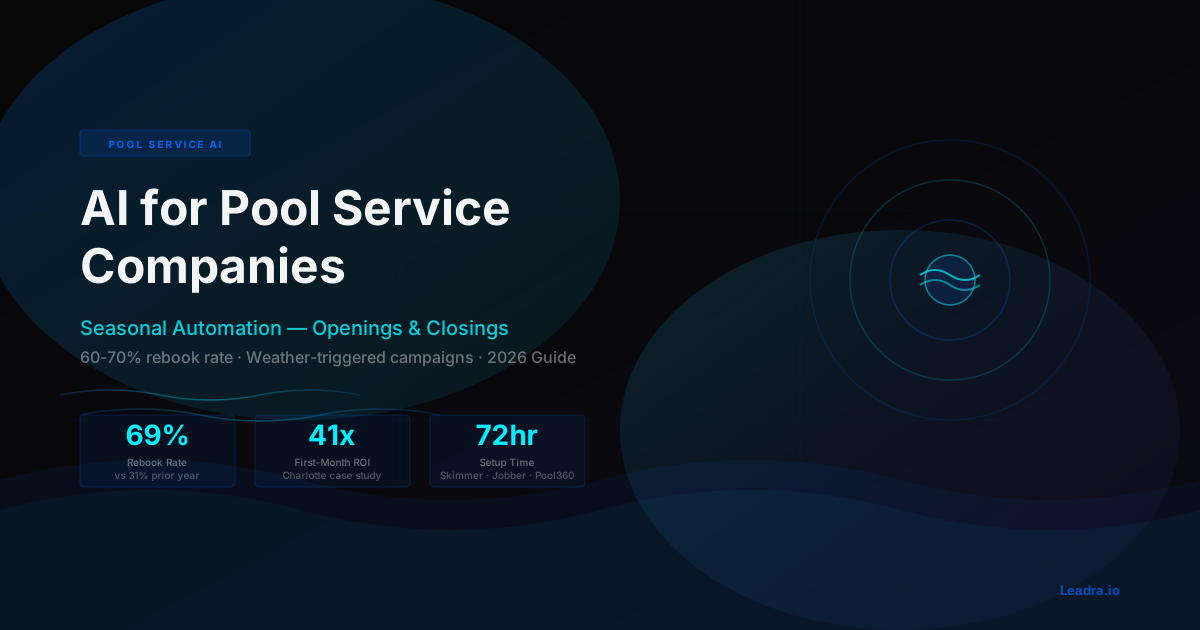
Leadra.io connected to their Skimmer account, segmented the 263-customer database into spring opening candidates, active maintenance holds, fall closing candidates, and lapsed accounts (no booking in 15+ months). A 4-touch spring opening campaign went live in the third week of February — referencing each customer's specific prior service and offering early booking priority. The system also set a weather trigger: if Charlotte temperatures exceeded 72°F for three consecutive days before March 15, the campaign would accelerate send timing to capitalize on early-season demand. That trigger fired on March 8 after an early warm stretch. By the time the traditional spring season started in early April, the results were measurable.
Prior-year rebook rate
31%
69%
Spring jobs pre-booked
47
94
Lapsed customers recovered
~0
28
Added seasonal revenue
—
$32,400
System cost: $780/month · Spring opening average: $310 · 47 additional pre-booked openings = $14,570. Lapsed reactivations (28 accounts, avg $580 first-season value): $16,240. Equipment upsells (filter/heater): $1,590. Combined first-season impact: $32,400+. Month-1 ROI: 41.5x. All 3 techs fully booked for April before the second week of March.
The weather trigger was the highest-performing element. When the early warm stretch hit in the first week of March, the system automatically accelerated the campaign send timing for all spring opening candidates. Twenty-two customers booked within 36 hours of the accelerated SMS going out — customers who were actively thinking about their pool and received a personalized message from their prior-year service company at exactly the right moment. A generic email blast would have caught some of them. A personalized SMS from the company that serviced their pool last year, arriving during the exact weather event that triggered their awareness, converted at 3.4x the rate of the baseline campaign.
The lapsed customer recovery produced a secondary insight: 28 customers who hadn't booked in 15-24 months converted at a 24% rate. Most of them cited the same reason for not rebooking — they hadn't switched to a competitor, they'd just lost the contact info or tried calling at the wrong time. A single personalized SMS referencing their last service was enough to re-establish the relationship. Without the AI system, none of those 28 customers would have been contacted that season.
What AI Seasonal Automation Costs for Pool Service Companies
Pricing depends on database size, number of seasonal campaigns, and whether AI voice outreach and weather triggers are included:
Starter
$500-$900/moSMS + email reminder sequences for 2 seasonal campaigns (spring opening + fall closing), up to 200 customers, Skimmer/Jobber integration, basic booking link. Best for solo operators or 1-2 tech companies doing $150k-$400k in annual revenue.
Growth
$900-$2,000/moFull 4-touch sequences for all seasonal campaigns plus weekly maintenance reminders, weather-triggered send acceleration, up to 450 customers, AI voice follow-up for non-responders, lapsed customer reactivation, equipment upsell sequences, Pool360/Skimmer/Jobber integration, monthly campaign reports. Best for 2-5 tech operations doing $400k-$1.5M annually.
Scale
$2,000-$4,500/moUnlimited customer database, multi-route or multi-location support, full customer LTV scoring with capacity-priority booking, advanced weather API integration, CRM sync, review generation post-service, commercial pool client outreach, monthly strategy call. Best for pool companies with 5+ techs or multi-location operations serving commercial accounts.
The ROI math is favorable even for small operations. A pool company with 150 past customers currently rebooking 30% manually (45 customers) that improves to 65% with AI (98 customers) gains 53 additional repeat bookings per year. At $300 average per opening and $250 per closing, that's $29,150 in incremental seasonal revenue against an $800/month or $9,600/annual system cost. First-year ROI is 3.0x on seasonal revenue alone — before counting weekly maintenance conversions and equipment upsells that come from having a systematic customer relationship.
Pool companies that add weekly maintenance upsell sequences to the seasonal framework see the highest long-term returns. Converting a spring opening customer to a summer maintenance plan — at $100-$200/month — turns a $310 one-time transaction into a $900-$1,500/season relationship. AI follow-up sequences that offer maintenance packages immediately after a successful opening convert 15-25% of spring opening customers, compared to under 5% when the upsell is left to the tech to mention on-site.
How to Set Up AI Seasonal Automation for Your Pool Service Company: 3 Steps
Setup is straightforward and doesn't require changing your existing software stack. Here's the path from kickoff to first live campaign:
Export and organize your customer database
Pull every customer who has booked a service in the last 3 years from Skimmer, Jobber, Pool360, PoolOffice, or your billing software. The key data fields are: customer name, phone number, email, service address, last service date, and service type (opening, closing, maintenance, repair). Pool companies frequently have useful data in notes fields — pool size, equipment type, chemical preferences — that the AI can use to personalize outreach further. Leadra.io handles the segmentation during onboarding. Most pool companies have cleaner data than they expect once it's exported; the average setup has 80-90% of records usable on day one.
Configure seasonal windows and weather triggers for your market
For Charlotte NC pool companies, spring opening campaigns are configured to fire in the third week of February, with a weather trigger that accelerates send timing if temperatures exceed 70°F for three consecutive days before April 1. Fall closing campaigns fire in late September, with a cold-weather trigger if forecasted lows drop below 50°F in October. If you operate in a different climate zone — colder northern market or year-round warm climate in Florida or Arizona — Leadra.io adjusts all trigger thresholds to match your actual season windows. You also set capacity parameters: if you can complete 12 openings per week and have 200 spring candidates, the system prioritizes outreach to your highest-value accounts first, filling your capacity without overbooking.
Connect your scheduling software and go live
Leadra.io integrates with Skimmer, Jobber, Pool360, PoolOffice, and most pool service management platforms. Setup takes 48-72 hours from kickoff to first live message. Once connected, customers who book via reminder campaigns are automatically added to your schedule with a confirmation message — the same as a phone-in booking, without any manual entry. New jobs completed throughout the season update the customer database automatically, so next season's campaign always has current records. Your team sees incoming bookings appear in the scheduler in real time.
AI seasonal automation for pool companies pairs naturally with a broader AI lead generation system for local service businesses — the seasonal reminder system handles your existing customer base while the lead generation system fills capacity with new customers. Together they create a full revenue cycle: new customers acquired, converted, and retained through automated seasonal outreach every year. For the full cost picture, see our guide on AI implementation costs for Charlotte NC small businesses. For companies also running landscaping seasonal automation, the same multi-touch outreach framework applies with different seasonal windows.
Frequently Asked Questions
What is AI seasonal automation for pool service companies?
AI seasonal automation for pool service companies is a system that automatically contacts your past customers before spring pool openings and fall pool closings — using their service history to personalize the timing and message. The AI segments your customer database by last service date and service type (opening, weekly maintenance, closing, repair), then sends multi-touch outreach via SMS, email, and AI voice calls 5-7 weeks before each seasonal window. Pool companies using this system typically rebook 60-70% of prior-year customers before peak season starts, compared to 25-35% with manual reminders or no proactive outreach.
When should pool service companies send spring opening and fall closing reminders?
For Charlotte NC and the Southeast, spring pool opening reminders should go out in late February to early March — 6-8 weeks before the peak opening window in April. This is before homeowners start actively searching for pool service, giving you first-mover advantage. Fall closing reminders perform best in late September to early October, before the first cold snap hits and homeowners scramble to find someone available. Pool companies that wait until customers call lose 40-50% of their prior-year book to competitors who reach out first. AI automation sends these reminders automatically, timed to each customer's region and prior service history, without manual effort.
What ROI can pool service companies expect from AI seasonal automation?
Pool service companies that implement AI seasonal automation typically see their repeat customer rebook rate improve from 25-35% to 60-75%, which translates to 40-80 additional pre-booked seasonal jobs depending on database size. At an average pool opening of $250-$350 and closing of $200-$300, a pool company with 200 past customers can recover $15,000-$35,000 in previously lost seasonal revenue per year. Leadra.io clients in the pool and home services space report 12-25x ROI on seasonal automation campaigns within the first 90 days, with most of the value coming from customers who wanted to rebook but simply waited for the service company to reach out first.
Does AI pool service automation work for small one-truck or two-truck operations?
Yes — AI seasonal automation produces the highest ROI for small pool service operations with 50-300 past customers, because these businesses have the most to gain from systematic repeat customer outreach without adding headcount. A solo pool tech with 120 past customers who improves his spring opening rebook rate from 30% to 65% gains 42 additional booked openings — roughly $12,600 in incremental revenue at $300 per opening — against a $600-$800/month system cost. Leadra.io's starter tier integrates with Skimmer, Jobber, Pool360, and most scheduling tools used by small pool service operations, and typically goes live within 72 hours of kickoff.
Your Prior-Year Pool Customers Are Ready to Rebook — They're Just Waiting for You to Ask
The seasonal outreach problem in pool service is one of the most fixable revenue leaks in home services. You already earned the relationship — you showed up on time, treated the water correctly, and left the pool clean. The customer was satisfied. All that's missing is the system to contact them 6 weeks before the season, personalize the message to their specific service history, follow up if they don't respond immediately, and book the job directly into your schedule.
Most of your prior-year customers will rebook with you — if you ask before your competitors do. AI seasonal automation makes sure you're the first call they receive in February, not the third call they get in April after they've already booked someone else.
Leadra.io builds and manages AI seasonal automation systems for pool service companies, landscaping operations, and home service businesses across the U.S. — integrated with your existing scheduling software, live in under 72 hours. We back every engagement with a results guarantee: if the system doesn't produce measurable rebook improvement in the first 90 days, you don't pay.
Free Seasonal Revenue Audit
Find Out How Many Pool Customers You're Losing to Competitors Who Reached Out First
30-minute audit. We'll review your customer database, calculate your current seasonal rebook rate, and project the revenue impact of an AI seasonal automation campaign before you commit to anything.
Leadra.io
AI marketing agency — Charlotte, NC · Published June 3, 2026