AI Lead Qualification for Solar Installers: Stop Wasting Appointments in 2026
Most residential solar companies pay $150-$350 per lead. Then send a rep to 40-50% of those leads and close under 25% of the appointments they run. The math is broken — and AI for solar installers' lead qualification is what fixes it.
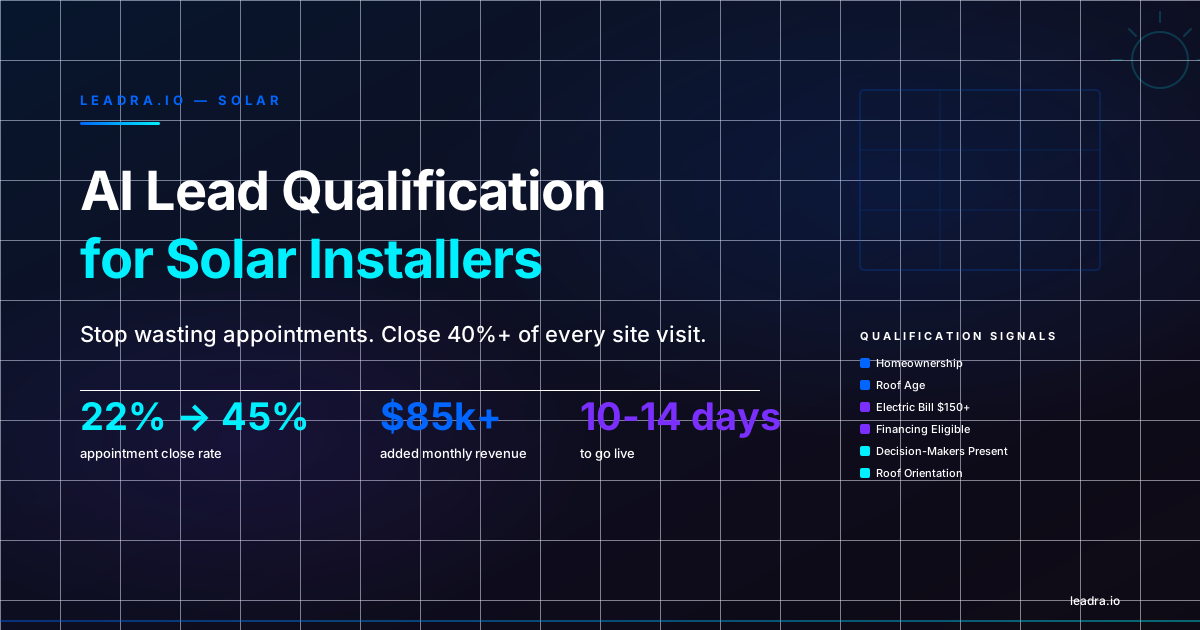
A solar installer in south Charlotte was running 42 appointments per month. His team closed 9 of them. That's a 21% close rate — which sounds low until you realize it's actually close to industry average for residential solar in 2026.
The problem wasn't his sales team. They were good. The problem was the other 33 appointments — the renters who couldn't sign, the homeowners with 22-year-old roofs that needed replacement first, the people paying $80/month in electricity who'd never clear the payback math, the appointments where only one spouse showed up and the other said no the next day.
He added an AI lead qualification layer before booking. Three months later he was running 28 appointments per month and closing 12 — a 43% close rate. Less driving, more closed deals, $48k more in monthly revenue. This guide explains how that system works and how to build it.
Why Solar Lead Qualification Fails Without AI
Solar has a lead quality problem that most other home services industries don't have at the same scale. The sales cycle is long (2-6 weeks from first contact to signed contract), the average ticket is high ($18,000-$35,000 for a full residential system), and the qualification bar is specific: you need homeownership, a qualifying electricity bill, financing eligibility or cash on hand, a roof that can hold panels, and a decision maker who will actually sign.
When marketing generates 60 leads and your SDR or setter team manually calls through them, four things go wrong:
AI for solar installers' lead qualification solves all four. It responds instantly, asks the same questions every time, has no booking quota, and nurtures unready leads automatically. See how AI lead generation systems work for other local service businesses.
The 6 Qualification Signals AI Scores on Every Solar Lead
A properly built AI qualification system for solar doesn't just ask one or two questions — it runs a six-signal intake that surfaces purchase readiness before your sales rep ever picks up the phone. Here's what each signal means and why it matters:
Renters cannot sign a solar contract. Period. Asking this first — 'Do you own the home, or do you rent?' — eliminates the single largest disqualifier in solar sales immediately. Renters get a graceful exit. Owners proceed. This one question alone removes 15-25% of leads from the qualified pool, depending on your market and ad targeting.
A roof over 15-20 years old likely needs replacement before or alongside the solar install. That changes the sales conversation, the financing, and the timeline significantly. Ask: 'Has your roof been replaced or installed within the last 15 years?' Homeowners who say no don't disqualify — but they route to a different track where your proposal includes roof replacement options, or they get flagged for a specialist call rather than a standard setter.
This is the economic viability filter. Homeowners paying under $100/month in electricity rarely have enough usage to justify a solar system's payback period at current panel and financing costs. The qualifying range is typically $150-$500+/month depending on your system pricing and financing options. Ask: 'What does your average monthly electric bill run — roughly?' The AI collects this, scores it, and routes accordingly.
Over 70% of residential solar deals are financed. If a homeowner has significant credit issues, most solar loan products (GreenSky, Mosaic, Sunlight) won't approve them, and the deal won't close regardless of how good the proposal is. The AI doesn't run a hard credit pull — it asks: 'Are you comfortable with your current credit situation, or have there been any major issues in the last few years like bankruptcy or collections?' This surfaces disqualifying issues early without damaging the relationship.
Appointments where only one spouse or partner is present close at roughly half the rate of appointments with both decision-makers present. This is one of the most consistent data points in residential solar sales. Ask: 'Will the person who typically handles financial decisions for your home be available for the appointment?' Confirm both names if applicable. Appointments with unconfirmed second decision-makers either get rescheduled or the rep goes in with explicit strategies for a two-call close.
South-facing roofs with minimal shading are ideal. North-facing primary roof sections and significant tree coverage can reduce system output enough to change the economics or make installation impractical. The AI asks: 'Are there large trees or structures that shade most of your roof during the day?' This is a soft disqualifier — it doesn't kill the lead, but it flags it for a satellite view check before booking so your rep shows up knowing the roof situation.
The AI runs these six checks in a natural-sounding conversation — not a robotic questionnaire. It takes 3-5 minutes per lead. Leads that score above your qualification threshold get booked into your calendar automatically. Leads that score below get routed to a nurture sequence or disqualified. Your setter team only touches leads the AI has already validated.
Manual vs AI Lead Qualification for Solar: The Real Difference
Here's how the two approaches compare across the metrics that matter most for a residential solar installer running 30-80 leads per month:
| Factor | Manual (Setter Team) | AI Qualification |
|---|---|---|
| Speed to first contact | 15 min – 4 hrs (business hours) | Under 60 seconds, 24/7 |
| Intake consistency | Varies by rep; key questions missed | Same 6 questions every lead, every time |
| Cost per qualified lead | $35 – $65 in setter time per contact | $4 – $9 per AI-handled intake |
| After-hours coverage | None without weekend/evening staff | Full coverage — nights, weekends, holidays |
| Lead nurture (not-yet-ready) | 1-2 follow-up calls then dropped | Automated 90-day multi-touch sequence |
| Appointment close rate | 18 – 26% (industry average) | 32 – 48% (qualified pipeline) |
| Scalability | Hire more setters to scale | Handles 10x volume with no headcount increase |
The close rate difference is the one that moves revenue. Going from 22% to 40% on 30 appointments per month means 5-6 more closed deals — at $20,000 average contract value, that's $100,000-$120,000 in additional monthly revenue from better qualification, not more leads.
Case Study: Charlotte Solar Installer Closes 43% More Deals in 90 Days
A residential solar installer in south Charlotte — 6-person team, 2 dedicated sales reps, running Facebook and Google ads generating 55-70 leads per month — came to Leadra.io after a brutal Q1: $28,000 in ad spend, 58 leads, 41 appointments booked, 9 contracts signed. $23,000 in setter labor cost factored in. The cost per acquisition was over $5,600.
Before AI Qualification — Q1 2026
- —58 leads/month from paid ads
- —41 appointments booked (71% booking rate)
- —9 closed contracts (22% appointment close rate)
- —$28k ad spend + $23k setter labor = $51k total acquisition cost
- —$5,667 cost per closed customer
- —Average system contract: $21,400
We deployed an AI qualification layer on their inbound lead flow. Every new lead — regardless of source — triggered an immediate AI voice call (under 45 seconds after form submit) running the six-signal intake. Leads that scored above threshold were booked directly into the reps' calendars with the qualification summary attached. Leads below threshold went into a 60-day SMS/email nurture sequence.
Of the first 62 leads in the test month: 34 scored as qualified (55%), 14 went to nurture (23%), and 14 were disqualified (22% — renters, severe roof issues, or $60-80/month electricity bills). The 34 qualified leads turned into 31 booked appointments — a 91% booking rate on qualified leads versus the prior 71% on unfiltered leads.
By month three, the nurture sequences had recovered 7 additional qualified leads that initially scored below threshold but re-engaged after follow-up. Appointment volume stabilized at 28-32 per month — fewer total appointments than before, but every one pre-qualified.
Monthly appointments
Contracts signed
Close rate
Cost per customer
13 closed contracts at $21,400 average versus 9 previously — $278,200 in monthly revenue versus $192,600. An additional $85,600 in monthly revenue on the same ad spend. The AI qualification system cost $1,400/month. The ROI in month three was 61x — the system paid for itself in less than one additional closed deal.
The owner's comment: "My reps used to leave 3 appointments a week saying 'they were never going to close.' Now they walk into every appointment knowing the homeowner owns the house, has a $200+ bill, both spouses are there, and the roof is under 15 years old. The whole energy in the room is different when you're talking to someone who actually qualifies."
What AI Lead Qualification Costs for Solar Installers in 2026
Pricing depends on monthly lead volume, CRM integration depth, and whether you need outbound nurture sequences alongside inbound qualification:
- —AI qualification on all inbound leads (web, phone, ad form)
- —Six-signal scoring: ownership, roof age, bill, financing, decision-maker, shading
- —Qualified leads auto-booked into your calendar
- —Disqualified leads routed to email/SMS nurture sequence
- —CRM record creation with intake scores and notes
- —Up to 100 inbound lead intakes/month
Best for: Companies with an existing voice or setter system who want AI qualification added on top
- —AI voice agent (24/7 inbound + immediate callback on web leads)
- —Full 6-signal qualification built into every call
- —Calendar booking with rep assignment by zip code or capacity
- —CRM sync (Salesforce, HubSpot, JobNimbus, or custom CRM)
- —60-day automated nurture sequences for below-threshold leads
- —Appointment confirmation and same-day reminder texts
- —Up to 200 inbound lead intakes/month
Best for: 2-6 rep solar teams running 40-120 leads/month from paid ads or referral programs
- —Everything in Full Qualification + Voice System
- —Outbound AI calling for aged leads (30-90 days old)
- —No-show recovery: same-day AI outreach to reschedule
- —Dormant lead reactivation campaigns (leads from prior 6 months)
- —Post-site-visit follow-up sequences for un-closed proposals
- —Monthly close rate and lead source attribution reporting
- —Unlimited lead intakes
Best for: Larger solar operations ($500k+/mo revenue) focused on maximizing yield from existing lead database
At an average residential solar contract value of $18,000-$35,000, one additional closed deal per month covers the full system cost several times over. Most Leadra.io solar clients see payback within the first 2-3 weeks of going live.
See the full AI implementation cost breakdown for service businesses if you want to understand how qualification fits into a broader AI investment.
How to Set Up AI Lead Qualification for Your Solar Company
A qualification system needs to be calibrated to your specific business before it can run — your financing products, your minimum bill threshold, your roof age cutoffs, your CRM fields. Here's the standard setup sequence:
1. Define your ideal qualified lead profile.
Work with your top closer to define the profile of every deal they've loved to walk into: homeowner, roof under 15 years, $175+/month bill, both decision-makers present, south-facing roof with minimal shading. That profile becomes the 'Green' tier. Leads that match 4 out of 6 signals become 'Yellow' (worth calling, not worth booking until more info). Leads matching 2 or fewer become 'Red' — immediate nurture, not appointment. This calibration takes 2-3 hours with your sales lead.
2. Configure your financing thresholds.
Tell the AI the minimum bill amount for your primary financing products. If GreenSky requires a $150/month bill minimum for positive-ROI system sizing, that becomes the hard floor. Homeowners below it get a different conversation — maybe a smaller system, battery storage, or a callback when rates change. Setting these parameters prevents your reps from sitting in living rooms selling systems that won't pass underwriting.
3. Connect your CRM and calendar.
The AI writes a new lead record to your CRM with all six signal scores, plus books directly into your reps' calendars by zip code assignment. Salesforce, HubSpot, Solar-specific CRMs like Aurora or Solargraf, and Google Calendar are all supported. Setup and API integration takes 3-5 business days. You'll also set buffer rules — how many appointments per rep per day, blackout times, travel radius.
4. Build your nurture sequences for below-threshold leads.
Below-threshold leads aren't necessarily dead — they may just need time. A homeowner on a $90/month bill might upgrade when rates increase. A homeowner with an old roof might re-engage after replacing it. Build a 90-day sequence: Week 1 (educational content on solar savings), Month 1 (utility rate increase news), Month 2 (financing update), Month 3 (requalification check-in). These sequences run automatically and surface re-qualified leads for your team.
5. Test with 15 dry-fire scenarios before going live.
Run 15 test calls: 5 clearly qualified, 5 clearly unqualified, and 5 edge cases (single homeowner, roof question, borderline bill). Verify that qualified leads book correctly, that disqualified leads get the appropriate nurture route, and that edge cases trigger the correct rep follow-up flag. Fix any routing errors before real lead dollars hit the system.
Full setup from calibration to live system is 10-14 business days. The system works on your existing phone number and integrates with whatever CRM you already use. You don't need to change your ad campaigns, your offer, or your sales process — just the layer between the lead coming in and the appointment being booked. Read how to pair AI qualification with a broader lead generation system.
Frequently Asked Questions
What is AI lead qualification for solar installers?
AI lead qualification for solar installers is an automated system that scores every inbound lead against six purchase-readiness signals — homeownership, roof age and condition, monthly electricity bill, financing eligibility, decision-maker status, and roof orientation — before a sales rep spends time on the lead or books a site visit. The AI handles the intake conversation via voice or SMS, scores the lead in real time, and routes high-score leads to your calendar while flagging or disqualifying low-score leads automatically. The result is a booked appointment list filled with homeowners who can close, not leads your rep drives to and walks away from.
How does AI qualify solar leads before a site visit?
AI qualifies solar leads before a site visit by running a structured intake conversation the moment a lead comes in — by phone, SMS, or web form response. It asks about homeownership, roof age, monthly electricity bill, financing comfort, decision-maker availability, and roof shading. Each answer gets a score weight. Leads that score above threshold get booked. Leads that score below get nurtured automatically or disqualified. The whole intake runs in under 5 minutes with no rep time required — and works 24/7, including nights and weekends when a large portion of solar leads arrive.
What does AI lead qualification cost for solar companies?
AI lead qualification for solar companies costs $600-$900/month as a standalone qualification layer, $1,200-$2,000/month for a full AI voice plus qualification system with CRM integration and automated follow-up sequences, and $2,500-$4,500/month for a full pipeline covering inbound qualification, outbound lead nurturing, appointment confirmation, and no-show recovery. At an average of $18,000-$35,000 per residential solar installation, most companies recover the full system cost from 1-2 additional closed deals per month.
What solar lead qualification questions matter most for closing rates?
The four questions that move the needle most on solar closing rates are: (1) Homeownership — renters cannot sign a solar contract, and asking this first eliminates the largest disqualifier immediately. (2) Monthly electric bill — homeowners under $100/month rarely clear the payback math; the qualifying range is $150-$300+/month. (3) Decision-maker confirmation — appointments with only one spouse present close at half the rate of appointments with both; confirming this before booking doubles close rates on the appointments you do run. (4) Roof age — a roof over 20 years old changes the sales conversation and financing entirely. Surface these four questions first and appointment quality improves immediately.
The solar companies winning on close rate in 2026 aren't running more appointments — they're running better ones. AI for solar installers' lead qualification is the layer that ensures every appointment on your calendar represents a homeowner who owns the house, has the bill to justify the system, has the credit to finance it, and has both decision-makers ready to sign. That shift alone — from 22% to 40%+ close rate — is worth more than doubling your ad spend.
At Leadra.io, we build AI lead qualification systems for solar installers and home service companies across Charlotte and the Carolinas. Setup is 10-14 business days. The system runs on your existing phone line and CRM. Most clients see results in the first 30 days.
Built for Solar Installers
Stop Sending Reps to Appointments That Won't Close
We'll set up your AI lead qualification system in 10-14 days. Every inbound lead scored against 6 purchase-readiness signals. Qualified leads booked automatically. Below-threshold leads nurtured for 90 days. Your reps only meet homeowners who can close.