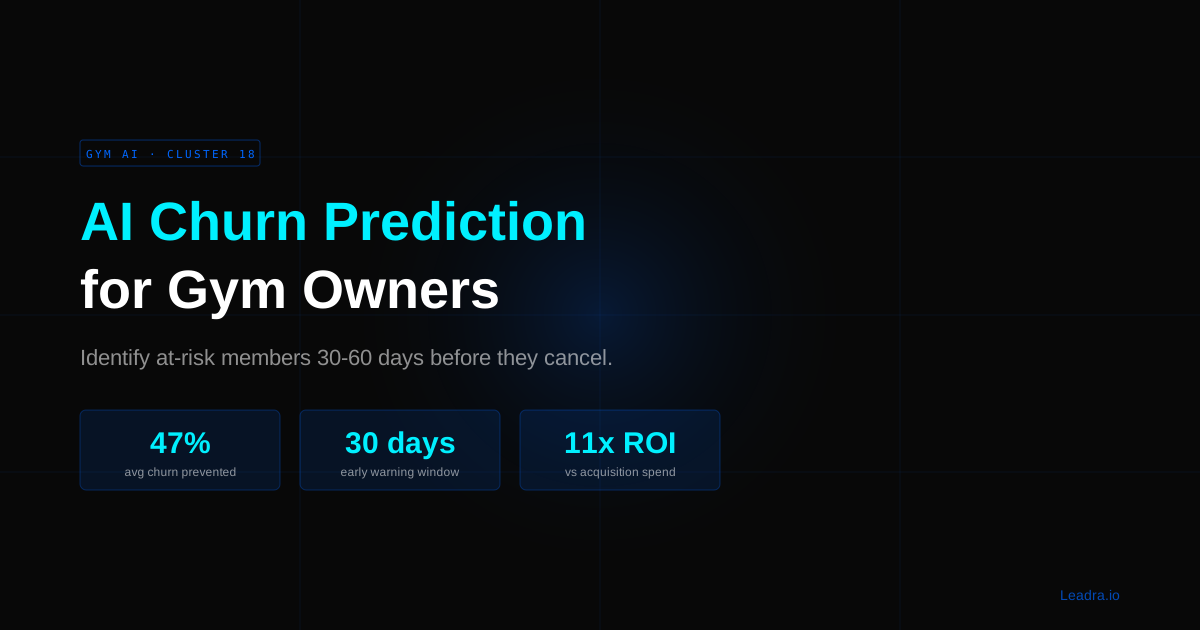
The average gym cancels 20-40% of its membership base every year. Of those cancellations, industry research consistently shows that 40-55% were preventable — members who showed clear warning signs weeks before they submitted the request. The problem is that most gyms only learn a member is unhappy when that member is already gone, or actively trying to leave.
AI churn prediction flips this. Instead of waiting for a cancellation form, the system scores every member's at-risk probability each week using behavioral signals pulled directly from your gym management software. When a member crosses the risk threshold, a personalized retention sequence fires automatically — before the member has made a decision to leave.
Gyms running AI churn prediction through Leadra.io prevent 40-50% of the cancellations they would otherwise only learn about after the fact. This post breaks down exactly how the system works, what signals it tracks, and what results you can expect in 90 days.
Why Reactive Retention Fails Gym Owners
Most gym retention strategies are reactive. A member submits a cancellation request, a front-desk staff member tries to talk them out of it, maybe offers a discount or a free month, and succeeds 5-9% of the time. The rest leave — and the gym just lost a member they spent $200-$400 acquiring.
The deeper problem is that by the time a member submits a cancellation, the decision is already 80% made. Research from the fitness industry shows that the average member mentally "quits" 3-6 weeks before they act on it. During those weeks, they attend less frequently, stop engaging with your marketing, and increasingly view the membership as an expense rather than a value.
The right time to intervene is during those 3-6 weeks — when the member is disengaging but hasn't decided. That window is where AI churn prediction operates. And it's why gyms that intervene proactively retain 5-7x more at-risk members than gyms that only act on cancellation requests.
The 7 Behavioral Signals AI Uses to Predict Gym Churn
No single signal reliably predicts churn. AI churn prediction combines 7-12 signals into a composite weekly risk score for every member.
Visit frequency drop below 50% of baseline
High riskA member who previously averaged 3 check-ins per week dropping to 1.2 is a stronger churn signal than a member who has always averaged 1.2. AI tracks the delta, not just the absolute number.
14+ consecutive days without check-in
High riskA two-week attendance gap predicts 90-day cancellation with 61% accuracy when combined with other signals. The AI fires a re-engagement sequence after day 10 so you act before the gap widens.
Missed 3+ consecutive bookings in a recurring class
High riskMembers with a consistent class habit (Monday 7am spin, Thursday 6pm yoga) who miss 3 in a row are signaling a routine disruption. This is distinct from a member who never had a booking habit.
Failed billing attempt or payment plan change request
High riskA failed charge often precedes a cancellation by 2-4 weeks. The AI triggers an empathetic check-in message — not a collections notice — and offers a payment flexibility option before the member decides to cancel over cost.
Zero opens on last 3 email campaigns
Medium riskDisengagement from marketing communications correlates with 38% higher 60-day churn probability. The AI switches these members to SMS-only outreach, which has 4-6x higher open rates for lapsing members.
Reduction from multi-class to single-class usage
Medium riskMembers who previously attended 3+ class types narrowing to 1 are psychologically detaching from the gym community. Community detachment is the third most common stated reason for cancellation after cost and schedule.
Freeze request or support complaint in prior 60 days
Medium riskA freeze request is a warning signal 40% of the time — members who freeze often don't return. A prior complaint that wasn't resolved to the member's satisfaction creates a 2.4x higher churn probability in the following 90 days.
How AI Churn Prediction Works: The 5-Step System
Here's the exact flow from data ingestion to retention outcome:
Data sync with your gym management software
The system connects to Mindbody, Glofox, ClubReady, Pike13, Zen Planner, or ABC Fitness via API. It pulls check-in records, class booking history, billing events, app engagement data, and communication open rates on a daily sync schedule. This data feeds the churn model continuously — you don't need to export anything or update any spreadsheets.
Weekly risk scoring for every member
Every Monday morning, the AI recalculates a churn risk score (0-100%) for every active member based on the prior 7-30 days of behavioral data. The score isn't based on any single signal — it's a composite of all 7 behavioral signals weighted by how predictive each signal has been for your specific member population. Members who were at 30% risk last week and jumped to 68% this week get flagged as "rapidly escalating" and receive priority in the retention queue.
Automated retention sequence triggered at threshold
When a member crosses the threshold (typically set at 65% risk), the system automatically fires the appropriate retention play based on the member's specific risk profile. A member flagged for attendance drop gets a different message than a member flagged for billing failure. The messaging is personalized to the reason — not a generic "we miss you" blast that members have learned to ignore.
Multi-touch follow-up over 7 days
If the member doesn't respond to the first outreach, the system follows up on day 3 and day 7 with a different angle and different channel. Day 1 might be a trainer SMS. Day 3 might be an email with a challenge invite. Day 7 might be an AI voice call from your gym's number. The multi-touch approach reaches members who are passively disengaging — not ignoring you specifically, just not paying attention.
Outcome tracking and model improvement
Every outreach, response, and outcome (retained, churned, engaged but still at-risk) feeds back into the model. After 60-90 days, the churn prediction model has calibrated to your specific member population and becomes measurably more accurate. Gyms typically see a 10-18 percentage point improvement in prediction accuracy between month 1 and month 3.
Retention Plays by Risk Level
The AI doesn't send the same message to every at-risk member. Here's how retention plays map to risk level and trigger type:
| Risk Level | Retention Play |
|---|---|
| High (70%+ churn probability) | Trainer personal outreach |
| High (70%+ churn probability) | Complimentary class or session offer |
| Medium (45-69% churn probability) | Re-engagement challenge invite |
| Medium (45-69% churn probability) | Membership tier or schedule review offer |
| Billing failure | Empathetic billing flexibility message |
Case Study · Charlotte, NC
NoDa Fitness Studio: 47% Reduction in Preventable Churn in 90 Days
A boutique fitness studio in Charlotte's NoDa neighborhood was losing 22-28 members per month — a 38% annual churn rate that was eating into growth even as they added new members. They were running a manual retention program: the studio manager reviewed membership software weekly and called members who hadn't been in for 3+ weeks. The save rate was 6-8%. Staff time: 5-6 hours per week.
Leadra.io deployed AI churn prediction integrated with their Mindbody account. The model identified 34 at-risk members in the first week — 12 of whom the manager had not flagged manually. Of those 34, 27 received automated retention sequences. 16 re-engaged within 7 days. 12 were still active at the 90-day mark. The monthly cancellation rate dropped from 24 to 13 — a 46% reduction in preventable churn.
Monthly cancellations
24
13
Preventable churn saved
6-8%
47%
Staff time on retention
5-6 hrs/wk
< 30 min/wk
90-day ROI
11.2x
Manual Retention vs. AI Churn Prediction: Side-by-Side
| Metric | Manual / Status Quo | AI Churn Prediction |
|---|---|---|
| When you learn a member is at risk | When they submit cancellation | 30-60 days before they decide |
| At-risk identification method | Front desk intuition | 7-signal composite score, weekly |
| Outreach trigger | Manager notices (inconsistent) | Automatic when risk threshold crossed |
| Intervention message | Generic 'we miss you' blast | Personalized to member's specific signal pattern |
| Follow-up if no response | Rarely happens | 3-touch sequence over 7 days, auto |
| Members reviewed per week | 5-10 (whoever staff notices) | Every active member, every week |
| Preventable churn rate | 8-12% of cancellations saved | 40-50% of preventable cancellations saved |
| Staff time required | 4-6 hrs/week on retention tasks | Under 30 min/week (review + approvals) |
The Math: What Preventing Churn Is Actually Worth
Most gym owners underestimate the financial impact of churn because they think about it one member at a time. Here's a cleaner way to see it:
These are conservative numbers for a smaller gym. Larger gyms with 600-1,200+ members and higher churn volumes see proportionally larger returns. The unit economics improve at scale because the AI system cost stays flat while the number of saves it generates scales with membership count.
The comparison that matters most: acquiring a new gym member costs $200-$400 in ads, promotions, and staff time. Retaining an existing member costs $10-$30 in AI automation costs per member saved. Retention is 8-14x more cost-effective than acquisition — and AI churn prediction is the reason gym owners can finally execute on it at scale.
How to Get Started: 3-Step Implementation
Step 1: Churn audit (free)
Before setting anything up, Leadra.io runs a 48-hour churn audit on your existing gym management software data. This identifies your current churn rate, the percentage of cancellations that showed advance warning signs, which behavioral signals most strongly predict churn in your specific member population, and how many additional members per month you could realistically retain. The audit is free and gives you the business case numbers before you commit to anything.
Step 2: Integration and model calibration (days 1-7)
Once you decide to move forward, Leadra.io connects the AI to your gym management platform via API, sets the initial churn score threshold, and configures the retention sequence library based on your member profile and available offers (class credits, membership pause options, tier downgrades, trainer sessions). You approve the offer menu — the AI handles delivery. Most gyms are fully operational within 72 hours of this step.
Step 3: Monitor results and optimize (days 30-90)
The system runs automatically. Your dashboard shows weekly risk score distributions, members in active retention sequences, and save outcomes. At day 30, Leadra.io reviews the first month of data with you, adjusts the risk threshold if needed, and refines the offer menu based on which plays are working. By day 90, the model has calibrated to your member population and the retention sequences are running at peak efficiency.
Frequently Asked Questions
What is AI churn prediction for gyms and how does it work?
AI churn prediction for gyms is a system that analyzes member behavior data — check-in frequency, class booking patterns, app engagement, billing history, and communication response rates — to calculate a weekly churn risk score for every member. Members who cross a risk threshold (typically set at 65-75% probability of canceling within 30 days) automatically enter a personalized retention sequence: SMS check-in, targeted offer, trainer outreach, or complimentary class, depending on their profile and risk factor. The system connects directly to your gym management software (Mindbody, Glofox, ClubReady, Pike13, Zen Planner) and requires no manual monitoring. Gyms using AI churn prediction prevent 40-50% of the cancellations they would otherwise only discover after the fact.
What behavioral signals does AI use to predict gym member churn?
The strongest churn signals are declining visit frequency (attending less than 50% of their historical average), missed class bookings they previously attended consistently, a gap of 14+ consecutive days with no check-in, non-response to marketing emails over 3+ cycles, late payment or a failed billing attempt, and reduction in class variety (dropping from multiple class types down to one or none). Secondary signals include reduced app logins, dropping out of a group challenge or program, and a support complaint or freeze request in the prior 60 days. No single signal predicts churn reliably — AI churn prediction works by combining 8-12 signals into a composite risk score that's far more accurate than any manual rule a manager could monitor.
How much does AI churn prediction for gyms cost in 2026?
AI churn prediction and retention automation for gyms typically costs $600-$1,800/month depending on member count and integration complexity. A single-location gym with under 400 members usually fits in the $600-$900/month range. Multi-location gyms or studios with more complex segmentation run $1,200-$1,800/month. At $60 average monthly dues, preventing 10 additional cancellations per month adds $600 in recurring revenue — meaning most gyms break even within the first 30-60 days and generate 8-14x ROI within 90 days. Leadra.io offers a no-commitment pilot for qualifying gyms. Call +1 (864) 721-8384 or visit leadra.io/contact to get a churn audit.
Which gym management platforms does AI churn prediction integrate with?
AI churn prediction systems built by Leadra.io integrate natively with Mindbody, Glofox, ClubReady, Pike13, Zen Planner, ABC Fitness Solutions, and GymMaster. Integration is read-only for behavioral data (check-ins, bookings, billing events) and write-enabled for triggering communication sequences (SMS, email, push). Setup takes 48-72 hours for most platforms. No developer resources are needed on the gym's side — Leadra.io handles the API connection, churn model calibration, and retention sequence setup as part of onboarding.
Related guides
Free Churn Audit
Find Out How Many Members You're Losing That You Could Have Saved
Leadra.io runs a free 48-hour churn audit on your gym management software data. You'll see your real preventable churn rate, which signals are firing in your member base, and what you could realistically retain. No commitment.