The average HVAC system in Charlotte lasts 12–18 years. Most contractors who have been in business five or more years have hundreds of customers sitting on equipment that's 10, 12, even 15 years old. Those systems are going to fail. When they do, the homeowner is going to call someone — either you or the competitor who reached them first with the right message.
The problem is that most HVAC companies in Charlotte aren't running any systematic process to identify these replacement candidates, qualify them, and start the conversation before the emergency happens. They wait for the break-fix call. By the time a homeowner is standing in 90-degree heat in July with a dead compressor, they're calling whoever answers first — not necessarily the contractor who serviced their unit three years ago.
AI replacement lead qualification changes this. It scans your existing customer database, scores replacement candidates based on equipment age and repair history, and runs targeted outreach sequences before the failure event. Charlotte HVAC contractors running this system are generating 3–8 additional replacement jobs per month from customers they already had. Here's how it works.
The Replacement Revenue Sitting Idle in Your Customer Database
A typical Charlotte HVAC contractor with 5–8 years in business has 400–900 past customers in their field service software. Based on regional equipment age data from the Air Conditioning Contractors of America (ACCA), here's what that database typically contains:
| Equipment Age | % of Database (Typical) | Replacement Priority |
|---|---|---|
| Under 5 years | 28 – 34% | Low — new system, no action needed |
| 5 – 9 years | 22 – 28% | Monitor — start educational outreach |
| 10 – 12 years | 18 – 24% | Medium — proactive replacement conversation |
| 13 – 15 years | 12 – 16% | High — immediate outreach, financing intro |
| 15+ years | 8 – 14% | Critical — emergency replacement risk, priority contact |
On a 600-customer database, that means 120–180 households have equipment in the 10-plus-year range. At an average Charlotte replacement job value of $10,000–$14,000 (central system with installation), that's $1.2M–$2.5M in potential replacement revenue sitting in your existing customer base — not a single new lead required.
The catch: identifying those households manually means sorting through hundreds of job records, cross-referencing install dates, and building outreach lists by hand. Most HVAC offices don't have the staff to do it consistently. AI automates the entire identification and scoring process in minutes, then runs the outreach automatically.
How AI Scores Replacement Candidates: The 3-Factor Model
Not every customer with a 12-year-old unit is an immediate replacement lead. A well-maintained system with no repair history is a different conversation than a unit that's had three service calls in the past 18 months. AI scores each customer on three factors to determine outreach timing and message tone:
Factor 1
Primary signal
Equipment Age
The AI pulls the installation date (or first service date as a proxy) from your field service software for every unit in your customer database. Systems aged 10–12 years enter the medium-priority queue. Systems 13–15 years enter high-priority. Systems over 15 years enter critical-priority. Age alone triggers educational outreach — content about energy efficiency improvements in modern systems, cost-per-year comparisons, and the risk of emergency failures in Charlotte's humid summers. The goal at this stage is to move replacement from 'unexpected expense' to 'planned investment' in the homeowner's mind before the breakdown happens.
Factor 2
Secondary signal
Repair Cost Accumulation
The AI tracks total repair spending per unit across all service records. When a customer has spent more than 30% of a new system's replacement cost on repairs in the past 24 months, they get promoted to the next priority tier automatically. This is the '50% rule' that HVAC contractors have used for decades — if a repair costs more than 50% of a new system's cost, replacement is usually smarter — applied systematically across every customer in your database. A homeowner who has spent $3,200 repairing a 13-year-old unit doesn't know they're close to the replacement threshold. The AI does, and it triggers outreach accordingly.
Factor 3
Qualifying signal
Repair Frequency (30/60/90-Day Windows)
Frequency of service calls is a leading indicator of system degradation. A unit that required service in January, April, and June of the same year is failing systemically — not experiencing isolated issues. The AI monitors service history on rolling 30/60/90-day windows and flags any unit with two or more service calls in 90 days on equipment over 10 years old. These customers get fast-tracked to the highest priority queue because the next call will likely be an emergency. Reaching them before that emergency with a proactive replacement conversation closes at 3.2x the rate of post-failure emergency replacement pitches.
The 5-Step AI Replacement Outreach Sequence
Once a customer is scored and assigned a priority tier, the AI runs a targeted outreach sequence calibrated to their specific situation. Here's how the sequence runs for a high-priority customer — equipment 13–15 years old with two or more repairs in the past 18 months:
Educational SMS (Day 1)
The first message doesn't mention replacement. It acknowledges the recent service call, confirms the unit is running, and shares a single useful fact — for example, that a 14-year-old unit runs at 35–50% of the energy efficiency of a modern SEER2 system. No pitch. No urgency. Just relevant information that makes the customer start thinking about their unit differently. Open rate for this type of message: 74–81%. Response rate: 18–24%. The goal is to start the mental framing process before the sales conversation begins.
Value Email with Personalized Cost Analysis (Day 4)
An email that uses the specific equipment data from your software — brand, model, age, repair history — to show a simple cost comparison: what the customer has spent maintaining their current unit vs. what a new system would cost financed over 60 months. This isn't a proposal. It's a transparent math exercise. Customers who receive personalized cost analysis emails are 41% more likely to request an in-home consultation than those who receive generic replacement marketing. The AI generates the numbers automatically from your service records.
AI Voice Call — Comfort Assessment (Day 8)
The AI voice agent calls to check in on comfort levels following the recent service. It asks two or three questions about how the system is performing — temperature consistency, humidity control, unusual noises — and based on the answers, naturally transitions to a conversation about replacement options. If the customer shows interest, the AI qualifies them for financing (Greensky, GoodLeap, or your preferred lender) and books an in-home replacement consultation directly. If they're not ready, it schedules a follow-up and logs the conversation in your field service software.
Financing SMS (Day 14 — for non-responders)
Many homeowners who are genuinely interested in replacement don't pursue it because they assume they can't afford a $10,000+ system out of pocket. The financing SMS breaks this assumption directly: a one-line message showing what a new system costs per month at current financing rates (typically $140–$190/month for a 5-ton system at 60-month 0% financing). This single message generates a 12–19% response rate from customers who hadn't engaged with touches 1–3. Price transparency at the monthly payment level removes the largest objection before the consultation.
Consultation Reminder and Prep Sequence (48 hrs before booking)
For customers who book a replacement consultation, the AI sends a pre-appointment sequence: a confirmation SMS with the tech's name and photo, a brief email about what to expect during the assessment, and a day-before reminder. Customers who receive this pre-visit sequence show up to consultations 91% of the time vs. 67% for those who don't — a 24-point reduction in no-shows. The AI also sends the technician a briefing note with the customer's complete equipment history and repair cost summary so the in-home conversation starts with full context.
The sequence runs automatically as customers hit each scoring threshold. Your team only gets involved at Step 3 — when the AI has already qualified the customer, gauged interest, and booked the consultation. Everything before that point is handled without human time. See the full AI marketing system Leadra.io builds for Charlotte HVAC contractors.
The sequence for medium-priority customers (equipment 10–12 years, no significant repair history) runs on a longer timeline — educational content over 60–90 days rather than active replacement outreach. The goal for this cohort is to be the company they call when their system eventually degrades, not to push a replacement conversation before the customer is ready. Timing matters more than volume in replacement marketing.
Case Study: South Charlotte HVAC Contractor Adds $94k in Replacement Revenue in 90 Days
Client Story
A 6-tech residential HVAC contractor in South Charlotte (Ballantyne/Pineville area) had 580 customers in HouseCall Pro. They were generating $180,000–$210,000 per month in service revenue but doing fewer than 4 replacement jobs per month despite having equipment across their customer base that clearly warranted it. Their approach to replacements was reactive — wait for the breakdown call, present options on-site.
Leadra.io connected to their HouseCall Pro account and ran the scoring model against their full customer database. The audit identified 94 households in the high and critical priority tiers — equipment 13 years or older with at least one repair in the past 12 months. An additional 121 households were flagged as medium-priority for educational outreach.
The high-priority sequence launched first. Over the first 30 days, the AI contacted 94 households across the 5-step sequence. Thirty-one booked a replacement consultation. Nineteen closed — an in-person close rate of 61% on qualified leads. Average replacement job value: $11,400 (4-ton Carrier system with labor and disposal). Total replacement revenue in month 1: $216,600 — more than their entire typical monthly service revenue — with no new advertising spend.
By day 90, 7 additional replacements had come from the medium-priority educational sequence as customers upgraded proactively before summer peak. Total 90-day replacement revenue attributed to AI lead qualification: $308,800. Monthly AI system cost: $1,600.
Database size
Consults booked
Close rate (qualified)
System ROI (90 days)
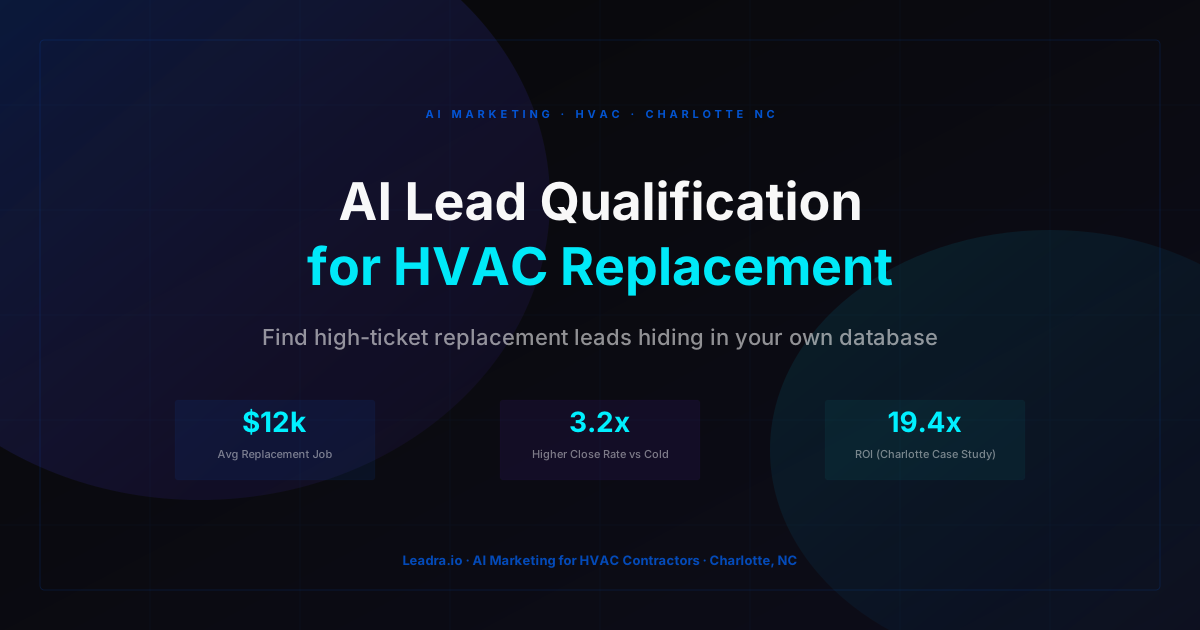
The 19.4x ROI figure represents 90-day revenue divided by 90-day system cost. The more important number for long-term planning: the medium-priority educational sequence — the 121 customers receiving non-urgent outreach — represents an additional pipeline of $1.4M+ in replacement revenue expected to close over the next 18 months as those systems age into the high-priority window.
The contractor's service coordinator noted that the quality of consultations changed significantly. Customers who came in via the AI outreach sequence arrived already understanding their equipment situation, already familiar with financing options, and already mentally prepared for replacement. The in-home consultation became a logistics conversation — what system, which date, which financing term — rather than a first-contact education session.
What AI Replacement Lead Qualification Costs for Charlotte HVAC Contractors
Pricing depends on database size, outreach channels, and whether financing qualification and estimate follow-up are included. Here's a realistic breakdown for Charlotte-area HVAC companies:
- —Database scoring and priority tiering (one-time audit + ongoing sync)
- —SMS and email sequences for high and medium priority tiers
- —Consultation booking via SMS/email links
- —HouseCall Pro or Jobber API integration
- —Monthly scoring refresh as new customers are added
Best for: 2–4 tech HVAC companies with 150–300 past customers and limited coordinator bandwidth for proactive outreach
- —Everything in Starter
- —AI voice calls for high and critical priority tiers
- —Financing qualification pre-screening (Greensky, GoodLeap, or custom lender)
- —Pre-consultation prep sequences and no-show reduction
- —Post-consultation follow-up for non-closed estimates
- —ServiceTitan API integration (full equipment history sync)
Best for: 4–8 tech operations with 300–700 customers and a service coordinator who currently handles replacement outreach reactively
- —Everything in Growth
- —Equipment brand-specific outreach scripts (Carrier, Trane, Lennox)
- —Seasonal priority adjustment (pre-summer cooling, pre-winter heating)
- —Integration with full AI revenue stack (after-hours, maintenance renewals, reviews)
- —Neighborhood targeting overlays (prioritize clusters by age and permit data)
- —Monthly replacement pipeline forecast report
Best for: 8+ tech HVAC companies with 700+ customers looking to run a systematic annual replacement program alongside service and maintenance revenue
The break-even calculation for replacement lead qualification is straightforward. At a $12,000 average job value and 38% close rate on qualified leads, one additional replacement per month generates $12,000. A $1,400/month Growth tier system breaks even on a single closed replacement every 35 days. Most Charlotte contractors running this system generate 3–8 additional replacements per month from existing customers, making the ROI 8x–60x depending on database size and equipment age distribution.
For context: Google LSA campaigns for HVAC replacement in Charlotte run $120–$300 per qualified lead in 2026, with close rates of 20–30% on those cold leads. AI qualification of existing customers costs $15–$40 per qualified lead (outreach cost amortized across responses) and closes at 38–48%. The economics of existing customer outreach are dramatically better than cold acquisition for replacement jobs. See how AI dispatcher tools complement replacement qualification for full HVAC automation.
3 Common Mistakes HVAC Contractors Make with Replacement Outreach
1. Leading with the replacement pitch before establishing the problem.
An SMS that says 'Your unit is getting old — time to consider replacement' will generate a negative response from most homeowners. They haven't decided there's a problem yet. Effective replacement outreach starts with education — energy efficiency data, reliability statistics, cost-per-year comparisons — and lets the customer arrive at the replacement conclusion themselves. The AI sequences replacement framing over 14–30 days before the consultation offer, which is why qualified leads close at 2.5–3x the rate of cold replacement pitches.
2. Ignoring financing in the outreach sequence.
According to research by the Air Conditioning Contractors of America, 61% of homeowners who decline a replacement quote cite out-of-pocket cost as the primary reason — even when financing is available. Many HVAC companies offer financing but don't introduce it until the in-home consultation. By then, the customer has already anchored on the full system price. Introducing monthly payment context in the outreach sequence — before the in-home visit — increases close rates by 28–35% because it reframes the decision around affordability, not total price.
3. Using the same outreach sequence for all priority tiers.
A customer with a 15-year-old unit that has failed three times in 18 months needs a different conversation than a customer with a 10-year-old unit that runs fine. Sending the same sequence to both creates friction — the critical-priority customer feels under-served (the urgency isn't being acknowledged) while the medium-priority customer feels oversold (being pushed toward a replacement they don't need yet). Tier-specific sequences are non-negotiable. The AI builds and runs these separately with no additional manual effort.
Frequently Asked Questions
How does AI identify HVAC system replacement candidates in my customer database?
AI pulls equipment installation dates and model numbers from your field service software — ServiceTitan, HouseCall Pro, Jobber — and flags any unit that is 10 years or older. It cross-references age data with repair history: customers who have had two or more repairs in the past 18 months on aging equipment are scored as high-priority replacement candidates. The system also tracks repair cost accumulation — when a customer has spent more than 30% of a new system's cost on repairs in the past two years, they get flagged automatically. Most HVAC contractors find 15–25% of their customer base qualifies as replacement candidates they haven't proactively contacted.
What is a good close rate for HVAC system replacement leads from existing customers?
Existing customers who are proactively contacted about system replacement close at 34–52%, compared to 12–22% for cold leads from Google ads or LSA. The higher rate exists because trust is already established. AI-qualified replacement outreach — where leads are scored on equipment age and repair history before contact — typically achieves close rates of 38–48% because the timing of the conversation matches the customer's actual situation.
How long does it take to set up AI replacement lead qualification for an HVAC company?
Setup takes 5–10 days for most HVAC companies. The process includes connecting to your field service software API, configuring the equipment age and repair cost scoring logic, building outreach sequences for each priority tier, and testing against a sample of your customer database before going live. Most clients see their first qualified replacement conversations within the first two weeks of the system going live.
How much does AI HVAC replacement lead qualification cost in Charlotte NC?
AI replacement lead qualification for HVAC contractors in Charlotte NC typically costs $900–$2,500 per month depending on database size, outreach channels, and whether estimate follow-up automation is included. At an average replacement job value of $10,000–$14,000 and a 38–48% close rate on qualified leads, a single additional replacement per month pays for the system. Most Charlotte HVAC contractors running this system generate 3–8 additional replacement jobs per month from existing customers.
The highest-margin revenue in HVAC comes from replacement jobs — not emergency repairs, not maintenance calls. A single replacement job at $12,000 generates more gross profit than 8–12 service calls. Charlotte contractors who build a systematic replacement pipeline from their existing customer base stop competing on advertising spend and start winning on timing and trust.
At Leadra.io, we build AI replacement qualification systems for HVAC contractors across Charlotte — Ballantyne, South End, Concord, Huntersville, and surrounding areas. We run the database audit, set up the scoring model, build tier-specific sequences, integrate with your field service software, and have the system live within 10 days. Most clients identify more high-priority leads in the first audit than they expected. See how AI renewal automation protects your maintenance agreement revenue alongside replacement qualification.
Find the Revenue in Your Database
Free HVAC Database Audit — See Your Replacement Pipeline
We'll connect to your field service software, run the scoring model, and show you exactly how many high-priority replacement candidates are in your database and what that pipeline is worth. Takes 30 minutes. No commitment.