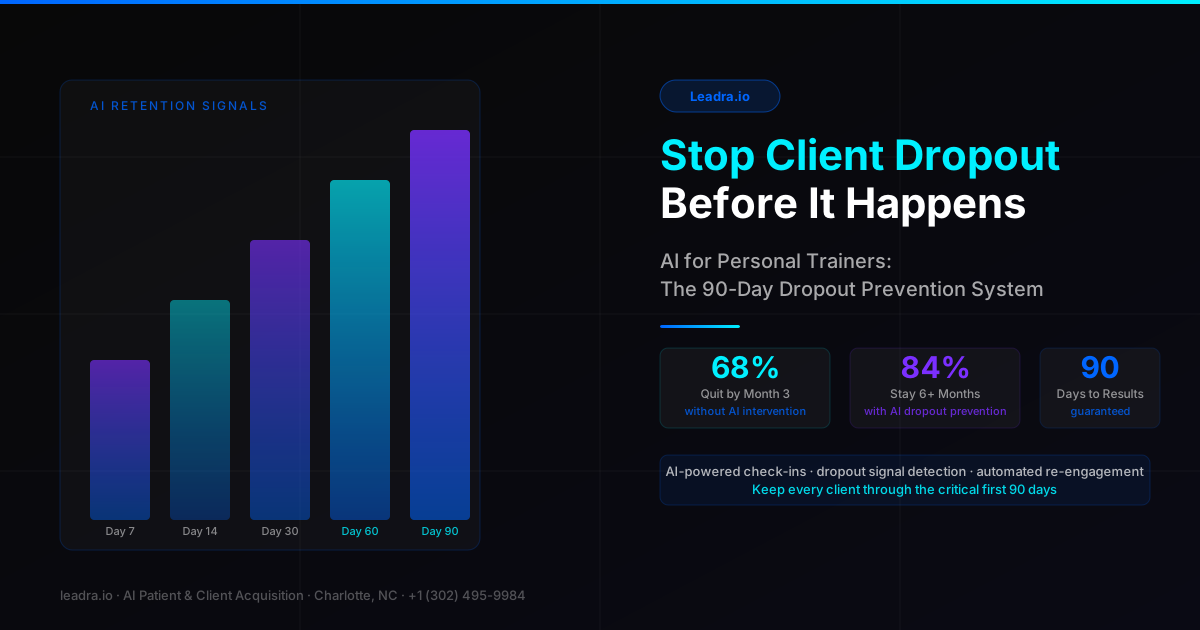
The 90-Day Problem by the Numbers
Why the First 90 Days Are the Most Dangerous Window
Most personal trainers focus their energy on getting clients. The acquisition problem feels urgent — empty spots on the calendar, slow months, price objections. But the math on retention is brutal: if you're losing 60-70% of new clients before month 3, you're running a leaky bucket. You can fill it faster, but you'll never get ahead.
The first 90 days of personal training have the highest drop-off rate of any phase in the client lifecycle. IHRSA research identifies three consistent reasons: clients expected faster visible results, a schedule disruption broke the habit before it formed, or they stopped feeling like a priority when life got busy. None of these require a better trainer. They require better communication — specifically, the right message at the right moment before the client's internal narrative shifts from "I'm committed to this" to "I'll come back when things calm down" (which means never).
The problem isn't that trainers don't care. It's that manually monitoring 15-30 clients for early warning signs while running sessions, building programs, and managing your own schedule is impossible. You find out a client is about to quit when they send the cancellation text. By then, you've already lost them.
AI dropout prevention systems change this. They monitor every client continuously, score their dropout risk in real time, and trigger the right communication automatically — without requiring the trainer to do anything until a client has already failed to respond to three automated touchpoints. At that point, the system hands it back to you with full context: last session date, last contact, progress summary, risk score. You make one direct call with everything you need to convert it.
The 4 Dropout Signal Stages (And What AI Does at Each One)
Client dropout doesn't happen all at once. It follows a predictable signal sequence that plays out over 7-10 days. AI systems catch it at stage 1 or 2. Trainers working manually catch it at stage 4 — if at all.
AI Action: Automated same-day check-in text. Friendly, no pressure. Re-books the session or confirms the reschedule.
AI Action: Progress summary sent showing specific results since start date. Reinforces value. Asks one open-ended question about schedule.
AI Action: Program flexibility offer: shorter format, virtual option, or brief hiatus with a scheduled restart date. Lowers the re-entry barrier.
AI Action: Trainer alert escalation. Direct personal call or voice message from trainer. AI provides context: last session date, progress summary, risk score.
The 90-Day Dropout Prevention Timeline
Different phases of the 90-day window carry different dropout risks. Effective AI prevention systems treat each phase differently — running phase-specific messaging rather than a generic check-in cadence.
Onboarding Vulnerability
The first two weeks are exciting but fragile. Clients are motivated but haven't built the habit. Logistics friction — scheduling conflicts, soreness, commute — can break the pattern before it forms. AI systems send automated welcome sequences on days 1, 3, and 7 of the new program: a personalized welcome message referencing the client's stated goal, a quick-win check-in at day 3 ('How's your energy level this week?'), and a first-week summary on day 7 that highlights early wins — sessions completed, workouts logged, any measurable data points. These aren't generic blasts. They pull the client's specific data and goal from their intake form and reflect it back in a personal-sounding message. Clients who receive this welcome sequence complete 40% more of their first-month sessions than clients who receive no structured onboarding communication.
The Motivation Dip
Between weeks 3 and 6, the novelty wears off. Clients expected to see visible results by now. If the scale hasn't moved or the strength gains feel small, they start questioning whether training is worth the cost. This is the moment the AI system earns its keep. At the 21-day mark, it automatically generates a 'what you've built so far' summary — sessions completed, weight handled compared to week 1, any measurements taken, any stated goal milestones crossed. It sends this summary proactively, before the client brings up doubt. If no progress data exists yet, it shifts to an effort-based milestone: 'You've shown up 8 times. That consistency is exactly what builds results. Here's what to expect in weeks 4-8.' Trainers who deploy this 21-day progress touchpoint see a 33% reduction in cancellation inquiries between weeks 3-8.
The Schedule Disruption Window
Work travel, holidays, family events, and illness hit hard between weeks 7 and 9. Research shows that 1-2 consecutive missed sessions during this window, without any follow-up, predict cancellation at a 62% rate. The AI system catches every missed session within 24 hours and triggers a two-part response: a check-in message that acknowledges life happens and offers to rebook, followed by a specific reschedule prompt tied to the client's stated availability window from their intake form. The critical piece is the specificity — 'I know Tuesdays and Thursdays work best for you — want to lock in Tuesday the 15th at 7am?' converts at 3x the rate of a generic 'let me know when you're free.' For clients who miss two consecutive sessions without responding, the system escalates to the trainer for a direct call with a full context briefing.
The 90-Day Decision Point
The 90-day mark is the most dangerous point in the client lifecycle. Initial program commitments expire. Clients evaluate whether to continue. Without proactive retention outreach, 68% decide not to renew. The AI dropout prevention system starts working on week 10 — not week 12. At 10 weeks, the client receives a '2-weeks-out' results summary showing measurable progress from start to present, framed around their original goal. At week 11, they receive a renewal offer: a loyalty incentive (1 bonus session, a reduced 6-month rate, or a program upgrade) with a specific expiration date that creates urgency without pressure. At the start of week 12, they receive a goal-projection message — 'Here's where you'll be by week 24 if you continue what you've built.' Trainers using this 3-stage sequence renew 64-71% of 90-day clients versus the industry average of 32%.
Why Automation Works Better Than Manual Follow-Up
The instinct is to think that a personal, human check-in is always better than an automated message. It sounds right. But the data doesn't support it for dropout prevention at scale.
The problem with manual follow-up isn't quality — it's consistency and timing. A trainer running 8 sessions per day has maybe 15 minutes between clients to send messages. They'll follow up with the client they're most worried about, not necessarily the one with the highest actual dropout risk. They'll do it when they remember, not within the 24-48 hour window that maximizes conversion. And they'll track it in their head, not in a system, so nothing triggers at the right stage automatically.
AI systems don't have better intentions — they have better execution. Every client gets the same quality of follow-up regardless of how many clients the trainer has. Messages go out within hours of a trigger signal, not when the trainer gets a break. The sequence runs to completion automatically without the trainer needing to remember to check in on day 3 and then again on day 5.
The trainer's role shifts from manual firefighter to high-value closer. You get an alert when a client has gone through the full automated sequence without responding — meaning you're spending your personal outreach time on the 10-15% of situations that genuinely need a human, not every missed session across your entire roster.
Manual vs. AI Dropout Prevention
| Scenario | Manual Approach | AI Dropout Prevention |
|---|---|---|
| Client misses first session | Trainer notices if they check their calendar. Follow-up happens when they get a break (often 24-48hrs later). | Automated check-in triggers within 4 hours. Offer to rebook included. No trainer action needed. |
| Client goes quiet for 5 days | Trainer may not notice across 20+ clients. No systematic monitoring. | Risk score flags client on day 2 of silence. Progress summary sent on day 3. Program flexibility offer on day 5. |
| 21-day progress review | Ad hoc if trainer remembers. Inconsistent — some clients get it, others don't. | Every client receives a data-driven progress summary on day 21. Personalized to their specific goal and metrics. |
| 90-day renewal window | Reminder sent 1-2 days before expiration. Too late for hesitant clients. | 3-stage sequence starts at week 10. Loyalty offer at week 11. Goal projection at week 12. |
| Plateau in client progress | Client brings it up, or cancels without explanation. | Flagged at day 14 of plateau. Proactive program-adjustment conversation initiated by system. |
| Trainer time spent on retention | 4-8 hrs/week texting and following up manually | Under 30 min/week reviewing AI-flagged at-risk clients |
| 90-day retention rate | 32% (industry average) | 72-84% with full dropout prevention system |
How to Implement AI Dropout Prevention Without Changing Your Training Workflow
The biggest objection trainers raise is time. Adding another system to manage, another dashboard to check, another process to learn — on top of everything else. It's a fair concern. But AI dropout prevention is designed to run in the background, not to add to your plate.
Setup takes one session: connect your booking or scheduling system, import your client list, set the trigger thresholds (how many missed sessions, how many days of silence, etc.), and customize the message templates with your name and voice. After that, the system runs autonomously. You get a daily digest of at-risk clients — usually a list you can review in under 10 minutes — and alerts when a client has gone through the full automated sequence without engaging.
The messages go out from your number or email address, in your name, in language you've approved. Clients don't know a system sent the check-in. They receive a message that feels like their trainer noticed they'd been absent and reached out. Because in the most meaningful sense, they did — the trainer built the system that cares about every client.
For online and hybrid trainers, AI dropout prevention is even more critical. Without in-person sessions as a natural check-in mechanism, remote clients can disappear for weeks before the trainer notices. The AI system monitors engagement across every touchpoint — app check-ins, message response time, workout logging frequency — and catches drift early regardless of whether the training relationship is in-person, virtual, or hybrid.
The Revenue Math on Keeping One More Client
A personal trainer with 20 clients at $500/month generates $10,000 MRR. At the industry-average early dropout rate, losing 6 clients per year to 90-day cancellation costs roughly $18,000 in annual revenue — not counting the acquisition cost to replace them (typically $200-$500 per new client in advertising and time).
Preventing 4 of those 6 cancellations — a realistic outcome with a dropout prevention system — generates $12,000 in recovered annual revenue. Each retained client who stays an additional 6 months at $500/month adds $3,000. Keep 4, that's $12,000. Keep 6, that's $18,000.
Leadra.io's dropout prevention system for personal trainers starts at $600/month. That's $7,200 per year. Against $12,000-$18,000 in recovered revenue, the ROI is 67-150% annually — and that's without accounting for the referral value of retained clients, who refer at 4x the rate of clients who cancel early.
Most trainers recover the cost in the first 30 days by preventing 2 early cancellations.
Frequently Asked Questions
Why do most personal training clients quit in the first 90 days?+
The first 90 days of personal training are the highest-risk window because clients haven't yet built the habit loop or experienced enough visible results to feel committed. Research from the International Health, Racquet and Sportsclub Association (IHRSA) shows that 68% of fitness clients who cancel do so within the first 12 weeks. The top three reasons: results feel slower than expected (cited by 41% of early quitters), life disruption breaks the routine and no one follows up (34%), and the client feels like 'just a number' rather than a priority (25%). AI dropout prevention systems address all three: they monitor progress against expectations, trigger automatic check-ins when sessions are missed, and send personalized milestone messages that make every client feel seen.
How does AI detect that a personal training client is about to drop out?+
AI dropout prevention systems monitor a set of behavioral signals that consistently precede cancellation: two or more consecutive missed sessions, response time to trainer messages exceeding 48 hours, a gap of 7+ days without any client-initiated contact, a plateau in logged progress metrics for 10+ days, and reduced engagement with check-in messages or program content. When a client shows two or more of these signals simultaneously, the system scores them as high-dropout-risk and queues an automated intervention. The key difference from manual monitoring is speed — a trainer reviewing their roster once a week misses the 48-72 hour window when a re-engagement message can still recover the client. The AI flags the risk within hours and triggers the sequence the same day.
What does an AI-powered check-in sequence look like for a personal trainer?+
A typical AI-driven re-engagement sequence for personal trainers runs over 5-7 days after a dropout signal is detected. Day 1: a personal-sounding text check-in referencing the client by name and their specific goal ('Hey [Name], noticed you've had a tough week — how's the [goal] tracking?'). Day 3: a progress summary sent via SMS or email showing specific numbers from their history (weight lifted, sessions completed, measurements taken). Day 5: a program flexibility offer — suggesting a shorter session format, virtual training, or a brief program adjustment to lower the barrier to returning. Day 7: if no response, the trainer receives an alert to make a direct call or personal outreach. This 7-day window is critical because IHRSA data shows that clients who disengage for 10+ consecutive days without contact have a 78% probability of cancellation.
How much revenue does AI dropout prevention save a personal trainer per year?+
The math is straightforward. A personal trainer with 20 active clients at $500/month per client has $10,000 in monthly recurring revenue. Without a dropout prevention system, losing 6-8 clients per year to early cancellation (the industry norm at 68% early dropout) costs $3,000-$4,000 in monthly revenue replacement cost — plus the acquisition cost of filling those spots. With an AI dropout prevention system that reduces early cancellation to 15-20%, the trainer retains 4-6 additional clients per year. At $500/month and an average retention extension of 6 months per saved client, that's $12,000-$18,000 in recovered annual revenue. Leadra.io's dropout prevention system for personal trainers starts at $600/month — most trainers hit positive ROI within the first 30 days by preventing 2 early cancellations.
Related Resources
Stop Losing Clients in the First 90 Days
Leadra.io builds AI dropout prevention systems for personal trainers and fitness professionals. We set up the signal monitoring, message sequences, and escalation alerts — you get more retained clients and fewer cancellation texts. Most trainers see positive ROI in the first 30 days.
Charlotte, NC · Serving personal trainers and fitness professionals nationwide