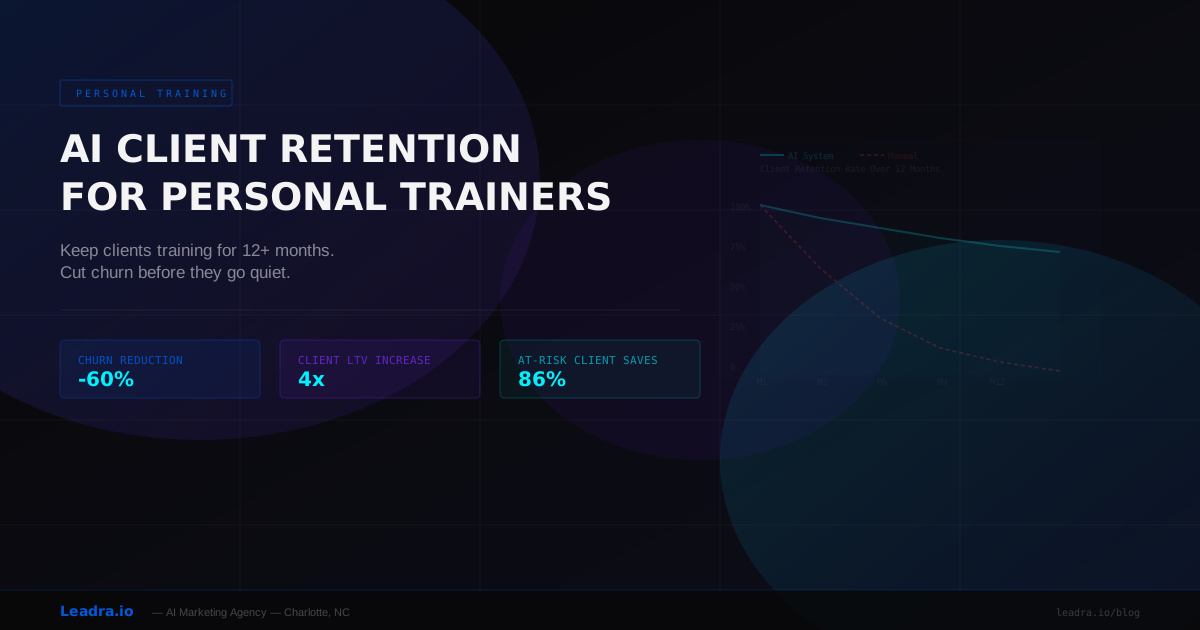
Getting a new personal training client is hard. Keeping one is harder — and most trainers are losing the battle quietly. The average personal training client stops training within 3-4 months of starting, according to data from the International Health, Racquet and Sportsclub Association (IHRSA). That means the typical trainer spends more time and money replacing lost clients than they do on anything else in their business.
The math of poor retention is brutal. A client who stays for 12 months at a $650/month package is worth $7,800. A client who quits at month 3 is worth $1,950 — and cost you $150-$350 in acquisition time and resources to land in the first place. Run that across 20 clients per year and the difference between a 40% retention rate and an 80% retention rate is $78,000 in annual revenue. That is not a small problem. It is the revenue problem.
The reason most trainers can't fix retention is time. Staying on top of every client's progress, attendance, emotional state, and renewal timeline while actually training people is not humanly possible — especially for solo practitioners. The clients who quit rarely announce it in advance. They miss a session, go quiet, then send the cancellation text from a decision that was made 2-3 weeks earlier.
AI client retention systems solve this by doing the monitoring, flagging, and outreach that the trainer simply doesn't have bandwidth to do manually. This guide covers the 5-component AI retention system Leadra.io deploys for personal trainers, the data behind why clients quit, and a Charlotte-area case study showing what the numbers look like when the system runs.
Why Personal Training Clients Quit (and When It Actually Happens)
Clients rarely quit because they hate their trainer. They quit for four predictable reasons — and all four are catchable with early signals if someone is watching:
The motivation cliff at 90 days
Initial motivation (a wedding, a health scare, a New Year commitment) fades between weeks 8 and 12. Clients who started with high urgency lose the emotional driver that got them started — and nothing has replaced it. Retention systems counter this by celebrating the 30-day, 60-day, and 90-day marks with milestone messages tied to specific progress data. Acknowledging what a client HAS achieved reframes the narrative at exactly the moment when their internal motivation is declining.
Invisible progress and the plateau trap
A client who doesn't see measurable change after 6 weeks of work starts to question whether the investment is worth it — even if physiological improvements are happening at a level they can't see on the scale or tape measure. Trainers who track and surface non-obvious metrics (strength gains, endurance improvements, posture changes, sleep quality) give clients a reason to stay. AI systems automate this: they compile progress summaries and push them to the client on a regular cadence without requiring the trainer to manually build reports.
Life disruption without a bridge
A client travels for work for two weeks, comes back feeling guilty about the gap, and quietly doesn't rebook. A client's schedule changes and in-person sessions no longer work, but they don't ask about alternatives because they assume there aren't any. These life disruptions are normal — the issue is that without a proactive outreach system, they become permanent exits. An AI system detects the absence and reaches out with a bridge option (virtual sessions, a 2-week reduced schedule, a pause-and-resume plan) before the client mentally closes the door.
Price sensitivity at renewal time
A client who has been paying $650/month without reinforcement of the value is a client who does mental math at renewal time and sometimes decides the number is too high. Trainers who systematically communicate value — progress summaries, comparative metrics, results projections — create a different renewal context. The client isn't just deciding whether to continue; they're looking at documented proof of what the investment has produced. Clients who receive a personalized results summary 3 weeks before renewal renew at 2.1x the rate of clients who receive no pre-renewal communication.
The common thread across all four churn drivers is timing. Clients don't quit on the day they send the cancellation text — they quit 7-21 days earlier when the mental decision forms. Every AI retention system component targets that window: the period between when a client starts disengaging and when they officially cancel. That's the window where intervention works.
The 5-Component AI Client Retention System for Personal Trainers
This is the retention system Leadra.io deploys for personal training clients. Each component addresses a different churn driver and runs automatically in the background. The trainer's only input is reviewing flagged at-risk cases once or twice per week.
Churn prediction and early-warning monitoring
Most trainers don't know a client is about to quit until they get the cancellation text. By then it's too late. The AI retention system monitors five churn signals in real time: session attendance gaps, response latency to trainer messages, progress plateau duration, engagement with check-in content, and package renewal proximity. When a client shows two or more signals simultaneously, the system flags them as 'at risk' and queues a personalized intervention — within 24 hours of the first warning sign, not after the client has already mentally checked out. A Charlotte trainer who deployed this component alone reduced early-cancellation notices by 38% in the first 60 days.
Automated progress milestone messaging
Clients quit personal training for one of two reasons: they stop seeing progress, or they feel like just another customer. Milestone messaging solves both. The system automatically sends personalized messages when a client hits measurable benchmarks — their first 10 sessions, their first 5-pound weight loss, their first unassisted pull-up, the 30-day and 90-day marks in their program. Each message references the specific milestone and the client's stated goal from intake. These are not generic 'good job' blasts — they are personalized acknowledgments tied to what that client said they wanted when they started. Clients who receive milestone messages renew at 2.3x the rate of clients who receive no milestone communication.
Pre-churn re-engagement sequences
When the churn prediction model flags an at-risk client, the re-engagement sequence activates automatically — no action required from the trainer. The sequence runs over 5-7 days: day 1 is a personal-sounding check-in text ('Hey [name], noticed we haven't connected this week — how's everything going?'), day 3 is a progress summary with specific numbers pulled from their history, day 5 is an offer to adjust the program or switch formats ('Would virtual sessions work better for your schedule right now?'), and day 7 escalates to the trainer for a direct outreach if there's been no response. This 7-day window is critical — IHRSA data shows that clients who disengage for 10+ days without contact have a 78% churn probability. The sequence catches them at day 2-3, when recovery is still easy.
Program adjustment automation
A training plateau is the #1 reason personal training clients rationalize quitting. 'I'm not seeing results anymore' is the most common exit justification — but the real cause is a program that hasn't adapted to where the client is now. The AI system detects when a client's logged progress has plateaued for 14+ days against their goal trajectory and flags it for a program adjustment. It sends an automatic message to the client framing the plateau as a signal for a change — not a failure — and offers a program-review session. Trainers who use this feature report 40% fewer 'results plateau' cancellations and clients who stay an average of 3 additional months after a mid-program adjustment versus clients who plateau without intervention.
Loyalty automation and renewal incentive sequences
The 90-day mark is where most personal training clients churn. Their initial motivation has normalized, the novelty has worn off, and unless there's a compelling reason to continue, they start to ask 'do I really need this?' The retention system starts working on renewal 3 weeks before the package expiration date — not the day before. At 21 days out, the client receives a personalized 'here's what you've accomplished' summary. At 14 days out, they get a renewal offer with a loyalty incentive (1 free session, a reduced rate for a 6-month commitment, or a bonus program add-on). At 7 days out, they get a results projection showing where they'll be in 6 months if they continue. This 3-stage sequence converts 65-72% of at-risk renewals versus the 30-35% spontaneous renewal rate trainers see without proactive communication.
The compounding retention effect
Client retention compounds in a way that client acquisition doesn't. A client who stays for 12 months instead of 3 doesn't just generate 4x more revenue — they also generate 3-5x more referrals (longer-tenured clients have deeper trust and more visible results to share), write more detailed Google reviews, and are more likely to upgrade to higher-value packages. The retention system doesn't just protect existing revenue — it multiplies the downstream value of every client in the roster.
Manual Retention vs. AI Retention System: The Full Comparison
Most personal trainers' retention “system” is personal relationships and good training. Those things matter — but they don't scale across a full client roster, and they can't run proactive outreach sequences while the trainer is on the floor. Here's how the two approaches compare across every retention metric that matters:
| Factor | Manual Approach | AI Retention System |
|---|---|---|
| Churn detection | When client texts to cancel (too late) | 2-3 warning signals caught in real time, 7-10 days before cancellation |
| Progress milestone acknowledgment | Ad hoc, if trainer remembers | Automatic, personalized, tied to client's stated goals |
| Re-engagement after missed sessions | Manual follow-up (often delayed or skipped) | Automated 7-day sequence starting 24hrs after second missed session |
| Program adjustment for plateau | Client mentions it or cancels first | Flagged at day 14 of plateau, proactive session scheduled |
| Renewal outreach timing | 1-2 days before expiration (too late) | 21-day multi-touch sequence with loyalty incentives |
| 6-month client retention rate | 35-45% (industry average) | 72-84% with full retention system |
| Average client lifetime value | $900-$2,400 (3-month avg tenure) | $4,800-$9,600 (10-12 month avg tenure) |
| Trainer time spent on retention outreach | 4-8 hours/week manually texting clients | Under 30 min/week reviewing AI-flagged at-risk cases |
The trainer time row is worth pausing on. Trainers who try to handle retention manually end up spending 4-8 hours per week on client communication — checking in with people who seem disengaged, manually writing progress updates, remembering to follow up before renewals. That's 200-400 hours per year on administrative retention work that an AI system handles in under 30 minutes per week. The time recovered is either reinvested in training more clients or in the trainer's own life.
Case Study: Charlotte PT Cuts Churn Rate from 48% to 14% in 90 Days
Client Story — Charlotte, NC
A personal training studio in Charlotte's South End neighborhood came to Leadra.io in March 2026 with a specific problem: they were consistently bringing in 8-10 new clients per month but couldn't grow their total active client count past 28-32. The pipeline was working — retention wasn't. The studio had 3 trainers, $24,000-$28,000 in monthly revenue, and an informal retention process that consisted of each trainer personally staying in touch with their book of clients.
The churn audit revealed a 90-day dropout rate of 48%. Of every 10 clients who started a program, fewer than 6 were still active at month 3. The primary exit reasons from client exit surveys: 39% said they “didn't feel like they were making progress,” 28% said “life got in the way and I didn't rebook,” and 21% said they “didn't feel like the investment made sense anymore.” All three are directly addressable with a retention system.
Leadra.io deployed the 5-component retention system in week 1 of April 2026. The first intervention came at day 6: the AI flagged 4 clients as at-risk based on missed sessions and response gaps. The re-engagement sequence ran for all 4. Two responded and rebooked. One switched to virtual sessions. One cancelled — but 3 out of 4 saves in the first week alone validated the system. By the end of month 1, the studio had its first month ever with no net client loss.
By day 90: the 90-day churn rate dropped from 48% to 14%. Active client count grew from 31 to 47 without adding a new trainer or increasing the new-client acquisition budget. Monthly revenue grew from $26,200 to $40,800. The milestone messaging system produced the highest-volume week of Google reviews the studio had ever seen — 11 new reviews in a single week from clients who received their 90-day progress summary.
90-day churn rate
48%
14%
Active client count
31
47
Monthly revenue
$26,200
$40,800
Google reviews (90 days)
+2/mo avg
+14/mo avg
System cost: $1,400/month · Revenue increase: +$14,600/month · 90-day ROI: 10.4x. Client saves in 90 days: 22 at-risk clients flagged, 19 saved (86% save rate). Average package value: $650/month. Estimated annual revenue impact of 16 additional retained clients: $124,800.
The 86% save rate on flagged at-risk clients is the most significant number in this study. When the AI catches an at-risk signal and the re-engagement sequence runs within 24-48 hours, the vast majority of clients respond positively. They weren't gone — they were just quiet. A well-timed, personalized message at the right moment is enough to re-engage them. The problem was never that those clients didn't want to continue. The problem was that nobody reached out before it was too late.
The compounding effect on reviews is also worth noting. Clients who receive milestone messages at the 30, 60, and 90-day marks are emotionally primed to share their experience. The studio went from 2 new Google reviews per month (the organic average for a business that never asks) to 14 per month — without ever directly asking a client to “leave us a Google review.” The milestone messages created the emotional context; review requests were timed automatically to follow.
AI Client Retention System Pricing for Personal Trainers and Studios
Pricing scales with your active client volume and the complexity of your setup. Here's how Leadra.io structures the retention system:
Solo Trainer
$600-$900/moChurn prediction monitoring for up to 20 active clients, automated milestone messaging at 30/60/90-day and goal-based benchmarks, 5-day re-engagement sequence for flagged at-risk clients, and 21-day renewal sequence. Best for sole practitioners with a stable client base who are losing 2-4 clients per month to preventable churn. Typical results: 6-month retention rate from 38% to 70%+, 2-4 additional clients retained per month.
Multi-Trainer Studio
$1,200-$2,000/moEverything in Solo plus monitoring for up to 80 clients across multiple trainers, trainer-specific escalation routing (at-risk flags go to the correct trainer), program plateau detection with adjustment-request automation, and loyalty tier system with renewal incentives. Best for studios with 2-5 trainers trying to standardize retention across the team. Typical results: 90-day churn from 45% to under 18%, active client count growing by 10-20 within 90 days without increasing acquisition spend.
Performance & Specialty Facility
$2,000-$3,500/moFull-scale retention system for high-volume studios, performance centers, or specialty fitness businesses with 100+ active clients. Includes advanced churn modeling with cohort analysis, AI-generated client progress reports, automated referral triggers for long-tenure clients, and custom integration with Mindbody, TrainerRoad, TrueCoach, or other fitness management platforms. Best for businesses generating $40k+/month who want to optimize lifetime value across a large, diverse client base.
The retention ROI calculation is simpler than most marketing investments. If a trainer loses 3 clients per month who each pay $650/month, that's $2,340 in monthly revenue walking out the door — $28,080 per year. If an AI retention system at $750/month saves just 2 of those 3 clients, the system returns $1,300/month net after cost. Most solo trainers see full cost recovery within the first 30 days. Every month after that is compounding revenue that wasn't there before.
How to Set Up an AI Client Retention System: 3-Step Process
Getting the retention system live takes 5-7 days from kickoff with Leadra.io. Here is what the setup process looks like:
Client audit and churn baseline
The first step is a 30-minute audit of your current client roster — how many active clients you have, when each client started, their current attendance rate, and any historical exit data you have from past clients. This establishes your baseline churn rate and identifies which clients are currently at risk before the system even goes live. For most trainers, the audit reveals 2-5 clients who are already showing churn signals that have gone unaddressed. The system often produces its first saves within the first week of monitoring.
System integration and milestone mapping
Leadra.io connects the retention system to your existing training management tools — whether that's Mindbody, TrueCoach, Trainerize, Google Calendar, or a simple spreadsheet-based client tracking system. We set up milestone triggers based on your specific service structure (your session packages, your pricing tiers, your 30/60/90-day marks), and customize the re-engagement messaging to match your voice and your brand. The system is built to sound like you, not like a generic autoresponder. Clients should feel like the trainer reached out personally — that's what drives response rates.
Launch, monitor, and iterate
Once live, the system runs in the background and sends you a daily digest of at-risk flags and upcoming renewals. Your job is to review that digest (under 10 minutes), handle the escalated cases that need your personal touch, and approve any major program adjustments the system recommends. Most trainers spend 20-25 minutes per week in the system after the first two weeks of onboarding. Leadra.io reviews retention metrics monthly with you and adjusts the signal thresholds and messaging sequences based on what's working in your specific client base.
AI client retention pairs directly with Leadra.io's AI lead generation system for personal trainers and the dormant member reactivation system for fitness studios. Lead generation fills the top of the funnel. Retention keeps clients in the middle. Reactivation recovers the ones who already left. Together, the three systems create a complete client lifecycle engine — from first Google search to long-term loyal client.
Frequently Asked Questions
How does AI improve client retention for personal trainers?
AI improves personal trainer client retention by monitoring attendance patterns, progress data, and engagement signals to detect clients at risk of quitting before they cancel. When the system spots 2+ missed sessions, a plateau in progress metrics, or a gap in communication, it automatically triggers a personalized re-engagement sequence — a check-in text, a progress summary, or a program-adjustment offer. Trainers using AI retention systems see dropout rates fall from the industry average of 40-50% at the 90-day mark to 15-20%, doubling average client lifetime value without adding manual outreach to the trainer's workload.
What are the early warning signs a personal training client is about to quit?
Research from the International Health, Racquet and Sportsclub Association (IHRSA) identifies the top churn signals for fitness clients: two or more consecutive missed sessions, no response to the last trainer message within 48 hours, a pause or reschedule request after a strong initial start, a plateau in measurable progress without a program adjustment, and reduced engagement with content or check-in messages. AI retention systems track all five signals simultaneously across every client and flag at-risk relationships within 24-48 hours of the first warning sign — far earlier than a trainer manually reviewing their roster.
What is a good client retention rate for a personal trainer?
The personal training industry average for client retention at 6 months is 35-45% — meaning more than half of clients who start a training program stop within 6 months. Top-performing trainers retain 65-75% of clients through 6 months. With an AI client retention system in place, Leadra.io clients average 72-84% retention at 6 months and 55-68% through 12 months. The lifetime value difference is substantial: a client retained for 12 months generates $5,400-$10,200 at $450-$850/month package rates, versus $900-$2,400 from a client who quits at 3 months.
How much does an AI client retention system cost for a personal trainer?
AI client retention systems for personal trainers from Leadra.io range from $600 to $2,500 per month depending on client volume and scope. Solo trainers with 10-20 active clients start at $600-$900/month for churn monitoring, automated milestone messaging, and re-engagement sequences. Boutique studios with 40-100 active clients across multiple trainers run $1,200-$2,500/month including program-adjustment triggers, loyalty automation, and renewal incentive sequences. Most trainers recover the system cost within 30 days by preventing 2-3 early cancellations — each retained client is worth $1,200-$3,600 in extended revenue.
Stop Replacing the Clients You Already Have
Every personal trainer knows that retention is the foundation of a sustainable business. The math is simple: doubling your retention rate doubles your revenue without adding a single new client. The problem has never been understanding this — the problem has been that doing retention right requires consistent, timely, personalized outreach across every client in your roster simultaneously. That is impossible to do manually at scale.
AI client retention systems make it possible by handling the monitoring, the sequencing, and the outreach — and flagging only the cases where the trainer's personal touch is actually needed. The result is a trainer who spends less time chasing cancellations and more time training clients who stay for years, refer their friends, and leave the reviews that build the business organically.
Leadra.io deploys AI client retention systems for personal trainers and fitness studios across the U.S. — churn prediction, milestone automation, re-engagement sequences, and renewal logic fully integrated and live within one week. The first client saves often happen before the end of week 2.
Free Retention Audit
Find Out How Many Clients You're Losing Every Month
30-minute audit. We'll review your current client roster, calculate your churn rate, identify at-risk clients, and show you exactly what an AI retention system would save and generate for your specific business.
Leadra.io
AI marketing agency — Charlotte, NC · Published June 3, 2026