A pool service company opens 120 pools every spring. Each opening represents a satisfied homeowner with a freshly running pool, a direct line to the company that just serviced it, and a pool that will need weekly chemical maintenance for the next five months. By July, 8 of those 120 customers are on a maintenance contract. The other 112 are managing chemistry themselves, calling competitors on bad weeks, or slowly letting the water go green.
That gap — between customers who just paid you and customers who could be paying you every week — is the largest untapped revenue source in pool service. Research from the Pool & Hot Tub Alliance shows that pool owners with a maintenance contract spend 3.2x more with their service company annually than those on a call-when-needed basis. They also churn at a fraction of the rate, refer more neighbors, and generate more Google reviews. The math on a recurring maintenance client versus a one-time opening customer isn't close.
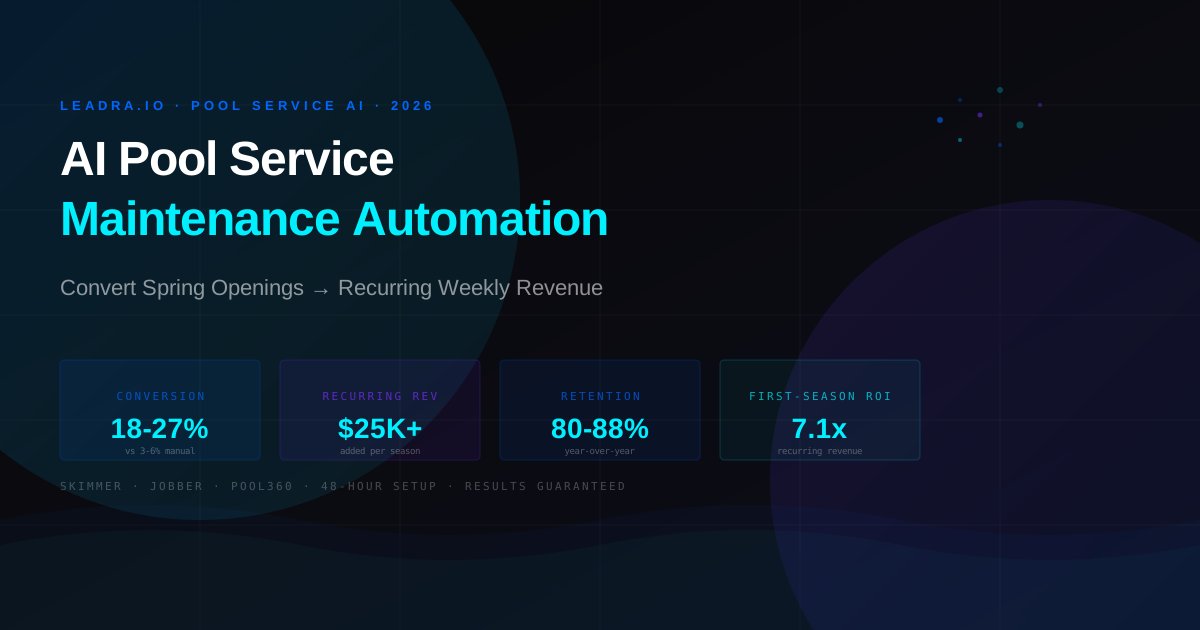
The problem is conversion, not intent. Most homeowners who get their pool opened in April would pay for weekly maintenance if someone presented it clearly, at the right moment, with the right offer. The tech on-site after a 45-minute opening job isn't in a selling position — he's loading his truck, calling about the next job, and heading out. A generic email blast a week later gets ignored. AI post-opening follow-up sequences that reference the specific job just completed convert 18-27% of spring opening customers into maintenance contracts — compared to 3-6% when the upsell is left to the technician to mention in passing.
This guide covers the 5-component AI system that pool service companies use to convert one-time customers into recurring weekly clients, keep those clients engaged through the season, and retain them year-over-year — without adding a single sales or admin hire.
Why Most Pool Companies Leave Maintenance Revenue on the Table
Pool service is a recurring revenue business that most operators run as a transactional one. Here's why the recurring revenue never materializes:
The upsell timing problem
The best moment to offer a maintenance contract is 24-48 hours after the opening — when the homeowner is happy, the pool looks great, and the service company's name is fresh in their mind. Most companies miss this window entirely. The tech moves on, the owner gets busy, and three weeks later a generic marketing email lands in the promotions folder. The window isn't a week — it's 72 hours. AI automation fires post-opening sequences precisely within that window, every time, for every customer, without the owner needing to remember to follow up.
The personalization gap
A maintenance upsell that says 'join our weekly service program' converts at around 4%. A message that says 'Hi Sarah, we opened your pool at 4217 Lakeview — your phosphate levels were a bit high, which will make it harder to keep chlorine balanced through summer. We'd love to keep an eye on that weekly' converts at 18-22%. The difference is specificity. AI automation reads the completed job record, pulls the actual chemical readings from the service ticket, and writes a message that sounds like it came from someone who was just there — because it references the job that just happened.
No system for at-risk maintenance clients
Pool companies that do have maintenance clients lose 30-40% of them between seasons not from dissatisfaction, but from drift. The customer doesn't cancel — they just don't renew, or they pause for a week and never restart. Without an automated system to detect these behavioral signals early and re-engage before the relationship fully lapses, every maintenance book has a 30-40% annual leak that the owner can't see until spring rolls around and the repeat revenue isn't there.
The revenue difference between a one-time opening customer and a recurring maintenance client is significant at the individual level. At scale, it defines what kind of business you're building. A pool company with 100 active maintenance clients averaging $150/month for 5 months generates $75,000 in predictable seasonal recurring revenue — independent of whether it's a hot summer, a slow spring, or a cold fall. A company with 100 one-time opening customers generates $30,000 one week in April and then depends on weather and inbound calls for everything that follows.
The 5-Component AI System for Pool Maintenance Contract Automation
Leadra.io deploys this system for pool service companies. Every component connects directly to your existing pool service software — no new platform for your techs to learn, no manual triggers required.
Post-opening maintenance upsell sequence (24-72 hours after job completion)
When a technician marks a spring opening complete in Skimmer, Jobber, or Pool360, the AI triggers a 3-touch post-service sequence starting 24 hours later. Touch 1 is an SMS from the company thanking the customer by name and referencing their specific pool: 'Hi [Name], glad we got your pool at [Address] opened up right. We noticed the phosphate levels were a bit elevated — we can keep that in check all season with weekly service. Want us to put you on the schedule?' This specificity is critical. A generic maintenance upsell converts at 3-5%. A message that references the actual service visit and a specific chemical reading converts at 16-22%. The follow-up email 48 hours later includes a one-click link to choose a weekly or bi-weekly plan. An AI voice call goes out to non-responders at 72 hours, offering to book the first service while on the call.
Automated chemical maintenance check-in and alert system
For active maintenance clients, the AI monitors service visit records and sends proactive alerts when chemical readings — chlorine, pH, phosphates, alkalinity — fall outside safe ranges between scheduled visits. If the tech records an abnormal reading during a Tuesday visit, the system sends the homeowner a brief SMS the same afternoon: 'We adjusted your chlorine levels today — pool is swimming-ready but give it 2 hours before anyone gets in. We'll check again Thursday.' Clients who receive these proactive service updates have a 34% lower cancellation rate than those who receive only billing communications. They feel like they're getting personalized attention, not just a weekly truck in the driveway. This system also flags pools that are consistently problem-prone — high bather load, heavy tree cover, older equipment — so the tech can proactively discuss equipment upgrades or more frequent service before a larger issue creates a frustration moment.
Maintenance contract renewal automation (fall and spring)
Most pool companies lose 30-40% of maintenance customers between seasons — not because the customer was unhappy, but because no one explicitly asked them to continue. AI contract renewal sequences go out 3 weeks before each service season ends (late September for fall, late February for the following spring) to every active maintenance client. The sequence offers early renewal pricing, acknowledges their current service history ('We've taken care of your pool at [Address] for the past 22 weeks — here's a summary of what we've done'), and confirms their preferred service day and time for the next season. Pool companies that run this sequence retain 78-85% of maintenance clients year-over-year, compared to 50-60% with no renewal outreach. The sequence also offers plan upgrades: clients on bi-weekly service are offered a weekly plan for a nominal upgrade, and weekly clients are offered add-ons like monthly filter cleaning or end-of-season chemical balancing.
Churn prevention — at-risk customer detection and re-engagement
The AI flags at-risk maintenance customers based on behavioral signals: a service cancellation with no reschedule, two consecutive unanswered confirmation texts, a billing complaint, or a payment decline. When any of these signals trigger, a re-engagement sequence activates within 4 hours — not days. The first message is a soft check-in: 'Hi [Name], we noticed we missed connecting this week — everything okay with the pool? We want to make sure you're getting the most from your service.' Non-response after 48 hours triggers a retention offer: a complimentary water chemistry test, a one-month discount, or a free filter cleaning. Pool companies that implement this early-warning churn prevention system recover 35-50% of customers who show at-risk signals before they formally cancel — customers who would otherwise be lost without a single human following up.
Review generation and referral request automation
After every successful service month, the AI sends a brief satisfaction check to each maintenance client. For clients who respond positively (rating 4-5 or replying with a positive message), the system immediately follows up with a Google review request linking directly to the review form — no searching required. For clients who respond with a concern, the system flags the service manager before the review is requested, turning a potential negative review into a recovery opportunity. Pool companies running this system generate 4-8x more Google reviews per year than those relying on in-person requests from techs. A separate referral sequence goes to clients who have been on maintenance for 60+ days, offering a service credit for every neighbor they refer who signs a maintenance contract. Maintenance clients are the highest-converting referral source in pool service — they see the results firsthand, every week.
The Recurring Revenue Compounding Effect
Every maintenance contract customer is more than a recurring revenue line — they're a future high-probability rebooker for fall closing, next spring's opening, and any equipment repair that comes up. A one-time opening customer has a 30-40% chance of rebooking with you next spring. A maintenance contract customer who's been on your schedule all summer has a 78-85% rebooking probability — because you've seen their pool 20+ times, you know the equipment, and they already have your number. The maintenance contract isn't just the recurring revenue — it's the relationship that makes every subsequent service more likely.
Manual Maintenance Upsell vs. AI Automation: What the Numbers Show
Most pool companies rely on their technicians to mention maintenance plans on-site, a method that produces inconsistent results and leaves most revenue on the table. Here's what AI automation changes across every customer touchpoint:
| Touchpoint | Manual Approach | AI Automation |
|---|---|---|
| Maintenance upsell after spring opening | Tech mentions it on-site (3-6% conversion) | Automated 3-touch sequence (18-27% conversion) |
| Chemical alert communication | None — customer only hears if problem is visible | Proactive SMS within hours of abnormal reading |
| Seasonal contract renewal | Owner manually emails or calls (often forgotten) | Automated renewal sequence 3 weeks before season end |
| At-risk customer detection | Discovered when customer cancels | Flagged by behavioral signals before cancellation |
| Year-over-year client retention | 50-60% retain | 78-88% retain |
| Google review volume | Tech asks on-site (1-2 reviews/month) | Post-service automation (8-20 reviews/month) |
| Referral program activation | Passive — word of mouth only | Triggered at 60-day tenure milestone automatically |
| Equipment upsell offers | Forgotten or felt awkward to raise | Triggered by service history + visit data |
The churn prevention row is what most pool company owners underestimate until they run the numbers. If you have 80 maintenance clients and lose 35% between seasons, that's 28 clients you're re-acquiring every year at some combination of time, discounts, and marketing spend. Retaining 85% of those same clients instead — through an automated renewal sequence that costs a fraction of re-acquisition — compounds across every season you run it.
Case Study: Charlotte Pool Company Adds 34 Maintenance Contracts in One Spring Season
Client Story — Charlotte, NC
A 2-tech pool service company in South Charlotte came to Leadra.io after their 2025 spring season. They had opened 127 pools that spring. Of those, 9 had converted to weekly maintenance contracts — a 7% conversion rate, all from in-person mentions by the techs. The owner knew the number was low but had no system to improve it. He didn't want to hire a salesperson for a seasonal business, and he didn't have time to personally follow up with 127 customers after opening season ended.
Leadra.io connected to their Jobber account and built a post-opening upsell sequence triggered when each opening job was marked complete. The sequence referenced the specific chemical readings recorded during the visit — phosphates, pH, and stabilizer levels — and offered a weekly maintenance plan sized to the pool's volume. An AI voice call went out at 72 hours to anyone who hadn't responded to the SMS or email, offering to schedule the first maintenance visit while on the call. For the 2026 spring season opening 131 pools, the results shifted measurably.
Maintenance conversion rate
7%
26%
New maintenance contracts
9
34
Monthly recurring revenue added
—
$5,100
Projected seasonal recurring
—
$25,500
System cost: $720/month · 34 maintenance contracts at avg $150/mo · 5-month season = $25,500 added recurring revenue. Net first-season impact after system cost ($3,600): $21,900. First-season ROI: 7.1x recurring revenue — plus projected fall closing and next-spring rebooking value from the 34 new contract clients. Both techs' weekly schedules fully committed by mid-May for the first time.
The insight that surprised the owner most was the voice call performance. Of the 34 new maintenance contracts, 14 came from the AI voice call — customers who had received the SMS and email but hadn't responded. The voice call referenced their opening job by address, mentioned the chemical readings, and asked if they wanted to lock in their preferred service day before the summer schedule filled. Eleven of those 14 booked on the call itself. The remaining 3 called back within 24 hours.
The seasonal projection understates the long-term value. Each of those 34 new clients is now a high-probability fall closing customer and a rebooker for next spring's opening — at a rebooking rate the owner expects to be 80%+ because they've been on weekly service all summer. The maintenance contract didn't just add recurring revenue this season. It locked in four or five future transactions per customer that previously would have competed in the open market every spring.
What AI Pool Service Maintenance Automation Costs in 2026
Pricing scales with database size, number of active maintenance clients, and whether the system includes AI voice follow-up and churn prevention:
Starter
$500-$900/moPost-opening maintenance upsell sequence (SMS + email), seasonal contract renewal reminders, up to 200 customers, Skimmer/Jobber/Pool360 integration, booking link. Best for solo operators or 1-2 tech companies doing $100k-$350k annually. Focused on converting openings to maintenance contracts and retaining existing clients.
Growth
$900-$2,000/moFull 5-component system: post-opening upsell (SMS + email + AI voice), proactive chemical alert messaging, contract renewal sequences, at-risk churn detection, Google review automation, equipment upsell triggers, up to 500 customers, multi-platform integration, monthly performance reports. Best for 2-5 tech operations targeting $500k-$1.5M annually.
Scale
$2,000-$4,500/moUnlimited customer database, multi-route or multi-location support, full LTV scoring by customer tier, referral program automation, advanced churn prediction, commercial account maintenance contracts, monthly strategy call, CRM sync. Best for pool companies with 5+ techs or those serving commercial and HOA accounts in addition to residential.
The ROI calculation for this system is different from most marketing investments because it generates compounding returns. A pool company that converts 25 additional customers to maintenance contracts this spring adds $150/month × 5 months × 25 clients = $18,750 in new seasonal recurring revenue — against a $720/month or $8,640 annual system cost. Year-one ROI is 2.2x on the new maintenance revenue alone.
In year two, those same 25 clients — retained at 82% — start the season as existing maintenance customers who don't need to be converted. The post-opening upsell sequence opens a fresh cohort of new spring customers on top of the retained base. Year-three recurring revenue from the same system investment is typically 3-4x the year-one number, because each season adds a new conversion cohort while the prior cohorts compound.
How to Set Up Pool Service Maintenance Contract Automation: 3 Steps
Setup doesn't require changing your scheduling software or adding new tools for your techs. Here's the path from kickoff to first live sequence:
Connect your pool service software and map job completion triggers
Leadra.io integrates with Skimmer, Jobber, Pool360, PoolOffice, and ServiceFusion. The integration reads your completed job records to trigger post-service sequences — no manual data entry, no new workflow for your techs. The key data fields are job type (opening, closing, maintenance, repair), chemical readings recorded during the visit, customer contact information, and service address. Most pool companies can complete the integration setup in 48-72 hours. Your techs don't need to change anything about how they use your current scheduling software — the automation runs behind the scenes off the same job records they're already creating.
Configure maintenance offer tiers and message sequences
Leadra.io builds your post-opening upsell sequences based on the maintenance plans you actually offer — weekly, bi-weekly, chemical-only, full-service. Messages are written to reference the chemical readings from each specific job, so they sound personal to the individual customer rather than generic. You set the pricing, the package details, and the preferred tech assigned to each service route. The system builds the messaging around your actual offer. For the churn prevention component, you set the behavioral thresholds that flag at-risk clients — one missed service, two unanswered confirmations, a specific payment status. These are adjustable after launch based on what you observe in the first 30 days.
Launch before the next opening job is complete
Once the integration is live and message sequences are approved, the system activates for all future completed opening jobs automatically. There's no seasonal switch to flip — the trigger fires every time a tech marks an opening complete in your scheduling software, for every customer, for the rest of the season. Leadra.io provides a live dashboard showing upsell conversion rates, active maintenance client count, at-risk client flags, and review generation volume. Most pool companies see their first maintenance contract conversions from the new system within the first week of launch. The seasonal renewal and churn prevention components activate on a rolling basis as existing maintenance clients approach the end-of-season window.
Maintenance contract automation works best as part of a complete pool service revenue system. See how AI seasonal automation fills your spring and fall schedule before customers start searching, and how AI marketing builds new pool maintenance contracts from homeowners who haven't worked with you before. For the full implementation cost picture, see our guide on AI implementation costs for Charlotte NC small businesses.
Frequently Asked Questions
How does AI maintenance contract automation work for pool service companies?
AI maintenance contract automation connects to your pool service software (Skimmer, Jobber, Pool360) and triggers a post-opening follow-up sequence 24-48 hours after each spring opening job is marked complete. The sequence sends 3-4 personalized messages — SMS, email, and an AI voice call for non-responders — offering a maintenance package tailored to the customer's pool size and service history. The AI presents the weekly or bi-weekly plan as a natural continuation of the opening service, referencing specific details like pool volume or prior chemical readings. Pool companies using this system convert 18-27% of spring opening customers into recurring maintenance contracts, compared to 3-6% when the upsell is left to the technician to mention on-site.
What is the average recurring revenue gain from pool maintenance contract automation?
A pool service company that opens 100 pools in spring and converts 22% to weekly maintenance contracts gains 22 recurring clients. At $120-$180 per month per client for a May-September service season (5 months), that's $13,200-$19,800 in added recurring seasonal revenue. Each of those 22 clients is also a high-probability rebooker for fall closing and the following spring — making the lifetime value of a maintenance contract customer 4-6x higher than a one-time opening customer. Leadra.io pool service clients who implement this system see average first-season recurring revenue gains of $14,000-$28,000 from maintenance contract conversion alone.
How does AI prevent pool maintenance customer churn?
AI churn prevention for pool service works through three automated systems: service completion confirmations that reinforce the value of each weekly visit, proactive water chemistry alerts when readings are outside normal range (triggering a check-in SMS before the customer notices a problem), and a 30-day re-engagement sequence for any client who pauses or misses a service without explanation. Identifying at-risk customers before they cancel — rather than after — is the key behavioral difference. Pool companies running AI churn prevention retain 80-88% of maintenance clients through the full season, compared to 60-70% with no systematic follow-up.
Does pool service maintenance automation work with Skimmer, Jobber, and Pool360?
Yes. Leadra.io's pool service automation integrates natively with Skimmer, Jobber, Pool360, PoolOffice, and ServiceFusion. The integration reads completed job records to trigger post-service follow-up sequences, pulls customer contact data and service history for personalization, and writes confirmed maintenance bookings directly back into your scheduling software. Setup takes 48-72 hours from kickoff. No manual data entry is required — the system stays current automatically as your techs mark jobs complete in the field.
Every Spring Opening Is an Unanswered Maintenance Contract Offer
The pool service companies that build strong recurring revenue businesses aren't opening more pools than their competitors. They're converting more of the openings they already have. One additional maintenance contract from every fourth opening you complete this spring adds $900-$1,500 to your seasonal recurring book — no new customer acquisition cost, no additional sales staff, no pricing wars.
The technology to run this conversion system exists, it integrates with the software you already use, and it goes live in under 72 hours. What it requires is the decision to stop leaving 18-23% of your opening customers on the table and start treating every completed job as the start of a five-month relationship.
Leadra.io builds and manages AI maintenance contract automation for pool service companies, landscaping operations, and home service businesses nationwide — connected to Skimmer, Jobber, Pool360, and your existing scheduling stack. Every engagement comes with a results guarantee: if the system doesn't produce measurable improvement in maintenance contract conversion within 90 days, you don't pay.
Free Maintenance Revenue Audit
Find Out How Much Recurring Revenue Your Spring Openings Should Be Generating
30-minute audit. We'll review your opening volume, current maintenance conversion rate, and project what AI automation would produce in new recurring revenue before you commit to anything.
Leadra.io
AI marketing agency — Charlotte, NC · Published July 3, 2026