An interior design studio finishes maybe 20 to 40 projects a year. Every one of them is a client who just spent five or six figures and, if the project went well, is sitting on exactly the kind of detailed, enthusiastic review that convinces the next prospect to book a consultation. Most of those reviews never get written, because asking for them competes with everything else on a designer's plate and usually loses.
That is not a small leak. For a purchase as high-stakes as a full home renovation or a whole-house design, prospective clients read reviews closely before they ever pick up the phone. A studio with 8 reviews and a studio with 40 reviews doing identical work are not competing on a level field, even if the work itself is comparable.
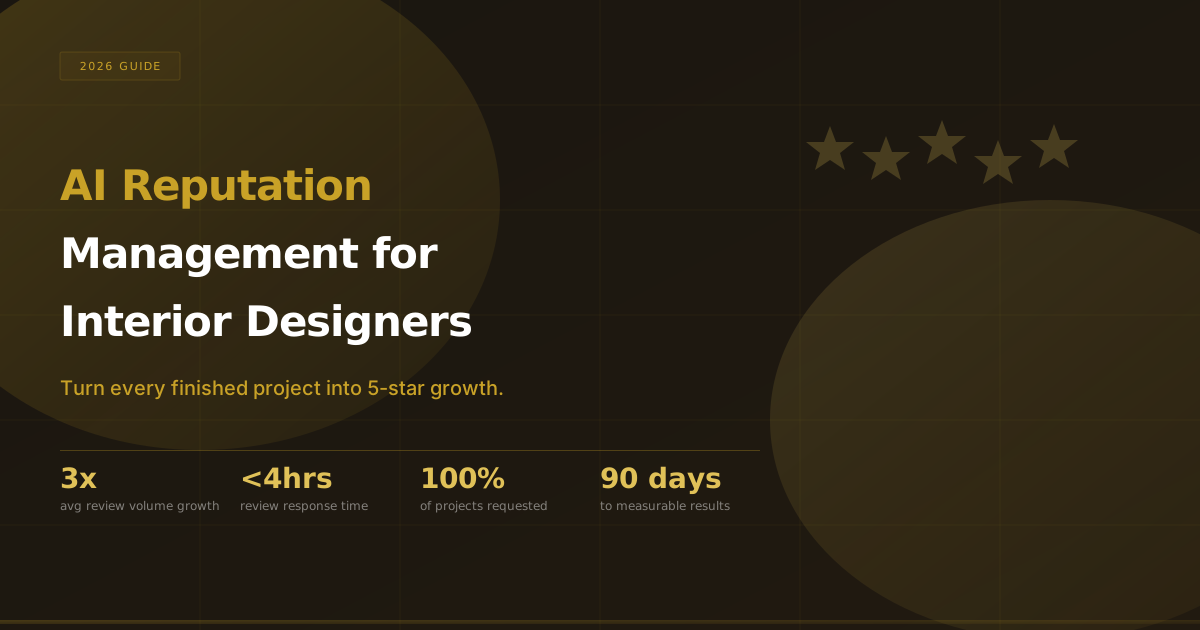
This guide breaks down the AI system that automates the review request, drafts a response to every new review within hours, and turns your best reviews into content that helps close the next project, plus what it looked like before and after for a Charlotte NC studio.
None of this replaces doing great design work. It just makes sure the studios doing great work actually get credit for it in the place prospects look first.
Why Reputation Works Differently for Interior Designers
Review generation for a design studio is a different problem than for a restaurant or a retail shop. A restaurant gets hundreds of chances to earn a review every month. A design studio gets a handful of finished projects a year, and each one has to convert.
Too few projects to rely on volume
A studio finishing 8-10 projects a quarter cannot afford to lose the review from even one of them. Yet without a system, the ask depends entirely on a designer remembering to send a follow-up email during the busiest week of a project handoff, which means it often just doesn't happen.
The best moment to ask is narrow and easy to miss
Client satisfaction peaks right after the final walkthrough, before the excitement fades into daily life with the finished space. A request sent two months later, if it gets sent at all, lands with a client who has moved on and is far less likely to write anything detailed.
A referral network runs on the same client relationships
Interior design leans on word of mouth more than almost any other service business, yet most studios have no repeatable process for turning a happy client into both a review and a referral. Asking for one without the other leaves real value on the table.
A single unanswered bad review carries outsized weight
With only a handful of total reviews, one unanswered negative review can drag down a studio's average rating and sit at the top of a prospect's search results for months. A restaurant with 500 reviews can absorb one bad one. A studio with 12 cannot.
None of these four problems get solved by trying harder to remember. They get solved by a system that fires automatically, every time, without depending on a designer's memory during the busiest part of the project.
The 4-Part AI Reputation System for Interior Designers
Here is the full reputation stack Leadra.io deploys for interior design studios. Each piece closes one of the leaks above.
Automated review request, perfectly timed
Triggered a few days after the final walkthrough, when satisfaction is highest and the project is still fresh in the client's mind. The message references the actual project and routes to the platform where a review does the most good for your studio, usually Google first and Houzz second.
AI-drafted response to every new review
Google, Houzz, and Yelp are monitored continuously. Every new review gets a drafted, on-brand response within hours, queued for a one-click approval. Negative reviews get priority, since a slow or missing response does more damage than the review itself.
Review-to-content repurposing
Strong reviews are automatically formatted into pull quotes for your website, Instagram, and proposal decks, tagged by project type and style so you can pull the right testimonial for the prospect in front of you.
Referral request bundled into the same ask
The same sequence that requests a review also asks happy clients for a referral 60-90 days after project completion, without adding another manual task to a designer's already full plate.
Reputation Note
Components 1 and 2, automated requests and fast responses, drive most of the early review-count growth because they close the gap between projects finished and projects that actually generate a review. Repurposing and referral bundling compound that gain over the following 60-90 days as the review library grows.
Manual vs AI: The Review Volume Difference
This comparison reflects the actual difference in review capture between a studio asking for reviews on an ad hoc basis and one with the full AI system active.
| Metric | Manual / Current | With AI |
|---|---|---|
| Review requests sent per completed project | Occasional, whenever remembered | Every project, automatically timed |
| Typical response rate to review requests | 5-10% | 35-45% |
| Response time to a new review, good or bad | Days, if answered at all | Under 4 hours, drafted for approval |
| Reviews reused as website or social proof | Rarely, manual copy-paste | Auto-formatted, tagged by project type |
| Referral requests paired with reviews | Not systematic | Bundled into the same automated ask |
Elizabeth, Charlotte NC Studio: 11 to 34 Google Reviews in 90 Days
A 3-designer studio in Charlotte's Elizabeth neighborhood had a strong portfolio and a loyal client base, but only 11 Google reviews and 4 on Houzz after nearly six years in business. Prospects kept mentioning they "couldn't find much" about the studio online before booking a consultation.
A reputation audit found the gap: review requests went out for maybe one in five completed projects, usually whenever a designer remembered during a slow week, and two negative reviews from years earlier had never received a response.
Case Study Results — 90 Days
Google reviews (total)
Before: 11
34
Average star rating
Before: 4.4
4.9
Houzz reviews (total)
Before: 4
15
Referral inquiries/month
Before: 2-3
8-10
Negative review response time
Before: 3-5 days
under 4 hrs
Reputation-sourced consultations/mo
Before: 1-2
6-7
Automated post-project review requests drove most of the review-count growth, since they caught nearly every completed project instead of the one in five the studio was catching manually. The two old unanswered negative reviews got thoughtful, on-brand responses within the first week, which several prospects later mentioned specifically when they booked. Nothing about the design work changed. The studio just started getting credit for it.
What AI Reputation Management Costs for a Design Studio (2026 Pricing)
Pricing scales with how many platforms are covered and how much of the response and content work is automated. Here's what the tiers look like in 2026:
Review Foundation — $300-$600/mo
- →Automated post-project review requests (Google + Houzz)
- →New review monitoring and alerts
- →Monthly review-volume reporting
Solo designers and small studios just starting to systemize reviews.
Reputation Engine — $700-$1,400/mo
- →Everything in Review Foundation
- →AI-drafted response for every new review, good or bad
- →Review-to-content repurposing for website and social
- →Referral requests bundled into the review sequence
Boutique studios wanting reviews to actively drive new inquiries.
Full Reputation + Referral System — $1,500-$2,500/mo
- →Everything in Reputation Engine
- →Negative-review recovery outreach before it goes public
- →Coverage across Google, Houzz, Yelp, and Facebook
- →Quarterly reputation report tied to inquiry source
Multi-designer studios or firms competing in crowded markets.
How Fast Does an AI Reputation System Go Live?
Most studios have review requests going out automatically within a week. Here's the typical setup sequence:
Reputation audit. Leadra.io pulls your current review count and rating across Google, Houzz, and Yelp, and flags any unanswered reviews sitting in your history.
Review request automation deployed. The post-project trigger sequence is built and connected to your project timeline, with platform routing configured.
Response monitoring activated. AI begins drafting responses to new reviews, queued to an approval inbox until you're comfortable letting it run automatically.
Content repurposing pipeline built. Your strongest existing reviews are formatted for the website and social channels.
Referral bundling goes live, old unanswered reviews get responses, and the full system is running.
3 Things to Check Before Choosing an AI Reputation Vendor
Do they review-gate, and will they admit it?
Some tools route unhappy clients away from public review platforms while pushing only happy ones to post. This violates most platforms' terms of service and can get a Google Business Profile suspended. Ask directly how negative feedback is handled before signing.
Is there an actual response protocol for negative reviews?
A vendor that only automates requests and ignores responses is solving half the problem. Confirm every new review, positive or negative, gets a drafted response within hours, not days.
Can they show real review-growth numbers from another design or home services business?
Reputation systems built for restaurants churn through volume differently than a business finishing 20-40 high-ticket projects a year. Ask for a reference from a design or home services studio specifically.
Frequently Asked Questions
How does AI review and reputation management work for interior designers?
It automatically requests a review from every client at the moment satisfaction is highest, right after the final walkthrough, and routes the request to the platform where it does the most good, usually Google or Houzz. It also drafts a response to every new review, including negative ones, within hours, and repurposes 5-star reviews into content for your website, social media, and proposals. Most studios go from asking occasionally to capturing a review from nearly every completed project.
How many more reviews can an interior design studio expect with AI reputation automation?
Studios typically see review volume roughly triple within 90 days, because automated requests catch nearly every completed project instead of the small share a busy designer remembers to ask manually. A studio finishing 8-10 projects a quarter can expect 15-25 new reviews in that period versus 2-4 without a system.
What does AI reputation management cost for interior designers?
AI reputation management for interior designers runs $300 to $2,500 per month. Basic review request automation covering Google and Houzz starts around $300-$600/mo. A full system adding AI-drafted responses and review-to-content repurposing runs $700-$1,400/mo. A complete reputation and referral engine with negative-review recovery outreach across Google, Houzz, Yelp, and Facebook runs $1,500-$2,500/mo.
Does responding quickly to a negative review actually help an interior design studio?
Yes. A prospective client researching a five-figure design project reads how you respond to criticism as closely as the review itself. A thoughtful, fast response to a negative review often builds more trust than another 5-star review would, because it shows how the studio actually handles problems when a project doesn't go perfectly.
Related Reading
Find Out How Many Reviews Your Studio Is Missing
Leadra.io runs a free reputation audit for interior design studios — checking your review count, rating, and unanswered reviews across every major platform, and calculating what a full system would recover. No sales pressure. Just the numbers.