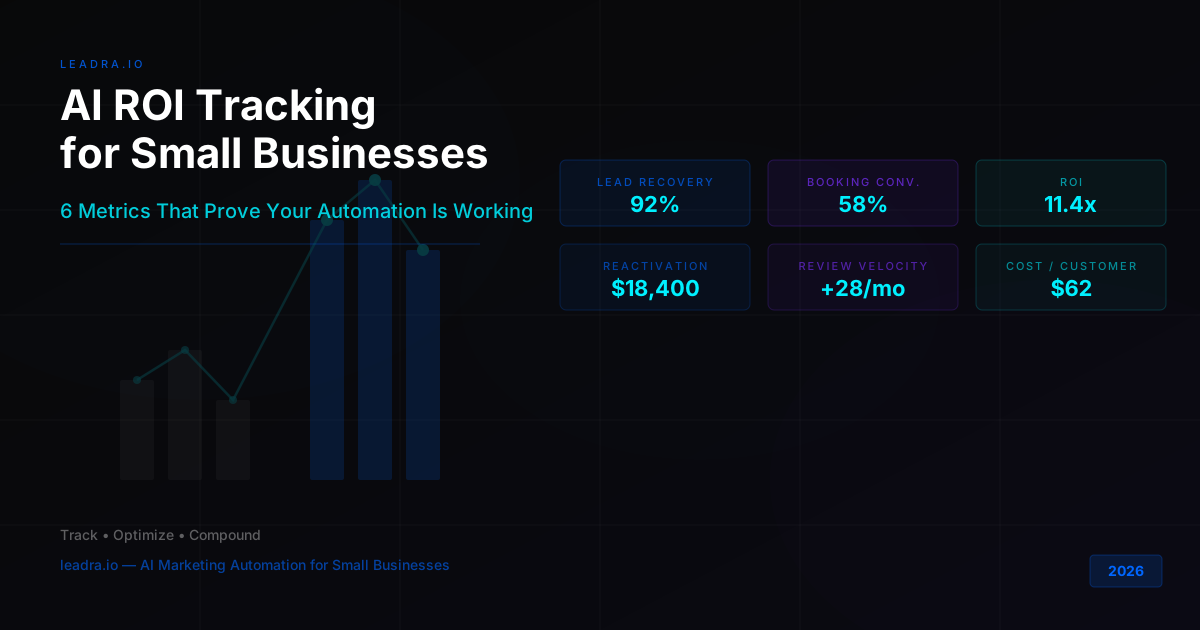
Most small businesses that invest in AI automation make the same mistake: they set up the systems, watch the first week of activity, and then never look at the numbers again. Six months later they don't know if it's working — and when it's time to renew or expand, they have no data to justify the decision either way.
That's a problem, because AI ROI for small businesses is measurable. Not eventually — from week one. But only if you know which metrics to look at and where to find them.
The businesses that get the most out of AI automation aren't necessarily the ones that deploy the most tools. They're the ones that track performance, identify which system is generating the most return, and double down on it. A business that measures nothing runs AI at 1x. A business that tracks six numbers and adjusts based on them runs AI at 3x-5x.
At Leadra.io, we build AI automation systems for small businesses across the US — and the clients who grow fastest are the ones who treat their monthly ROI report like a board meeting. Here are the six metrics that actually tell you if your investment is generating return, how to track each one without expensive software, and what the numbers should look like at 30, 60, and 90 days.
Why AI ROI Tracking Changes the Math for Small Businesses
Most AI ROI calculators for small businessesfocus on the pre-investment estimate — what should you expect to earn based on your lead volume and average job value? That's useful. But post-deployment tracking is where the real money is made.
Tracking reveals hidden revenue you didn't calculate.
Most businesses deploy AI to fix one problem — usually missed calls or slow follow-up. But the systems also generate review velocity, reactivation revenue, and referral lift that nobody projected. Businesses that track all sources find 25-40% more ROI than their original estimate. That revenue is real, but invisible if you're only watching one number.
Tracking tells you what to fix before it costs you money.
An AI voice agent with a 70% booking rate is performing well. One with a 28% booking rate has a script problem — and you won't know until you check. The difference is $3,000-$6,000 per month in recovered bookings. Businesses that monitor conversion metrics monthly catch these gaps in 30-45 days instead of six months.
Tracking justifies expansion at the right time.
When a business owner sees that their AI voice agent is generating $9,400/month in recovered revenue against a $1,100 investment, the decision to add a reactivation campaign or content engine becomes simple math, not a leap of faith. Data converts hesitation into action — and action into compounding ROI.
The 6 AI ROI Metrics Every Small Business Should Track
These are the six metrics Leadra.io uses in every client performance report. You don't need custom software to track them — a call log, your CRM, Google Business Profile, and a spreadsheet are enough.
| Metric | How to Measure | Healthy Benchmark | What a Problem Looks Like |
|---|---|---|---|
| Lead Recovery Rate | Missed calls before vs. after AI | 90%+ captured | Under 75% — script or routing issue |
| Response Time Delta | Time from inquiry to first contact | Under 2 min for web leads | Over 10 min — automation not triggering |
| Booking Conversion Rate | AI-handled leads booked ÷ total AI leads | 45-65% for service businesses | Under 30% — offer or script problem |
| Reactivation Revenue | Revenue from dormant customer campaigns | $8k-$25k per campaign | Under $3k — list quality or timing issue |
| Review Velocity | New Google reviews per month | 15-40 new reviews/month | Under 5/month — request trigger broken |
| Cost Per Acquired Customer | Monthly AI cost ÷ new customers from AI | $40-$90 for service businesses | Over $200 — volume or conversion problem |
The most important thing about this table is the problem column. Every number that falls below benchmark points to a specific, fixable issue — not a failed investment. A booking conversion rate of 28% isn't a reason to cancel your AI subscription. It's a signal that the booking script needs to be rewritten with a stronger offer or a tighter call to action. Fix that one thing and you add $4,000-$8,000/month in recovered revenue.
How to Set Up AI ROI Tracking Without Expensive Software
You don't need a $500/month analytics platform to track AI ROI. Here's the zero-overhead stack that Leadra.io clients use when they're managing tracking themselves.
Phone system call log.
Every business phone system — including Google Voice, RingCentral, and carrier-provided systems — logs incoming calls with time stamps. Export this monthly. Compare after-hours call volume before and after AI deployment. Count missed calls versus answered calls. This single report tells you your lead recovery rate and gives you the raw data for response time delta. Takes 10 minutes to pull and read.
CRM or booking software.
Whether you're using Jobber, ServiceTitan, Jane, Mindbody, or a simple spreadsheet, your booking data tells you booking conversion rate. Filter for leads that came in through AI channels (web forms, after-hours calls, SMS sequences). Divide booked jobs by total AI-sourced leads. For reactivation campaigns, your CRM shows exactly which dormant customers responded and the revenue generated — most AI platforms tag these leads automatically.
Google Business Profile Insights.
Free, built into every Google Business Profile. Track monthly review count, average star rating, and profile views. Review velocity is the number of new reviews in a given month — you'll see this spike 3-5x within 45 days of activating automated post-service review requests. Profile views correlate with organic call volume increases in 60-90 days as the rating and review count improve ranking in local search.
A monthly ROI spreadsheet.
One tab. Six columns: the six metrics above. Two rows: before-automation baseline and current month. Add a seventh column for monthly automation cost and an eighth for net ROI (total recovered revenue minus cost). Update it on the first of every month. This 20-minute monthly process is the difference between knowing your AI is generating 11x ROI and guessing. Leadra.io clients receive this pre-built as part of every engagement.
Case Study: How Tracking Doubled ROI for a Charlotte, NC Plumbing Company
Client Story — Charlotte, NC
A plumbing company in Charlotte's University City area came to Leadra.io after three months with a different AI vendor. They had an AI voice agent deployed and were paying $1,200/month — but they had no idea if it was working. The owner's gut said "probably something," but he couldn't quantify it.
Leadra.io ran a 30-day tracking audit. Findings: the voice agent had a 91% after-hours call capture rate — strong — but a 24% booking conversion rate. Healthy benchmark is 45-65%. The script was answering calls but failing to commit callers to a booked slot. It was offering "we'll call you back in the morning" instead of booking an appointment on the spot. Every after-hours caller who said yes to a callback but wasn't booked was calling a competitor by 8am.
Script rewrite: 3 days. The new script offered a same-day arrival window and confirmed a specific technician name. Booking conversion rate went from 24% to 58% in the first month. That one change — identified entirely by tracking the booking conversion metric — added 11 booked jobs per month at $680 average job value. That's $7,480 per month in additional revenue from the same phone calls that were already being captured.
Without tracking, this business would have been paying $1,200/month for an AI system running at 30% efficiency indefinitely. The tracking setup took 2 hours. The fix took 3 days. The revenue gain was permanent.
Booking conversion
Added jobs/month
Monthly revenue added
ROI lift from tracking
This pattern — deploy, track, fix one thing, compound the result — is how the best Leadra.io clients operate. The AI system isn't a fire-and-forget investment. It's a machine with gauges. You have to read the gauges to know when to make adjustments. See the full AI ROI calculator for small businesses.
What Your AI ROI Numbers Should Look Like at 30, 60, and 90 Days
Knowing the benchmarks takes the anxiety out of early tracking. Here's what healthy AI automation performance looks like across each milestone period for a typical service business investing $1,000-$1,500/month.
Day 30 benchmarks.
Lead recovery rate should be 85-95% within the first month — the voice agent and follow-up sequences are either working or they're not, and this shows immediately. Response time delta should be under 3 minutes for all web form leads. Reactivation campaign should be complete (if you have a past-customer database) with initial revenue logged. Booking conversion rate will be in the 35-55% range as the script is still calibrating. Review velocity will show an uptick but won't be significant yet — 3-8 new reviews above baseline.
Day 60 benchmarks.
Booking conversion rate should be at 45-65% after any script adjustments from the 30-day review. Review velocity should be 15-25 new reviews per month — the automated post-service requests have been running long enough to show consistent volume. Google Business Profile views typically start rising 10-20% as the review count and rating improve. Cost per acquired customer should be tracking under $90 for most service businesses. If it's over $120, there's a lead quality or conversion problem worth investigating.
Day 90 benchmarks.
Full ROI picture is visible at 90 days. Lead recovery, booking conversion, and reactivation revenue are all established data points. Organic call lift from improved Google ranking is starting to show — usually 8-15% more organic calls than the pre-automation baseline. Full-system ROI for a business running three components (voice agent, follow-up automation, review generation) at $1,200/month should be 6x-14x, depending on industry and lead volume. Businesses tracking all six metrics are averaging 25-35% higher measured ROI than businesses tracking only lead recovery.
3 AI ROI Tracking Mistakes That Cause Businesses to Undervalue Their Investment
These mistakes aren't about bad math — they're about incomplete measurement. Each one causes businesses to undercount their actual return by 30-60%.
Only tracking lead recovery.
Lead recovery is the easiest AI ROI metric to see, so most businesses stop there. But reactivation revenue, review-driven organic call growth, and follow-up conversion improvements together account for 40-60% of total AI return. A business that measures only lead recovery and concludes they're getting 3x ROI is likely getting 6x — they just can't see it because they stopped looking after the first metric.
Not establishing a pre-automation baseline.
You can't measure improvement without a starting point. Before deploying any AI system, pull 90 days of call logs, booking conversion data, and Google review counts. Businesses that skip the baseline stage have no way to prove ROI at 90 days — which creates false doubt and premature cancellations. The baseline pull takes 30 minutes and makes every future tracking conversation concrete.
Measuring ROI monthly instead of by cohort.
Month-to-month revenue can be noisy for seasonal businesses. A roofing company that installed AI in October will show massive December revenue from storm calls, then a quiet January — and mistakenly conclude performance dropped. Track AI ROI by lead cohort (all leads generated in a given week, followed through to final booking and payment) and by channel (AI voice vs. AI follow-up vs. AI reactivation) for a clean picture that doesn't conflate seasonality with system performance.
Frequently Asked Questions
What metrics should I track to measure AI ROI for my small business?
The six core AI ROI metrics for small businesses are: lead recovery rate, response time delta, booking conversion rate, reactivation revenue, review velocity, and cost per acquired customer. Track all six monthly and compare against your pre-automation baseline. Most businesses only track the first one — and miss 60-70% of their actual return.
How do I calculate AI ROI for my small business in 2026?
AI ROI for a small business is: (Total revenue generated by AI systems minus monthly automation cost) divided by monthly automation cost, multiplied by 100. Revenue generated includes lead recovery, reactivation campaign revenue, and organic search lift from automated review generation. The most common mistake is counting only lead recovery and ignoring reactivation and SEO lift — which together account for 40-60% of total AI return in the first year.
What tools should small businesses use to track AI marketing ROI?
Most small businesses don't need expensive software. The core stack is: your phone system's call log, your CRM or booking software, Google Business Profile Insights, and a simple monthly spreadsheet comparing pre-automation and post-automation revenue by source. Businesses using Leadra.io receive a monthly performance report that pulls all six tracking metrics into a single dashboard with a running ROI calculation.
How long does it take to see measurable AI ROI for a small business?
Most small service businesses see measurable AI ROI within the first 30 days — primarily from lead recovery and reactivation campaigns. Review velocity improvements show in 45-60 days. Organic ranking improvements materialize in 60-120 days. Businesses that set up proper tracking from day one consistently identify 25-35% more total return than businesses that only monitor one metric.
The Bottom Line on AI ROI Tracking
AI ROI for small businessesis not a black box. It's six measurable numbers that you can pull from systems you already have access to. Businesses that track all six find 25-35% more return than their original estimate — not because the AI is doing more than expected, but because they can see all of it instead of just part of it.
The Charlotte plumbing case study is the pattern we see repeatedly: a single underperforming metric — booking conversion, review velocity, reactivation response rate — gets fixed in 3-5 days once you can see it, and adds $5,000-$10,000/month in permanent revenue. That's not a product improvement. That's measurement doing its job.
At Leadra.io, every client receives a monthly performance dashboard covering all six metrics, with benchmark comparisons and specific optimization recommendations when a number drops below threshold. If you're currently running AI automation without tracking, a free 30-minute audit will show you exactly what you're missing. See how fast AI automation pays for itself by industry.
Know your exact AI ROI numbers
Get a Free AI Performance Audit from Leadra.io
We'll review your current AI systems (or map out the opportunity if you haven't started), pull your six tracking metrics, and give you a written ROI report with specific fixes. 30 minutes, no obligation.
Last updated: July 3, 2026 | Leadra.io — AI ROI Tracking for Small Businesses