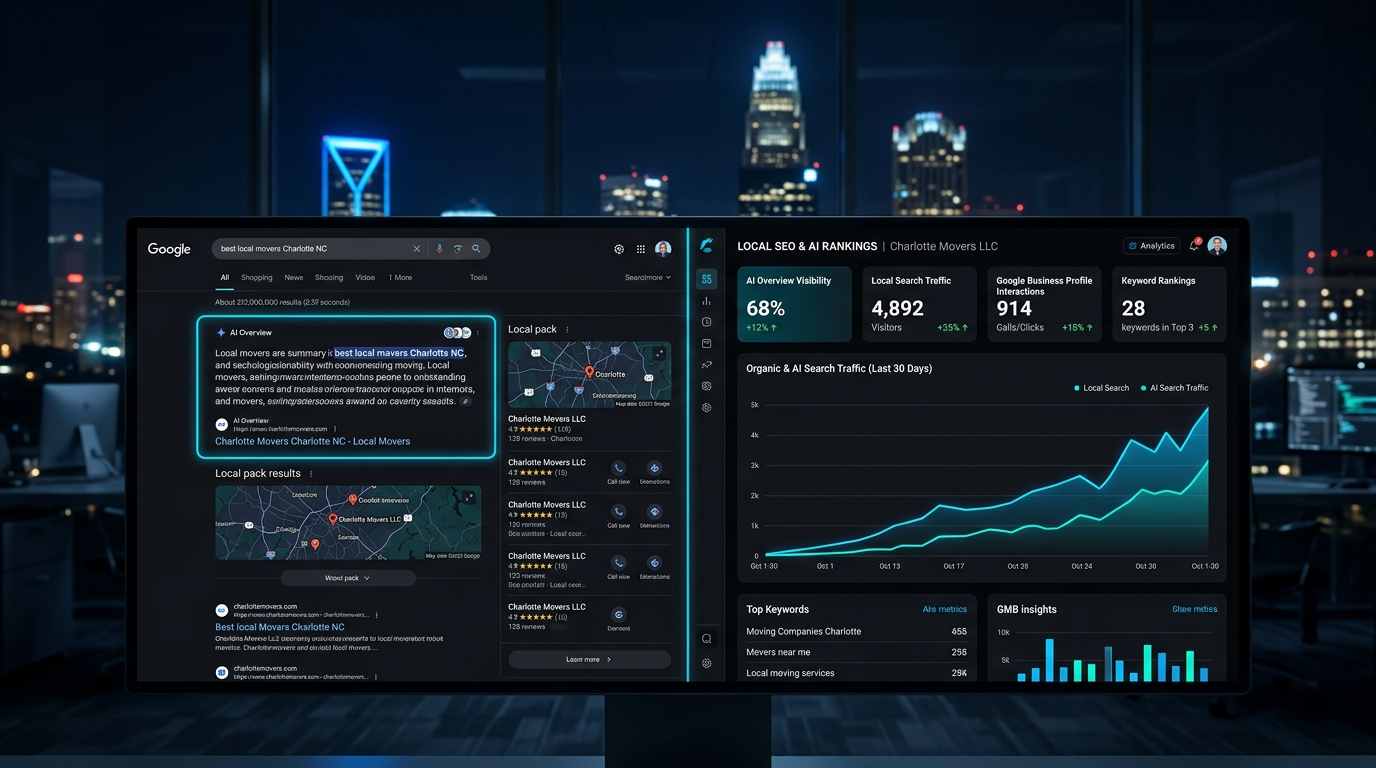
In 2025, ranking on page 1 of Google meant optimizing for 10 blue links. In 2026, it means showing up in Google AI Overviews, getting cited by ChatGPT when someone asks for the best plumber in their city, and appearing in Perplexity answers before your competitor's paid ad even loads.
The local service businesses winning search in 2026 — dental practices, HVAC companies, plumbers, roofers, law firms — aren't the ones with the biggest ad budgets. They're the ones that figured out AI SEO early and built structured, answerable content while everyone else was still writing keyword-stuffed blog posts nobody reads.
This is the exact AI SEO strategy Leadra.io uses to get local service businesses onto page 1 — including the 30-60-90 day implementation plan, the content structure that gets picked up by AI Overviews, and a Charlotte NC case study showing real before-and-after organic traffic numbers.
How Local Search Changed in 2026 (And Why Most Businesses Don't Know It Yet)
Google rolled out AI Overviews to 100% of US searches by mid-2025. By early 2026, an estimated 62% of searches with local intent now show an AI-generated answer block before any paid ads or organic results. That box pulls from local business websites — specifically, from pages with clear, direct answers to the question the person asked.
Three specific shifts are driving this:
AI Overviews are now the first result most people see.
For queries like "best HVAC company Charlotte NC" or "dental implants cost near me," Google now shows a synthesized AI answer at the top. The sources cited in that answer get free, high-intent traffic that bypasses the paid ad auction entirely. Businesses that aren't in the AI Overview for their key local searches are invisible to the majority of searchers.
ChatGPT and Perplexity are eating local search traffic.
A BrightEdge study from Q1 2026 found that 38% of US consumers now use ChatGPT or Perplexity to find local service providers — up from 14% in 2024. When someone asks ChatGPT "who is the best dentist in Charlotte NC," it pulls from websites with structured, credible, geo-specific content. Businesses without that content simply don't get mentioned.
Traditional 10-blue-links SEO is still relevant but no longer sufficient.
Ranking #3 in organic results used to mean significant traffic. In 2026, with an AI Overview, a local pack, and paid ads above it, organic position 3 often sits below the fold on mobile. AI Overview inclusion now drives 2-4x more clicks than a traditional organic #1 ranking for the same local keyword. Local SEO without AI optimization is leaving the biggest traffic source untouched.
Most local service businesses haven't adapted to this shift. Their websites have generic service pages, no FAQ schema, and blog content that hasn't been updated since 2023. That creates a window for businesses that move now to dominate their local market before competitors catch up. Learn more about how AI search visibility works step by step for local service businesses.
The 5 Pillars of AI SEO for Local Service Businesses
AI SEO for local service businesses isn't about doing more of the same thing. It's a different framework. These five pillars are what separate the businesses getting 40-80 organic leads per month from the ones stuck at 5-10.
01. Local Intent Content (Not Generic Blog Posts)
AI systems pull from content that directly answers specific local questions. "What does furnace installation cost in Charlotte NC in 2026?" beats "Everything You Need to Know About Furnaces" every single time. The winning format is a specific question in the title, a direct 2-3 sentence answer in the first paragraph, then depth below.
Target 2-4 posts per month at this format. Each post should target a single, specific local question with real search volume. Tools like Google Search Console, AnswerThePublic, and Google's People Also Ask section are your keyword sources.
02. FAQ Schema Markup on Every Page
FAQ schema is the single highest-ROI technical SEO change most local businesses aren't making. Adding JSON-LD FAQ markup to your blog posts and service pages tells Google and AI systems exactly which questions your content answers — and in what format.
Google AI Overviews heavily favor pages with FAQ schema when constructing their answers. A dental practice that adds FAQ schema covering "how much do dental implants cost," "how long does Invisalign take," and "what insurance do you accept" can appear in AI Overviews for all three queries simultaneously — organic reach that would cost hundreds of dollars per day in ads.
03. Google Business Profile as an AI Signal
Google Business Profile (GBP) is no longer just for map rankings. In 2026, GBP content feeds directly into Google AI Overviews for local queries. Businesses with complete, regularly updated GBP profiles — services listed in detail, weekly posts, Q&A section populated — get cited in AI Overviews at a rate 3x higher than businesses with incomplete profiles (Whitespark Local Search Ranking Factors, 2026).
Update your GBP at minimum once per week. Add every service you offer with a description. Answer every question in the Q&A section before a competitor does. This takes 20 minutes per week and directly improves your AI search visibility.
04. Review Velocity as a Trust Signal
AI systems — particularly ChatGPT and Perplexity — weight Google review counts and recency heavily when deciding which local businesses to recommend. A business with 200 reviews and an average of 8 new reviews per month outranks a competitor with 300 total reviews and 1 new review per month in AI-generated recommendations.
The fastest way to increase review velocity is automated post-service review requests via SMS — sent within 24 hours of service completion when satisfaction is highest. This single system typically increases review acquisition by 4-6x without any manual effort.
05. Topical Authority Over One City and One Service
AI search favors businesses with depth in one topic over breadth across many. A plumbing company in Charlotte NC that has 15 detailed posts covering every plumbing-related question in Charlotte — emergency plumbers, water heater installation costs, drain cleaning services, pipe repair — is far more likely to appear in AI Overviews than a company with a single services page and a few generic blog posts. Build topical authority by answering every question your ideal customer might ask before they ever pick up the phone.
The 30-60-90 Day AI SEO Implementation Plan
Most local service businesses try to do everything at once and execute nothing well. This phased approach produces measurable results at each stage so you can see the ROI before doubling down.
| Phase | Action | Expected Outcome |
|---|---|---|
| Days 1-30 | Technical fixes: FAQ schema on all service pages, GBP optimization, review request SMS system | Early AI Overview appearances, +20-40% review velocity, GBP map pack improvement |
| Days 31-60 | Content engine: 8 local intent blog posts, each targeting a specific question + location | First blog posts indexed, early AI Overview citations, 10-20% organic traffic lift |
| Days 61-90 | Authority build: internal links between posts, 4 more blog posts, GBP posts 2x/week | Topical authority established, consistent AI Overview inclusion, page 1 rankings for 5-10 local queries |
The 90-day window is critical because AI search systems re-index and re-rank local content on a rolling basis. Businesses that publish consistently for 90+ days build an authority signal that compounds — month 4 and 5 organic traffic typically doubles month 1 traffic with zero additional effort once the content engine is running. See how this connects to a broader AI content calendar for small businesses to stay consistent.
Case Study: Charlotte HVAC Company Goes from 6 to 51 Organic Leads Per Month
Client Story — Charlotte, NC
A residential HVAC company in south Charlotte came to Leadra.io in January 2026. They had a 7-year-old website, a GBP profile with 14 reviews, and were spending $2,800/month on Google Ads to generate approximately 20 inbound calls per month — a cost per lead of $140.
Their organic traffic was essentially zero: fewer than 200 sessions per month, all branded (people searching directly for their company name). They had no blog, no FAQ schema on any page, and their GBP was last updated in 2024.
Leadra.io implemented the full 30-60-90 AI SEO plan. In the first 30 days: added FAQ schema to all 6 service pages, fully built out the GBP with service descriptions and Q&A, and launched automated SMS review requests to past customers. The GBP went from 14 to 31 reviews in 28 days.
Days 31-90: published 12 local intent blog posts covering Charlotte HVAC searches — furnace installation cost Charlotte NC, emergency AC repair SouthPark, best HVAC company Ballantyne, heat pump vs furnace Charlotte climate. By day 90, 8 of those posts were appearing in Google AI Overviews for their target queries.
Organic leads/mo
6
51
AI Overview appearances
0
14
Google reviews
14
67
Cost per organic lead
—
$31
90-day results. Total Leadra.io SEO investment: $1,400/month. Organic leads at $31/lead vs $140/lead on paid search.
The paid ad budget didn't change. What changed was that organic and AI search started generating leads at a fraction of the cost — and unlike paid ads, those rankings don't disappear the moment you stop paying. Month 4, organic leads hit 78 per month with no additional investment.
The Exact Content Structure That Gets Picked Up by AI Overviews
Every local SEO post that earns AI Overview citations follows the same basic structure. Use this template for every piece of content your service business publishes:
Title = the exact question your customer searches
"How Much Does AC Installation Cost in Charlotte NC in 2026?" — not "Air Conditioning Installation Services." The title should match the natural language search query as closely as possible.
Direct answer in paragraph 1 (under 50 words)
"AC installation in Charlotte NC typically costs $3,800-$8,200, depending on system size and whether ductwork needs replacement. Most homeowners with a 2,000 sq ft home in the Charlotte metro pay $4,500-$5,800 for a standard split system." AI systems pull this paragraph directly into Overviews.
Depth section covering related questions
Break down factors that affect price, local considerations specific to your city, what to watch out for, and when to call a professional. 800-1,200 words minimum. This depth signals authority to AI ranking systems.
FAQ section with schema markup
4-6 Q&As covering follow-up questions your customer likely has. Each question should mirror natural search language. Add JSON-LD FAQPage schema to the page so Google can extract these answers without a user clicking through.
CTA tied to the post topic
"Get a free AC installation estimate from our Charlotte HVAC team — call +1 (864) 721-8384 or book online in 60 seconds." Every post should have one clear next step that converts the reader into a lead.
How to Track AI SEO Results for a Local Service Business
Traditional SEO metrics don't fully capture AI SEO performance. These are the four numbers to watch alongside standard organic traffic data:
AI Overview Impressions
Google Search Console → Performance → Search type: Web → filter for queries where your site appears. A sudden impression spike with lower CTR often signals AI Overview inclusion (users see your answer without clicking).
Branded Search Volume
When people see your business in AI Overviews and then search your name directly, branded search volume rises. Track this in Google Search Console monthly. A 20-30% branded search lift in 90 days confirms AI Overview visibility is driving awareness.
GBP Direction Requests + Calls
Google Business Profile Insights shows how many users called or requested directions after finding your listing. This is your AI-local-search-to-action conversion rate. Benchmark it in month 1 and track monthly.
Review Velocity
New reviews per month is both a ranking signal and a result metric. If your AI SEO strategy is working, more people are finding you — and more satisfied customers means more reviews. Track new reviews per month in Google Business Profile.
The most direct ROI metric: inbound leads sourced to "organic search" in your CRM or call-tracking software. If organic leads are growing month over month, AI SEO is working. If they're flat after 60 days, the content strategy or schema implementation needs adjustment — not more time.
Frequently Asked Questions
What is AI SEO and how is it different from traditional SEO for local businesses?
AI SEO is the practice of optimizing your local business website to appear in AI-generated search results — Google AI Overviews, ChatGPT responses, and Perplexity answers — in addition to traditional organic rankings. For local service businesses, this means writing content that directly answers specific local questions, adding FAQ schema markup so AI systems can extract your answers, and building topical authority around your service area. Traditional SEO focused on keyword density and backlinks. AI SEO focuses on answer completeness, schema structure, and content depth that AI systems can reliably cite.
How long does AI SEO take to show results for a local service business?
Most local service businesses see early results within 30-60 days of implementing AI SEO changes — particularly from Google AI Overviews and ChatGPT citations, which can index new content faster than traditional organic rankings. Full page 1 ranking momentum for competitive local keywords typically takes 90-120 days. The fastest wins come from FAQ schema markup and Google Business Profile optimization, which can shift AI Overview inclusion within 2-4 weeks of implementation.
Which local service businesses benefit most from AI SEO in 2026?
High-ticket, high-intent local services see the biggest ROI from AI SEO: dental practices, HVAC companies, plumbers, roofing contractors, and legal services. These businesses have high customer lifetime values ($500-$5,000+), so ranking for even 2-3 additional searches per month pays for months of SEO investment. Service businesses in competitive metro markets — Charlotte NC, Atlanta, Phoenix, Denver — benefit most because AI Overviews give smaller operators a path to top-of-page visibility without matching a large competitor's ad budget.
Do local service businesses need a blog for AI SEO to work?
Yes — a blog is the primary vehicle for AI SEO content for local service businesses. Google AI Overviews and ChatGPT citations pull answers from in-depth, specific content that service pages alone can't provide. A blog lets you target long-tail local questions like 'how much does furnace installation cost in Charlotte NC' or 'best dental implant options for seniors in Phoenix AZ' — queries with clear buying intent that AI systems answer directly. Two to four posts per month, each targeting a specific local question, is enough to build AI Overview visibility within 90 days.
Local Service Businesses That Move First Win the Biggest
AI search isn't coming — it's already here, already changing where local service leads come from, and already separating the businesses that adapted early from the ones that are watching their organic traffic decline while wondering what happened.
The window to build AI SEO authority in most local markets is still open. In most cities, fewer than 5% of local service businesses have implemented FAQ schema, built out GBP Q&A, and published local intent content consistently. That means the businesses that start this quarter can dominate AI search for their category for years — because topical authority compounds and is extremely difficult for competitors to displace once established.
Leadra.io builds and runs AI SEO systems for local service businesses across the US. We handle keyword research, content production, schema implementation, GBP management, and performance tracking — so you get page 1 results without adding a marketing hire. Contact us to get started.
AI SEO for Local Service Businesses
Get Your Free Local AI SEO Audit
We'll analyze your current organic visibility, identify which AI Overview opportunities you're missing, and show you the exact content and schema changes needed to rank in your local market within 90 days.
Leadra.io
AI marketing agency — Charlotte, NC · Published June 28, 2026