How Auto Detailing Shops Use AI to Build Repeat Customers and Predictable Monthly Revenue (2026)
Most auto detailing shops are great at getting the first booking. Someone sees a Google ad, finds the shop on Maps, books online, shows up, and gets their car back looking immaculate. They say they will be back. And then they are gone.
Not because they were unhappy. Because life moves fast, and no one woke up on a random Thursday six weeks later thinking about booking another detail. Without a system that nudges them at the right moment, the average first-time detailing customer comes back once every 9-14 months instead of once every 4-6 weeks. That gap is where most detailing businesses quietly bleed out.
Auto detailing business growth with AI is not just about getting more new customers through the door. It is about building a retention machine that makes every customer worth 4-6x more over their first year than they would be without follow-up. This guide covers how it works, what the numbers look like, and what a complete AI retention system for a detailing shop includes.
The Repeat Booking Problem Every Detailing Shop Has (And Most Ignore)
Here is the math that most detailing shop owners have never sat down and calculated: a customer who comes in once pays you $150-$220 for a standard detail. A customer who comes in every 5 weeks pays you $1,560-$2,288 per year. The difference is not the quality of your work. It is whether you have a system that keeps them coming back.
The average detailing shop running without any customer follow-up sees a repeat booking rate of 12-18%. That means out of every 10 new customers, 1-2 come back in the next 60 days on their own. The other 8 disappear into the pool of people who “meant to call back.”
The cost of this leak is invisible because it shows up as revenue you never saw — not a line item on your P&L. But it is real. A detailing shop with 40 new customers per month and an 85% first-year dropout rate is effectively capping its customer lifetime value at $175 per person. A shop with a 50% 60-day retention rate is running $520 per customer in the same period. Same new customer volume. Same service quality. Completely different revenue trajectory.
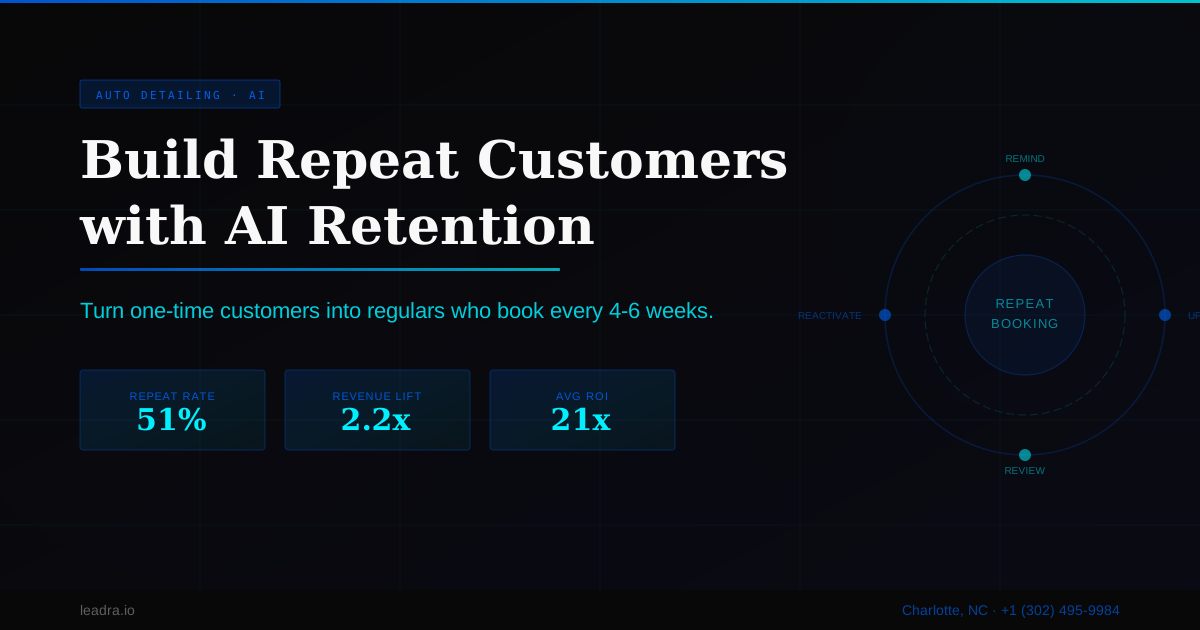
AI-powered retention systems close this gap by automating every touchpoint that currently relies on the customer to self-initiate — reminders, review requests, win-back messages, and upsell sequences. The shop owner does not have to remember to text anyone. The system does it for them.
The 4-Part AI Retention System for Auto Detailing Shops
A complete AI retention system for an auto detailing business runs four components. Each addresses a specific gap in the typical shop's post-service workflow:
Component 1: Timed Service Reminder Sequences
The moment a job is marked complete in your booking system, the AI logs the customer, their vehicle, their service type, and the date. It then calculates when to send the next reminder based on what they had done. Exterior wash and wax customers get a text 4 weeks out. Full interior and exterior detail customers get one at 6 weeks. Ceramic coating clients get a maintenance check-in at 90 days. The message references their actual vehicle — “Hey Marcus, your 2022 BMW M3 is coming up on its next recommended detail. Want to lock in a spot this week?” — and includes a direct booking link. That level of personalization is what separates a reminder that converts from one that gets ignored.
Component 2: Post-Service Review Automation
Within 2 hours of job completion — while the customer is still driving around in a freshly detailed car and feeling good about it — the AI sends a text with a direct Google review link. One tap. No extra steps. No need to search for the shop on Google. Auto detailing shops that automate this request consistently see 6-10x the monthly review volume of shops that rely on asking in person or putting a card in the window. For a shop competing for local map pack visibility against 8-12 nearby competitors, review count and recency directly influence who appears first when someone searches “auto detailing near me.” More reviews mean more inbound calls without spending an extra dollar on ads.
Component 3: Dormant Customer Reactivation
Every detailing shop has a list of past customers sitting in their booking system who have not been back in 60, 90, or 120 days. These are people who already know your work and chose you once — they are the lowest-cost customers you can reactivate because you do not need to sell them on your quality. An AI reactivation sequence identifies every customer past their expected rebooking window and sends a personalized text: their name, their vehicle, their last service date, and a direct offer. “It's been 10 weeks since your Escalade was in. We have openings this week if you want to get back on schedule.” Most detailing shops see 20-32% of dormant customers book within the first 5 days of receiving this message. That is pure recovered revenue with no ad spend.
Component 4: Premium Package Upsell Sequences
After a customer books their second detail, they are a proven repeat buyer. That is the right moment to introduce higher-ticket services — ceramic coating, paint protection film, engine bay cleaning, paint correction, full interior restoration. An AI upsell sequence sends a brief educational message between their 2nd and 3rd appointments explaining the service, what it does for their specific vehicle type, and a link to book a consultation. Detailing shops with a premium package upsell sequence running see average ticket values rise 35-55% among repeat customers within 90 days. A shop that was averaging $180 per visit starts averaging $260-$310 among its returning client base without changing a single service on the menu.
Auto Detailing Retention: Manual Follow-Up vs. AI System
Here is what these four components translate to in measurable outcomes for a typical 1-3 person detailing operation:
| Metric | No Follow-Up System | With AI Retention |
|---|---|---|
| 60-day repeat booking rate | 12-18% | 40-58% |
| Monthly Google reviews added | 2-4 | 14-28 |
| Dormant customer reactivation rate | 2-5% | 20-32% |
| Average repeat customer ticket | $170-$200 | $240-$320 (with upsell) |
| Customer lifetime value (Year 1) | $175-$220 | $680-$1,200 |
| Staff time on manual follow-up | 4-8 hrs/week | Under 30 min/week |
| Revenue from referrals (tied to review vol.) | Low / inconsistent | Steady (5-15 new inbound/mo) |
The lifetime value number is the one that changes everything. A shop getting 40 new customers per month with a 15% retention rate acquires 6 returning customers the next month. The same shop with 50% retention is carrying 20 returning customers — plus their higher average ticket from upsell sequences. That compounding effect is what separates a detailing shop stuck at $9,000/month from one growing past $22,000/month with the same number of new customers coming in.
Case Study: Charlotte Detailing Shop Doubles Monthly Revenue Without Adding a Single New Ad
A 2-person mobile detailing operation based in the South End area of Charlotte was doing solid work but stuck at $7,400 per month. The owner handled all the detailing. His partner managed bookings and customer communication. They were getting 35-40 new customers per month from word of mouth and a Google Business Profile with 22 reviews. Their problem: 82% of first-time customers never came back. They had no follow-up system. Every repeat booking was the customer remembering to call.
Leadra.io deployed a 4-component AI retention system over 5 days: service reminder sequences configured for their three package types, a post-service review request flow, a dormant reactivation campaign targeting the 190 past customers in their booking system who had not returned in 60+ days, and a ceramic coating upsell sequence triggered after the second booking.
Results after 90 days:
- →60-day repeat booking rate: 14% to 51%
- →Dormant customers reactivated from the initial 190-person campaign: 44
- →Google reviews: 22 to 81 (59 new reviews in 90 days)
- →Average ticket for repeat customers: $185 to $268 (ceramic upsell conversions)
- →New inbound calls from Google Maps (driven by review increase): +18/month
- →Monthly revenue: $7,400 to $16,200
- →Monthly system cost: $650
- →ROI in month 3: 21.2x
The owner noted that the first week of the dormant reactivation campaign alone produced 11 bookings from past customers. “We had 190 people in our system who had used us before and I was letting them sit there. The AI texted all of them in 48 hours and 11 booked before the end of the week. That was $2,000 in the first week that I never would have seen.”
What AI Retention for Auto Detailing Shops Costs in 2026
Pricing for a complete AI retention system varies based on your shop size and the components you need. Here is what you should expect at three common levels:
Tier 1 — Service Reminders + Review Automation: $400-$700/month
Timed service reminder sequences for each package type and automated post-service review requests. Right for solo detailers and mobile operators just starting with AI. Most see positive ROI within the first 15 days from recovered repeat bookings and increased Google visibility from new reviews.
Tier 2 — Full Retention Suite: $650-$1,200/month
Everything in Tier 1 plus dormant customer reactivation campaigns, premium package upsell sequences, and booking system integration. Right for shops with an existing customer base of 100+ past clients. The dormant reactivation campaign alone typically pays for 6-12 months of service in the first 2 weeks it runs.
Tier 3 — Retention + Acquisition Growth System: $1,200-$2,800/month
Everything in Tier 2 plus a 24/7 AI voice agent for inbound call capture, local SEO content targeting detailing keywords in your city, and referral automation sequences. Right for fixed-location detailing shops or mobile operators running multiple teams targeting aggressive growth. Builds both retention depth and organic new customer acquisition simultaneously.
For a solo or 2-person detailing operation doing $8,000-$12,000/month, a Tier 1 or Tier 2 system is the right starting point. At $180 average ticket, recovering 5 additional repeat bookings per month pays for a Tier 1 system entirely. Every booking beyond that is net new revenue with no extra ad spend.
How to Set Up an AI Retention System for Your Detailing Shop: 3 Steps
Most AI retention setups for detailing shops go live in 5-7 days. Here is what the process looks like:
Step 1: Audit Your Current Customer Database
Pull your complete customer list from your booking system — Launch27, DetailPro, Jobber, Square, or wherever you track jobs. Segment by last service date, service type, and vehicle type. This gives you the foundation for both your dormant reactivation campaign and your timed reminder sequences. Most shops discover they have 150-400 past customers sitting in their system who have not booked in 60+ days. That is the first reactivation target.
Step 2: Configure Service-Specific Reminder Timing
Map each service package to a reminder interval that matches how often a customer in that package tier realistically needs another detail. Exterior wash = 4 weeks. Standard full detail = 6 weeks. Premium full detail = 8 weeks. Ceramic maintenance = 12 weeks. Build the AI sequences around these intervals so each customer gets reminded at the right window, not a generic blast that has nothing to do with what they had done.
Step 3: Launch the Dormant Reactivation Campaign First
Before your forward-looking reminder sequences have had time to build a pipeline of returning customers, your dormant reactivation campaign gives you immediate revenue. Send the first campaign to everyone who has not booked in 60-90 days with a personalized text referencing their vehicle and last service date. Expect 20-32% to respond within 5 days. This is the fastest ROI move in any detailing shop's AI playbook — revenue from customers you already won, recovered without any new marketing budget.
Frequently Asked Questions
How does AI help auto detailing shops retain customers?
AI retains auto detailing customers through four connected systems: timed service reminders sent at the right interval for each service type, post-service review requests within 2 hours of job completion, dormant reactivation sequences for customers who have not returned in 60-90 days, and premium package upsell sequences for proven repeat buyers. Most shops see 40-58% of first-time customers return within 8 weeks compared to 12-18% without any follow-up system.
How often should auto detailing shops follow up with past customers?
Follow-up frequency should match the service type. Exterior wash customers need a nudge at 4 weeks. Full detail customers at 6-8 weeks. Ceramic coating clients at 90-120 days. AI follow-up systems can be configured per service type so each customer receives a reminder timed to their specific last booking — not a generic blast. The right timing is what converts reminders into rebookings instead of unsubscribes.
What ROI can an auto detailing business expect from AI retention tools?
Most detailing businesses see 3-5x ROI within 90 days. A 2-person shop doing $8,000-$12,000 per month with a 15% repeat rate can realistically reach 40-50% repeat bookings within 60 days. At a $180 average ticket, 12 additional repeat bookings per month adds $2,160 in revenue from existing customers with zero ad spend. Most AI retention setups for detailing shops run $400-$800 per month — the system pays for itself with 2-4 recovered repeat bookings.
Can AI integrate with auto detailing booking software like Launch27, DetailPro, or Jobber?
Yes. AI retention systems integrate with Launch27, DetailPro, Jobber, ServiceM8, Square Appointments, and similar platforms. The integration reads completed job records and triggers the right follow-up sequence automatically — service reminders timed to job type, review requests within 2 hours of completion, and reactivation messages for dormant customers. For shops using simpler setups like Google Calendar, a custom integration pulls completed appointment data and runs the same sequences.
Ready to Stop Losing Repeat Customers to Silence?
Leadra.io builds and manages complete AI retention systems for auto detailing shops. We handle the setup, booking system integration, reminder sequences, reactivation campaigns, and upsell flows — so you focus on the cars while the system brings customers back automatically.
Most detailing shops see their first recovered repeat bookings within 48 hours of the dormant reactivation campaign going live. Review volume increases start showing within the first week. Repeat booking rate improvements compound over the first 60-90 days.