The top auto repair shop in your neighborhood has 312 Google reviews. You have 41. Both shops do good work. One of them gets called first every time a driver types "mechanic near me" into Google — and it is not the shop with 41 reviews. Auto repair AI marketing in Charlotte NC has made review generation automatic, and the shops using it are compounding that advantage every single month.
Why Google Reviews Are the Most Valuable Asset an Auto Repair Shop Can Build
Every week, more than 80% of people who need car repairs search Google before calling anyone. They look at the Maps pack. They see the star ratings and the review counts. And then — according to research from BrightLocal — 88% of consumers will not visit a business with fewer than four stars.
For auto repair shops in Charlotte NC, this plays out in a very specific way. Google's local ranking algorithm weighs three things: relevance, distance, and prominence. You cannot control distance. Relevance takes months of content work. But prominence — driven by review count, recency, and rating — is something you can move fast with the right system.
Here is the competitive reality across Charlotte neighborhoods right now:
| Charlotte Area | Avg Reviews (Top 3) | Min Rating to Rank | Reviews Needed to Compete |
|---|---|---|---|
| Ballantyne / Pineville | 280 | 4.7+ | 150+ |
| SouthPark / Myers Park | 340 | 4.8+ | 200+ |
| University City / NE Charlotte | 190 | 4.6+ | 100+ |
| Huntersville / Cornelius | 210 | 4.7+ | 120+ |
| Matthews / Mint Hill | 160 | 4.6+ | 90+ |
| Steele Creek / Carowinds | 145 | 4.6+ | 80+ |
Most independent shops in Charlotte collect reviews at 1-3 per month — because they ask occasionally, awkwardly, and inconsistently. At that pace, it takes four years to hit 150 reviews. AI review generation compresses that into 90 days.
The Problem: Manual Review Collection Doesn't Work at Scale
Most shop owners know reviews matter. The problem is the workflow for getting them is broken.
A service advisor finishes explaining the invoice to a customer. The customer is relieved the car is done and already thinking about getting back to their day. The advisor says something like "If you have a second, it would really help us if you left a Google review." The customer nods. They mean to do it. They never do.
This pattern plays out across hundreds of completed jobs every month. The conversion rate on in-person review asks is typically 2-5%. For a shop doing 200 service tickets a month, that is 4-10 reviews if everything goes right. AI review generation systems convert at 18-28% of completed jobs when the ask goes out at the right time through the right channel.
| Factor | Manual Process | AI Review System |
|---|---|---|
| Review ask conversion rate | 2-5% | 18-28% |
| Reviews per month (200 tickets) | 4-10 | 36-56 |
| Consistency across all customers | Depends on advisor mood | 100% of completed jobs |
| Negative review early warning | None | Internal flag before Google post |
| Response to new reviews | Sporadic, often ignored | Auto-drafted within 2 hours |
| Staff time required | 3-5 hours/week | 15 minutes/week (review approvals) |
| Integration with shop management software | None | Direct (Mitchell1, Shop-Ware, Tekmetric) |
| Review velocity signal to Google | Flat / unpredictable | Consistent monthly growth |
The 5-Component AI Review Generation System for Auto Repair Shops
This is the system Leadra.io deploys for auto repair AI marketing in Charlotte NC. Each component handles a specific failure point in traditional review collection.
Component 1: Trigger-Based Post-Service SMS
The moment a repair order closes in your shop management software, the system triggers an automated SMS to the customer's cell phone. The message goes out within 30-90 minutes — while the customer is still thinking about their car. It uses their first name and the specific service performed ("Hey Marcus — glad we could get your brake job done today..."). This single change — going from in-person ask to timed SMS — is responsible for most of the conversion rate improvement. People do not ignore texts the way they ignore awkward counter-side requests.
Component 2: 48-Hour Follow-Up Sequence
Roughly 60% of customers who will leave a review do not do it on the first message. They intend to, set the phone down, and forget. A second message 48 hours later captures this group. The follow-up is shorter — a one-sentence reminder with the direct Google link. Shops see an average 40% increase in total review volume from the follow-up alone. The system stops after two touches to avoid annoying customers who have already decided not to leave a review.
Component 3: Sentiment Filter and Internal Alert
Before the review request goes to Google, the system sends a simple satisfaction check: "How was your experience? Rate us 1-5." Customers who respond with 1 or 2 get routed to an internal complaint flow — their feedback goes to the shop owner or service manager, not to a Google review prompt. This gives you a chance to recover the relationship before a one-star review goes live. Customers who respond 4 or 5 get the direct Google review link immediately. This is legal and Google-compliant because you are not paying for good reviews — you are simply routing negative feedback to a resolution path.
Component 4: AI-Drafted Review Responses
Google rewards businesses that respond to reviews. Shops that reply to every review rank measurably higher than those that do not — especially for competitive keyword searches. The AI drafts a personalized response to each new review within two hours, matching the tone of the original (warm for glowing reviews, solution-focused for critical ones). The shop owner or manager approves and posts with one click. Response time goes from "whenever I remember" to same-day, every time.
Component 5: Monthly Review Velocity Report
The system generates a monthly report showing new reviews, average rating trend, response rate, and competitor comparison for the top three shops in your zip code. Most shop owners have never seen their competitors' review velocity data. Knowing that the shop two miles away added 38 reviews last month while you added 4 changes how seriously you take this system.
Charlotte Case Study: Arrowhead Auto Service, Steele Creek (Real Results, Anonymized)
This example represents the type of results achieved by Leadra.io clients. Business name anonymized.
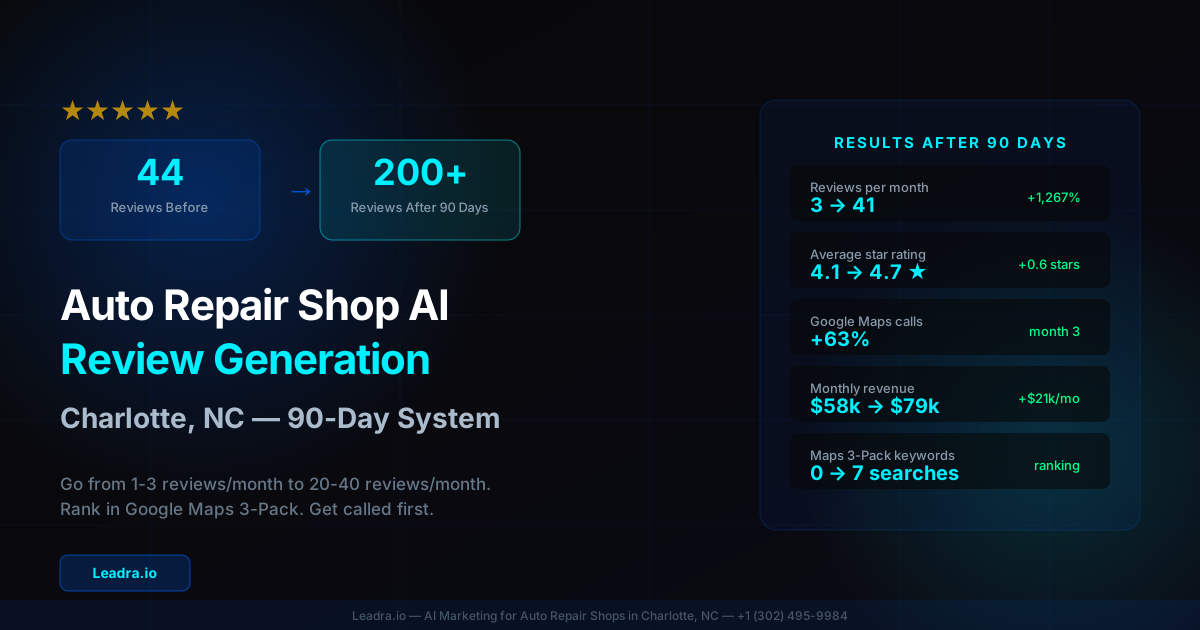
A five-bay independent auto repair shop in the Steele Creek area of Charlotte came to Leadra.io with 44 Google reviews and a 4.1-star average. They were not showing up in the Maps 3-Pack for any neighborhood search. A competing shop two miles away had 189 reviews and 4.8 stars and was capturing the majority of new customer calls.
Here is what changed after 90 days with the AI review generation system:
- Monthly review count: 3/month → 41/month
- Total reviews after 90 days: 44 → 167
- Average rating: 4.1 → 4.7 stars
- Google Maps 3-Pack appearances: 0 → 7 neighborhood keyword searches
- Inbound calls from Google Maps: +63% month-over-month by month 3
- Monthly revenue: $58,000 → $79,000 (additional revenue attributed to increased Google visibility)
- Negative reviews intercepted before posting: 11 in 90 days (resolved internally, converted 4 to 5-star reviews after service recovery)
The shop did not change their service quality, their pricing, or their staffing. The only thing that changed was how many customers were asked for a review, when, and how. The competitive gap that took the other shop six years to build was closed in one quarter.
Learn more about the broader auto repair AI marketing system for Charlotte NC shops and how review generation fits into the full acquisition funnel.
How to Implement AI Review Generation in Your Shop — 3 Steps
Step 1: Connect Your Shop Management Software
The system needs to know when a repair order closes to trigger the review request at the right time. Leadra.io integrates directly with Mitchell1, Shop-Ware, Tekmetric, and most other major platforms via API or webhook. Setup takes one business day. No changes to your existing workflow — the system watches the software you already use.
Step 2: Configure Sentiment Filter and Message Templates
Before launch, we build two message templates: the initial satisfaction check and the Google review request. Both are personalized with the customer's name and service details pulled from the repair order. You approve the templates before anything goes live. The sentiment threshold (which star rating routes to internal vs. Google) is configurable — most shops start at 3-star cutoff and adjust after the first 30 days of data.
Step 3: Set Up AI Response Drafting
Connect your Google Business Profile to the response system. The AI monitors for new reviews every two hours and drafts a personalized reply. You get a notification with the draft — approve it as-is or edit before posting. Most shop owners spend under 15 minutes a week on this task after the first two weeks. The response approval process stays with the owner because responses are public-facing and should reflect the shop's voice.
Pricing: What AI Review Generation Costs for a Charlotte Auto Repair Shop
| Tier | Monthly Cost | What's Included | Best For |
|---|---|---|---|
| Review Only | $400-$600 | SMS trigger, sentiment filter, AI response drafts, monthly report | Shops with 50-150 reviews wanting to close the gap |
| Review + AI Voice | $900-$1,400 | Everything above + 24/7 AI voice agent for missed calls and after-hours booking | Shops losing calls overnight or on weekends |
| Full AI Marketing Stack | $1,800-$3,500 | Reviews + voice agent + local SEO content + estimate follow-up + dormant reactivation | Shops ready to dominate their market in 6-12 months |
The math is straightforward. A shop doing 200 repair tickets per month at an average $280 ticket needs to close 2-3 incremental jobs per month from improved Google ranking to break even on the review-only tier. Most Charlotte shops see 8-15 incremental Google-sourced calls within the first 60 days as their rating and review count improves. See our AI implementation cost guide for Charlotte small businesses for a full ROI breakdown by business size.
Frequently Asked Questions
How does AI review generation work for auto repair shops in Charlotte NC?
AI review generation for auto repair shops works by automatically sending a timed SMS or email to every customer within 30-90 minutes of job completion. The message uses the customer's first name, references the specific service performed, and links directly to the shop's Google Business Profile review page. If the customer does not leave a review, a follow-up message goes out 48 hours later. Shops using this system in Charlotte NC typically go from 1-3 reviews per month to 20-40 per month within the first 60 days.
How many Google reviews does an auto repair shop need to rank in Charlotte NC?
To rank in the Google Maps 3-Pack for competitive searches like "auto repair Charlotte NC" or "oil change near me Charlotte," a shop typically needs 150+ reviews with a 4.7 or higher average rating. For neighborhood-level searches like "mechanic Ballantyne NC" or "brake repair Matthews NC," 50-80 reviews with a 4.8+ average is usually enough to hold a top-3 position. Review velocity — how many new reviews you get per month — matters as much as the total count.
Is it legal to automate Google review requests for an auto repair shop?
Yes, automating review requests is legal and complies with Google's policies as long as you ask all customers — not just the ones you think will leave good reviews. What Google prohibits is incentivizing reviews with discounts or cash, or filtering so only happy customers get the request. AI review generation systems send requests to every customer after service completion, which is fully compliant. The automation handles timing and follow-up; the customer writes an authentic review.
How much does AI review generation cost for an auto repair shop in Charlotte?
AI review generation for auto repair shops in Charlotte NC typically costs $400-$600 per month as a standalone service, or is included in a full AI marketing system running $1,800-$3,500 per month. Most shops see a direct revenue impact within 60 days as their Google ranking improves and more customers choose them over lower-rated competitors. A shop moving from 3.9 stars with 40 reviews to 4.8 stars with 180 reviews can expect 15-25% more organic calls from Google Maps.
The Bottom Line
Google reviews are not a nice-to-have for auto repair shops in Charlotte NC. They are the single most direct lever between your shop and the first call every time someone searches for a mechanic in your area. The shops dominating those searches did not get there by asking customers nicely at the counter. They automated it.
If your shop is doing good work but not showing up where customers are looking, the gap between you and your competitors is almost certainly a review gap — and AI closes it faster than any other system.
Ready to Start Building Your Review Advantage?
Leadra.io sets up the full AI review generation system for Charlotte auto repair shops — integrated with your existing shop management software, live within one week. Call us at +1 (864) 721-8384 or schedule a free strategy session to see your current review gap and what it takes to close it in 90 days.
Get Your Free Review Gap Analysis