Auto Repair AI Marketing in Charlotte NC: Get 30+ More Jobs Per Month Without Paying Per Lead (2026 Guide)
A Charlotte auto repair shop owner in Ballantyne was spending $2,200 per month on Yelp ads and CarGurus leads. He tracked the numbers closely: 34 paid leads per month, 9 booked appointments, 7 vehicles serviced. Cost per serviced vehicle: $314. His average repair ticket was $390. He was barely breaking even on his marketing budget before labor and parts.
Three miles away, a competitor had stopped paying for leads entirely. That shop was getting 61 inbound calls per month from Google searches alone — people typing “oil change Ballantyne NC,” “brake repair Pineville,” and “transmission shop near me” — and converting them at a 74% rate because an AI voice agent answered every call and booked the appointment on the spot.
The difference was not budget. It was strategy. The first shop was buying attention. The second shop had built a system that owned its local search real estate and captured every customer who found it.
This guide covers exactly how auto repair AI marketing in Charlotte NC works in 2026 — the five systems that drive sustained lead flow, what the Charlotte market looks like by neighborhood, and what real revenue results look like for independent shops that deploy it.
The Charlotte Auto Repair Market: Why AI Marketing Works Here Better Than Most Cities
Charlotte is one of the fastest-growing metro markets in the country. The population has grown 23% since 2015 and is projected to add another 300,000 residents by 2030. That growth means more vehicles, more commuters, and more service demand — but also more competition for the local search traffic that captures them.
Charlotte's auto repair market has three structural features that make AI marketing unusually effective here:
Neighborhood fragmentation.Charlotte drivers strongly prefer shops within 3-7 miles of home or work. A resident in Huntersville does not drive to South End for an oil change unless they have a specific relationship with that shop. This means the search volume for hyper-local queries (“oil change Huntersville,” “brake repair Cornelius,” “auto repair near Birkdale Village”) is high and the competition for those specific queries is thin. Most shops have one generic city-level page. Very few have optimized neighborhood-level content.
New suburb growth outpacing established shops. Ballantyne, Waxhaw, Harrisburg, and Concord have added significant housing density since 2020 with limited auto repair infrastructure relative to population. New residents are actively searching for local shops they do not know yet. First-page visibility for service + neighborhood searches captures those customers early and builds loyalty before competitors do.
After-hours search volume.Charlotte has a large population of commuters who search for services outside business hours. Searches for “auto repair near me” spike between 7-9 PM and again at 7-8 AM — before most front desks open. Shops with AI voice agents that answer calls and book appointments during those windows capture customers that otherwise bounce to whoever answers first.
Charlotte Auto Repair Market by Neighborhood: Where to Target First
Not all Charlotte neighborhoods are equal for auto repair demand. Here is where to prioritize AI marketing content based on vehicle demographics, search volume, and competitive saturation:
| Neighborhood | High-Value Services | SEO Competition | Opportunity |
|---|---|---|---|
| Ballantyne / Pineville | Luxury/European service, tires, brakes | Medium | High — affluent, high tickets, brand loyalty |
| Huntersville / Cornelius | Fleet service, tires, brakes, diagnostics | Low-Medium | Very High — fast growth, underserved market |
| Matthews / Mint Hill | Transmission, engine, older vehicles | Low | High — established homeowners, repeat customers |
| Concord / Harrisburg | Oil changes, tires, pre-purchase inspections | Low | Very High — new residents seeking local shops |
| University City | AC service, oil change, roadside emergencies | High | Medium — high volume but more competition |
| South End / NoDa | EV service, tire rotation, quick service | High | Medium — young professionals, convenience-driven |
The highest-ROI neighborhoods for a new AI marketing campaign are Huntersville/Cornelius and Concord/Harrisburg — fast-growing, low SEO competition, and active search volume from residents who have not yet established shop relationships. Ballantyne follows as a high-ticket-value market where quality positioning and review counts drive differentiation.
The 5-Component AI Marketing System for Charlotte Auto Repair Shops
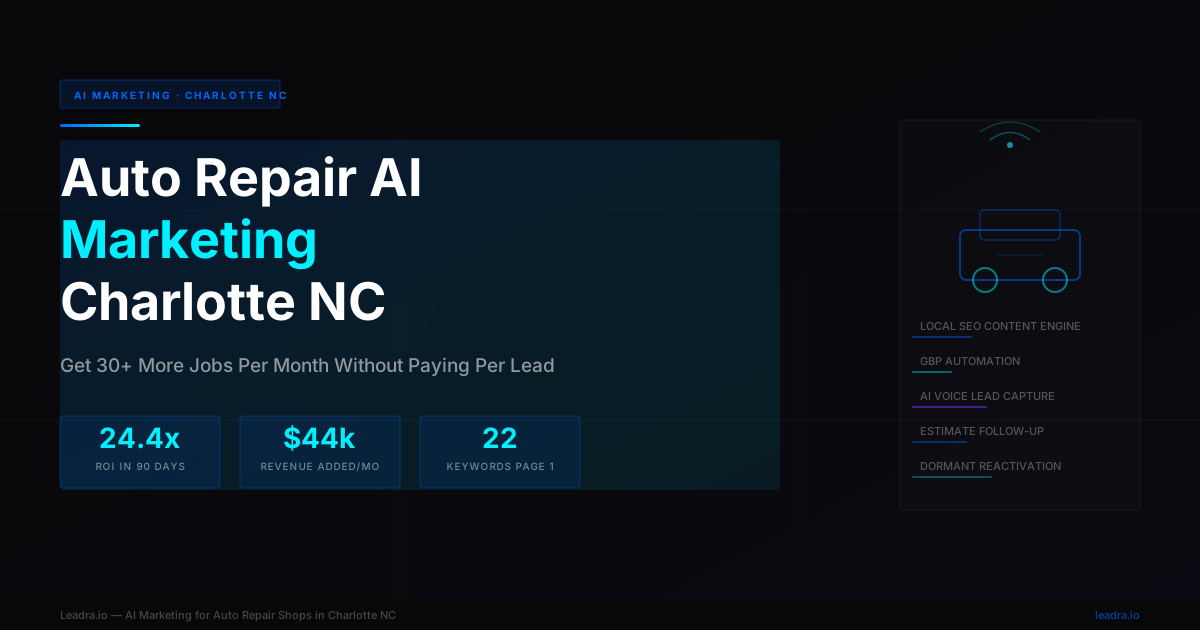
A complete auto repair AI marketing system for Charlotte runs five connected components. Each targets a specific point in the customer acquisition funnel — from the moment a driver searches on Google to the moment they become a repeat customer.
Component 1: AI Local SEO Content Engine
The content engine publishes 8-12 pieces of location-specific content per month targeting the exact search queries Charlotte drivers use before booking a shop. Instead of one generic “auto repair Charlotte” page, the system creates individual service + neighborhood pages: “oil change Ballantyne NC,” “transmission repair Matthews NC,” “brake shop Huntersville,” and “AC repair Concord NC.” Each page is optimized with FAQ schema for AI Overview eligibility in Google Search, and structured to answer the specific question a Charlotte driver would type at 8 PM after their AC stops working. Most independent shops currently have zero neighborhood-specific content. This creates a direct path to first-page rankings for 20-40 local keywords within 90 days.
Component 2: Google Business Profile Automation
Your Google Business Profile is the first thing a Charlotte driver sees when they search for auto repair near their location. An AI-managed GBP system posts weekly service updates, seasonal maintenance content, and new review responses — keeping the profile active and signaling to Google that the business is engaged. More importantly, it automates the review request process: every completed repair triggers a text to the customer with a direct one-tap Google review link. Independent shops using this system average 18-32 new reviews per month compared to 2-5 without automation. Review velocity directly correlates with local pack ranking — shops that generate reviews consistently outrank shops with higher static review counts but no recent activity.
Component 3: 24/7 AI Voice Lead Capture
Charlotte drivers who find your shop through Google search or GBP often call immediately — at 7 AM before they leave for work, at 9 PM after they notice a problem, or at noon when your service advisors are with vehicles in the bays. An AI voice agent answers every call your team misses, greets callers with your shop name, captures the vehicle and service request, checks live bay availability, and books the appointment on the spot. This is not a voicemail system — it is a live-sounding agent that completes the booking before the caller hangs up. Charlotte shops using this system typically capture 88-94% of all inbound calls including after-hours, compared to 52-65% for shops relying on front desk staff alone.
Component 4: Estimate Follow-Up Automation
When a Charlotte driver brings their vehicle in, gets a multi-point inspection, and receives an estimate for additional work they do not approve that day, most shops send them home and hope they come back. The industry average call-back rate on deferred estimates is 8-12%. An automated 5-touch follow-up sequence changes that number significantly: Day 1 text referencing the vehicle and specific service needed, Day 2 email with the estimate details, Day 4 AI voice call from a local number, Day 7 text with a booking link, Day 10 final reminder. Charlotte shops using this sequence see 28-40% of previously cold estimates convert to booked jobs within 10 days. On a $520 average deferred service ticket, converting 6-8 estimates per month adds $3,100-$4,200 in revenue from work customers already knew they needed.
Component 5: Dormant Customer Reactivation
Every auto repair shop in Charlotte has a database of past customers who have not returned in 6-18 months. These customers trusted your shop once. Reacquiring them costs dramatically less than acquiring new customers — no ad spend, no review decision, no cold trust-building. An AI reactivation system identifies customers whose vehicle is overdue for service based on last visit date and typical service intervals, sends a personalized text referencing their vehicle and last service, and books them back into your calendar automatically. Shops using this system reactivate 15-25% of contacted dormant customers each month with zero incremental ad budget.
Paid Leads vs. AI Marketing for Charlotte Auto Repair Shops
Most Charlotte auto repair shops currently use some combination of Yelp, CarGurus, Google Ads, or HomeAdvisor to generate new customers. Here is how those paid lead sources compare to an AI marketing system over time:
| Metric | Paid Leads (Yelp / Ads) | AI Marketing System |
|---|---|---|
| Cost per acquired customer | $180-$420 | $28-$74 (month 4+) |
| Lead quality (intent level) | Mixed — includes price shoppers | High — self-selected organic search |
| Traffic if you stop paying | Drops to zero immediately | SEO content keeps generating leads |
| After-hours lead capture | Leads go to voicemail — ~8% convert | AI books appointment live — ~91% convert |
| Deferred estimate recovery | No follow-up system | 5-touch sequence — 28-40% close rate |
| Review generation | Manual — 2-5/month | Automated — 18-32/month |
| Dormant customer value | No reactivation system | 15-25% reactivation rate |
| ROI at month 3 | 1x-2x (break-even territory) | 8x-18x compounding |
The key structural difference: paid leads stop the moment you stop paying. AI marketing builds assets — content that ranks, reviews that accumulate, dormant customer databases that grow — that continue generating revenue without ongoing ad spend. Month 6 with an AI marketing system is cheaper per customer than month 1 because the SEO content is ranking and the review count is compounding.
Case Study: South Charlotte Auto Repair Shop Grows from $74k to $118k/Month in 90 Days
A 5-bay independent auto repair shop in the Arrowood/South Boulevard corridor had operated since 2017 on a steady diet of repeat customers and Yelp spend. Monthly revenue had plateaued at $74,000 for six months. The owner was spending $1,900/month on Yelp and Google Ads, generating approximately 22 paid leads per month and converting 9 of them into service appointments. Cost per converted customer from paid sources: $211.
Their organic Google visibility was minimal — they ranked on page 3 for “auto repair near me” and had 31 Google reviews after seven years in business. Their call-back rate on deferred estimates was under 10%. They had no after-hours call coverage and no dormant customer outreach system.
Leadra.io deployed a full 5-component AI marketing system over 10 days: local SEO content engine targeting 8 Charlotte neighborhoods and 12 service-specific queries, GBP automation and review generation, 24/7 AI voice agent integrated with their Mitchell 1 shop management software, 5-touch estimate follow-up sequences, and dormant customer reactivation targeting 340 customers who had not returned in 9+ months.
Results after 90 days:
- →Page 1 Google rankings achieved for 22 local service keywords (0 at start)
- →Organic inbound calls from Google: 11/month to 58/month
- →Google reviews: 31 to 94 (63 new reviews in 90 days)
- →After-hours appointments booked: 0 to 29/month
- →Deferred estimate close rate: 9% to 34%
- →Dormant customers reactivated: 68 of 340 contacted (20% rate)
- →Paid ad spend eliminated in month 2 (organic volume replaced it)
- →Monthly revenue: $74,000 to $118,000
- →Monthly system cost: $1,800 (paid ad spend ended in month 2, saving an additional $1,900)
- →Net ROI in month 3: 24.4x (including ad spend savings)
The owner eliminated paid ads entirely in month 2 after organic call volume from Google search exceeded what Yelp and Google Ads had been delivering — at zero cost per click.
What Auto Repair AI Marketing Costs in Charlotte (2026 Pricing)
AI marketing systems for auto repair shops in Charlotte run at three tiers based on shop size and which components you deploy:
Starter — Call Capture + No-Show Prevention
$600-$1,000/mo24/7 AI voice agent, appointment booking integration with shop management software, 3-step no-show reminder sequence. Best for shops primarily trying to stop losing calls during peak hours and reduce empty bay time. ROI positive within 30-45 days for most shops.
Growth — Full Marketing + Booking System
$1,200-$2,500/moEverything in Starter plus local SEO content engine (8-12 posts/month), GBP automation and review generation, estimate follow-up sequences, and dormant customer reactivation. Most 4-6 bay independent shops land here. This is the tier where organic search starts replacing paid ads within 60-90 days.
Scale — Multi-Location or High-Volume
$2,500-$5,000+/moFull Growth tier plus fleet account outreach automation, commercial client acquisition sequences, multi-location GBP management, and advanced reporting dashboards. For shops doing $150k+ per month or managing 2+ locations across Charlotte's metro.
The break-even math is straightforward for most Charlotte shops: recovering 2-3 missed calls per week at a $380 average repair ticket covers the monthly cost of the Starter tier entirely. Every conversion beyond that is margin.
How to Get Started: 3-Step Implementation for Charlotte Auto Repair Shops
Audit Your Current Call and Ranking Gaps
Before deploying any system, establish a baseline. Run a call log audit for the last 30 days — how many calls came in, what percentage were answered within 3 rings, and how many went to voicemail without a callback. Then run a local ranking check: search for your top 5 service types + your neighborhood on Google in incognito mode and record where you appear. Most Charlotte shops find they are invisible for neighborhood-specific searches and missing 30-50% of inbound calls. These gaps define exactly where AI marketing will return the fastest ROI.
Deploy Call Capture First, Content Second
The fastest ROI comes from stopping the revenue bleeding before building the acquisition engine. Deploy the AI voice agent and estimate follow-up sequences in week 1 — these recover revenue from calls you are already getting and estimates you are already giving. Once those systems are running and generating positive cash flow in week 2-3, launch the local SEO content engine targeting your highest-value neighborhoods. The content compounds over 60-90 days and starts delivering organic calls that reduce your paid ad dependence.
Activate Dormant Customers in Month 2
After your call capture and content systems are running, export your customer database from your shop management software and identify customers who have not returned in 6-18 months. Segment by vehicle year and last service type to build personalized outreach messages (“Your 2019 Honda Accord is due for its next oil change — reply to book”). Most Charlotte shops have 200-600 dormant customers who represent zero ad cost and high conversion rates because the trust relationship already exists. Activating this list in month 2 adds significant revenue with no additional marketing spend.
Frequently Asked Questions: Auto Repair AI Marketing Charlotte NC
What is the best AI marketing strategy for auto repair shops in Charlotte NC?
The best strategy combines five systems: a local SEO content engine targeting neighborhood-specific service queries, Google Business Profile automation for consistent review generation, a 24/7 AI voice agent for after-hours and overflow call capture, a 5-touch estimate follow-up sequence for deferred repairs, and a dormant customer reactivation system for lapsed customers. Together these systems typically add 30-50 new jobs per month within 90 days without paying per lead.
How much does AI marketing for auto repair shops cost in Charlotte?
A full system runs $1,200-$2,500 per month for a 4-6 bay independent shop. A starter call capture and no-show prevention system runs $600-$1,000 per month. Most shops see ROI positive by month 2 as the incremental revenue from recovered calls and reactivated customers exceeds the monthly investment.
How does AI help auto repair shops rank higher on Google in Charlotte?
AI publishes neighborhood-specific service pages targeting searches like “oil change Huntersville NC,” “brake repair Ballantyne,” and “transmission shop Matthews NC” at a pace of 8-12 pages per month — far faster than any manual content strategy. Combined with GBP automation that generates reviews weekly, most Charlotte shops achieve page 1 rankings for 15-40 local keywords within 90 days.
What ROI can a Charlotte auto repair shop expect from AI marketing?
A 5-bay shop spending $1,800/month on a full AI marketing system typically adds $22,000-$34,000 in monthly revenue by month 3, representing 12x-19x ROI. The compounding effect of SEO content, review accumulation, and dormant reactivation means month 6 and month 12 returns are significantly higher than month 1 at the same monthly investment level.
Ready to Get 30+ More Jobs Per Month Without Paying Per Lead?
Leadra.io deploys full AI marketing systems for auto repair shops in Charlotte NC — local SEO content, GBP automation, 24/7 AI voice lead capture, estimate follow-up sequences, and dormant customer reactivation. Most shops see ROI positive results within 60 days. Setup takes 7-10 days with no disruption to your current operations.