Most barbershops run on hustle. You take calls between cuts, remind clients manually before appointments, ask satisfied customers to leave reviews (when you remember), and chase down lapsed clients when things slow down. The problem is you do all of this inconsistently — because cutting hair is the actual job, and marketing is what happens in the gaps.
Marketing automation fixes that. Not by replacing the personal touch that makes a great barbershop — but by running the follow-up, booking capture, and client retention work on autopilot so you can focus on the chair.
This guide walks through the full six-step barbershop marketing automation system: what each component does, how to set it up, what it costs, and what results look like in practice. By the end you'll know exactly which pieces to build first and what to expect at 30, 60, and 90 days.
Why Most Barbershop Marketing Wastes Money
Barbershop owners who try traditional marketing run into the same problem. They pay for Facebook ads or Instagram promotions, get some traffic, and then lose those potential clients in the follow-up gap. Someone sees the ad, DMs the shop, and doesn't hear back for three hours because the barber was in the middle of a cut. By then, they've already booked somewhere else.
The problem is rarely traffic. It's conversion. Most barbershops convert 10-20% of inquiries into confirmed appointments. Shops with automation running convert 45-65%. That gap comes entirely from response speed and follow-up consistency.
Automation doesn't just fix response speed. It eliminates the three biggest revenue leaks that drain most barbershop revenue every month: missed inbound contacts, no-shows with empty chairs, and dormant clients who came once and disappeared. Here's how to plug all three.
The 6-Step Barbershop Marketing Automation System
Build this in order. Each step compounds on the one before it. Most shops see measurable ROI from steps 1-3 within the first two weeks.
AI Booking and Inquiry Capture (24/7)
Every call, text, DM, and Google Business Profile message gets answered instantly — even at 11pm, even when you're mid-fade. The AI connects to your real-time schedule, checks availability for the specific barber the client wants, and books the appointment in the same conversation. No booking links to find, no hold music, no callback needed.
Set this up first because it's the highest-leverage change you can make. Shops that go from manual call handling to AI capture typically see a 35-55% increase in booked appointments within the first 30 days — not because more people are calling, but because dramatically more of the calls that were already coming in convert into bookings.
No-Show Prevention Sequences
For every booked appointment, the system runs a three-touch confirmation sequence: a personalized text 48 hours before asking the client to confirm or reschedule, a reminder 24 hours before, and a final check-in 2 hours before chair time. Each message uses the client's name and their barber's name.
If the client doesn't confirm by the 24-hour mark, the system automatically offers the slot to the next person on that barber's waitlist. The seat fills before you know there was a risk. For a three-chair shop running at 20% no-shows, this sequence typically recovers 12-18 slots per month — between $480 and $1,440 in monthly revenue that was previously evaporating.
Post-Visit Review Automation
Twenty minutes after every completed appointment, the system sends the client a brief text with their barber's name and a direct link to leave a Google review. No generic request — personalized, immediate, and one tap to the review form.
This alone generates 15-30 new Google reviews per month from a shop that was getting 2-5 before. More reviews directly raise your ranking in Google search and Google Maps — the two places most new barbershop clients find a shop for the first time. A shop going from 30 to 100 reviews with a 4.8+ rating typically sees organic new-client inquiries increase by 40-70% over six months, with no ad spend.
Dormant Client Reactivation
Every barbershop has a graveyard of past clients in the booking system who haven't returned in 60 days or more. For a busy shop, that's typically 150-400 people who already liked the work, already know the location, and just drifted because no one followed up.
The automation identifies dormant clients automatically and sends a personalized re-engagement message referencing their last visit and their barber's name. A sequence of two or three messages runs over 10 days and typically reactivates 22-30% of the dormant list — which for most shops translates to $800-$2,200 in recovered monthly revenue from clients you already acquired and paid for.
Post-Visit Rebooking Nudge
After each visit, the system sends the client a rebooking nudge 3-4 weeks later — timed to when they're likely due for their next cut based on their appointment history. The message is specific to their barber and offers to lock in a slot before the schedule fills.
This keeps your regular clients on a consistent cadence instead of waiting for them to remember to book. Shops running this step see a 25-35% reduction in the gap between repeat visits, which effectively increases revenue per client per year without acquiring anyone new. A client who came in every 5 weeks becomes one who comes in every 3.5 weeks — a 40% increase in annual revenue from that single person.
Google Business Profile Content Engine
Your Google Business Profile is often the first thing a new client sees about your shop. Most barbershops post once every few months, which signals to Google that the business isn't actively managed and lowers your ranking in local search.
An automated content engine publishes weekly GBP posts — service highlights, seasonal promotions, and before/after callouts — keeping the profile active without any manual effort. Combined with the review volume from step 3, an active GBP profile consistently pushes shops higher in "barbershop near me" searches and into Google's map pack results, where 70% of local search clicks go.
Manual Marketing vs. Automation: What Actually Changes
| Activity | Manual | Automated |
|---|---|---|
| Inbound call / text response | You respond when free — avg 2-4 hrs | Instant response, booked in 2 min |
| After-hours inquiries | Missed until morning — most gone | Answered and booked any time |
| No-show prevention | One generic reminder, maybe | 3-step sequence, auto waitlist fill |
| Review requests | Ask verbally — 2-5/month if lucky | Post-visit text — 15-30/month |
| Dormant client follow-up | Never, or bulk text blast | Personalized 3-touch sequence |
| Rebooking reminders | None — clients book when they remember | Timed nudge at peak re-visit window |
| GBP posts | Quarterly at best | Weekly, auto-generated |
| Overall inquiry conversion | 10-20% | 45-65% |
Case Study: Charlotte Barbershop Adds $13,200/Month in 90 Days
A three-chair barbershop in Charlotte's Plaza Midwood neighborhood was running a solid book of regulars but leaking revenue in three places: calls going to voicemail during peak hours, a 19% no-show rate, and 230 past clients in the system who hadn't booked in over 60 days. Monthly revenue was sitting at $18,200 — consistent but not growing.
Inquiry conversion
17%
58%
No-show rate
19%
6.8%
Google reviews
31
94
Monthly revenue
$18,200
$31,400
Leadra.io deployed the full six-step system in 7 days. The AI booking capture went live first — within the first week it handled 34 inbound inquiries that would have hit voicemail, converting 21 of them into confirmed appointments. That alone was roughly $840-$1,260 in recovered weekly revenue.
The no-show sequence cut the rate from 19% to 6.8% within 30 days, recovering an average of 14 chairs per week that were previously sitting empty after no-calls. The review automation sent 67 requests in month one and generated 31 new Google reviews — moving the shop from 31 reviews to 62 in a single month and pushing them from the 5th to the 2nd position in local barbershop search results.
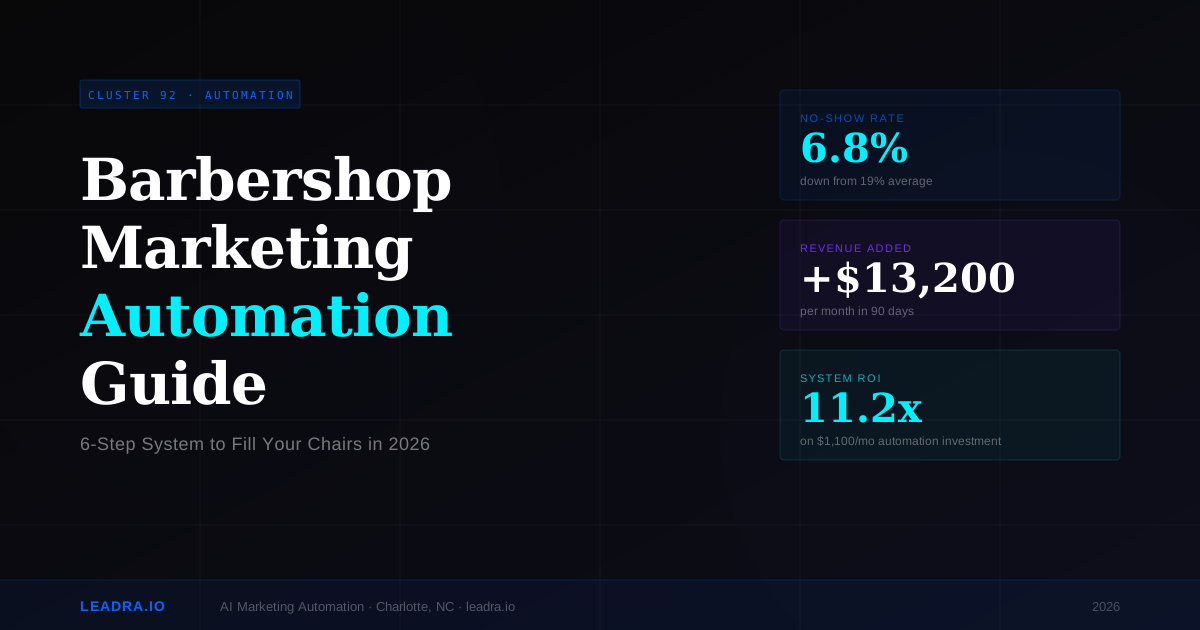
The dormant reactivation campaign at day 21 reached 230 past clients and brought back 54 of them over six weeks. By day 90, monthly revenue had grown from $18,200 to $31,400. The full automation system cost $1,100 per month. ROI at 90 days: 11.2x. The barbershop now runs a waitlist for three of its most requested barbers on Saturdays.
What Barbershop Marketing Automation Costs in 2026
Pricing scales with which components you activate and the number of barbers in the shop. Here's how it breaks down:
Starter
$400–$800/mo
- →AI booking via SMS and Google Business Profile chat
- →3-step no-show prevention sequence
- →Post-visit review automation
- →Waitlist fill on cancellations
- →Best for: solo or 2-chair shops with existing booking app
Growth
$800–$1,500/mo
- →Everything in Starter
- →After-hours inbound handling (calls + texts)
- →Dormant client reactivation campaigns
- →Post-visit rebooking nudge sequences
- →GBP content posts (weekly)
- →Best for: 2-4 chair shops replacing manual follow-up
Full System
$1,500–$2,500/mo
- →Everything in Growth
- →AI voice receptionist for inbound calls
- →Multi-channel: phone, SMS, Instagram DM, GBP chat
- →Monthly performance reporting and optimization
- →Local SEO content engine for organic ranking
- →Best for: 3+ chair shops ready to build a waitlist
What to Expect at 30, 60, and 90 Days
- →AI booking live — inquiries converting at 45-65% vs 10-20% before
- →No-show sequence cutting no-shows by 50-65% within 2-3 weeks
- →First 15-20 new Google reviews from post-visit automation
- →Initial revenue recovery: $1,200-$2,800 from converted missed contacts and recovered chairs
- →Dormant client reactivation campaign launched — 20-30% reactivation rate
- →Review count growth pushing GBP ranking higher in local search
- →Rebooking nudges increasing visit frequency for existing regulars
- →Cumulative revenue impact: $3,500-$7,000 over the first 60 days
- →Organic new-client inquiries increasing as GBP rank improves
- →Full automation running at scale — no manual follow-up required
- →Review count at 60-90 new reviews added since launch
- →Most shops at 6-11x ROI on their monthly automation investment
Frequently Asked Questions
What is barbershop marketing automation?
Barbershop marketing automation is the use of AI-driven software to handle the marketing and client management tasks that owners currently do manually — or skip entirely. This includes automatically booking appointments from calls and texts, sending no-show prevention reminders, requesting Google reviews after every visit, re-engaging dormant clients, and posting to your Google Business Profile. Instead of doing these tasks by hand, automation runs them 24 hours a day without any input from the barber or owner.
How much does marketing automation cost for a barbershop?
Barbershop marketing automation typically costs $400 to $2,500 per month depending on which components you activate. A basic stack covering AI booking, no-show reminders, and review automation runs $400-$800/month. A full system with voice AI for inbound calls, dormant client reactivation, and a content engine runs $1,500-$2,500/month. Most three-chair shops recover the full cost within 30 days from no-show prevention alone — 13-15 recovered slots per month at $40-$80 per slot adds up fast.
How long does it take to set up barbershop marketing automation?
A complete barbershop marketing automation system typically takes 5-7 days to configure and launch. Days 1-2 cover integrating the AI with your booking software (Booksy, Vagaro, StyleSeat, or Square Appointments) and setting up the no-show reminder sequences. Days 3-4 activate the review automation and Google Business Profile integrations. Days 5-7 build and launch the dormant client reactivation campaign. Most shops start seeing recovered revenue before the first week is over.
Does marketing automation work for independent barbershops or just chains?
Marketing automation works especially well for independent barbershops. Independent shops have tighter client relationships, which means personalized AI messages — using the client's name and their specific barber's name — get much higher response rates than generic chain communications. Independent shops also have more to gain from recovering missed calls and no-shows because every lost appointment directly hits the owner's income. Automation levels the playing field by giving a solo operator or small team the same follow-up infrastructure a larger operation has with full staff.
Related Reading
Ready to Build the Full Automation System for Your Shop?
Leadra.io builds and manages complete barbershop marketing automation systems — from AI booking capture to dormant client reactivation to GBP ranking. Most shops see positive ROI within the first 30 days.