Best AI for Electrical Contractors: Book More Jobs Without Adding Staff (2026 Guide)
The call came in at 6:48 PM on a Friday. A homeowner in south Charlotte smelled something burning near the main panel. She called three electrical contractors. The first two were on jobs and sent the call to voicemail. The third had an AI voice agent that picked up immediately, ran a 90-second triage, confirmed the smell and panel location, and dispatched an on-call electrician within three minutes. The job — a failing double-tapped breaker about to arc — was $1,840 by the time the tech left the driveway.
The other two contractors found the voicemail Saturday morning. By then, the job was done and the review was already posted.
This scenario plays out dozens of times a week across every electrical contracting market in the country. Electrical contractors miss more high-value calls than almost any other trade — because the work keeps them on-site, away from their phones, for 4-10 hours at a time. Meanwhile, the homeowner with a panel question, an EV charger quote request, or an emergency situation moves down their list until someone answers.
This guide covers what the best AI for electrical contractors actually does, how the system works for both emergency triage and quote follow-up, what real results look like for a Charlotte electrical company, and how to choose the right system for your business.
Why Electrical Contractors Lose More Jobs Than They Realize
Electrical contractors face two specific problems that drain revenue without leaving a visible record:
Problem 1: Missed calls during the workday. Electricians are on-site for hours at a stretch — in panels, attics, or behind walls where calls go to voicemail. A homeowner who calls while your tech is mid-job and gets no answer typically calls the next company on Google within 90 seconds. You never know the call happened. It just never shows up in your calendar.
Industry data on missed call rates for trades businesses puts the figure at 35-55% of inbound calls going unanswered during peak hours. For an electrical contractor doing $800,000 in annual revenue, recovering even 20% of those missed calls typically represents $60,000-$120,000 in additional bookable work — work that exists, that customers are willing to pay for, that is currently going to your competitors.
Problem 2: Quotes that go cold. The average electrical contractor sends 15-30 estimates per month. Industry close rates for electrical estimates run 28-42% — meaning 58-72% of the quotes you spend time and fuel on never convert. Most of those quotes die not because the customer chose a competitor, but because no one followed up. The customer got busy. The estimate sat in an inbox. Life moved on.
A 5-7 day automated follow-up sequence recovers 20-35% of those cold estimates. On a $1,400 average electrical project, recovering 4-6 quotes per month adds $5,600-$8,400 in revenue from work you already quoted. The best AI for electrical contractors handles both problems simultaneously — capturing missed calls and following up on estimates automatically, so nothing falls through.
What the Best AI for Electrical Contractors Does: A 5-Component Breakdown
A complete AI system for electrical contractors runs five interconnected components. Each one addresses a specific revenue leak in the typical electrical contracting business:
Component 1: 24/7 AI Voice Agent for Inbound Calls
The AI answers every call your team misses — during jobs, after hours, on weekends. It greets callers with your company name and runs a structured intake: What's the issue? Is it an emergency? What's the address? It books routine appointments directly into your field software and dispatches emergencies to your on-call tech in under 90 seconds. Callers hear a live-sounding voice and never hit voicemail.
Component 2: Electrical Emergency Triage Logic
Not every after-hours electrical call is an emergency. The AI uses intent detection and conditional questions to separate true emergencies — sparking outlets, burning smell, main breaker tripped and won't reset, no power to part of the home, downed service line — from routine requests like outlet installation quotes, ceiling fan inquiries, or EV charger questions. Emergencies get dispatched immediately. Non-emergencies get booked for next available daytime slot with no after-hours dispatch fee.
Component 3: Automated Quote Follow-Up Sequences
When a homeowner doesn't respond to your estimate within 24 hours, the AI starts a 5-7 day follow-up sequence: a friendly text on day 1, an email on day 2, a voice call on day 4, a final check-in on day 7. Each touchpoint references the specific job quote and keeps your company name visible while the customer is still in decision mode. Most electrical contractors see 20-35% of previously cold estimates convert through this sequence alone.
Component 4: Local SEO Content Engine
The AI publishes two to four SEO-optimized blog posts per week targeting electrical keywords in your service area: “electrical panel upgrade Charlotte NC,” “EV charger installation near me,” “licensed electrician for home addition [city].” These posts target Google's AI Overviews, traditional search results, and platforms like Perplexity and ChatGPT that are now handling a growing share of home service searches. Over 90 days, this creates a compounding organic lead channel that gets cheaper per lead every month.
Component 5: Automated Review Generation
After every completed job, the AI sends a text to the customer asking for a Google review — with a direct link, no extra steps. Electrical contractors who automate review requests see 4-8x the review volume of those who rely on asking in person. More reviews drive higher local search rankings, which puts your listing above competitors when homeowners search for electricians in your area.
Manual Operations vs. AI-Assisted Electrical Business: How the Numbers Compare
Here is what these five components mean in measurable terms for a typical electrical contracting business:
| Metric | Manual (Today) | With AI System |
|---|---|---|
| Inbound call capture rate | 45-65% | 92-97% |
| After-hours emergency capture | ~18% (voicemail) | ~94% |
| Estimate close rate | 28-42% | 48-61% |
| Monthly Google reviews added | 2-5 | 14-28 |
| Organic leads from SEO | 0-4/month | 12-30/month (by month 4) |
| Emergency dispatch speed | Morning callback (often) | Under 90 seconds |
| Hours/week spent on follow-up | 4-8 hrs (or zero) | Automated |
| Cost per booked job (blended) | $120-$300 | $28-$65 (month 4+) |
The biggest impact shows up in two places: after-hours emergency capture and quote follow-up. These are the two highest-ROI improvements because they recover revenue that already exists — jobs the customer was already willing to hire someone for. You're not creating demand. You're capturing it before a competitor does.
Case Study: Charlotte Electrical Contractor Adds $22,400/Month in 90 Days
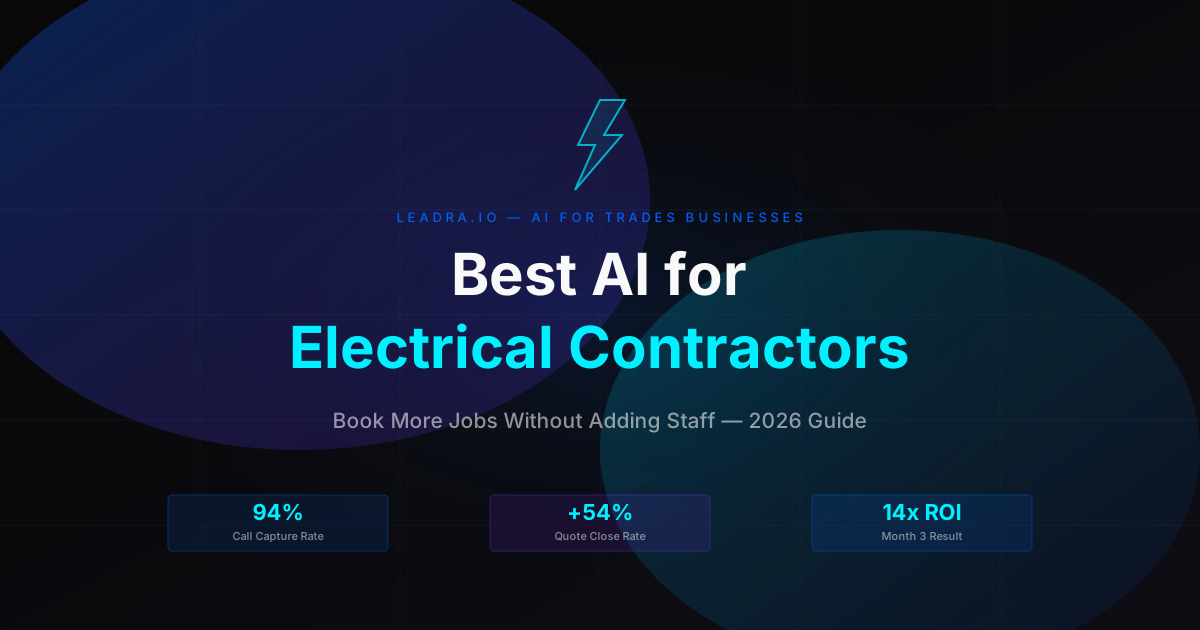
A 5-technician electrical contracting company in south Charlotte was doing solid work — panel upgrades, EV charger installations, residential rewiring, service calls — but had plateaued around $84,000 per month in revenue for three consecutive quarters. Their call-to-booked rate was 51%. Their estimate close rate was 31%. They had 29 Google reviews after six years in business.
They were not losing jobs because of poor work quality. They were losing jobs because of three specific gaps: missed calls during the workday, estimates that went cold after no follow-up, and a thin Google presence relative to competitors who had been accumulating reviews aggressively.
Leadra.io deployed a 5-component AI system in 9 days: 3 days for AI voice agent configuration and electrical triage scripting, 4 days for field software integration and quote follow-up sequence build-out, and 2 days of live call monitoring before full handoff.
Results after 90 days:
- →Inbound call capture rate: 51% to 94%
- →Estimate close rate: 31% to 54%
- →After-hours emergency jobs captured per month: 3 to 14
- →Google reviews added: 29 to 71 (42 new reviews in 90 days)
- →Organic leads from SEO content: 0 to 11/month (by day 87)
- →Monthly revenue: $84,000 to $106,400
- →Monthly system cost: $1,600
- →ROI in month 3: 14x
The owner noted that the quote follow-up system alone changed how he thought about his pipeline: “We used to send estimates and hope. Now the system follows up automatically, and we're closing jobs we sent quotes on three weeks ago. Some of those customers just needed one more touch.”
4 Things to Demand from Any AI System for Electrical Contractors
Most generic AI call or marketing tools are not built for the electrical trade. Here is what separates a purpose-built system from a generic product that will frustrate your team:
1. Electrical-Specific Job Qualification Logic
A generic AI that asks “how can I help you?” is not an electrical triage system. The AI needs to distinguish between a panel upgrade quote, an emergency arcing situation, an EV charger installation request, a ceiling fan swap, and a whole-home rewire — and handle each one differently. Emergency flags include: burning smell near the panel, outlets sparking, main breaker tripped and won't reset, partial power loss, downed lines, or flickering lights across multiple circuits. These need dispatch. Everything else needs a booking, not a dispatch.
2. Field Software Integration
The AI should write directly to your job management software — ServiceTitan, Jobber, Housecall Pro, or FieldEdge. A system that only sends SMS dispatch requires a manual data-entry step that gets missed during busy periods. Integration means new jobs appear in your dispatch board automatically, quote follow-ups pull from your estimate list in real time, and review requests trigger after job closure — no manual exports or copy-paste.
3. Multi-Touch Quote Follow-Up (Not Just One Text)
Single-touch follow-up — one text after the estimate — recovers 8-12% of cold quotes. A 5-touchpoint sequence over 7 days recovers 20-35%. The difference is persistence across multiple channels. Text on day 1. Email on day 2. Voice call on day 4. Final check on day 7. Each message should reference the specific estimate by job type and location, not a generic template. Homeowners deciding between three electrical contractors respond to specificity.
4. Local SEO Content Targeting High-Value Electrical Services
The highest-margin electrical jobs — panel upgrades ($1,800-$3,500), whole-home rewiring ($8,000-$20,000), EV charger installations ($1,200-$2,800), generator installations ($4,000-$12,000) — are actively searched by homeowners on Google. An AI that publishes two to four keyword-targeted posts per week compounds your organic visibility over time. By month 4-5, you should be pulling 10-25 organic leads per month from content alone, at near-zero marginal cost per lead.
AI Pricing for Electrical Contractors: 3-Tier Breakdown (2026)
| Tier | Monthly Cost | What's Included |
|---|---|---|
| Core | $800-$1,200/mo | 24/7 AI voice agent with electrical triage, on-call SMS dispatch, quote follow-up sequences (5 touchpoints), next-day booking for non-emergencies. Best for solo operators and 2-3 tech shops. |
| Growth | $1,200-$2,500/mo | Everything in Core + field software integration (ServiceTitan, Jobber, Housecall Pro, FieldEdge), automated review generation, GBP optimization, local SEO content (2 posts/week). Best for 3-6 tech companies. |
| Enterprise | $2,500-$4,500/mo | Everything in Growth + multi-location support, 4 SEO posts/week targeting high-value service keywords, custom escalation trees, quarterly strategy reviews, dedicated account manager. |
Add $80-$200/month for call minutes and SMS credits depending on volume. Most electrical contractors with 3-8 techs land in the $1,400-$2,800 all-in monthly range. A single recovered panel upgrade job ($2,200 average ticket) pays for two months of the Growth tier. Most companies hit positive ROI within their first 3-4 weeks.
The best AI for electrical contractors pairs naturally with a broader local service business lead generation strategy. For a full breakdown of how to build a multi-channel system across all your inbound channels — not just voice — read our guide on the AI lead generation system for local service businesses.
If you want to see exactly what implementation costs and timelines look like for deploying AI in a Charlotte-area trades business, our AI implementation cost breakdown for Charlotte NC small businesses covers three tiers with real numbers.
For electrical contractors who also want to recover jobs from old customer lists — previous service clients who haven't called in 12-24 months — the same AI infrastructure that handles new-lead capture also runs client reactivation sequences that pull dormant customers back into your booking calendar.
Frequently Asked Questions
What is the best AI for electrical contractors?
The best AI for electrical contractors combines a 24/7 AI voice agent that captures every inbound call — emergency and routine — with an automated quote follow-up system that texts or calls leads who haven't responded to estimates within 24 hours. Together these two systems address the two biggest revenue leaks in electrical contracting: missed calls going to competitors and quotes left unaccepted because no one followed up. Look for a system with electrical-specific job qualification logic, field software integration (ServiceTitan, Jobber, Housecall Pro, FieldEdge), and proven dispatch speeds under 90 seconds for emergency calls.
How does AI help electrical contractors get more jobs?
AI helps electrical contractors get more jobs in three ways. First, a 24/7 AI voice agent answers every call your team misses — during jobs, after hours, on weekends — and books the appointment or dispatches for emergencies automatically. Second, automated quote follow-up sequences contact every unresponsive estimate recipient over 5-7 days via text and email, recovering 20-35% of estimates that would otherwise go cold. Third, a local SEO content engine publishes electrical-specific blog content targeting searches like “electrical panel upgrade Charlotte NC” or “EV charger installation near me,” driving organic leads without paid ad spend.
How much does AI for electrical contractors cost?
AI systems for electrical contractors cost $800-$1,200 per month for a core call capture and quote follow-up setup, and $1,200-$4,500 per month for a full system with field software integration, local SEO content, GBP automation, and review generation. Most electrical contractors running 3-8 techs land in the $1,000-$2,500 all-in range. At an average electrical job ticket of $800-$2,400, a single recovered panel upgrade or rewire quote pays for 1-3 months of service. Most companies see positive ROI within the first 30 days.
Can AI handle electrical emergency calls after hours?
Yes. A properly configured AI voice agent handles electrical emergency calls after hours without any live staff. It answers immediately, runs a structured triage to identify true electrical emergencies — tripped main breaker, sparking outlets, burning smell, no power to part of the home, downed service line — and dispatches your on-call electrician via SMS within 90 seconds. Non-emergencies like outlet installation requests, light switch questions, or EV charger quotes are booked for next-day service. The AI filters so your on-call tech only gets dispatched for genuine overnight emergencies, not routine inquiries.
Stop Losing Electrical Jobs to Voicemail and Cold Quotes
Leadra.io deploys AI systems for electrical contractors in 7-10 days. Setup includes electrical-specific call triage, quote follow-up sequences, field software integration, and 30 days of live monitoring. Most electrical companies recover the first month's cost within their first two weeks of captured emergency calls and closed quotes.