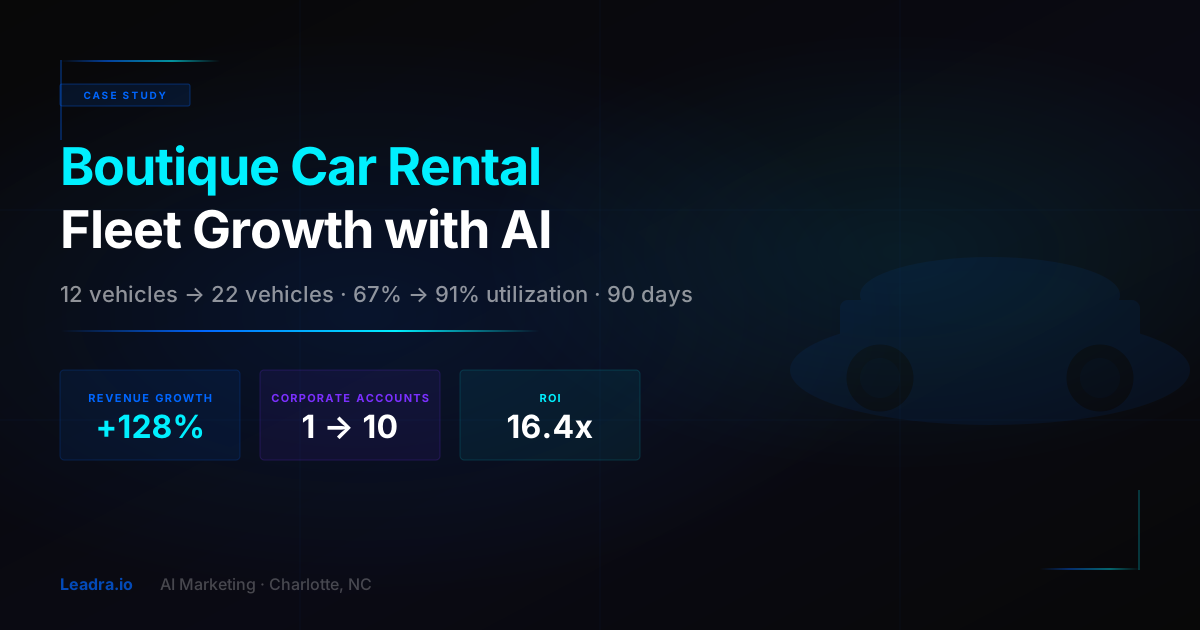
Marcus runs a boutique car rental company in Charlotte, NC. Twelve vehicles — six luxury SUVs, four premium sedans, and two cargo vans for corporate clients. Average rental rate: $340 per day. Before working with Leadra.io, his utilization rate sat at 67%. His phone went to voicemail after 6 PM. His web inquiries took an average of four hours to get a response. He had one corporate account.
Ninety days later: 91% utilization, nine corporate accounts, 22 vehicles in the fleet. Monthly revenue went from $28,000 to $64,000. This is the exact story of how that happened — which AI systems were deployed, in what order, and what each one cost.
Boutique car rental operators face a specific set of problems that generic fleet marketing advice doesn't address. This case study is built for operators running 8-30 specialty vehicles who want to grow revenue and fleet size without the overhead of a national chain.
The Boutique Car Rental Problem: High Value, High Leak
Boutique operators have one significant advantage over large fleet companies: higher average rental values. A luxury SUV renting at $350/day generates more revenue per vehicle than three economy cars combined. But that advantage disappears fast when the booking pipeline has holes in it.
Marcus's situation before AI was typical for boutique operators:
After-hours calls going to voicemail.
His call log showed 34 missed calls in a single month after 6 PM. At an average rental value of $340/day and a typical 3-day booking, each missed call represented $1,020 in potential revenue. That's $34,680 in monthly exposure — all going to competitors with 24/7 answering.
Web inquiries sitting unanswered for hours.
The average response time for his web contact form was 4.2 hours. Research consistently shows that after the first 5 minutes, the probability of converting a car rental inquiry drops by 80%. His four-hour response window was burning conversion before he even picked up the phone.
No systematic corporate outreach.
Marcus had one corporate account — a law firm that found him through a personal referral two years earlier. He knew corporate clients were the most valuable segment (predictable recurring bookings, high vehicle utilization, long relationships) but had no system to consistently pursue them.
Invisible in local search.
Searches like "luxury car rental Charlotte NC" and "premium SUV rental Charlotte" returned Enterprise and Hertz on page one. Marcus's website ranked on page three — effectively invisible. Fewer than 8% of searchers click past page one.
These four gaps, taken together, explain why a 12-vehicle boutique operator with $340 average daily rates was only generating $28,000 per month. The revenue was available. The demand existed. The leaks were eating it.
The 4 AI Systems Deployed (and Why in This Order)
Leadra.io deployed four systems over a 14-day setup period. The sequence was deliberate: stop the bleeding first, then build the growth engine.
01. AI Voice Agent — 24/7 After-Hours Booking
Deployed first, live within 48 hours. The AI voice agent answers every inbound call after business hours (6 PM–9 AM and all day weekends), qualifies the rental need — vehicle type, dates, pickup location, special requirements — and completes the reservation directly into Marcus's booking system.
For boutique operators, the voice agent was tuned to match the premium positioning. It doesn't sound like an IVR. It answers questions about specific vehicles, handles corporate account inquiries with a different script than leisure rentals, and escalates complex requests via text to Marcus with a summary so he can follow up first thing in the morning.
In week one alone, the agent captured 7 after-hours bookings that would have gone to voicemail. At Marcus's average rental value, that was $7,140 in week-one revenue from a single system.
02. Web Inquiry Follow-Up Automation
Deployed simultaneously with the voice agent. Any form submission or quote request on Marcus's website triggers an automated text within 90 seconds — personalized to the vehicle type requested, confirming availability and providing a direct booking link.
If the prospect doesn't book within 24 hours, a follow-up sequence runs at day 1, day 3, and day 7. Each message includes a different angle: day 1 is availability confirmation, day 3 is a testimonial from a past customer with a similar rental need, day 7 is a soft close with a direct call option.
Marcus's web inquiry conversion rate went from 12% to 38% within 30 days of deployment. That's the same number of web leads converting at 3x the rate — without spending a dollar more on traffic.
03. Corporate Account AI Outreach Sequence
Started in week three. The AI system identified 140 Charlotte-area businesses matching Marcus's target profile: law firms, commercial real estate companies, healthcare networks, consulting firms, and executive staffing agencies — businesses with regular executive travel needs and budgets to match.
A five-touch outreach sequence ran over 18 days for each prospect: personalized email introducing Marcus's fleet with a specific vehicle relevant to their business type, LinkedIn connection request with a short note, a follow-up email with a local Charlotte angle ("we work with three firms in your building"), a voicemail drop, and a final email with a clear call-to-action for a 20-minute intro call.
Result at 90 days: 9 new corporate accounts, averaging 4.2 rental days per month each. At $340/day, the corporate accounts alone add $14,500 in predictable monthly recurring revenue — a number that grows as the relationships deepen.
04. Local SEO Content and Review Automation
Running in parallel from day one, but results take longer to materialize. Each month, three to four articles targeting specific Charlotte-area luxury rental searches were published on Marcus's site — "luxury SUV rental Charlotte NC," "corporate vehicle rental Charlotte no credit card deposit," "premium car rental for executives Charlotte."
Review automation sent a post-rental text to every customer 2 hours after vehicle return. In 90 days, Marcus went from 14 Google reviews to 61 — and his average rating improved from 4.2 to 4.8 as the volume of authentic recent reviews diluted two older negative posts.
By day 75, Marcus's site ranked on the first page for three Charlotte luxury rental searches. Organic traffic to his booking page increased 4x. The SEO work is the slowest system to show results — and the one that compounds the longest.
90-Day Results: The Full Breakdown
Before vs After — 90 Days
| Metric | Before AI | After 90 Days |
|---|---|---|
| Fleet utilization rate | 67% | 91% |
| Monthly revenue | $28,000 | $64,000 |
| Vehicles in fleet | 12 | 22 |
| Corporate accounts | 1 | 10 |
| After-hours bookings/mo | 3 | 31 |
| Web inquiry conversion | 12% | 38% |
| Google reviews | 14 | 61 |
| Average Google rating | 4.2 | 4.8 |
Leadra.io monthly investment: $2,200. Revenue increase in 90 days: +$36,000/mo. ROI: 16.4x.
The fleet expansion from 12 to 22 vehicles happened in month three, not month one. That sequencing matters. Marcus didn't add vehicles until utilization consistently hit 88%+ for three consecutive weeks — the threshold where adding inventory is clearly the right financial move rather than a speculative bet.
The 10 additional vehicles added in month three were funded partly by the revenue increase and partly by a small business credit line Marcus secured using the 90-day revenue data as documentation. The AI systems effectively produced the proof of demand that made the financing straightforward.
Why Boutique Operators Get Faster AI ROI Than Large Fleets
Most AI marketing case studies in the car rental space focus on large regional or national operators. The ROI mechanics are different for boutique operators — and in most cases, significantly better. Here's why.
Higher per-booking value
A boutique luxury vehicle renting at $350/day generates the same revenue as five economy cars combined. Every additional booking captured by AI systems is worth proportionally more. The math on after-hours recovery and follow-up automation is dramatically better at $350/day than at $70/day.
Reputation leverage amplified
Boutique operators live and die by reputation. Going from 14 to 61 Google reviews in 90 days — with an average rating of 4.8 — has an outsized effect on conversion when every customer is making a considered, higher-dollar decision. Review automation ROI is compounding for boutique operators in a way it isn't for commodity fleets.
Corporate accounts are more attainable
Large fleet operators have sales teams pursuing enterprise contracts. Boutique operators can target the mid-market — local law firms, consultancies, healthcare groups — that national chains ignore. AI outreach automation makes it possible to run a consistent corporate development effort without dedicated sales headcount.
Niche keyword opportunity
Enterprise and Hertz dominate generic rental searches. They don't rank for 'luxury SUV rental Charlotte' or 'premium corporate car rental [city]' at a local level. Boutique operators can own these searches with focused content because they genuinely are the best answer — national chains can't match the vehicle quality or personalized service narrative.
What AI Marketing Costs for a Boutique Car Rental Operator
Marcus's setup was $2,200 per month. Here's how that breaks down, and what each component delivers.
Monthly Investment — Boutique Operator Package
At $350/day average rental rate, the break-even on a $2,200/month investment is 6-7 additional rental days per month. That's roughly two extra bookings — a number the AI voice agent alone exceeds in week one for most operators.
The compounding dynamic is what makes this a different calculation than standard advertising: OTA commissions are a percentage of every booking forever. AI system costs are fixed and don't scale with your revenue. At Marcus's 90-day revenue level, his effective cost per booking is $34 — and falling every month as volume increases on the same fixed system cost.
How to Replicate This: The 90-Day Boutique Fleet Growth Playbook
Marcus's results aren't unique to his market or vehicle type. The same system architecture applies to any boutique operator — luxury, specialty commercial, vintage, executive transport — because the leaks are the same across the category. Here's the sequence.
Week 1-2: Deploy AI voice agent and web follow-up automation
Stop the bleeding. Capture after-hours revenue immediately. These two systems have a 48-72 hour deployment window and show measurable results (additional confirmed bookings) within 7 days. Don't wait to deploy them together — every day of delay is missed revenue.
Week 3-4: Launch corporate account outreach and review automation
Begin building the recurring revenue base. Corporate account outreach takes 4-8 weeks to close first accounts — starting in week three means first closings in month two. Review automation starts compounding your reputation immediately.
Month 2: Publish first local SEO content; optimize follow-up sequences based on data
Start the SEO clock. Local ranking takes 60-90 days from first publication — the earlier you start, the earlier you compound. Review data from weeks 3-6 of follow-up sequences to identify where prospects drop off and refine the messaging.
Month 3: Evaluate fleet expansion and scale corporate pipeline
If utilization is consistently above 85%, fleet expansion is financially justified. Use month two revenue data for financing conversations. Scale the corporate outreach pipeline by adding a second segment — Marcus expanded from professional services into hospitality management in month three.
Frequently Asked Questions
Can AI really help a small boutique car rental company grow its fleet?
Yes. Fleet growth is a demand problem before it's a capital problem — if you can't fill the vehicles you already have at 85%+ utilization consistently, adding more vehicles just spreads the same revenue thinner. AI solves demand by capturing after-hours bookings, converting more web inquiries, and adding corporate accounts that provide predictable recurring volume. Once utilization is consistently above 85%, adding vehicles is a straightforward financial decision. Marcus went from 68% utilization to 91% in 60 days — which justified adding 10 vehicles in month three.
What makes boutique car rental operators different from large fleet companies when it comes to AI marketing?
Boutique operators have three distinct advantages: higher average rental values (specialty vehicles command $200-600/day vs $60-120 for standard fleets), stronger local reputation leverage (reviews and word-of-mouth matter more when every customer interaction is personal), and niche keyword opportunities that large chains ignore. AI marketing amplifies all three. The trade-off is that boutique operators have less margin for operational errors — AI systems that prevent missed calls and no-shows protect revenue that a large chain can absorb but a small operator cannot.
How many additional bookings does a boutique car rental company need to justify AI marketing costs?
For a boutique operator with specialty vehicles averaging $350/day, a full AI marketing system at $1,800-2,500/month requires 6-8 additional rental days per month to break even. That's roughly two extra weekly rentals — a number most boutique operators hit within the first 14 days just from deploying the AI voice agent and web inquiry follow-up. The corporate account pipeline and local SEO content then stack on top of that baseline, producing compounding returns through month three and beyond.
What AI systems should a boutique car rental operator deploy first?
Start with the two systems that stop revenue from walking out the door today: an AI voice agent for after-hours calls and an automated follow-up sequence for web inquiries. Together, these two systems typically recover 15-25% of previously lost bookings within 30 days. Then layer in corporate outreach in weeks 3-4 to build the high-value recurring revenue base that makes fleet expansion financially viable. Local SEO content and review automation run in parallel but take 60-90 days to show ranking results.
Fleet Growth Is a Demand Problem. AI Solves the Demand Problem.
Marcus went from 12 vehicles and $28,000 per month to 22 vehicles and $64,000 per month in 90 days. The fleet growth was the easy part — once utilization was consistently above 85%, the financial case for expansion wrote itself. The hard part was building the demand engine that made 85% utilization repeatable and predictable.
That engine is four AI systems running in parallel: a voice agent capturing after-hours revenue, follow-up automation converting web inquiries, corporate outreach building recurring accounts, and local SEO content compounding organic demand month over month.
If you run a boutique car rental operation — 6 to 30 vehicles, specialty or luxury focus, independent or regional — this system architecture applies directly to your business. The numbers will be different. The mechanics are the same.
Leadra.io works with boutique and specialty fleet operators to deploy these systems end-to-end. We start with a free audit of your current booking pipeline — missed calls, inquiry response time, web conversion rate, local search visibility — and show you exactly where your revenue is leaking and what each fix is worth.
Want to see how these systems handle the no-show problem specifically? Read our guide on AI reservation automation and no-show reduction for car rental companies.
Already have strong utilization but losing corporate accounts that go dormant? See the playbook for recovering dormant corporate car rental accounts with AI.
Free Fleet Growth Audit
Find Out Where Your Fleet Is Losing Revenue
30-minute audit. We analyze your after-hours capture rate, web inquiry conversion, corporate account pipeline, and local search visibility — then show you the exact revenue recovery available from each AI system.
Leadra.io
AI marketing agency — Charlotte, NC · Published June 30, 2026