Catering Company Marketing Automation Guide: The Complete System for 2026
Most catering companies lose 40-60% of their event leads before ever sending a quote. Not because they lack skill or reputation — because they respond too slowly, follow up inconsistently, or rank on page 3 of Google where no one looks. This guide covers the exact marketing automation system that fixes all three.
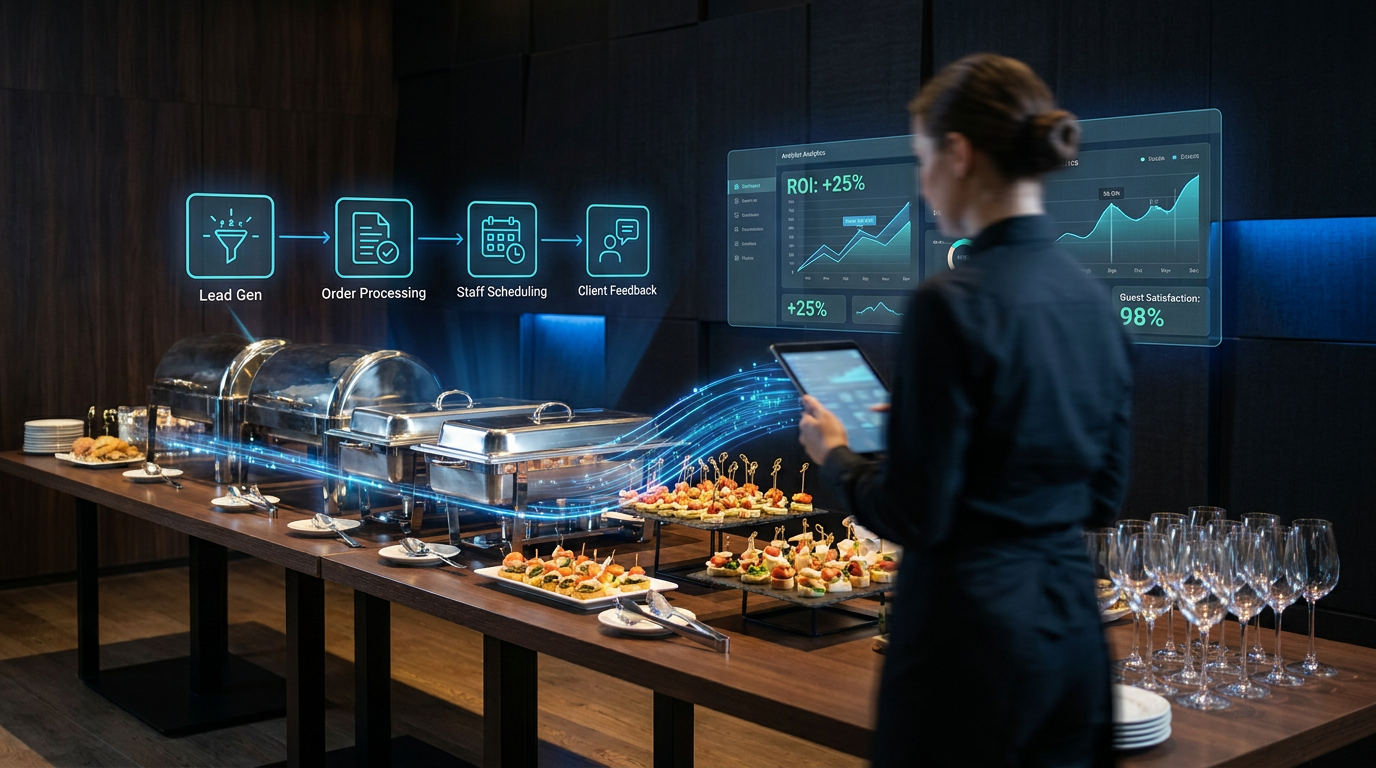
Why Most Catering Marketing Fails (The Data Is Ugly)
The average catering company responds to new event inquiries in 5-8 hours. Corporate planners and wedding coordinators who submitted that same inquiry to four other caterers have already moved on. A Harvard Business Review study found companies responding within 5 minutes are 100 times more likely to connect with the lead than those waiting 30 minutes. For catering, with weekend and evening inquiries making up 40% of volume, slow response is a death sentence.
But speed is only part of the problem. Most catering businesses also:
- Send one quote and never follow up when the client goes quiet
- Rank on page 2-3 of Google for high-intent searches like "catering company near me"
- Have 15-30 Google reviews when competitors have 200+
- Spend $2,000-$5,000/month on ads while ignoring free organic traffic
- Lose past clients to competitors because they never run reactivation campaigns
Marketing automation solves every one of these problems — simultaneously — without hiring additional staff. Here is the complete system.
Component 1: AI Lead Capture (The 90-Second Response)
The first component of catering company marketing automation is an AI lead capture agent that responds to every inquiry within 90 seconds — regardless of time, day, or whether you are currently serving 300 guests at a wedding.
When a potential client fills out your contact form, sends a Facebook message, or triggers a missed call text-back, the AI agent takes over. It sends a personalized response that asks four qualifying questions:
- What type of event? (corporate, wedding, social, fundraiser)
- What is the date and guest count?
- Do you have a venue selected, or do you need event space recommendations?
- What is your approximate per-person budget?
Based on the answers, the system either books a tasting or consultation call directly into your calendar, or flags the lead as out of budget/range and sends a polite follow-up. You wake up every morning with qualified leads already triaged — not a raw inbox full of unread form submissions.
For catering companies doing $400k-$800k per year, this single component typically recovers 8-12 events per month that previously went to faster competitors.
Component 2: Automated Follow-Up Sequences
You send a quote. The client says "we're still deciding." Then silence. Most catering companies send one follow-up email three days later and give up. The data says that 80% of sales require 5+ follow-up touchpoints — but 44% of salespeople quit after one.
Automated follow-up sequences handle this without anyone on your team sending a single message. A properly structured catering follow-up sequence looks like this:
| Day | Channel | Message |
|---|---|---|
| Day 1 | Quote delivery + 3 event photos from similar events | |
| Day 3 | SMS | "Did you get a chance to look at the proposal? Happy to adjust the menu or budget." |
| Day 6 | Social proof email — 2-3 testimonials from similar events | |
| Day 10 | SMS | Availability check — "Your date is still open. Want to hold it with a small deposit?" |
| Day 14 | Final reach-out with a limited-time menu upgrade offer |
This sequence runs automatically for every unconverted quote. Catering companies using automated follow-up sequences close 15-25% of leads that previously went dark — events that were already partially sold, they just needed one more nudge at the right time.
Component 3: Local SEO Content Automation
The most sustainable lead source for any catering company is organic Google traffic — people actively searching for exactly what you offer. But ranking on page 1 requires consistent content production, technical SEO, and Google Business Profile optimization. None of which a busy catering operator has time to do manually.
Local SEO content automation handles this end-to-end. The system publishes 2-4 keyword-optimized blog posts per week targeting the searches your ideal clients use. For a catering company, those searches look like:
- "corporate catering [city]" and "office lunch catering near me"
- "wedding catering [city]" and "catering company for weddings [state]"
- "affordable catering per person [city]" and "catering cost estimate"
- "catering company for [event type] near me" — graduations, galas, fundraisers
- "catering company reviews [city]" — high-intent comparison searches
Each post is built with Article + FAQPage + LocalBusiness JSON-LD schema markup, which makes it eligible for Google AI Overviews — the summary answers Google shows at the top of results before any organic links. Getting featured in AI Overviews for "catering company near me" queries is the 2026 equivalent of a top-3 organic ranking.
Within 90 days, consistent local SEO content automation typically moves catering companies from page 3 to page 1 for 5-10 target keywords, adding 25-50 new inbound inquiries per month from organic traffic alone.
Component 4: Review Generation Automation
Google reviews are the single biggest factor in local pack rankings — and in whether a corporate planner or wedding client picks you over a competitor. A catering company with 200+ reviews at a 4.7 average beats one with 40 reviews at a 4.9 in local search results every time. Volume matters more than perfection.
Manual review requests almost never happen. You finish a 6-hour event, break down equipment, reconcile with staff, and review requests fall off the priority list. Automated review generation fixes this by triggering a review request sequence automatically 24-48 hours after each completed event.
The sequence uses SMS because SMS open rates are 98% versus 21% for email. The first message is a simple satisfaction check: "Hi [name], it was a pleasure serving [company/couple] yesterday. How did we do?" Clients who reply positively get a follow-up with a direct Google review link. Clients who reply with concerns get routed to you directly — which means you catch problems before they become public reviews.
Catering companies using automated review generation collect 8-15 new reviews per month versus 1-2 manually. Within a year, that is 100+ new reviews — enough to dominate local search and eliminate competitors with outdated profiles.
Component 5: Past Client Reactivation
Your existing client list is your most underused asset. Corporate clients repeat catering purchases quarterly. Wedding clients refer friends who are getting married. Social clients host events annually. But only if they remember you.
Past client reactivation automation runs in the background year-round. It identifies clients who booked 6-12 months ago and have not reordered, then sends a targeted sequence referencing their specific event. A corporate client who used you for a holiday party in December gets a message in October: "Hi [name], we loved working with [company] last year. Planning your holiday party this year? We're booking December now and have limited availability."
This channel consistently produces 3-8 rebooking events per month for catering companies with a client list of 100+ past clients. These are zero-acquisition-cost bookings — the relationship already exists. You are just reminding people at the right time.
What the Numbers Look Like After 90 Days
Here is a realistic model for a catering company doing $500,000/year with a $3,500 average event value and 143 events per year:
| Metric | Before Automation | After 90 Days |
|---|---|---|
| Monthly inquiries | 35 | 52 |
| Close rate | 19% | 29% |
| Events booked/month | 6-7 | 14-15 |
| Monthly revenue | ~$41,700 | ~$52,500 |
| Google reviews | 28 | 52 |
| Google local pack ranking | #6-8 | #2-4 |
| System cost | $0 | $1,200/mo |
| Net new revenue | — | +$10,800/mo |
The system pays for itself with one additional event per month. Everything beyond that is pure margin.
How to Set Up Marketing Automation for Your Catering Company
The fastest path to implementing this system is not building it yourself — every piece takes weeks to configure, integrate, and optimize. Here is the recommended sequence for getting started:
- Audit your current lead response time. Use a test inquiry from a friend to see exactly how long it takes your business to respond. Most owners are shocked — 4-12 hours is typical. That number is your baseline.
- Inventory your unconverted quotes from the past 90 days. Every quote that did not convert is a reactivation opportunity. Automated follow-up can recover 15-25% of these.
- Claim and fully optimize your Google Business Profile. Add every service category, upload 20+ event photos, enable messaging, and set up automated review requests. This alone improves local pack ranking within 30 days.
- Identify your top 10 target keywords. Use Google Search Console if you have it, or search for "[your city] catering company" and note which competitors dominate. That tells you what content to produce first.
- Implement in order of ROI. AI lead capture first (fastest payback), then follow-up sequences, then review generation, then local SEO content, then reactivation. Do not try to launch all five at once.
Frequently Asked Questions
What is marketing automation for catering companies?
Marketing automation for catering companies is a set of software systems that handle lead capture, follow-up, local SEO content, and review requests without manual effort. Instead of checking email after-hours, missing inquiry calls, or forgetting to follow up on quotes, automation handles every touchpoint 24/7. The core components are an AI lead capture agent that responds to inquiries in under 90 seconds, an automated email/SMS follow-up sequence for unconverted quotes, a local SEO content engine that publishes keyword-optimized posts targeting event searches, and a review generation system that texts happy clients post-event.
How fast should a catering company respond to a new lead?
A catering company should respond to a new lead within 5 minutes — ideally under 90 seconds. Research from Harvard Business Review shows companies that respond within 5 minutes are 100x more likely to connect with a lead than those that wait 30 minutes. For catering specifically, event planners and corporate buyers are comparing 3-5 caterers simultaneously. The first to respond and provide a quote typically wins. An AI lead capture agent solves this by qualifying the inquiry and booking a consultation automatically — within seconds of the form submission or missed call.
How does local SEO automation work for a catering company?
Local SEO automation for catering companies works by publishing fresh, keyword-optimized content consistently. The system generates 2-4 blog posts per week targeting searches like 'corporate catering [city]', 'wedding catering near me', and 'catering company for office lunch'. Each post includes proper schema markup (Article + LocalBusiness + FAQ JSON-LD) for Google AI Overview eligibility. Simultaneously, the system automates Google Business Profile updates. Within 60-90 days, catering companies typically see their local pack ranking climb 3-6 positions, generating 20-40 new inbound inquiries per month from organic traffic alone.
How much revenue can marketing automation add to a catering business?
Marketing automation typically adds $8,000-$25,000 per month in new revenue for catering companies doing $300k-$1M+ annually. A catering company getting 35 event inquiries per month with a 19% close rate and $3,500 average event value earns about $41,700/month. Automation increases inquiry volume 30-50% through local SEO improvements and improves close rate from 19% to 28-32% through instant response and consistent follow-up. That combination typically adds 7-10 additional booked events per month — $24,500-$35,000 in new monthly revenue — at a system cost of $800-$2,500/month.
Ready to Automate Your Catering Marketing?
Leadra.io builds and manages the complete marketing automation system for catering companies — AI lead capture, follow-up sequences, local SEO, and review generation. Most clients see ROI within 30 days.
Charlotte, NC — serving catering companies across the US