Most chiropractic practices spend money on Google Ads or Facebook ads to generate new patients — then lose 40-60% of those leads because nobody answers after 5 PM, web forms sit unanswered overnight, and first appointments no-show at a 30% rate.
The problem isn't lead volume. It's what happens to leads after they arrive. A 2024 analysis by Software Advice found the average chiropractic practice misses 42% of inbound calls. Of the patients who fill out a web form, fewer than 20% convert to a booked appointment when response time exceeds 30 minutes. Add a 28-35% first-appointment no-show rate and a dormant patient database that nobody ever contacts — and most practices are running at half capacity while paying full overhead.
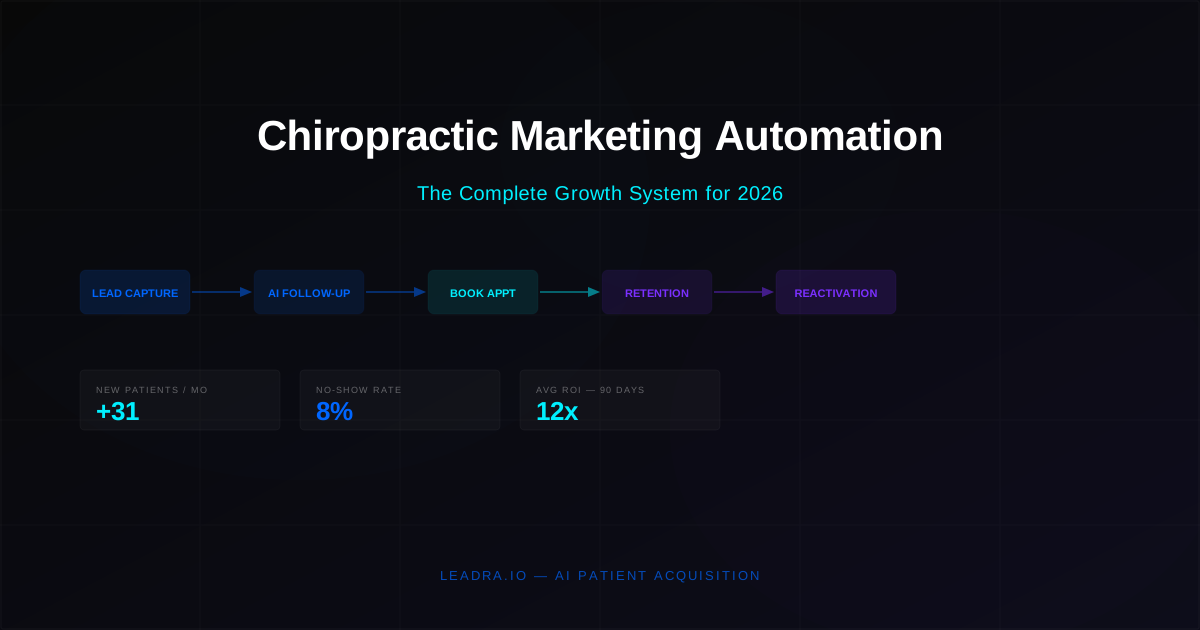
Chiropractic marketing automation fixes this by replacing manual follow-up with systems that operate 24 hours a day, seven days a week, without staff involvement. This guide covers all six automation components, how each one connects to the patient lifecycle, and what a fully deployed system produces — with real numbers from chiropractic practices running it in 2026.
At Leadra.io, we've deployed these systems for chiropractic practices across Charlotte, NC and nationally. The data consistently shows the same pattern: most practices have more than enough inbound interest to double their new patient volume — they just lack the infrastructure to capture it.
Why Manual Marketing Fails Chiropractic Practices
Chiropractic has one of the highest intent-to-contact rates of any healthcare specialty. Patients in acute pain act immediately — they search Google, call the first practice that shows up, and book within hours of the onset of symptoms. The conversion window is short: research from Harvard Business Review found that a prospect who doesn't reach a live person within 5 minutes of initiating contact has a less than 5% chance of converting with that provider.
The manual approach to chiropractic marketing has four failure points that automation fixes directly:
After-hours call misses
38-44% of new patient calls arrive outside business hours. These are the highest-intent prospects — acute pain doesn't wait for Monday morning. Voicemail converts under 20% of these callers because they've already called two other practices by the time your front desk calls back.
Slow web inquiry response
The average chiropractic practice responds to a web form or GBP message in 6-18 hours. At that response time, contact rates drop below 5%. The patient booked elsewhere within 30 minutes of submitting the form.
First-appointment no-shows
A 28-35% no-show rate is standard for new chiropractic patients. Without an automated reminder sequence that re-engages the patient between booking and arrival, roughly 1 in 3 new patient slots sits empty — representing $150-$250 in direct lost revenue plus the opportunity cost of a filled slot.
Zero reactivation outreach
The average chiropractic patient has a 60-70% chance of recurring symptoms within 12-18 months of completing a care plan. Most practices never contact discharged patients again — those patients end up booking with whoever shows up first in their next Google search, which is often a competitor.
None of these are staffing problems. No additional front desk hire fixes a patient who called at 9 PM on a Saturday. These are infrastructure problems — and automation is the only solution that covers the full 24-hour window at a cost that makes sense for a single-provider or small-group practice.
The 6 Systems in a Complete Chiropractic Marketing Automation Stack
Here's what each component does, the specific failure point it addresses, and what measurable impact practices see in the first 90 days.
24/7 AI Voice Agent — Never Miss a New Patient Call
Roughly 38-44% of new patient calls to a chiropractic practice come outside office hours — evenings, weekends, and the lunch window when front desk staff step away. An AI voice agent answers every one of those calls, qualifies the caller (new vs. existing patient, chief complaint, insurance), and books them directly into your schedule using real-time availability. The AI handles the entire conversation — it doesn't take a message or promise a callback. It gets the patient booked. For practices averaging 60 inbound calls per month, capturing 40% of the after-hours calls they're currently losing to voicemail translates directly to 8-12 additional new patients per month without any change to advertising spend.
60-Second Web Lead Follow-Up
When a potential patient fills out your contact form or sends a message through Google Business Profile, speed determines whether you get the patient or a competitor does. MIT research found that calling a web lead within 5 minutes makes you 21x more likely to connect versus calling 30 minutes later. Most chiropractic front desks respond to web inquiries the next morning — a 12-hour gap that drops contact rates below 5%. An automated web-to-SMS system sends a personalized text within 60 seconds of any form submission, confirms receipt, asks about scheduling availability, and offers to book directly from the conversation thread. This single automation typically increases web-to-appointment conversion rates from 15-20% to 45-60%.
Appointment Confirmation and No-Show Prevention
New chiropractic patients no-show at a rate of 28-35% — the highest in any outpatient specialty. The patient booked while in acute pain, the pain eased, and showing up now feels optional. A three-step automated reminder sequence cuts this to 7-12%: a confirmation SMS sent immediately after booking, a personalized reminder 48 hours before the appointment that references the patient's chief complaint, and a final reminder 2 hours before with directions and parking. The 48-hour message is the most important — it re-anchors the patient to the reason they booked and reduces the "I feel better now" cancellation pattern. At an average first-appointment value of $200, reducing no-shows from 30% to 9% on 40 new patient appointments per month recovers $1,680 in monthly revenue.
Automated Google Review Generation
Chiropractic is a high-trust local search category. Patients searching "chiropractor near me" or "back pain relief [city]" look at review count and rating before clicking — practices in the Google Maps 3-Pack get 60-70% of local search clicks, and maintaining a 3-Pack position requires consistent new reviews. Most practices get 2-4 reviews per month organically because front desk staff ask verbally, inconsistently, at checkout. An automated review request system sends a personalized SMS 2 hours after every patient visit with a direct link to your Google Business Profile review form. This consistency produces 18-35 new reviews per month for the average chiropractic practice — enough to climb into the 3-Pack within 60-90 days in most markets and hold position once there.
Google Business Profile Content Automation
Google weights recency and engagement signals for GBP rankings. Practices that post weekly — sharing condition-specific content, patient education, and seasonal relevance — rank significantly higher than practices that post monthly or not at all. Manual GBP posting gets deprioritized by front desk staff the moment the waiting room gets busy. An automated GBP content system publishes 4-7 posts per week targeting local pain-condition keywords ("sciatica treatment Charlotte NC," "sports injury chiropractor near me"), responds to GBP reviews within 24 hours to signal engagement, and flags any negative reviews for immediate human response. Practices using this system see a 40-80% increase in GBP-sourced calls within 90 days.
Discharged Patient Reactivation Campaigns
Every chiropractic practice has a database of patients who completed a care plan, got significant relief, and stopped coming in — even though their underlying condition never fully resolved. Degenerative disc disease, chronic muscle tension, and recurring sports injuries don't fix themselves. A discharged patient reactivation system contacts these patients at 90 days, 6 months, and 12 months post-discharge with a personalized message referencing their original complaint and the progress they made during care. These are the warmest leads in your entire marketing universe — they already trust you, have experienced results, and are far more likely to rebook than a cold prospect. Typical reactivation rates are 15-25% per campaign. At 200 inactive patients contacted, that's 30-50 reactivations at a cost of $20-$40 each, compared to $200-$400 for a new patient acquisition.
What a Full Automation Stack Produces: A 2026 Chiropractic Case Study
Client Case — Multi-Specialty Practice, Southeast US
A two-provider chiropractic practice came to Leadra.io in February 2026 averaging 32 new patients per month. Their Google Ads spend was $3,200/month. Their cost per new patient was $100. The practice had 680 inactive patient records — former patients who had completed care plans in the past 3 years and never returned.
A call audit showed 47% of inbound calls during a 30-day sample were unanswered. Web form response time averaged 9 hours. New patient no-show rate was 29%. The 680 inactive records had received zero outreach since their last appointment.
Leadra.io deployed all six automation components over a 7-day setup. The AI voice agent activated on day 4, capturing 14 after-hours calls in week one — 11 of which booked appointments without speaking to a human staff member. The web-to-SMS system cut average response time from 9 hours to 47 seconds. The discharged patient reactivation campaign launched targeting the 680 inactive records segmented by care plan type and recency.
New patients / month
32
61
No-show rate
29%
8%
Google Ad cost/patient
$100
$54
Google reviews
48
127
Automation stack cost: $2,800/month · New patient revenue increase: +$58,000/month · Month-3 ROI: 20.7x · Discharged patient campaign: 112 reactivations from 680 contacts in 90 days · Average reactivation cost: $25 vs. $100 Google Ads cost per new patient.
The cost per patient acquisition dropped from $100 to $54 — not because ad spend decreased, but because the practice started converting the leads their ads were already generating. The AI voice agent alone recovered patients who would have booked with a competitor after the practice's voicemail picked up.
The highest-ROI component was the discharged patient campaign. Of the 680 inactive records contacted over 90 days, 112 rebooked — at an average care plan value of $650. That single campaign generated over $72,000 in recovered revenue from patients already in the database, at a fraction of what acquiring new patients through advertising costs.
Implementation Timeline: What the First 90 Days Look Like
Setup is faster than most chiropractors expect. Here's the standard deployment timeline Leadra.io runs with new chiropractic clients:
No Technical Work Required
Your staff provides EHR login credentials and phone system access. Leadra.io handles all integration, configuration, and testing. The only thing your team does during setup is a 45-minute onboarding call to review scheduling rules, qualification questions, and messaging preferences. After that, the systems run automatically.
How to Calculate the ROI Before You Commit to Anything
Before deploying any automation system, run a revenue leak audit on your own data. This takes about 90 minutes and surfaces the exact dollar value of what you're currently losing. Here's the framework:
Quantify your missed calls
Pull 30 days of call data from your phone system, Google Voice, or your EHR's call log. Count unanswered calls as a percentage of total inbound calls. Multiply missed calls by your average new patient value. Most practices find $5,000-$18,000 in monthly missed-call revenue.
Check web inquiry response time and conversion rate
Pull your last 30 web form submissions and calculate average response time. For each 30-minute increment beyond 5 minutes, conversion rate drops by roughly 3-5 percentage points. If you're responding in 8 hours, you're converting under 10% of web inquiries. Calculate the delta between your current rate and a 50% conversion rate — that's the revenue gap the automation closes.
Calculate your no-show revenue loss
Pull your new patient no-show report for the past 90 days. Multiply no-shows by your average first-appointment value. Then calculate the difference between your current no-show rate and 9% (the rate practices hit with automated reminder sequences). That's the monthly revenue floor the no-show prevention system recovers.
Value your inactive patient database
Count patients who completed a care plan in the past 3 years and haven't returned. Multiply that number by 0.18 (a conservative 18% reactivation rate) to get projected reactivations. Multiply by your average care plan value. Most practices with 200+ inactive records find $20,000-$60,000 in recoverable revenue from a single campaign.
When you add up these four numbers, the total almost always exceeds the cost of the automation system by 4x-6x before accounting for the GBP improvement and review generation impact on organic search traffic. That's your baseline ROI projection — built from your own data, before any money changes hands.
See also: AI for chiropractors: getting 30+ new patients per month and discharged patient reactivation for chiropractic practices for deeper dives into specific components of this system.
Frequently Asked Questions
What is chiropractic marketing automation and what does it include?
Chiropractic marketing automation is a set of software systems that replace manual marketing tasks at a chiropractic practice. A complete automation stack includes: a 24/7 AI voice agent that answers and books calls after hours, a web-to-SMS system that follows up online leads within 60 seconds, appointment confirmation and no-show prevention sequences, automated post-visit review requests sent by SMS, Google Business Profile content automation, and a discharged patient reactivation system that contacts inactive patients at 90 days, 6 months, and 12 months. Each system runs continuously without staff involvement, covering the full patient lifecycle from first contact through long-term retention.
How much does chiropractic marketing automation cost per month?
Chiropractic marketing automation costs between $800 and $4,500 per month depending on the systems included and practice size. A foundational package covering 24/7 call capture, web lead follow-up, and no-show prevention runs $800-$1,800/month. Adding review generation, GBP automation, and discharged patient reactivation brings the cost to $1,800-$3,200/month. A full growth stack with local SEO content automation costs $3,200-$4,500/month. Most chiropractic practices that implement a mid-tier package see positive ROI within 45-60 days — the average month-3 ROI is 8x-15x across Leadra.io deployments.
What software do chiropractic marketing automation systems connect to?
Chiropractic marketing automation systems built by Leadra.io connect to ChiroTouch, Jane App, Genesis Chiropractic Software, Office Ally, Practice Fusion, and any EHR or practice management platform with API access or webhooks. For phone-based automation, the AI voice agent integrates with your existing phone number via call forwarding — no hardware changes needed. Review request automation connects to Google Business Profile and optionally Yelp and Healthgrades. For practices on legacy or closed systems without direct API access, automation runs via two-way SMS, email, and manual schedule sync with a 30-minute daily reconciliation process.
How long does it take to set up marketing automation for a chiropractic practice?
Setting up chiropractic marketing automation takes 3-7 business days from initial kickoff to all systems live. Day 1-2 covers access setup, EHR integration, and phone routing configuration. Day 3-4 covers AI voice agent training on your scheduling rules, qualification questions, and practice-specific information. Day 5 covers web follow-up activation and no-show sequence setup. Day 6-7 covers review automation and GBP posting schedule configuration. The discharged patient reactivation system launches on day 7 after the initial patient database segmentation is complete. No IT work is required from your staff — Leadra.io handles the entire technical setup.
The Patients Are There — the System Just Isn't Catching Them
Most chiropractic practice growth problems aren't marketing problems. The search volume is there. The Google Ads are generating clicks. The GBP listing is getting views. The problem is what happens between the first contact and the first appointment — and what happens after a patient completes care and disappears.
A complete chiropractic marketing automation system closes every gap in that lifecycle: 24/7 call coverage, 60-second web follow-up, no-show prevention, consistent review generation, GBP content that drives local rankings, and a reactivation engine that turns your existing patient database into a recurring revenue stream.
Leadra.io builds and deploys these systems for chiropractic practices with full EHR integration, a 7-day setup timeline, and a 90-day ROI guarantee. Call +1 (864) 721-8384 or book a free revenue leak audit below.
Free Revenue Leak Audit
See Exactly How Much Revenue Your Practice Is Leaving on the Table
30-minute audit. We'll analyze your call data, web inquiry response times, no-show rate, and inactive patient database — then project the revenue impact of each automation component before you commit to anything.
Leadra.io
AI marketing agency — Charlotte, NC · Published July 3, 2026