Patient Reactivation for Chiropractors with AI: Win Back Dormant Patients at $28 CAC
June 3, 2026 · 10 min read
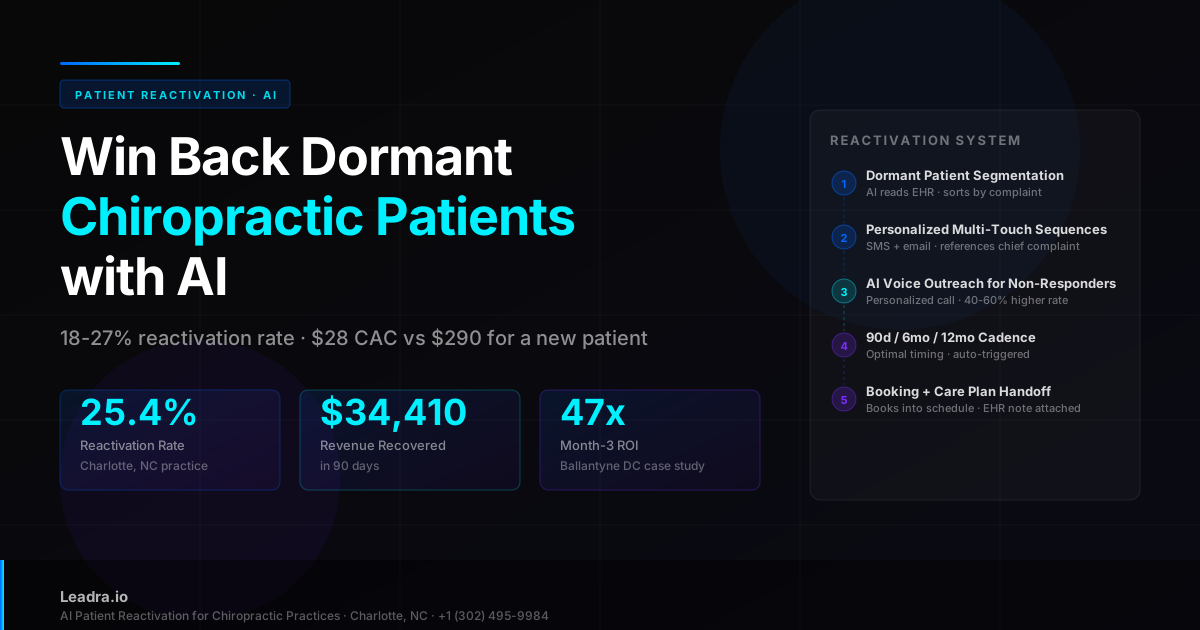
The average chiropractic practice has 300-600 patients who completed care, got relief, and disappeared — even though their underlying problem never fully resolved. These are not lost patients. They are warm leads sitting in your EHR, waiting for the right message at the right time. Generic recall postcards reach 2-5% of them. AI reactivation systems — personalized by complaint, triggered by time elapsed, and delivered across SMS, email, and voice — recover 18-27% of the same list at $20-$35 per reactivated patient versus $200-$400 to acquire a new one.
The Hidden Revenue Problem Every Chiropractic Practice Has
Most chiropractors focus their marketing on acquiring new patients — running Google Ads, buying leads from directories, paying for SEO. The average new patient cost in chiropractic runs $200-$400 in competitive markets. At 20 new patients per month, that's $4,000-$8,000 in monthly acquisition spend just to stay flat.
Meanwhile, 300-600 former patients sit in the EHR with unresolved complaints and zero outreach from the practice. A patient who came in for disc herniation, completed 18 visits, got 80% better, and was discharged — that patient's disc issue didn't disappear. Six months later, the tightness is back. They need care. But nobody called them.
A 2024 survey by the American Chiropractic Association found that 68% of patients who stopped care still had some level of unresolved symptoms at the 6-month mark. The reason they didn't return wasn't dissatisfaction — 71% said they intended to come back "when it got bad enough." AI reactivation removes the friction between that intention and an actual appointment.
The math: A practice with 400 dormant patients, running AI reactivation at a 22% recovery rate, books 88 reactivation appointments over 90 days. At an average case value of $280 (initial exam + 3-4 visits), that's $24,640 in recovered revenue from patients who cost $28 each to reactivate — versus $290 to acquire a new patient with the same lifetime value.
Why Traditional Recall Gets 2-5% — and AI Gets 18-27%
Traditional chiropractic recall fails for three reasons. First, it's not personalized — a postcard that says "We miss you!" doesn't tell a patient why they should come back. Second, it's poorly timed — most practices send one recall attempt at 6 months and give up, missing the 90-day window when symptom recurrence is highest. Third, it uses the wrong channel — mail open rates for healthcare recall average 15-20%, while SMS open rates exceed 95%.
AI reactivation fixes all three. The system sends personalized messages that reference the patient's specific complaint, fires at the statistically optimal 90-day, 6-month, and 12-month intervals, and uses SMS as the primary channel with email and voice as follow-up layers. A patient who ignored a postcard will respond to a text that says: "Hi Sarah — it's been about 4 months since your last visit for your lower back. Many of our patients find symptoms start returning around this point. Would you like to schedule a quick check-in this week?"
Specificity triggers response. Generic messages get deleted.
The 5-Component AI Patient Reactivation System for Chiropractors
Dormant patient identification and segmentation
The first step is knowing exactly who to contact — and in what order. AI connects to your EHR and segments every patient inactive for 90+ days into four groups: completed care plan (highest reactivation potential), dropped out mid-plan (warm leads with unresolved complaints), no-showed on last appointment (easiest to re-engage), and long-term lapsed (12+ months, lower rate but still profitable). Each segment gets a different message angle, different urgency level, and different follow-up cadence. Practices that send one generic recall blast to everyone see 2-4% response rates. Segmented AI outreach consistently delivers 18-27% response rates.
Personalized multi-touch outreach sequences
AI sends each dormant patient a sequence personalized to their original chief complaint. A patient who came in with acute lower back pain from a car accident gets a message that references that specific complaint — 'We noticed it's been 4 months since your last visit for your low back. Many patients find that without maintenance, the underlying issue starts to return. Would you like to schedule a quick 20-minute check-in?' A generic 'we miss you' postcard gets ignored. A message referencing their specific pain gets opened. Each sequence runs 3-5 touches across SMS, email, and a personalized AI voice call — stopping the moment a patient responds or books.
AI voice outbound calls for non-responders
Patients who don't respond to SMS or email within 5 days receive a personalized AI voice call. The voice agent introduces itself as calling from your practice, references the patient by name and their original complaint, and asks a direct question about how they're feeling. If the patient is interested, the AI books the appointment live — reading your real-time schedule and confirming the slot before ending the call. If the patient isn't ready, the AI logs the response and queues a follow-up message at the next sequence milestone. Practices using AI voice calls in their reactivation stack see 40-60% higher reactivation rates than practices using SMS and email alone.
Trigger-based timing: the 90-day, 6-month, 12-month cadence
Timing is the most underrated variable in chiropractic reactivation. Most practices that attempt recall send one postcard 6 months after discharge and give up. AI runs a systematic cadence: the first outreach sequence starts at exactly 90 days post-discharge (when the original complaint is statistically most likely to be returning), the second sequence fires at 6 months (targeting maintenance-minded patients), and the third at 12 months (capturing those who put off care). Each cadence point runs a fresh 3-5 touch sequence. This multi-cadence approach captures patients at different stages of pain recurrence — typically recovering 12-18% at 90 days, 6-8% at 6 months, and 4-6% at 12 months from the same patient database.
Reactivation booking and care plan handoff
When a dormant patient responds and books, the AI creates the appointment, sends a confirmation with directions and parking, and attaches a care plan reminder note to their chart in your EHR. The front desk sees the returning patient flagged as a reactivation — not a new patient — with their original complaint summary and treatment history. This context ensures the provider can immediately speak to where the patient left off rather than treating them like a stranger. The AI also triggers a no-show prevention sequence for the reactivation appointment — because patients who haven't been in the office for 6-12 months have the same high no-show risk as new patients.
The Reactivation Economics: Why This Outperforms New Patient Acquisition
The single biggest reason chiropractic practices don't prioritize reactivation is that they don't understand the unit economics. Here's the direct comparison:
| Metric | New Patient Acquisition | AI Reactivation |
|---|---|---|
| Cost per conversion | $200-$400 (Google Ads, leads) | $20-$35 (AI outreach cost) |
| Trust level at first contact | Zero — stranger | High — existing relationship |
| Conversion rate (contact → booked) | 15-25% | 18-27% (AI-driven) |
| Time to convert | Days to weeks | Hours to days |
| No-show risk | 28-35% for first appointments | 12-18% (relationship intact) |
| Average case value | $250-$350 | $220-$320 (slightly lower — returning for maintenance) |
| ROI on outreach spend | 3x-6x (competitive markets) | 8x-18x |
The math is not close. Reactivation consistently delivers 2-4x higher ROI than new patient acquisition in chiropractic — because you're converting warm leads with existing trust into re-booking patients, not convincing strangers to try a new provider.
Manual Recall vs AI Reactivation: Side-by-Side
| What You're Measuring | Manual Recall | AI Reactivation |
|---|---|---|
| Dormant patient identification | Manual EHR review (rarely done) | Automated daily segmentation by inactive days |
| Outreach personalization | Generic recall postcard | Chief-complaint-specific SMS + email + voice |
| Outreach speed after discharge | 6+ months (if at all) | 90-day trigger, automatic |
| Multi-touch follow-up | 1 postcard, then forgotten | 3-5 touch sequence per cadence milestone |
| AI voice calls | Staff calls (inconsistent, time-consuming) | Automated, personalized, 24/7 capable |
| Reactivation rate | 2-5% (postcard recall) | 18-27% (AI multi-touch) |
| Cost per reactivated patient | $80-$200 (staff time + postcard print) | $20-$35 (AI outreach cost) |
| Staff hours required | 4-8 hours/week on recall calls | Under 30 minutes/week (oversight only) |
Case Study: Charlotte Chiropractic Practice Recovers $34,400 in 90 Days from Dormant Patients
Client Profile
Practice type
Solo chiropractor, family practice
Location
Ballantyne, Charlotte NC
EHR system
ChiroTouch
Dormant patient database
412 patients inactive 90+ days
This solo DC in Ballantyne ran a thriving family practice — 35-45 new patients per month, strong retention through active care, but almost zero contact with patients after discharge. When Leadra.io connected to ChiroTouch and segmented the dormant list, the numbers were striking: 412 patients hadn't been seen in 90+ days. Of those, 249 had unresolved complaints flagged in their chart notes.
The AI reactivation system launched in week 1. The first 90-day sequence went to 291 patients inactive between 90 and 180 days — the highest-reactivation cohort. Each message referenced the patient's primary complaint (lower back, neck, headaches, sports injury) and their last visit date. The sequence ran three SMS touches plus one AI voice call for non-responders after 5 days.
291
Patients contacted
74
Appointments booked
25.4%
Reactivation rate
$465
Average case value
$34,410
Revenue recovered
$28
Cost per reactivation
The 6-month cadence launched automatically on day 91 for a second cohort of 121 patients inactive 180-365 days. That sequence recovered an additional 19 patients (15.7% reactivation rate) generating $8,835 in additional revenue — all without the DC or front desk taking any action.
Total 90-day result across both cohorts: 93 reactivated patients, $43,245 in recovered revenue, $26 average cost per reactivation. The system cost $900/month. Month-3 ROI: 47.2x.
Run Your Own Dormant Patient Audit in 15 Minutes
Before building a full AI reactivation system, run this 3-step audit to understand exactly what's sitting in your EHR:
Pull the 90-day inactive list
In ChiroTouch or Jane App, run a report for all patients with a last-appointment date older than 90 days who have had at least 3 visits (excluding one-time consultations). This is your core reactivation pool. Most practices see 250-600 patients in this segment.
Filter by chief complaint
Sort the list by primary complaint. Lower back, neck pain, and headaches have the highest reactivation rates because symptom recurrence is common and predictable. Sports injury and accident patients also reactivate well when their activity level has returned and new symptoms emerge. Exclude patients flagged as moved, deceased, or explicitly requesting no contact.
Calculate your dormant revenue estimate
Multiply your reactivatable pool size by 22% (average AI reactivation rate) by your average case value ($180-$400 for reactivation visits). A practice with 400 reactivatable patients and a $280 average case value has $24,640 in recoverable revenue sitting in their EHR right now — at $20-$35 per patient to reach them.
What AI Patient Reactivation Costs for Chiropractic Practices
Reactivation Only
$600-$1,400/mo
- ✓Dormant patient segmentation
- ✓Personalized SMS + email sequences
- ✓90-day / 6-month / 12-month cadence
- ✓Response handling and booking
- ✓ChiroTouch / Jane App integration
Reactivation + Call Capture
$1,400-$2,500/mo
- ✓Everything in Reactivation Only
- ✓AI voice outbound for non-responders
- ✓24/7 inbound AI voice agent
- ✓New patient no-show prevention
- ✓Google Business Profile automation
Full Patient Lifecycle
$2,500-$4,500/mo
- ✓Everything in previous tiers
- ✓60-second web-to-SMS follow-up
- ✓AI review generation
- ✓Local SEO content engine
- ✓Monthly performance reporting
Most solo and small group chiropractic practices start with the Reactivation Only tier. It typically pays for itself in the first 30 days from the initial 90-day dormant patient campaign — before any new patient acquisition systems are even running.
Frequently Asked Questions
How does AI patient reactivation work for chiropractic practices?
AI patient reactivation for chiropractors works by automatically identifying dormant patients in your EHR — those who haven't had an appointment in 90+ days — and reaching them with personalized outreach sequences through SMS, email, and AI voice calls. The system segments patients by discharge reason and sends messages that reference their original complaint and progress. Outreach triggers at 90 days, 6 months, and 12 months post-discharge. When a patient responds, an AI voice agent or SMS bot continues the conversation and books the appointment directly into your schedule. Setup integrates with ChiroTouch, Jane App, and other EHR systems in 3-5 days.
What percentage of dormant chiropractic patients can AI reactivate?
AI reactivation systems typically recover 18-27% of dormant chiropractic patients contacted over a 90-day campaign. The exact rate depends on how long the patient has been inactive and the quality of personalization. Patients discharged 90-180 days ago reactivate at the highest rates (22-30%). The key variable is personalization — patients who receive a message referencing their specific complaint and last treatment respond at 3-4x the rate of generic recall postcards.
How much does chiropractic patient reactivation with AI cost?
AI patient reactivation systems for chiropractic practices typically range from $600 to $3,500 per month. A standalone reactivation system runs $600-$1,400/month and typically pays for itself within 30 days from the first campaign. Each reactivated patient generates $180-$400 in average treatment revenue against an outreach cost of $20-$35, producing 8x-18x ROI in month 1 alone.
Does AI chiropractic reactivation work with ChiroTouch or Jane App?
Yes. Leadra.io's AI reactivation system integrates with ChiroTouch, Jane App, Genesis Chiropractic Software, and most EHR platforms that expose API access or webhook support. The integration reads your patient list, filters by last-appointment date, pulls the original chief complaint for personalization, and writes new appointments back to your schedule automatically. Integration takes 3-7 days depending on your EHR.
Related Guides
AI for Chiropractors: Get 30+ New Patients Per Month
The full patient acquisition system — call capture, web-to-SMS, no-show prevention, and reactivation.
Chiropractic AI Marketing Charlotte NC
Dominate local search and get 40+ new patients per month with AI in the Charlotte market.
AI Lead Generation for Local Service Businesses
The 5-component system that fills your pipeline without paying for every lead.
How Dental Practices Recover Dormant Patients with AI
Same reactivation framework applied to dental — useful benchmarks and parallels.
How Many Dormant Patients Are in Your EHR Right Now?
Most chiropractic practices have $20,000-$60,000 in recoverable revenue sitting in their patient database. Leadra.io builds and runs the AI reactivation system — dormant patient segmentation, personalized sequences, AI voice outreach, and booking automation — so you recover it without adding staff hours.