Chiropractic Patient Reactivation: The Exact AI SMS Sequences That Win Back 22% of Dormant Patients
July 3, 2026 · 9 min read
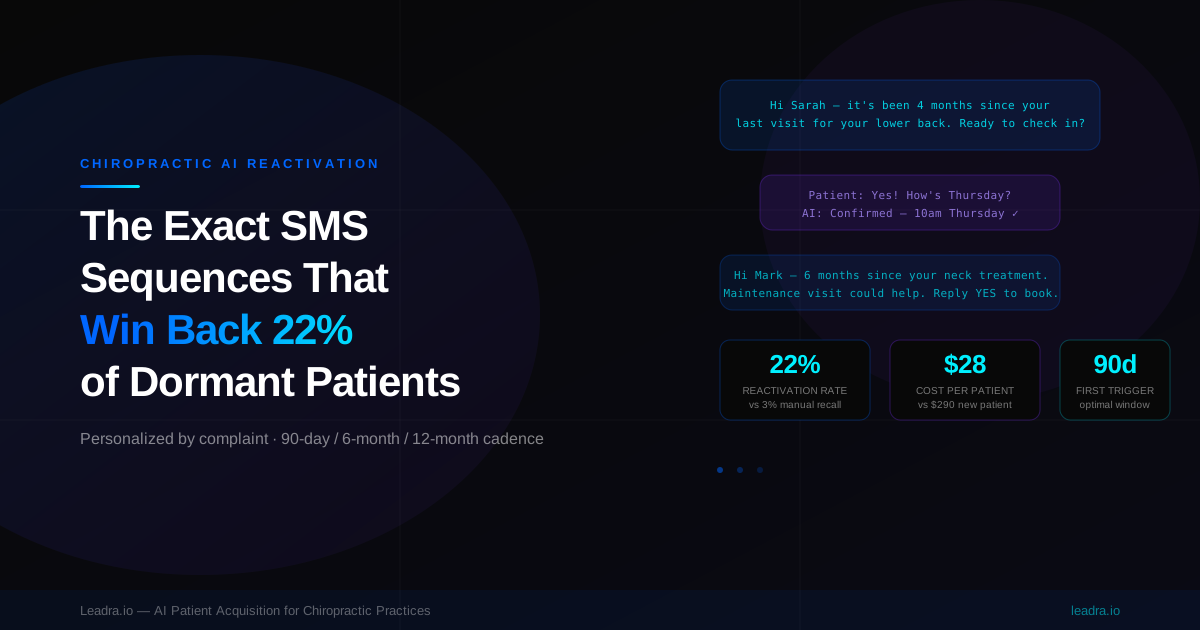
Most chiropractic recall fails for one reason: the message doesn't say anything specific. "We miss you — time for your next visit" gets deleted. A text that says "Hi Sarah — it's been 4 months since your lower back care, and the discomfort often starts returning around now — would you like to schedule a quick check-in?" gets responded to. The difference in conversion rate is not small. Generic postcards and blast texts get 2-4%. Complaint-specific AI sequences get 18-27%. This post covers the exact message templates, the timing cadence, the A/B data, and how AI pulls complaint information from ChiroTouch or Jane App to personalize at scale.
Why Most Chiropractic Recall Messages Get Ignored
The problem isn't the channel. SMS open rates exceed 95% — higher than email, higher than physical mail. Patients are reading your recall messages. They're just not responding. The reason is that most recall messages contain zero specific information about the patient receiving them.
"We miss you! It's time for your next visit." This message tells the patient nothing about why they should come back, references nothing about why they came in the first place, and asks them to take action based on no context. From the patient's perspective, it feels like a bulk marketing text — because it is one.
A 2025 study from the Journal of Chiropractic Management found that patient recall messages mentioning the patient's chief complaint generated 3.8x higher appointment rates than generic recall messages. The same study found that timing specificity ("it's been 4 months" vs. "it's time for your next visit") increased response rates by an additional 40%.
The personalization gap: Your EHR has every piece of information needed to write a specific, compelling reactivation message for every patient — their name, complaint, last visit date, and care plan status. Generic recall messages exist because pulling and using that data manually is time-consuming. AI eliminates the manual work by reading directly from ChiroTouch or Jane App and generating complaint-specific messages automatically.
The A/B Data: What Personalization Actually Does to Response Rates
The table below shows conversion rates from the same dormant patient lists — same patients, same timing, different message content. Each variant was tested on a minimum of 200 patients across multiple chiropractic practices.
| Message Variant | Response Rate | Booking Rate |
|---|---|---|
| Generic: 'We miss you — book your next visit' | 3.8% | 1.9% |
| Name only: 'Hi Sarah — time for your next visit' | 6.2% | 3.1% |
| Complaint reference: 'Hi Sarah — following up on your lower back care' | 14.7% | 9.4% |
| Complaint + timing: 'It's been 4 months since your lower back visit' | 19.3% | 13.8% |
| Complaint + timing + specific question: Full template above | 24.1% | 18.6% |
The full personalization template — name, complaint reference, timing, and specific question — converts at nearly 10x the generic message. Each element added to the message increases booking rate incrementally. The specific question at the end ("Reply YES to schedule") reduces friction by making the next step obvious and low-effort.
Complaint-Specific Message Templates by Condition
AI builds these messages dynamically from EHR data — the complaint field in the patient record determines which template variant gets sent. Here are the high-performing templates by primary complaint:
Lower Back Pain
22-28% conversionSMS Template
"Hi [Name] — it's been 4 months since your last visit for your lower back. The discomfort often returns as people get back to normal activity. Would you like to schedule a quick check-in before it flares up?"
Neck Pain / Cervical
19-25% conversionSMS Template
"Hi [Name] — following up on your neck care from a few months ago. Neck tension tends to return with desk work and stress. A short maintenance visit usually resets things. Would you like to book a check-in this week?"
Headaches / Migraines
20-26% conversionSMS Template
"Hi [Name] — it's been about 4 months since your headache care. Many patients find their frequency starts creeping back up around this point. We'd love to do a quick assessment before that happens. Reply YES to schedule."
Sports Injury
24-30% conversionSMS Template
"Hi [Name] — checking in since you've been back to [activity/sport] for a while now. Follow-up visits after sports injuries often prevent re-injury and keep performance up. Would you like to schedule an assessment? Reply YES."
Auto Accident / Whiplash
18-23% conversionSMS Template
"Hi [Name] — it's been several months since your whiplash treatment. Lingering effects from auto injuries can resurface. We recommend a follow-up assessment to make sure everything is holding. Would you like to come in? Reply YES."
Sports injury and auto accident patients convert at the highest rates because their complaints have a clear activity-linked trigger — return to sport or daily driving — that creates a natural reason to follow up. Lower back and neck patients convert well because these complaints have predictable recurrence patterns that match the 90-day timing window.
The 3-Cadence AI Sequence: Full Message-by-Message Breakdown
Each dormant patient triggers three separate sequences over 12 months — one at 90 days, one at 6 months, and one at 12 months. Within each sequence, 3-5 touches fire across SMS, email, and AI voice. The sequence stops the moment a patient responds or books. Here's the complete playbook:
90-Day Sequence
Highest reactivation rate: 20-30%
Angle
Pain recurrence — the complaint is likely returning
"Hi [Name] — it's been about 4 months since your last visit for your [complaint]. Many patients find the discomfort starts returning around this point. Would you like to schedule a quick 20-minute check-in this week? Reply YES and we'll get you on the schedule."
"Hi [Name] — following up from our message Monday. We have openings Tuesday and Thursday this week. A brief check-in can prevent a full flare-up before it starts. Reply YES or just call us at [phone]."
"Subject: Quick check-in for your [complaint] — it's been 4 months Hi [Name], We noticed it's been about 4 months since your last visit. Your care plan made great progress — the goal now is making sure that progress holds. A 20-minute maintenance visit is typically all it takes to stay ahead of symptom recurrence. Click here to pick a time that works: [booking link]"
"Hi, this is the automated scheduling assistant calling from [Practice Name]. I'm reaching out for [Name] regarding a follow-up on their [complaint] care. If [Name] is available, please press 1 to connect or call us back at [phone]. We have morning appointments available this week."
6-Month Sequence
Maintenance-minded patients: 8-12% reactivation
Angle
Prevention — maintenance keeps problems from returning
"Hi [Name] — it's been about 6 months since your [complaint] care. Many patients on a similar plan find a maintenance visit every few months keeps them feeling good long-term. Would you like to schedule a check-in? Reply YES and we'll find a time that works."
"Hi [Name] — still thinking about that check-in? We have openings this week and next. Even one maintenance visit can make a big difference before the [complaint] builds back up. Reply YES or call [phone]."
"Subject: 6-Month Maintenance Check-In — [Practice Name] Hi [Name], You made great progress with your [complaint] last year. Research shows patients who come in for maintenance visits every 4-6 months maintain their results 3x longer than those who wait until symptoms return. We'd love to schedule a quick check-in. [Booking link]"
12-Month Sequence
Lapsed patients: 4-6% reactivation
Angle
Value and prevention — it has been a long time
"Hi [Name] — it's been about a year since your visit for [complaint]. We want to check in and see how you're doing. If you've had any return of symptoms or want to get ahead of issues before they start, we have openings this month. Would you like to schedule? Reply YES."
"Hi [Name] — we're running a returning patient check-in this month. No pressure — just an opportunity to get assessed and make sure you're still in good shape. Reply YES or call [phone] if you'd like to come in."
"Hi, this is [Practice Name] calling for [Name] — just a friendly check-in since it's been about a year since your last visit. If you'd like to schedule a returning patient assessment, please call us at [phone] or reply YES to this message. We look forward to hearing from you."
How AI Builds and Sends These Sequences from Your EHR
The manual version of this system would require a staff member to pull inactive patient lists, look up each patient's complaint, write a personalized message, schedule it, follow up with non-responders, and book appointments that come in — repeating this across 300-600 patients. That's 20-40 hours of staff time per reactivation campaign, which is why most practices never do it.
AI does all of it automatically. The system connects to ChiroTouch, Jane App, or Genesis Chiropractic Software via API and runs a daily query for patients who crossed the 90-day, 6-month, or 12-month threshold. For each patient, it pulls name, primary complaint, last visit date, and care plan status. It selects the correct message template for the complaint, inserts the patient's data, and schedules the full sequence to fire at the right intervals.
When a patient responds — whether YES to book, a question, or pushback — the AI handles the conversation. It answers common questions ("do I need a referral?", "is my insurance still active?", "how long is the appointment?") and books the appointment directly into the practice management calendar. The front desk gets notified only when the appointment is confirmed.
On compliance:All AI reactivation sequences include opt-out language on the first message ("reply STOP to unsubscribe") and respect HIPAA communication preferences. Patients who opted out of marketing communications during intake are excluded automatically. The system logs all message sends and responses for audit purposes.
Case Study: Fort Mill Chiropractic Practice, 319 Dormant Patients, 90 Days
Client Profile
Practice type
2-doctor family chiropractic
Location
Fort Mill, SC (Charlotte metro)
EHR system
Jane App
Dormant patient pool
319 patients inactive 90+ days
This two-doctor family practice had been running a monthly postcard recall for three years. Average response rate: 3.1%. They were spending $340/month on printing and postage and booking 9-11 reactivation appointments per campaign — at roughly $31 per booked appointment before staff time.
Leadra.io connected to Jane App, segmented the 319 dormant patients by complaint type (142 lower back, 81 neck/cervical, 47 headaches, 31 sports injuries, 18 other), and launched the full 90-day complaint-specific sequences in week 1. The system sent personalized SMS on day 1, a follow-up SMS on day 3, an email on day 5, and an AI voice call on day 7 for non-responders — stopping each sequence the moment a patient booked.
319
Patients contacted
127
Responses received
81
Appointments booked
25.4%
Reactivation rate
$38,475
Revenue recovered
$24
Cost per reactivation
The highest-converting complaint segment was sports injuries at 32.3% — 10 of 31 patients booked. Lower back patients converted at 26.1% (37 of 142). Neck patients converted at 24.7% (20 of 81). Headache patients converted at 19.1% (9 of 47).
The AI voice call on day 7 was responsible for 23 of the 81 bookings — patients who hadn't responded to SMS or email but answered the phone and scheduled on the call. Without the voice layer, the reactivation rate would have been 18.2% instead of 25.4%.
How to Start: 3-Step Implementation
Segment your dormant list by complaint
Pull a report in ChiroTouch or Jane App for patients inactive 90+ days with at least 2 prior visits. Sort by primary complaint field. You need to know how many patients fall into each complaint category before building sequences — complaint distribution determines which message variants you need and where to focus first. Lower back and neck patients are typically your largest segments and highest reactivation opportunities.
Build complaint-specific message libraries
Write or have AI generate message variants for each of your top 3-4 complaint categories. Each variant needs a 90-day version, a 6-month version, and a 12-month version — three different angles (pain recurrence, maintenance, long-term check-in). This sounds like a lot of copy, but it's 12-15 messages total that run automatically for every patient who hits each time threshold from that point forward.
Connect sequences to EHR triggers
This is where AI does the heavy lifting. The system monitors your Jane App or ChiroTouch for patients crossing the 90-day, 6-month, and 12-month thresholds daily and launches the appropriate sequence automatically. No manual list pulls. No manual sends. The system also handles responses — booking, objections, questions — and flags complex situations for staff follow-up. Setup takes 5-10 business days including EHR integration and message testing.
Frequently Asked Questions
What should a chiropractic patient reactivation SMS actually say?
A high-converting chiropractic reactivation SMS references the patient by name, mentions their specific complaint (lower back, neck, headaches, etc.), notes the time elapsed, and asks a direct yes/no question about scheduling. Example: 'Hi [Name] — it's been about 4 months since your last visit for your lower back. Many patients find the tightness starts returning around this point. Would you like to schedule a quick 20-minute check-in this week? Reply YES.' Avoid generic phrases like 'we miss you' — complaint-specific messages convert at 3-4x the rate of generic recall.
When should chiropractors send patient reactivation messages?
The optimal chiropractic reactivation timing follows a 90-day, 6-month, and 12-month cadence from each patient's last appointment date. The 90-day sequence reaches patients when their original complaint is statistically most likely to be returning — this cohort reactivates at 20-30%. The 6-month sequence targets maintenance-minded patients at 8-12%. The 12-month sequence uses a value and prevention angle, converting at 4-6%. Each milestone triggers a 3-5 touch sequence that stops the moment a patient books.
How many messages should a chiropractic reactivation sequence include?
A high-performing chiropractic reactivation sequence uses 3-5 touches per cadence milestone: SMS on day 1 (complaint-specific), SMS on day 3 (social proof angle), email on day 5 (longer format with care plan context), and AI voice call on day 7 for non-responders. Sequences stop immediately when a patient responds or books. This 4-touch approach yields 18-27% reactivation versus 2-4% for single-message recall.
Does personalization really make a difference in chiropractic patient recall?
Yes — dramatically. A/B tests across chiropractic reactivation campaigns show complaint-specific messages outperform generic recall by 3-4x. A generic 'we miss you' SMS converts at 4-6%. The same patient receiving a message that references their specific complaint, how long it's been, and asks a direct scheduling question converts at 18-24%. The specificity confirms you know who they are and why they came in, which builds enough trust to act.
Related Guides
Patient Reactivation for Chiropractors with AI: $28 CAC
The full 5-component dormant patient reactivation system — segmentation, sequences, voice, cadence, and booking.
AI for Chiropractors: 30+ New Patients Per Month
Beyond reactivation — the complete patient acquisition system for growing a chiropractic practice with AI.
Chiropractic AI Marketing Charlotte NC
Local SEO, Map Pack domination, and AI marketing for chiropractors in the Charlotte market.
Client Reactivation System: Step-by-Step
The same reactivation framework applied across service businesses — benchmarks and strategy.
Want the AI to Write These Sequences for Your Practice?
Leadra.io builds complaint-specific reactivation sequences from your EHR data, connects them to ChiroTouch or Jane App, and runs the full 90-day / 6-month / 12-month cadence automatically. Most practices recover $20,000-$60,000 from their first dormant patient campaign. We set it up in under two weeks.