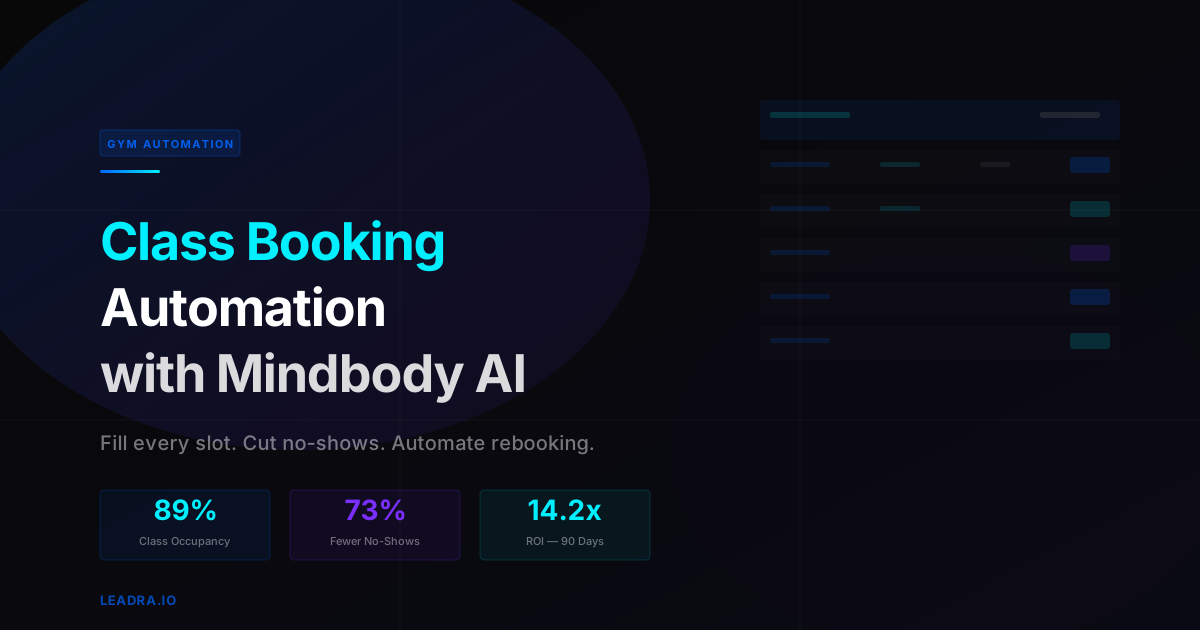
Every empty spot in a group fitness class is money your gym already spent to earn. You paid to acquire the member. You pay for the instructor, the space, and the utilities whether that class runs at 60% capacity or 95%. The difference between those two numbers — for a studio running 15-20 classes per week — is $1,000 to $2,500 in weekly revenue that evaporates through no-shows, unfilled cancellations, and members who just stop booking.
Mindbody is the industry-standard platform for gym scheduling, and it does its job well: it stores schedules, manages waitlists, and processes payments. What it does not do is act on that data. It doesn't text the next person on the waitlist the second a cancellation comes in. It doesn't automatically nudge the member who booked three classes last month but has gone quiet for two weeks. It doesn't follow up after a class to capture the rebooking while motivation is still high.
AI class booking automation fills that gap. Layered on top of Mindbody via API, it turns passive scheduling data into active revenue recovery — filling cancellations in real time, reducing no-shows with intelligent reminder sequences, and capturing rebookings before members drift. Gyms that implement it move from 60-70% average class occupancy to 83-91% within 90 days — without adding headcount or changing the Mindbody setup their staff already knows.
This guide breaks down how class booking automation gym Mindbody AI systems actually work, what five specific automations drive the biggest occupancy gains, and what a real Charlotte fitness studio achieved running the system in the first 90 days of 2026.
Why Mindbody Alone Leaves Class Revenue on the Table
Mindbody is a passive system. It waits for people to take action — to book, to cancel, to join the waitlist. The platform has no mechanism to proactively reach out to a member who hasn't booked in 12 days, or to notify the next person on a waitlist the moment a spot opens. That gap is where gym revenue leaks.
A study of boutique fitness studios found that the average class runs at 67% occupancy even when the studio has a full waitlist for that time slot. The disconnect happens because cancellations come in within 2-4 hours of class time — a window where waitlisted members may not be checking the app, and front desk staff are too busy handling check-ins to manually work down a list of 6-8 names. The slot stays empty. The revenue is gone.
No-shows cost more than empty waitlists
The no-show problem is distinct from the cancellation problem. A no-show means the member held a spot that a paying drop-in or waitlisted member could have used, and then didn't show up — leaving the class short and the instructor demoralized. Without automated reminders timed to the specific member's booking behavior, no-show rates stay at 22-28% industry average. AI reminders that adjust frequency based on each member's historical no-show rate bring that number under 9%.
Members stop booking before they cancel
Churn at group fitness studios rarely looks like a sudden cancellation. It looks like a member who booked three classes a week dropping to one, then zero — over a period of 3-6 weeks. By the time they cancel, the membership is already worthless. AI booking automation detects the drop in booking frequency at the 10-14 day mark and triggers a re-engagement sequence before the habit is fully broken — when a single well-timed message is enough to get them back on the schedule.
Every booking friction point costs conversions
When an interested prospect calls your gym after hours to ask about class availability, they reach voicemail. When they text to ask what's available Saturday morning, they wait 4-6 hours for a response. By the time your front desk calls back, the person has already booked a trial at the studio down the street. An AI booking agent handles inbound class inquiries 24 hours a day, books the trial in Mindbody in real time, and sends a confirmation before the prospect has time to second-guess the decision.
The solution is not to replace Mindbody — it's to add an active AI layer that sits on top of the platform and turns its data into real-time actions. The class schedule, member profiles, booking history, and waitlist data Mindbody already holds become the fuel for automated outreach that fills every available slot.
The 5-Component AI Class Booking Automation System
Here's the five-component system Leadra.io deploys for gyms running Mindbody, Glofox, Zen Planner, or Pike13. Each component targets a specific occupancy leak — together, they eliminate most of the gap between booked and attended.
Real-time cancellation detection and waitlist filling
The moment a member cancels a class in Mindbody — whether two hours out or 20 minutes before the session — the AI detects the open slot and immediately texts the next person on the waitlist with a one-click booking confirmation. The message includes class time, instructor name, and a single button to confirm. No front desk involvement. In Leadra.io deployments, this process fills 60-80% of last-minute cancellations within 15 minutes. Manually, gyms fill about 2-4% of those same slots because no one has time to call down the waitlist.
Intelligent pre-class reminder sequences
No-shows are not random. They cluster around specific members, specific time slots, and specific weather or calendar patterns. The AI analyzes booking history to identify members with a no-show rate above 20% and automatically increases reminder frequency for those members — a 48-hour reminder, a day-before SMS, and a 2-hour push notification with a one-tap cancellation option. Members who can't make it cancel instead of ghosting, which frees the slot for waitlist filling. Studios using this sequence see no-show rates drop from 22-28% to 6-9% within 30 days.
Lapsed booker re-engagement
Members who used to book regularly and haven't reserved a class in 10-14 days receive an automated re-engagement message. The AI references their previous classes — 'You haven't been in since your Tuesday spin session — we saved you a spot for this Thursday.' The message links directly to a pre-filled booking screen. This sequence runs automatically for every qualifying member, every week, without a staff member pulling a report. Gyms that implement lapsed booker re-engagement recover 18-26% of members who would otherwise quietly reduce attendance and eventually cancel.
AI voice and SMS booking agent for inbound inquiries
When a potential new member calls or texts asking about class availability, an AI voice agent handles the conversation — confirms schedules, answers questions about class types and pricing, and books the trial directly in Mindbody. For existing members texting 'what classes are available this week?', the AI pulls real-time Mindbody schedule data and responds with open spots plus a direct booking link. No hold times, no voicemail, no 'I'll have someone call you back.' Inbound booking handled in under 60 seconds, 24 hours a day.
Post-class follow-up and next-session rebooking
Within 30 minutes of a class ending, members who attended receive an automated follow-up: a short message acknowledging the session and offering a direct link to book their next class. The AI surfaces the instructor's next scheduled class first, since members are 3x more likely to rebook with an instructor they just trained with. This single automation captures 18-28% of attendees for a return booking before the workout endorphins wear off — and before competitors' ads appear in their Instagram feed. Loyalty compounds because consistent attendance is driven by consistent prompting, not willpower.
The Compounding Effect
Studios that deploy all five components — waitlist automation, smart reminders, lapsed booker re-engagement, AI booking agent, and post-class follow-up — see occupancy gains 3-4x larger than studios that only add reminder messages. The system learns your class patterns over 30-60 days and improves the timing and content of every outreach sequence based on what actually drives bookings for your specific member base.
Manual Booking Management vs. AI: The Real Numbers
Here's how the two approaches compare across the metrics that determine whether a gym runs at 67% or 89% class occupancy:
| Metric | Manual | AI Automation |
|---|---|---|
| Waitlist fill rate (last-min cancellations) | 2-4% filled | 60-80% filled in 15 min |
| No-show rate | 22-28% average | 6-9% with smart reminders |
| Lapsed member re-engagement | Quarterly manual email | Automatic at 10-14 day gap |
| Inbound booking inquiries | Staff callback / voicemail | AI handles in under 60 sec |
| Post-class rebooking rate | Under 5% (no follow-up) | 18-28% automated |
| Class occupancy rate | 60-70% typical | 83-91% within 90 days |
| Staff hours spent on booking admin | 8-15 hours/week | Under 2 hours (oversight) |
| Revenue recovered per week | $0 incremental | $1,000-$2,500 (15-20 filled slots) |
The class revenue gap between 67% and 89% occupancy for a studio running 18 classes per week at an average capacity of 20 members and a $22 drop-in rate is $3,872 per week — over $200,000 per year. That's revenue the studio already paid to acquire through membership sales and class scheduling. AI class booking automation captures it automatically, with no additional marketing spend.
Case Study: Charlotte Fitness Studio Hits 89% Class Occupancy in 82 Days
Client Story — Charlotte, NC
A boutique group fitness studio in Charlotte's South End neighborhood came to Leadra.io in January 2026. They ran 17 classes per week — cycling, HIIT, yoga, and strength — on Mindbody, with 480 active members and a waitlist culture for peak-hour slots. Average class occupancy over the prior 90 days was 64%. No-show rate was 24%. Their front desk team was manually texting waitlisted members when cancellations came in, filling maybe 3 out of every 20 last-minute open spots before class time.
Leadra.io connected to their Mindbody account via API and activated all five automation components within 72 hours. The waitlist automation went live first — within the first seven days, it filled 61 cancellation slots that would have gone empty. Smart reminder sequences launched in week two: the no-show rate dropped from 24% to 11% by day 30, then to 7% by day 60 as the system learned which reminder timing worked best for different member segments. The post-class rebooking sequence captured 22% of attendees for a follow-on booking in the first month.
Class occupancy
64%
89%
No-show rate
24%
7%
Weekly revenue
$14,200
$19,800
ROI (day 82)
—
14.2x
By day 82, the studio's weekly group fitness revenue had moved from $14,200 to $19,800 — a $5,600 weekly increase driven entirely by class booking automation on their existing Mindbody data. No new marketing spend. No new instructor hires. No changes to the class schedule. The system cost $1,100 per month — the first week of incremental revenue covered the monthly fee with $4,500 left over.
The studio owner noted one secondary benefit she hadn't anticipated: instructor morale improved. Instructors who had been teaching to 12-person classes in a 20-person room were now consistently hitting 16-18 attendees. Higher-energy classes drove better member reviews, which drove more inbound trial bookings through the AI booking agent. The occupancy gains compounded through retention and referrals, not just slot-filling.
What AI Class Booking Automation Costs: 3-Tier Breakdown
Pricing for class booking automation gym Mindbody AI systems scales with the number of active members and whether AI voice outreach is included. Here are the three tiers Leadra.io offers:
Core — $500-$900/mo
Waitlist automation, pre-class reminder sequences, post-class rebooking nudge. Connects to Mindbody, Glofox, or Zen Planner. Best for studios with under 300 members running 8-12 classes per week. Typical occupancy gain: +12-18 percentage points within 60 days.
Growth — $1,100-$1,800/mo
Everything in Core plus lapsed booker re-engagement (SMS + email sequences), AI SMS booking agent for inbound class inquiries, monthly occupancy and no-show performance reporting. Best for studios with 300-600 members running 13-20 classes per week. Typical occupancy gain: +18-26 percentage points within 90 days.
Full-Service — $2,000-$2,800/mo
Everything in Growth plus AI voice booking agent (handles inbound calls 24/7, books directly in Mindbody), dormant member reactivation sequences, churn prediction alerts, and A/B testing of message timing and copy. Best for multi-location studios or high-volume gyms with 600+ members. Typical occupancy gain: +22-30 percentage points within 90 days.
How to Get Started: 3-Step Implementation
Getting AI class booking automation running on your Mindbody account takes 3-7 days end-to-end. Here's the sequence:
Mindbody API audit and occupancy baseline
Leadra.io connects to your Mindbody account (read-only initially), pulls 90 days of class data, and identifies your three biggest occupancy leaks: cancellations not filled from waitlists, no-show rate by class type, and members who have dropped booking frequency in the last 30 days. This takes 24-48 hours and gives you a clear baseline — so you can measure exactly what the automation recovers in month one.
Sequence setup and Mindbody write-back configuration
We configure the five automation components to your class schedule, member segments, and brand voice. Message timing is set based on your class types — a 6am cycling class gets a 9pm reminder the night before; a weekend yoga session gets a 48-hour nudge. Write-back permissions let the AI confirm bookings and update waitlist status directly in Mindbody so your front desk always has an accurate schedule.
Week-one monitoring and sequence tuning
For the first 7 days, Leadra.io monitors every outreach sequence in real time — open rates, click-through rates, booking confirmations, and cancellation-to-fill speed. We tune message timing, adjust reminder frequency for high-no-show segments, and verify that the AI booking agent is handling inbound inquiries correctly. Most studios see measurable occupancy improvement within the first week. Month-over-month reporting continues from there.
Frequently Asked Questions
Does class booking automation work with Mindbody?
Yes. AI class booking automation systems like those built by Leadra.io connect directly to Mindbody via its API. The integration reads real-time class schedules, member profiles, booking history, and waitlist data. When a cancellation happens, the system immediately pulls from the waitlist and sends a booking confirmation. Reminder sequences, no-show follow-ups, and rebooking nudges all write back to Mindbody so your schedule stays accurate without manual updates. Integration typically takes 48-72 hours.
How much can AI booking automation improve class occupancy at a gym?
Gyms running AI class booking automation typically see class occupancy improve from 62-70% to 83-91% within 60-90 days. The gain comes from three sources: waitlist automation fills 60-80% of late cancellations within 15 minutes (versus 2-4% filled manually), pre-class AI reminders reduce no-show rates by 65-75%, and post-class rebooking sequences capture 18-28% of attendees for a return class before they leave the session. Combined, these three levers recover 18-25 filled slots per week in a studio running 15-20 classes.
What's the difference between Mindbody's built-in tools and AI booking automation?
Mindbody is a scheduling and payment platform — it records bookings and manages waitlists passively. AI booking automation is active: it detects a cancellation and immediately texts the next person on the waitlist with a one-click confirmation link. It monitors who hasn't booked this week and sends a behavioral nudge. It detects members who attended once and never returned, then triggers a re-engagement sequence. Mindbody stores the data. AI acts on it — 24 hours a day, for every member, without a staff member touching the keyboard.
How much does AI class booking automation cost for a gym?
AI class booking automation for gyms typically costs between $500 and $2,800 per month depending on member count, class volume, and whether AI voice outreach is included in the package. For a studio running 15-20 classes per week with 300-600 members, a system that fills 15-20 additional slots per week at an average drop-in or membership value of $18-$25 per slot generates $1,080-$2,000 in recovered weekly revenue — enough to cover the system cost 3-6x over each month. Most studios break even in the first two weeks.
Related Reading
Ready to Fill Your Classes?
See What AI Booking Automation Can Do for Your Studio
Leadra.io connects to your Mindbody account, audits your occupancy gaps, and shows you exactly how much revenue AI class booking automation can recover — before you spend a dollar. Most studios see positive ROI within the first two weeks.