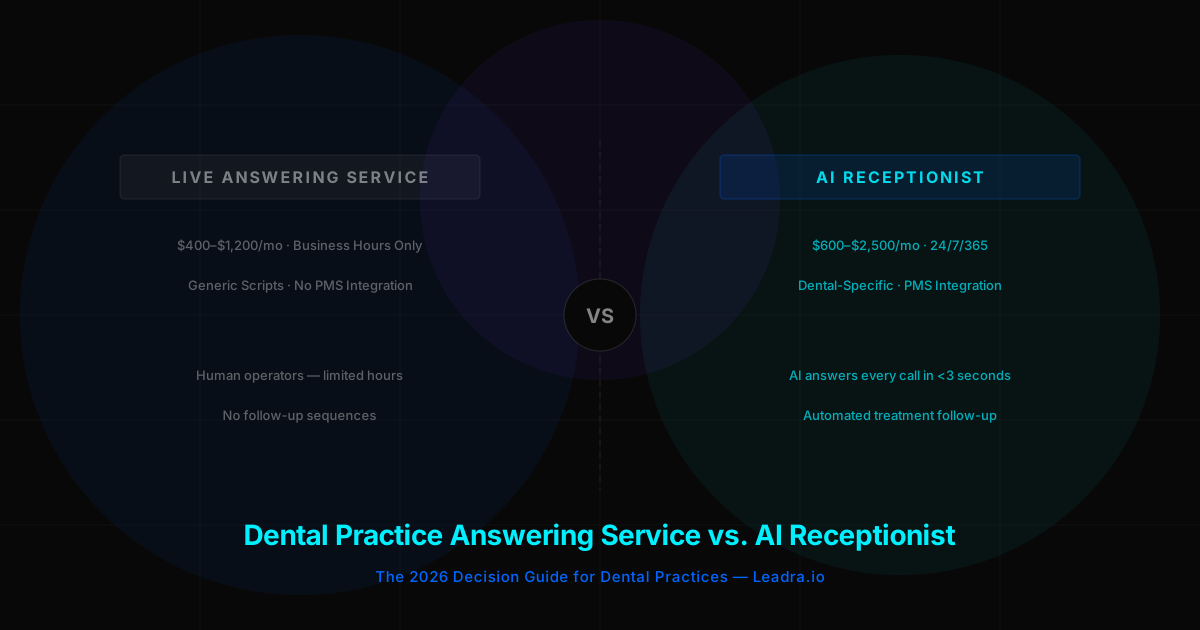
A dental practice loses an average of 6-10 bookable calls per week to unanswered phones. Most of that leakage happens after 5 PM, on weekends, and during the mid-morning rush when every line is occupied. Two solutions get pitched as fixes: a live answering service and an AI receptionist. They are not the same product, and choosing the wrong one is an expensive mistake.
This guide breaks down exactly how each solution works for a dental practice, where each one fails, what each costs, and which type of practice should choose which. No vendor spin — just the comparison your front office manager should have before you sign anything.
The short version: a live answering service solves one narrow problem. An AI receptionist solves that problem plus five others you probably have right now and haven't connected to your phone strategy yet.
What a Live Dental Answering Service Actually Delivers
A dental answering service uses human operators — typically from a shared call center — who pick up your practice's calls when your front desk is unavailable. The operator follows a script you provide, collects patient information, and either transfers the call or logs a message for your team to return the next business day. Here is what you actually get:
That is the ceiling for most live dental answering services. The service answers the phone, takes a message, and hands the problem back to your front desk. It buys time — it does not close the loop.
Where Live Answering Services Break Down for Dental Practices
A live answering service is a general-purpose product retrofitted for dental. The operators are not dental-trained, the scripts are generic, and the system has no connection to your clinical workflow. These are not hypothetical complaints — they are the four failure patterns that show up in every dental practice running a live answering service for more than 90 days:
Generic scripts that erode patient trust.
When a patient calls about post-extraction pain at 8 PM and the operator reads from a generic script without any knowledge of dental triage logic, it signals to the patient that they reached a call center, not their dental office. Trust drops. Some patients call a different practice instead of waiting for a callback.
The next-day callback loop loses bookings.
Most answering services deliver messages for your front desk to action the next morning. The patient called at 6:30 PM wanting to book a cleaning. By 9 AM the next day, they may have already booked with a competitor who answered their web form inquiry overnight. Studies on service business call response show that leads contacted within 5 minutes convert at 9x the rate of leads contacted after 30 minutes.
No integration with your PMS — double the work.
Your front desk receives a message summary from the answering service and must manually open Dentrix, Eaglesoft, or Open Dental, locate the patient record or create a new one, check schedule availability, and call the patient back to confirm. That is 10-15 minutes of work per inquiry — multiplied by every after-hours call you receive each week.
Per-minute pricing creates unpredictable costs.
Dental calls are longer than average — insurance questions, new patient intake, and treatment discussions easily run 4-7 minutes. Most answering service plans include 100-200 minutes per month. Once you exceed the plan, overage rates of $1.10-$1.75/minute kick in. A busy month with 60 after-hours calls averaging 5 minutes is 300 minutes — well above a standard plan, with $100-$165 in overages billed at the end of the month.
What a Dental AI Receptionist Does Differently
An AI receptionist for a dental practice is not a chatbot or a voicemail upgrade. It is a voice AI system trained on your practice's specific services, insurance contracts, appointment types, provider schedules, and clinical escalation logic. When a patient calls — at 2 PM or 2 AM — the AI answers in under three seconds and handles the conversation end-to-end without a handoff to a human operator or a callback queue. Key capabilities that live answering services cannot replicate:
Side-by-Side Comparison: Answering Service vs. AI Receptionist
Here is the full comparison across every dimension that affects a dental practice's schedule utilization and revenue recovery.
| Factor | Live Answering Service | AI Receptionist |
|---|---|---|
| Monthly cost | $250 – $1,200/mo + overages | $600 – $2,500/mo flat |
| Coverage hours | After-hours only (when you configure it) | 24/7/365 — every call, every hour |
| Appointment booking | Takes a message — callback required | Writes directly to PMS in real time |
| PMS integration | None (message delivery only) | Dentrix, Eaglesoft, Open Dental |
| Dental knowledge | Generic scripts — no clinical context | Trained on your services, insurance, policies |
| Insurance FAQs | Limited — operator reads from your notes | Full knowledge base from your insurance contracts |
| Treatment plan follow-up | Not available | 5-7 touch automated SMS + voice sequences |
| Hygiene recall outreach | Not available | Automated at 3, 6, 12 month intervals |
| Emergency escalation | Protocol-based — consistent | Clinical logic — routes true emergencies to on-call |
| Simultaneous calls | Limited by operator availability | Unlimited — all lines answered instantly |
| Per-minute billing risk | Yes — overages common for dental call lengths | No — infrastructure cost is predictable |
| Setup time | 1-3 days | 2-4 weeks (PMS integration) |
Real Cost Comparison for a Dental Practice
Most practices underestimate what a live answering service actually costs in practice. The base rate is one number — the all-in cost once call volume scales is another. Here is a realistic breakdown for a Charlotte NC dental practice fielding 250 calls per month with 60-80 of them coming in after hours:
Live Answering Service
AI Receptionist (Leadra.io Tier 2)
The answering service appears cheaper until you factor in overage fees, the front desk labor to process message callbacks, and the revenue lost when same-day appointment requests expire overnight. An AI receptionist costs more on paper per month. It captures revenue the answering service never touches.
The treatment plan follow-up sequences are where the math shifts most dramatically. A dental practice with $180,000 in unscheduled treatment in its PMS does not need the answering service to fix that — it needs a system that identifies those patients and closes the loop automatically. A live answering service has no mechanism for that at any price point. See the full AI receptionist cost guide for dental practices.
Which Option Is Right for Your Practice?
Both solutions have legitimate use cases. Here is the honest breakdown of which type of practice fits each:
Choose a Live Answering Service If...
- You receive fewer than 30 after-hours calls per month and budget is the primary constraint
- You have a protocol-heavy emergency escalation requirement where every after-hours call must reach a live human before clinical judgment is made
- You are a solo practice in a rural market where your patients expect to speak with a person for every inquiry
- You want something operational in 1-2 days as a stop-gap while evaluating longer-term solutions
Choose an AI Receptionist If...
- You are losing 5+ bookable calls per week after hours and want those converted — not messaged
- You have unscheduled treatment plans in your PMS that are not being systematically followed up
- You have a hygiene recall list of overdue patients who are not being contacted regularly
- Your front desk is spending hours per week on manual callbacks from answering service messages
- You run 2+ chairs and need coverage that scales with call volume without unpredictable overage costs
Case Study: Charlotte NC Practice Switches From Answering Service to AI — 4-Month Results
Client Story
A 4-dentist general practice in Charlotte NC had used a dental answering service for three years at $740/month. Their front desk received 35-50 message summaries per week from the service and spent roughly 9 hours per week processing callbacks and manually entering appointments. The practice was also running $210,000 in unscheduled treatment in their Dentrix system — cases that had been presented and never followed up because the answering service had no mechanism to address them.
Leadra.io replaced the answering service with a Tier 2 AI receptionist: 24/7 voice AI with direct Dentrix integration, a 6-touchpoint treatment plan follow-up sequence for every unscheduled case over $400, and automated hygiene recall outreach for patients 5+ months overdue. Total retainer: $1,400/month. Infrastructure: $190/month.
In month one, the front desk callback workload dropped from 9 hours per week to under 2 hours — the AI was closing bookings in real time rather than creating a message queue. By month two, the treatment follow-up sequences had converted 14 unscheduled cases into booked appointments, generating $31,800 in production from the existing patient base. Month four hygiene recall outreach reactivated 63 overdue patients, adding 38 completed hygiene appointments and $15,200 in hygiene production.
Front desk callback hrs/wk
Unscheduled tx converted/mo
After-hrs bookings/mo
Added production (mo 4)
The practice paid $740/month for an answering service that cost them 9 hours of front desk labor per week and left $210,000 in unscheduled treatment untouched. They switched to a $1,590/month AI system (retainer + infrastructure) and recovered $58,600 in production by month four — a 36.9x return on the monthly investment. The answering service was not the wrong choice three years ago. It became the wrong choice the moment their unscheduled treatment backlog and recall list outgrew what a message-taking service could address. See the full Leadra.io dental patient acquisition framework.
FAQ: Dental Answering Service vs. AI Receptionist
Is a dental answering service worth it compared to an AI receptionist?
A live dental answering service costs $400-$1,200/month and provides human operators who answer calls using generic dental scripts. An AI receptionist costs $600-$2,500/month and handles calls 24/7 with dental-specific training, PMS integration, and automated follow-up sequences. For most practices with 200+ monthly calls or significant unscheduled treatment, an AI receptionist delivers more bookings at a lower true cost. A live answering service can make sense for very low call volumes or practices that require a live human on every emergency escalation.
Can a dental answering service book appointments directly into my practice management software?
Most live dental answering services cannot write appointments directly into Dentrix, Eaglesoft, or Open Dental. They collect patient information and send a callback request to your front desk for manual scheduling. AI receptionist systems like Leadra.io's integrate directly with major PMS platforms and write appointments to your schedule in real time, eliminating the next-day callback loop that costs practices 1-2 bookings per week from delayed follow-up.
What is the difference between a dental answering service and an AI receptionist?
A dental answering service uses live human operators from a shared call center who follow scripts to take messages outside your office hours. An AI receptionist is a trained voice AI system deployed specifically for your practice that answers calls 24/7, books appointments directly into your PMS, answers insurance and treatment questions from your knowledge base, and runs automated follow-up sequences for unscheduled treatment plans and hygiene recall. The AI completes interactions end-to-end without a human operator or callback queue.
How much does a dental answering service cost per month?
A dental answering service typically costs $250-$1,200/month depending on call volume and coverage hours. Shared operator services run $250-$450/month for after-hours only. Dedicated dental services with custom scripts and evening/weekend coverage run $600-$1,200/month. Per-minute overage fees of $1.10-$1.75/minute apply beyond plan limits. An AI receptionist for a dental practice costs $600-$2,500/month depending on scope, with predictable infrastructure costs and no per-minute overages.
Stop Losing Bookings After Hours
See If an AI Receptionist Makes Sense for Your Dental Practice
Tell us your current call volume, PMS, and the biggest gap in your scheduling coverage. Leadra.io will give you a realistic projection on bookings recovered and unscheduled treatment converted — before you commit to anything.