"We miss you! Come back for 20% off!" is the single most-sent, worst-performing text message in gym marketing. Your dormant members have already seen it, ignored it, and deleted it from three other businesses this month.
What actually gets a reply isn't a bigger discount. It's a message that sounds like it came from a person who knows who they are — how long it's been, what class they used to take, and why they probably stopped showing up. That's the difference between a 3-5% reply rate and a 30%+ reply rate.
Below are 12 scripts Leadra.io uses across gym and fitness studio reactivation campaigns, organized by how long a member has been dormant and why they likely left. Each one is written as a template with variables — an AI reactivation system fills those variables automatically using data pulled from your gym management software, so every dormant member gets a version that's accurate to their specific history.
Why Generic Reactivation Texts Get Ignored
Most gyms run reactivation through whatever email platform they already use for newsletters — one message, one offer, sent to every lapsed member at once regardless of whether they left last week or eight months ago. That approach treats a member who's been dormant for 30 days the same as one who cancelled over a scheduling conflict a year ago. Neither gets a message that fits their actual situation, so neither responds.
No reference to their history
A blast that says "come back and save 20%" doesn't mention the classes they took, their favorite instructor, or how long it's actually been. It reads as automated because it is — and members can tell the difference between a message written for them and one written for a mailing list.
Wrong offer for the wrong reason
Someone who left because a monthly membership stopped fitting their budget doesn't want a free class — they want a cheaper plan. Someone who left over scheduling doesn't want a discount — they want a class time that actually works. Sending one offer to everyone guarantees it's the wrong offer for most of them.
One message, then silence
A single email or text gets a 3-5% response rate industry-wide, because most members aren't checking their inbox at the exact moment your one message lands. Reactivation is a sequence, not a single shot — and most gyms stop after one attempt.
The fix isn't writing a better single message. It's building a small library of scripts segmented by days dormant and cancellation reason, then personalizing each one with the member's actual data before it goes out.
8 Scripts by Segment — Copy, Adapt, and Send
Each script below is a framework. The bracketed variables get filled with real member data — either manually by your front desk team, or automatically by an AI reactivation system connected to your gym software.
"Hey {first_name}, noticed you haven't been in since {last_visit_date} — everything okay? Your spot in {favorite_class} is open again this week if you want to jump back in."
"Hi {first_name}, it's been a minute! Grab a free {favorite_class} session this week on us, no strings attached: {booking_link}"
"Hey {first_name}, saw you left back in {cancel_month} — we miss you at {gym_name}. Past members get a free week to come see what's changed. Want in?"
"Hi {first_name}, quick update — we now have a {flex_plan_name} starting at {flex_price}/mo. Thought of you since cost was the reason you left. Want details?"
"Hey {first_name}, we just added {new_class_time} classes and on-demand workouts you can do anytime. Might solve the timing issue — want the schedule?"
"Hi {first_name}, just checking in — hope you're doing well. No pressure at all, but if you're ever cleared to ease back in, we've got modified programs and would love to help."
"Last note from us, {first_name} — the door's always open at {gym_name}. If anything changes, just reply and we'll get you set up. No more texts after this one."
"Hi {first_name}, your membership freeze ends {freeze_end_date}. Ready to jump back in, or need more time? Reply RESUME or PAUSE and we'll handle the rest."
Why the variables matter
A script that says "grab a free {favorite_class}session" only works if the class name is actually correct for that member. Send the wrong class and the message reads as automated — which defeats the entire point. This is the step most gyms skip because filling 150+ individual variables by hand isn't realistic for a front desk team, which is exactly the gap AI personalization closes.
Generic vs. AI-Personalized: The Same Offer, Two Different Results
Here's the same win-back offer sent two different ways to a member who cancelled after three months on a $70/month plan:
Generic Blast
"We miss you! Come back to the gym this month and save 20% on your first month back. Reply STOP to opt out."
Typical reply rate: 3-5%
AI-Personalized
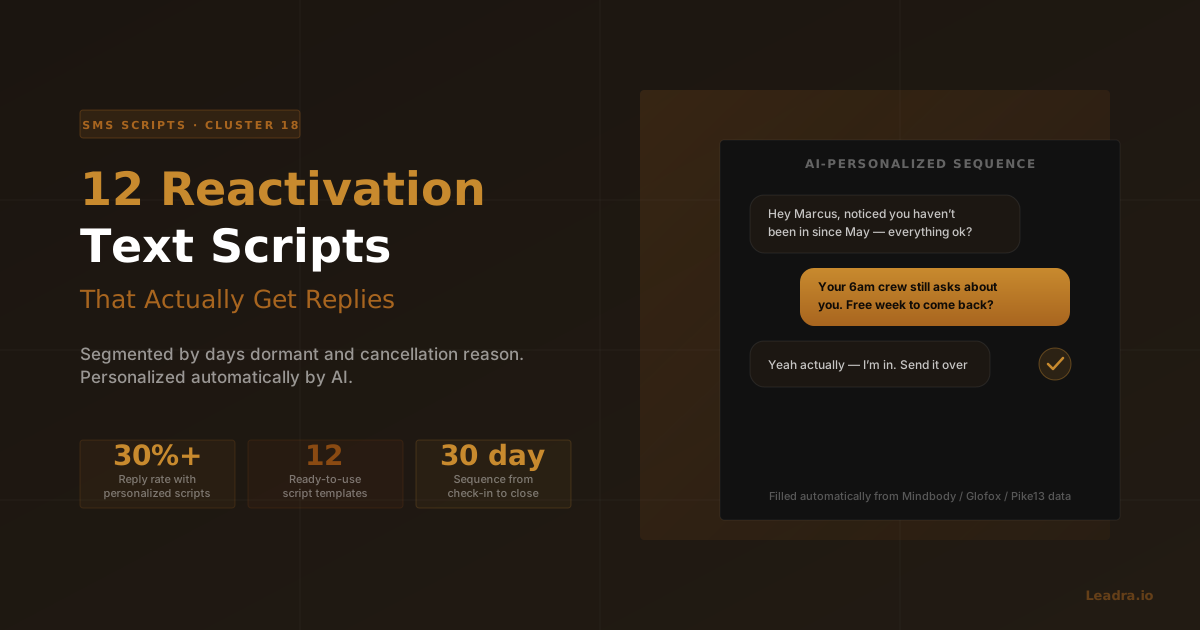
"Hey Marcus, saw you left back in May — we miss you at Charlotte Strength Co. Your old 6am crew still asks about you. Past members get a free week to come check out the new equipment. Want in?"
Typical reply rate: 25-35%
Same underlying offer — a free week back. The only difference is that the second version references the member's name, exact departure timeframe, gym name, and social connection (his old class time). That specificity is what triggers a reply instead of a swipe to delete.
How to Sequence These Scripts Over 30 Days
A single script sent once underperforms even when the wording is good. The scripts above work best run as a sequence, spaced out so members who need more convincing get it without feeling spammed:
Days 1-3: Check-in script, no offer
Open with the segment-appropriate check-in script and nothing else — no discount, no CTA beyond a simple question. This message alone recovers members who lapsed for a mundane reason (travel, a busy week) and just needed a nudge.
Days 7-10: Reason-specific offer
For members who didn't respond to the check-in, send the script matched to their cancellation reason — flexible plan for price, new class times for scheduling, a free session for general dormancy. This is where most conversions happen.
Day 14: AI voice call for high-value segments
For members on higher-tier plans or 60+ days dormant, a short AI voice call referencing the same personalized details as the texts adds a channel that most competitors skip entirely. It doesn't replace the texts — it reinforces them.
Day 30: Final low-pressure close
For anyone who still hasn't responded, send the "final note" script and stop. This closes the loop respectfully, keeps your opt-out rate low, and leaves the door open for members who come back on their own timeline later.
Running this manually across a dormant list of 100+ members means writing, personalizing, and tracking hundreds of individual messages by hand — which is why most gyms send one blast and stop. An AI reactivation system runs the entire sequence automatically, pulling the right variables and triggering the right script at the right touch, for every dormant member at once. For the full system architecture behind this — detection, segmentation, and churn prevention — see dormant member reactivation AI for gyms and fitness studios.
What Happens After They Reply
The scripts only do half the job — what happens in the next 60 seconds after a member replies determines whether that reply turns into a booked visit. Every script above should route to one clear next step, not a back-and-forth conversation that requires staff to be watching their phone in real time.
A booking link that pre-fills the member's information and shows real-time class availability converts significantly better than a reply that says "great, someone will call you to schedule." The gap between interest and friction is where most reactivation campaigns lose members who were genuinely ready to come back.
Keyword-based replies work well for simple actions — a member texting back RESUME to end a freeze, or YES to claim a free week — because they remove the need to open an app or fill out a form. The lower the friction between "I'm interested" and "I'm booked," the higher your actual reactivation rate ends up being, independent of how good the original script was.
4 Mistakes That Kill Reply Rates
Leading with a discount
Opening a message with a percentage off before establishing any personal context reads as promotional, which is exactly the tone that gets ignored. Save the offer for the second or third touch, after the check-in message.
Sending at the wrong time
A text that lands at 11pm or during a workday meeting gets dismissed regardless of how well it's written. Late morning and early evening consistently outperform other windows for gym audiences.
Making the CTA vague
"Let us know if you want to come back" requires the member to do the work of figuring out how. A direct booking link or a one-word reply option removes that friction entirely.
Ignoring the cancellation reason
Using the same script for every dormant member — regardless of why they actually left — is the single biggest lever most gyms leave on the table, and the easiest one to fix once cancellation reasons are tracked.
None of these fixes require new software or a bigger budget — they require tracking cancellation reasons at the point of cancellation and matching the script to the reason. That single change is the difference between a reactivation campaign that recovers a handful of members and one that recovers a meaningful share of your dormant list. Gyms evaluating the broader tooling for this should also see best AI for gym owners and member retention.
Frequently Asked Questions
What should a gym member reactivation text message say?
A gym member reactivation text should reference the member by name, mention specifically how long it's been or what class they used to attend, and offer one clear next step — a booking link, a free session, or a simple reply option. It should never open with a discount. Members respond better to a message that acknowledges their absence and their history at the gym than to a generic promotional blast.
How many reactivation texts should a gym send before giving up?
Most gyms give up after one or two attempts, which is far too early. Leadra.io deployments run 8-12 touches across SMS, email, and an optional AI voice call over a 30-day sequence, with each message using different framing. Response rates typically peak between touch four and touch seven, not on the first message.
Do reactivation scripts need to change based on why the member left?
Yes. A member who cancelled over price responds to a flexible-plan offer, not a free class. A member who cancelled due to a scheduling conflict responds to a message about new class times, not a discount. Sending the same script to every dormant member regardless of why they left is the single biggest reason generic reactivation campaigns underperform.
Can AI personalize reactivation scripts automatically for every dormant member?
Yes. Leadra.io's AI reactivation system reads each member's visit history, cancellation reason, membership tier, and favorite class or instructor from gym management software like Mindbody, Glofox, or Pike13, then fills a proven script template with that member's specific data automatically — no manual data entry required.
The Script Matters — But the Personalization Is What Gets the Reply
None of the 12 scripts above are complicated. What makes them work is specificity — the right message, matched to the right segment and the right cancellation reason, filled with the member's actual details, sent on a sequence instead of a single blast.
Writing that specificity by hand for every dormant member on your list isn't realistic for most front desk teams. Leadra.io builds AI reactivation systems that take these script frameworks, connect to your gym management software, and generate a personalized, accurate version for every dormant member automatically — running the full sequence without staff having to write or send a single message manually.
We back every engagement with a results guarantee — you don't pay if the system doesn't produce measurable reactivations.
Free Dormant Member Audit
Get These Scripts Personalized and Running for Your Dormant List
30-minute audit. We'll analyze your dormant member data, match the right scripts to the right segments, and project the ROI before you commit to anything.
Leadra.io
AI marketing agency — Charlotte, NC · Published August 29, 2026