The average food truck loses 40-60% of its catering and private event inquiries before they ever become paid bookings. Not because the food isn't good. Not because the price is too high. Because the event planner sent an inquiry at 11 AM on a Tuesday — when the operator was on the grill and couldn't answer — and by 2 PM had already booked a competitor who responded faster.
That's the core problem AI solves for food trucks. Not replacing the cook. Not automating the food. Fixing the gap between "someone wants to hire the truck" and "that booking is confirmed and deposited." AI closes that gap faster than any food truck operator can while running service — and it does it 24 hours a day, 7 days a week, for every lead simultaneously.
This guide covers six specific AI systems that help food truck businesses get more leads: what each one does, why it works for the food truck model specifically, and what results you can expect in the first 90 days. These are not theoretical tactics. Leadra.io deploys these systems for food businesses and local service companies across Charlotte, NC and the US — these are the numbers we see in practice.
If you're running a food truck and leads are slipping through the cracks — catering inquiries that go quiet, regulars who stopped showing up, a Google presence that doesn't reflect how good the truck actually is — every one of those problems has an AI solution running for other food trucks right now.
Why Food Trucks Lose Leads Before They Even Know It
Before looking at the solutions, it's worth understanding exactly where food truck leads leak — because the loss is usually invisible until you do the math.
The on-shift response gap
Food truck operators are physically unavailable during their busiest inquiry hours. The lunch rush runs from 11 AM to 2 PM — the exact window when corporate HR managers and event planners are searching for food truck catering. A DM or email that arrives at 11:30 AM doesn't get answered until 3 PM at the earliest. By then, the prospect has heard back from two other trucks and is in the deposit stage with one of them.
Catering inquiries with no intake system
Most food trucks take catering inquiries through a general Instagram DM or a generic contact form. There's no qualification flow, no automatic quote, no booking link. The prospect sends a message and waits. If the reply takes hours, they assume the truck isn't interested or isn't organized enough to handle their event. Both impressions kill the booking.
Invisible on Google despite being known locally
A food truck can have a loyal following on social media and still be completely invisible on Google search. When an out-of-town corporate event planner searches 'food truck catering Charlotte NC', they aren't checking Instagram — they're clicking the top three Google results. If the truck doesn't rank, it doesn't exist for that buyer. Most food trucks have minimal website content and zero SEO strategy, which means they're missing the highest-paying catering inquiries entirely.
Lapsed regulars with no re-engagement
A lunch regular who visited 12 times last quarter and then stopped is not lost — they're a warm lead sitting dormant. Maybe they switched jobs, started working from home, or just got out of the habit. Most food trucks have never sent a single outreach message to lapsed customers. That's a recoverable revenue stream sitting completely untapped in a Square or loyalty app database.
None of these are marketing problems in the traditional sense. They're operational gaps — places where the truck is already earning the lead but failing to capture it. AI fixes each systematically, running in the background without adding hours to the operator's day.
6 AI Systems That Help a Food Truck Get More Leads
Here's a breakdown of each system, what it does specifically for food trucks, and what the 90-day result benchmark looks like based on Leadra.io deployments.
AI Catering Inquiry Agent
Respond to every corporate event and private party inquiry in under 90 seconds — while you're on the grill
Catering and private event bookings are the highest-margin revenue a food truck generates. A corporate lunch for 150 people, a wedding cocktail hour, a birthday party in someone's backyard — these inquiries are worth $800 to $5,000 each. The problem is that event planners and corporate HR coordinators send inquiry emails and DMs between 9 AM and 2 PM on weekdays, exactly when the truck is parked and the owner is cooking. By the time the operator checks messages at 4 PM, the prospect has already gotten a quote from two other trucks. An AI catering inquiry agent handles the full first-contact conversation immediately: it asks about the event date, guest count, location, menu preferences, and budget — then generates a quote range and books a paid discovery call or captures a deposit. The agent runs 24/7, on email, the website contact form, and Instagram DMs simultaneously. Food trucks running AI catering agents convert 30-50% more inquiries into booked events because the single biggest barrier — response lag — is eliminated.
AI Location & Event Marketing Automation
Announce where you'll be today — across Facebook, Instagram, and Google — without touching your phone
Location marketing is the lifeblood of a food truck's walk-up revenue. People follow trucks on social media specifically to know where to find them for lunch. But manual posting is a daily chore: uploading a photo, writing a caption, tagging the location, posting to Facebook and Instagram, updating the Google Business Profile. Many operators skip days or post late — and the lunch crowd that would have shown up doesn't know the truck is there. AI location marketing automation handles this on autopilot. The operator inputs the schedule for the week — Monday at Central Avenue, Tuesday at the business park on Morrison Boulevard, Wednesday at the brewery — and the system generates, schedules, and posts location announcements to every platform in the brand's voice, with the right hashtags and location tags. It also posts countdown reminders the morning of each stop and "last call" posts 30 minutes before close. Food trucks running automated location marketing see 25-40% more walk-up traffic from social followers within the first 30 days.
AI Local SEO Content Engine
Rank on page 1 for 'food truck catering Charlotte NC' — and own that search result for years
When a corporate event planner searches 'food truck catering Charlotte NC' or 'food trucks for hire near me', the trucks that appear on page 1 of Google capture the majority of those inquiries. The trucks on page 2 and beyond are invisible. Getting to page 1 requires consistent SEO content — keyword-optimized articles about local food truck events, catering guides, neighborhood coverage, and FAQ-rich posts that Google's AI Overviews pull from. Most food truck owners don't have time to write three posts a week. An AI local SEO content engine does it on autopilot: local food truck event roundups, catering menu guides, neighborhood lunch spot lists featuring the truck prominently, and articles targeting specific searches like 'food truck for birthday party Charlotte NC' or 'best food truck for corporate lunch'. Within 60-90 days, food trucks running this system rank on page 1 for 10-20 high-intent local keywords — generating a steady flow of inbound catering inquiries from people actively searching for exactly what the truck offers.
AI Google Review Generation
Build 15-30 new Google reviews every month — and rank where the catering leads come from
Google reviews drive two things for food trucks: map pack ranking for location-based searches, and trust for catering decision-makers. A corporate event planner considering two food trucks will book the one with 140 reviews and a 4.8-star rating over the one with 22 reviews and a 4.3 — regardless of how good the food is. Most food trucks collect 2-5 reviews per month organically because satisfied customers don't leave reviews unless asked. An AI review generation system sends a satisfaction check-in to every customer 2-4 hours after their visit or order: a short text or email asking how the food was. Customers who respond positively get a one-tap Google review link. Customers who flag a problem get a private response before they post publicly. Within 60 days, the review count grows enough to shift the local map pack — moving the truck from position 8 into the top three 'food truck near me' results that capture 65% of all clicks. Every new position in the map pack directly generates new inbound leads.
AI Customer Reactivation Sequences
Turn your list of regulars who stopped showing up into a monthly revenue recovery campaign
A lunch customer who visited the truck every Tuesday for two months and then stopped coming isn't a lost customer. They're a warm lead who already knows the menu and trusts the food — they just need a reason to come back. Most food trucks have hundreds of these contacts in their Square or loyalty app database, completely untouched beyond occasional holiday blasts. An AI reactivation sequence identifies customers who haven't visited in 30-60 days and launches a personalized outreach: a message that references their last visit, announces the truck's upcoming schedule for the week, and includes a small incentive — a free drink, a discount on their next order, or first access to a new menu item. Reactivated customers convert at a much higher rate than cold leads because the trust work is already done. Most food trucks recover 20-35% of contacted lapsed regulars within 45 days, at near-zero cost per recovered customer.
AI Private Event Booking Automation
Fill your weekend private event calendar 6-8 weeks out — without playing phone tag
Private events — corporate lunches, office parties, weddings, birthday parties, neighborhood block parties — are the most predictable and profitable revenue a food truck generates. The problem is that booking them requires back-and-forth: availability checks, quote revisions, contract signing, deposit collection. Most operators handle this manually over phone calls and email threads that drag out for a week and sometimes fall apart entirely. AI private event booking automation manages the full process: the prospect submits a request form, the AI confirms availability, generates a quote based on guest count and menu selection, sends a digital contract, and collects a deposit — all within the same day, without a single phone call from the operator. The system also sends automated reminders at 2 weeks, 1 week, and 48 hours before the event, reducing no-shows and last-minute cancellations by 40-60%. Food trucks that automate this process consistently run 8-12 private events per month compared to 2-3 on manual booking systems.
What the Numbers Look Like Before and After AI
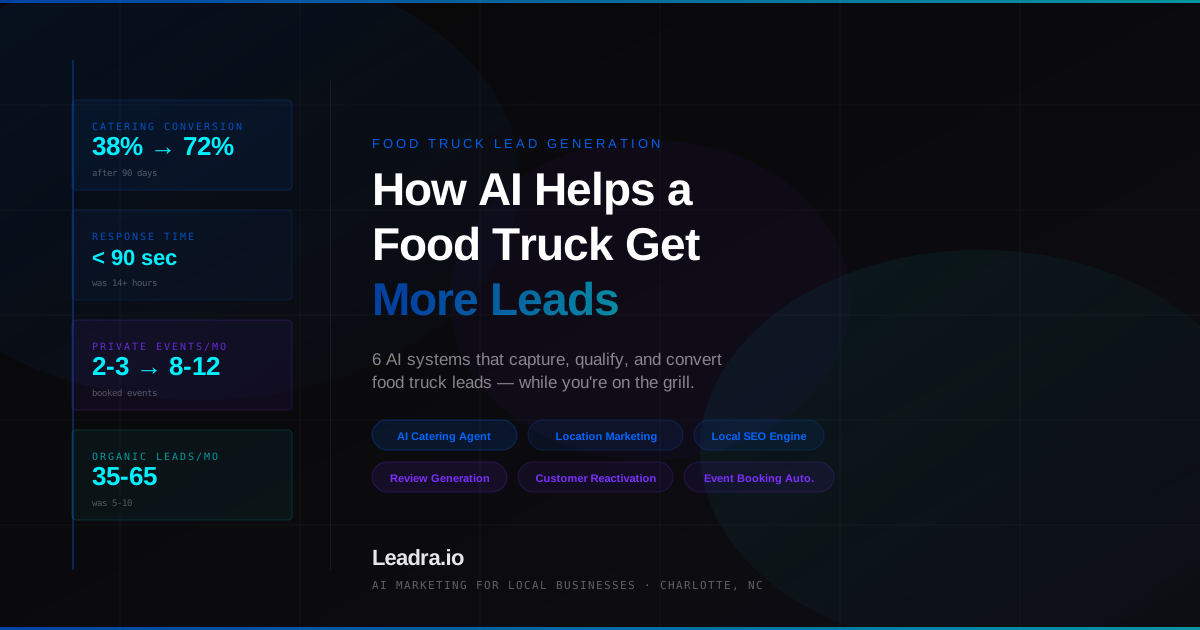
These benchmarks come from Leadra.io's food truck and food business deployments. The "before" column reflects a typical food truck running on manual marketing. The "after" column reflects 90-day results with a full AI lead generation stack.
Catering inquiry conversion
Before: 38%
After: 72%
Avg. response time to catering leads
Before: 14+ hours
After: < 90 seconds
Monthly Google reviews
Before: 2-5
After: 15-30
Private event bookings/month
Before: 2-3
After: 8-12
Organic search leads/month
Before: 5-10
After: 35-65
Owner hours/week on marketing
Before: 7-10 hrs
After: < 2 hrs
The catering inquiry conversion rate is the most immediate lever. Most food trucks convert catering leads at 35-40% because inquiries sit unanswered during service hours. Responding within 90 seconds consistently pushes that to 70%+. For a food truck receiving 10 catering inquiries per month at an average booking value of $1,200, the difference between 38% and 72% conversion is roughly $4,080 in additional monthly revenue — over $48,000 per year from one system change.
How the Systems Work Together to Compound Lead Flow
Each AI system generates leads independently. But the compounding effect of running them together is where food trucks see the biggest growth. Here's how they connect:
AI SEO content drives organic traffic from high-intent searches
AI-generated local content begins ranking for food truck search terms within 60-90 days. New prospects arrive from searches they made themselves — 'food truck for corporate lunch', 'food truck catering Charlotte NC', 'food truck for birthday party near me'. These are the highest-intent leads in the funnel: they were already looking for a truck to hire.
AI catering agent converts that traffic to booked and deposited events
Prospects who land on the website from organic search are met immediately by the AI catering inquiry agent. Instead of bouncing after reading the menu, they enter a qualification flow that collects their event details, generates a quote, and books a discovery call or collects a deposit — all within minutes, all without the operator touching a phone.
AI review generation grows the organic traffic further over time
As the review count climbs month over month, the truck climbs the local map pack rankings. A truck that moves from position 9 to position 2 for 'food truck near me' doesn't just get more reviews — it gets 3-4x more organic clicks per day. Those clicks feed more leads back into the catering inquiry system, compounding the result.
AI reactivation and location marketing work the existing audience
While the organic systems generate new leads, the reactivation and location marketing systems work the existing base. Lapsed regulars get a personalized message with the truck's schedule for the week and an incentive to come back. Social followers get daily location announcements they don't have to hunt for. Both systems drive revenue from an audience the truck already has but isn't fully activating.
Getting Started: What the First 30 Days Look Like
Deploying AI lead generation for a food truck doesn't require a tech background or replacing any existing systems. Leadra.io handles setup in 72 hours and integrates with whatever the truck already uses — Square, Toast, a basic spreadsheet of regular customers, or a loyalty app database.
First 30 Days — What Activates and When
AI catering inquiry agent live on the website and connected to the Instagram DM. AI review automation active for all transactions and event completions.
AI location marketing automation running on weekly schedule. First customer reactivation sequence launches to lapsed contacts.
First reactivated customers appear at regular stops. New Google reviews go live. Private event booking automation handles first inquiries end-to-end.
AI SEO content engine has published 12-16 posts. First keyword rankings appear in Google Search Console. Organic traffic begins growing.
Most food trucks see positive ROI within the first 30 days — typically from a combination of recovered catering inquiries that previously went unanswered during service and the first reactivated repeat customers. The SEO and review systems take longer but build the most durable and compounding lead flow over time.
Frequently Asked Questions
How does AI help a food truck business get more leads?
AI helps a food truck get more leads through six systems: instant catering inquiry response (no more 14-hour response gaps during service), AI location marketing that announces where the truck will be on autopilot, local SEO content that ranks for searches like 'food truck catering near me', review generation that grows Google map pack rankings, customer reactivation sequences that bring back lapsed regulars, and private event booking automation that handles the entire booking process without operator involvement. Each system targets a different leak point in the food truck's lead funnel.
What is the fastest way for a food truck to get more catering leads with AI?
The fastest impact comes from deploying an AI catering inquiry agent. Most food trucks see results within 48 hours — the agent responds to catering inquiries in under 90 seconds, qualifies the lead, and captures a deposit or books a discovery call. For trucks receiving 8-15 catering inquiries per month, this typically adds 4-8 booked events per month within the first 30 days by capturing leads the truck was already receiving but losing to slow response during service hours.
How long does it take AI to generate leads for a food truck?
AI catering inquiry automation starts working within 24-48 hours. Customer reactivation produces repeat visits within 14-21 days. AI local SEO content takes 60-90 days to build meaningful search rankings but generates consistent organic leads for years once established. AI review generation shifts local map pack rankings within 45-60 days. Most food trucks deploying a full AI system see positive ROI within 30 days from inquiry capture and reactivation alone.
Can a food truck get more leads with AI without spending money on ads?
Yes. AI drives organic leads through three channels with no ad spend: local SEO content that ranks for search terms event planners and lunch-seekers are already using, review generation that improves local map pack rankings (where walk-up and catering leads come from), and customer reactivation that turns the existing database into recurring revenue. Leadra.io clients consistently find that AI organic lead generation outperforms paid local ads at lower cost within 90 days.
Related Guides
The Bottom Line
The question "how does AI help a food truck get more leads" has a concrete answer: it fixes the specific places where food trucks lose leads they've already earned. The catering inquiry that sat in the DM during the lunch rush. The Google search result the truck doesn't appear in. The regular who drifted away because no one reached out. The private event booking process that takes a week of back-and-forth and sometimes falls apart entirely.
AI doesn't manufacture new leads out of nothing. It captures the leads that are already flowing through the truck's existing channels — more of them, faster, without adding hours to the operator's day. That's what 30-90 day revenue growth looks like in practice for food trucks that deploy these systems: not new magic, just fewer opportunities falling through the cracks while the operator is focused on the food.
Ready to Stop Losing Leads?
See how many leads your food truck is losing — and how to fix it
Leadra.io deploys AI lead generation systems for food trucks and local businesses across Charlotte, NC and the US. Setup takes 72 hours. Most food trucks see positive ROI within 30 days — often from the first recovered catering inquiry.