Every missed call in your HVAC business is a completed transaction — just not yours. The homeowner whose call went to voicemail at 2 PM on a Tuesday already booked with your competitor by 2:07 PM. They are not calling back.
The average HVAC company misses 35-45% of inbound calls during peak cooling and heating season. At an average service ticket of $550 and install ticket of $7,800, that miss rate translates to $9,000-$31,000 in revenue that never appears on any report — because it never became a customer. It just rings three times and disappears.
The problem is not that HVAC companies are bad at sales. It is that they are busy doing the work. Technicians are on job sites. The office line is tied up. Peak season hits and capacity collapses. AI missed-call capture fixes the gap without adding staff — and without requiring anyone to be at a desk.
Why HVAC Companies Miss So Many Calls
Most HVAC operators know they miss calls. They do not know how many, when, or what those calls were worth. Before building a recovery system, it helps to understand exactly where calls fall through:
1. Single-line phone systems during peak season.
Most small and mid-size HVAC companies run 1-2 office lines. When those lines are busy — which in July is most of the time — every additional caller hits a busy signal or voicemail. That caller does not wait. A 2023 Hatch survey found that 85% of callers who reach voicemail do not leave a message when contacting a service business for the first time.
2. Calls during transit and job site time.
Owner-operators and small crews spend 6-8 hours per day on job sites or in transit between them. Every call during that window is a missed call. No call-back happens until the job wraps — often 3-5 hours later. By then, the customer is already scheduled with someone else.
3. After-hours demand spikes in extreme weather.
AC failures on 95-degree evenings and furnace outages on cold winter nights generate the highest-urgency calls in the HVAC calendar. These callers are panicked, motivated, and ready to pay a premium — and they hit voicemail. Studies show after-hours emergency leads have a 3-4x higher close rate than routine service inquiries. They are also the most likely to call three competitors before any of them call back.
4. No visibility into what is being lost.
Most HVAC companies can not answer the question: 'How many calls did we miss last Tuesday?' Basic phone systems do not log missed calls with enough detail to act on. No log means no follow-up, no pattern recognition, and no ability to calculate what the problem actually costs.
These are not management failures. They are structural gaps that exist in every HVAC operation at a certain volume. AI missed-call capture is not about working harder — it is about building an automated layer that catches what the human team physically cannot.
The 4-Layer AI Missed-Call Capture System
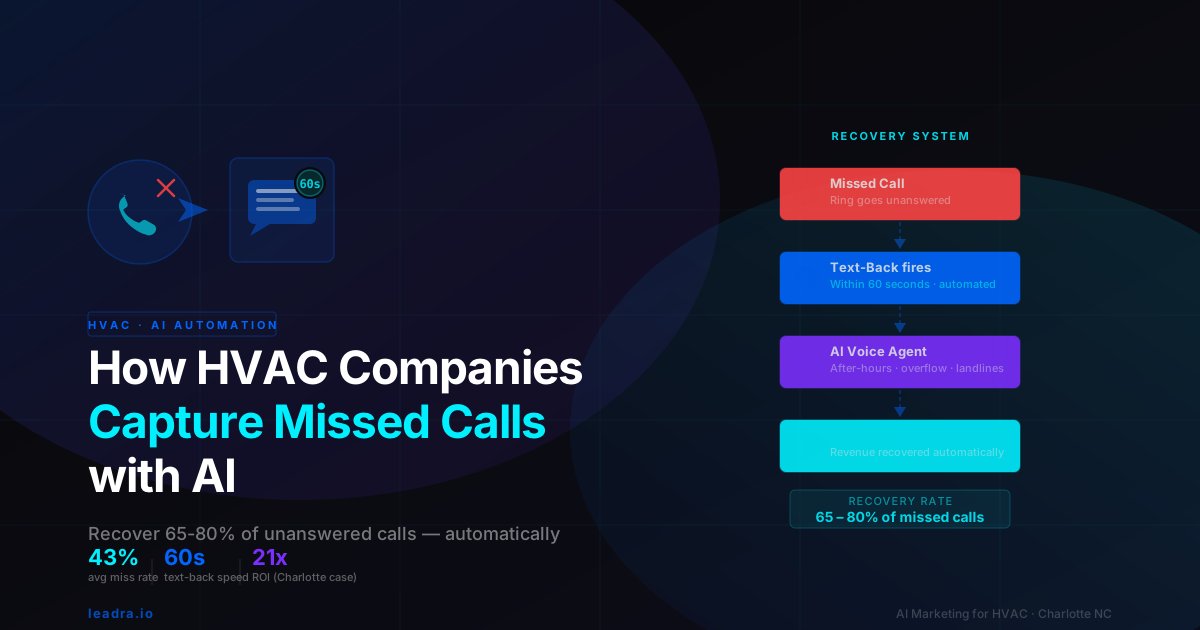
Recovering missed calls is not a single tool — it is a layered system. Each layer catches what the layer before it could not. Here is how the full stack works for HVAC companies:
Missed-call text-back — fires within 60 seconds.
The instant your business line goes unanswered — whether you are on another call, on a job, or it is 11 PM — an automated SMS fires to the caller's number. The message introduces your business, apologizes for missing them, and gives a direct booking link or asks them to describe their issue by text. This is the highest-leverage layer: a 2024 Lead Response Management study found that responding to a lead within 60 seconds increases contact rate by 391% compared to responding 5 minutes later. Most HVAC companies never respond within 60 minutes, let alone 60 seconds.
AI voice agent — answers calls the text-back cannot recover.
Some callers never receive the text-back (landlines, spam filters) and some simply prefer to speak to someone rather than text. An AI voice agent answers those calls within 2 rings, handles a natural conversation about the customer's issue, and books an appointment directly into your scheduling calendar. Unlike a text-back, the voice agent works during business hours too — any call your team cannot pick up routes to the AI rather than voicemail.
Call tracking — makes every missed call visible and actionable.
Before you can recover missed calls at scale, you need to see them. Call tracking software assigns unique phone numbers to each ad source (Google Ads, your website, Google Business Profile, truck wraps) and logs every call — answered and missed — with the source, call duration, caller's number, and timestamp. This turns missed calls from an invisible problem into a daily report your office manager can act on. It also shows you which ad sources generate the most missed calls — often a signal that you are getting calls during hours your AI coverage is not fully deployed.
Multi-touch follow-up sequences — converts the leads that did not respond to the text-back.
Roughly 30-40% of callers will not respond to a single text-back SMS — they may be driving, they may have already called someone else, or they may need a second prompt. A follow-up sequence sends 4-6 additional touchpoints over 10-14 days: a second SMS at 4 hours, an email at 24 hours, a third SMS at 72 hours with a booking link, and a final re-engagement message at day 10. Sequences stop automatically when the lead books, calls back, or opts out. HVAC companies using this approach recover an additional 18-24% of leads that went cold after the initial text-back.
Each layer works independently, but they compound when stacked. Layer 1 (text-back) catches the most — roughly 55-65% of missed-call leads respond to the first SMS. Layer 2 (AI voice agent) gets the calls that never even reach the text-back. Layer 3 (call tracking) makes the whole system visible and improvable. Layer 4 (follow-up sequences) converts the remaining holdouts. End result: 70-80% of missed calls become contacts instead of lost revenue. See how AI dispatching layers on top of missed-call capture for full call coverage.
Manual vs AI Missed-Call Capture: What Actually Happens to Each Call
| Scenario | Manual (No AI) | AI Capture System |
|---|---|---|
| Call during peak hours | Busy signal or voicemail, no callback | AI voice agent answers, books appointment |
| Call at 10 PM | Voicemail, caller books with competitor | Text-back fires in 60s, lead replies, booked |
| Emergency call — no AC at night | Voicemail, no emergency triage | Text-back + AI escalation to on-call tech |
| Lead does not respond to first text | Lead is gone | 4-touchpoint sequence over 14 days |
| Landline caller — no SMS | No contact possible | AI voice agent handles inbound call |
| Visibility into missed calls | No log, unknown volume | Full call tracking log by source and time |
| Recovery rate | 5-15% (those who call back later) | 65-80% of missed calls become contacts |
The most striking difference in that table is the visibility row. An HVAC company running without call tracking genuinely does not know what it is losing. The AI system is not just about recovery — it is about finally having the data to understand the problem.
Case Study: Charlotte HVAC Company Recovers 26 Jobs Per Month from Missed Calls
Client Story
A Charlotte-area HVAC company with 4 technicians and one office manager was doing $62,000/month in peak season revenue. When Leadra.io ran a call tracking audit in April, the numbers were stark: the company received 94 inbound calls in a 30-day period and answered 54 of them — a 43% miss rate. Of the 40 missed calls, not a single one was logged, followed up on, or recovered.
We deployed the full 4-layer capture system in 9 days: call tracking numbers across Google Ads, their website, and Google Business Profile; a missed-call text-back triggering within 45 seconds of any unanswered ring; an AI voice agent for overflow calls during business hours and all after-hours coverage; and a 5-touchpoint follow-up sequence for leads that did not respond to the initial text-back. Emergency triage logic routed urgent SMS replies directly to the owner's cell.
In the first 30 days after deployment, the system logged 41 missed calls and recovered 26 of them as booked appointments — a 63% recovery rate on calls that previously had a 0% recovery rate. The 26 recovered jobs averaged $580 in service revenue and $11,200 in equipment installs. Month 3 revenue: $94,000 — a $32,000 increase on the same ad spend and the same team.
Miss rate (before)
Recovered jobs/mo
Monthly revenue
ROI on system
The system cost: $1,100/month retainer plus approximately $130/month in voice minutes and SMS credits. Revenue recovered in month 3: approximately $32,000. That is a 21.3x return — and that number grows as peak season deepens, because more calls means more recoveries at the same system cost.
The owner's observation after seeing the call tracking data for the first time: "I had no idea. I thought we were doing fine because the team was busy. We were busy AND losing $30,000 a month. The AI just turned on a light in a room that had always been dark."
What the AI Missed-Call Capture System Costs in 2026
Pricing depends on which layers you deploy and the call volume your business handles. Here is a realistic breakdown for HVAC companies at three stages:
- —Missed-call text-back (fires in under 60 seconds)
- —Basic conversation handling via SMS
- —Direct booking link in text message
- —Simple follow-up: 1 additional SMS at 24 hours
- —Call log dashboard (answered vs. missed counts)
Best for: Owner-operators or 1-2 tech companies under 50 calls/month
- —Everything in Text-Back Only
- —AI voice agent for overflow and after-hours calls
- —Call tracking with source attribution by ad channel
- —5-touchpoint follow-up sequence over 14 days
- —Emergency triage logic with on-call tech escalation
- —Calendar booking integration (Jobber, ServiceTitan, Google Cal)
Best for: 3-8 tech HVAC companies — the most common entry point for full coverage
- —Everything in Full Capture Stack
- —SEO content engine (4-8 posts/month targeting HVAC keywords)
- —Google Business Profile management and post automation
- —Review request automation after each completed job
- —Monthly revenue attribution report by lead source
Best for: 8+ tech companies investing in both missed-call recovery and organic lead growth
Infrastructure costs — Twilio voice minutes ($30-$90/month), SMS credits ($15-$50/month), call tracking numbers ($10-$30/month) — add $55-$170/month on top of any retainer. Factor those in when comparing total system cost.
The break-even calculation is simple: how many recovered jobs per month do you need to cover the retainer? For most HVAC companies at the Full Capture Stack tier, that is 1-2 additional service calls. Most systems hit that number in the first week. See the full AI implementation cost breakdown for service businesses.
How to Set Up Missed-Call Capture for Your HVAC Company: 5 Steps
Getting the system live takes under two weeks when the setup follows this order:
Run a call audit first.
Before spending a dollar on tools, get 30 days of call data. Most phone carriers can pull a missed-call log. If your business uses Google Ads, the Calls report in Google Ads Manager shows answered vs. missed. This baseline tells you your actual miss rate and the ad sources generating the most unanswered calls.
Set up call tracking numbers.
Replace your ad-facing phone numbers with tracked numbers that forward to your main line. Each source (Google Ads, website header, GBP) gets its own tracking number. You answer calls the same way — the tracking layer runs invisibly in the background and logs every interaction.
Configure the text-back trigger and message.
Connect your call tracking system to a text-back platform (many HVAC CRMs like ServiceTitan or Jobber have this built in; standalone options include Hatch or a custom build). Write the initial SMS: short, branded, with a booking link. Test it by calling your own number and confirming the text fires within 60 seconds.
Deploy the AI voice agent for overflow and after-hours.
Configure call forwarding so any unanswered call (beyond 3-4 rings) routes to the AI voice agent instead of voicemail. Set up emergency triage language lists — phrases that trigger immediate SMS escalation to your on-call tech. Test the emergency flow before going live.
Build the follow-up sequence and set suppression rules.
Create a 4-6 touchpoint sequence that triggers for any lead that does not respond to the initial text-back. Set suppression rules so leads who book, call back, or reply 'stop' exit the sequence immediately. Review the sequence weekly for the first 30 days and adjust timing based on response rate data.
Most HVAC companies see their first AI-recovered booking within 48 hours of going live. The full system — all 4 layers active and tuned — typically reaches peak recovery rate by day 14-21 as the follow-up sequences complete their first full cycles. See how AI voice agents handle HVAC emergency calls specifically.
Frequently Asked Questions
How do HVAC companies capture missed calls with AI?
HVAC companies capture missed calls with AI through a 4-layer system: a missed-call text-back that fires an SMS within 60 seconds of any unanswered ring, an AI voice agent that answers calls the text-back can't recover, call tracking software that logs every missed call source, and a multi-touch follow-up sequence that runs automatically until the lead books or opts out. Together, these layers recover 60-75% of calls that would otherwise go to a competitor.
What is a missed-call text-back for HVAC companies?
A missed-call text-back is an automated SMS that fires within 30-90 seconds whenever your business phone goes unanswered — whether you're on another call, on a job site, or outside business hours. The message includes your business name, an apology for missing the call, and a direct booking link or prompt to reply with their issue. Studies show 78% of leads go with the first company that responds. A text-back lets you be first even when you can't answer.
How much revenue do HVAC companies lose from missed calls?
A typical HVAC company with 40-80 inbound calls per month during peak season misses 14-36 calls per month at a 35-45% miss rate. At an average ticket of $450-$800 for service calls and $4,000-$12,000 for installs, that's $6,300-$28,800 in monthly revenue walking out the door. Most HVAC operators don't see this number because missed calls don't appear on any report — they simply never become customers.
Does a missed-call text-back work for after-hours HVAC calls?
Yes — missed-call text-backs work around the clock, including nights and weekends. When configured with emergency triage logic, the text-back can ask the customer to describe their issue and automatically escalate urgent responses (no AC, furnace out, water leak) to your on-call tech via SMS. Non-emergency replies get queued for next-day booking. This means after-hours emergency leads get a response in under 2 minutes instead of waiting until your office opens.
The HVAC companies growing fastest in 2026 are not necessarily the ones with the most technicians or the biggest ad budgets. They are the ones that stop letting paid leads leak out of an unanswered phone line. One recovered job per day from missed calls adds $180,000-$250,000 in annual revenue at typical HVAC ticket sizes — on zero incremental ad spend.
At Leadra.io, we build missed-call capture systems for HVAC and service businesses across Charlotte and the Carolinas. Setup takes under 2 weeks. The first recovered booking typically happens within 48 hours of the text-back going live.
Built for HVAC Companies
Find Out How Many Calls You're Missing Right Now
We run a free call audit that shows your exact miss rate, the ad sources generating the most missed calls, and the estimated monthly revenue leaving your business. No commitment. Just the number — then you decide.