There is a line item missing from every HVAC income statement. It does not appear in QuickBooks. ServiceTitan will not show it. No end-of-month report captures it — because it never became revenue in the first place.
It is the missed call. And for most HVAC companies running $600,000-$2M per year, the number is staggering once you do the math: $15,000-$40,000 per month in revenue that rang three times, went to voicemail, and walked straight to a competitor.
The operators who know they miss calls tend to shrug it off — "we call them back when we can." The data says callbacks do not work. By the time you call back, the homeowner with no AC in the middle of a Charlotte summer has already scheduled with whoever answered first.
AI missed-call recovery changes the economics. This article walks through the exact cost formula, shows you what the ROI looks like in real numbers, and explains how to get the system running in two weeks.
The Cost Formula: What One Missed HVAC Call Is Actually Worth
Start with the average ticket values. Residential HVAC service and diagnostic calls average $380-$680 — use $475 as a conservative midpoint. AC and furnace system replacements average $4,200-$8,500 — use $5,800 blended. Maintenance visits and tune-ups average $280-$360.
A realistic inbound call breakdown for a residential HVAC company during peak season:
| Call Type | % of Inbound | Avg Ticket | At 60% Close |
|---|---|---|---|
| Service & Repair | 45% | $475 | $285 |
| System Replacement | 30% | $5,800 | $3,480 |
| Maintenance & Tune-Up | 15% | $320 | $192 |
| General Inquiry | 10% | — | $0 |
Weighted average revenue per answered and converted call: (0.45 × $285) + (0.30 × $3,480) + (0.15 × $192) = $128 + $1,044 + $29 = $1,201.
Round to $1,100-$1,200 as the average revenue value of a single answered and booked call. Now run the missed-call math:
Monthly Cost Calculation
80 inbound calls/month (peak season)
× 38% miss rate = 30 missed calls/month
× $1,150 average value per recovered call
= $34,500/month leaving through missed calls
That number never appears on a report because the calls never became customers. But it is real revenue walking out the door every month — and it is recoverable.
The Lifetime Value Problem: Why Each Missed Call Costs More Than the Ticket
The ticket value is just the beginning. HVAC customers are long-term relationships. A homeowner who books a service call once typically schedules annual maintenance, calls you for filter changes, asks about ductwork cleaning, and replaces their system in 8-12 years. They refer neighbors. They leave reviews.
The average residential HVAC customer generates $2,400-$4,100 in lifetime value over five years with a consistent provider. Industry retention data puts lifetime value even higher for customers who sign maintenance agreements.
A missed call does not lose you one ticket. It loses you a customer. At 30 missed calls per month and a 25% close rate had you answered (conservative — some of those callers went straight to a competitor regardless), you are losing 7-8 new customers per month.
LTV Impact Calculation
30 missed calls × 25% would-have-converted = 7.5 lost customers/month
× $3,200 average 5-year LTV
= $24,000/month in lost lifetime value
Annual impact: $288,000 in LTV walking out the door
This is why AI missed-call recovery does not cost money — it recovers money that was already leaving. The system costs $400-$1,200 per month. The LTV it protects is 20-100 times that amount.
Why "We'll Call Them Back" Does Not Work
Most HVAC operators believe callbacks recover the damage. The data says otherwise. HVAC leads behave exactly like emergency service leads — because for the caller, they often are emergencies.
Lead response research consistently shows:
- →78% of buyers go with the first company that responds — the rest of the market competes for 22%
- →After 5 minutes, lead response rates drop 80%. After 30 minutes, the prospect has contacted at least one other provider
- →Even a trained CSR calling back within 15 minutes closes at roughly half the rate of an answered call
- →A homeowner with no AC on a 95-degree day in Charlotte has zero patience. They are not waiting for a callback
Speed is the product. The company that responds first wins most of the market. AI delivers that speed at scale — a text-back within 60 seconds, a voice agent that answers immediately, and a follow-up sequence that runs on its own while your tech is finishing a job.
How AI Changes the Cost Math: Three Recovery Layers
The AI system that turns missed-call losses into recovered revenue works through three compounding layers. Each one catches what the previous layer missed.
Layer 1 — Missed-Call Text-Back (60 Seconds)
When your line rings and goes unanswered — during a call, on a job site, after hours — an SMS fires to the caller within 60 seconds. The message includes your company name, an acknowledgment, and a direct booking link or a prompt to reply with their issue.
Text-back recovery rate: 22-38% of missed calls convert when a text fires within 60 seconds. That drops to under 8% if the text fires after 10 minutes. For a company missing 30 calls per month, a 30% text-back recovery = 9 jobs recovered in month one.
Layer 2 — AI Voice Agent (24/7 Overflow and After-Hours)
An AI voice agent answers calls your team cannot get to — peak-hour overflow, after 5 PM, weekends. It sounds like a real receptionist, captures the caller's name, address, issue, and preferred appointment time, and books directly into ServiceTitan, HouseCall Pro, or whichever scheduling tool you use.
After-hours calls represent 30-40% of total missed-call volume. An AI voice agent turns those from silent losses into booked morning appointments. Recovery rate: 55-70% of after-hours callers that reach the agent book or leave a qualified lead record.
Layer 3 — Multi-Touch Follow-Up Sequences
Calls that do not convert through layer 1 or layer 2 enter a 5-touch automated follow-up: day 1 text, day 2 email, day 3 callback prompt, day 5 text with a seasonal offer, day 8 email with social proof (reviews). The sequence runs automatically until the lead books or opts out — no human time required.
Combined recovery rate across all three layers: 60-72% of missed calls get recovered within 72 hours.
ROI Math
30 missed calls/month × 65% recovery rate = 19-20 calls recovered
× $1,150 average revenue per recovered call = $22,425 recovered monthly
AI system cost: $895/month
Net ROI: 25x in month one
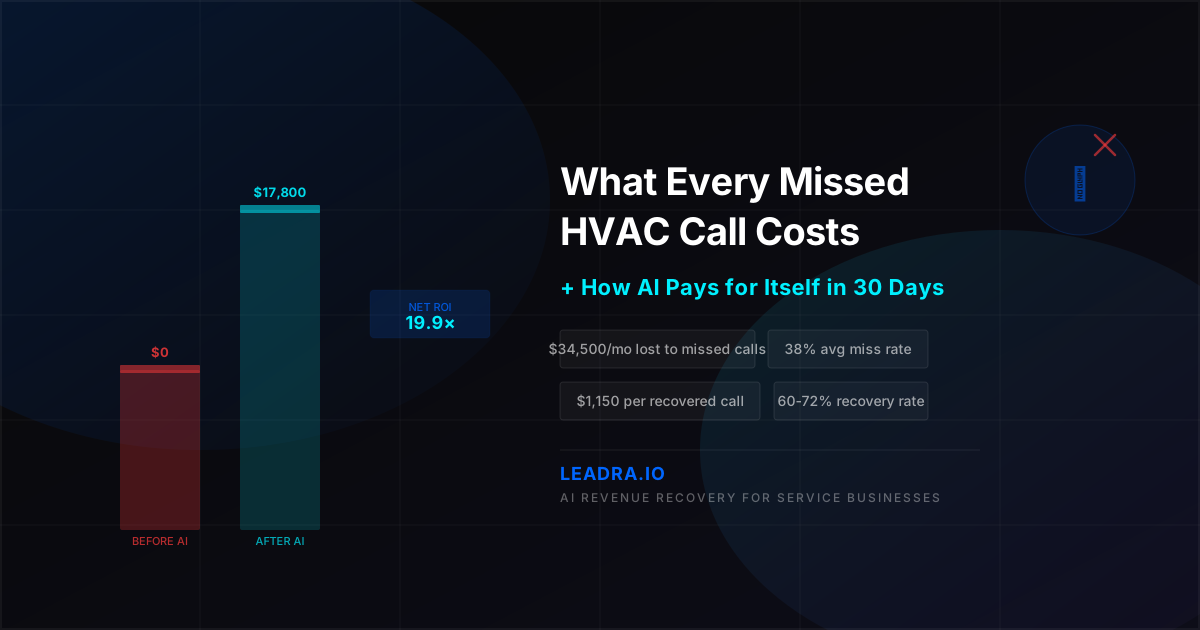
Charlotte HVAC Case Study: 19.9x ROI in 60 Days
A 7-technician residential HVAC company in Charlotte came to Leadra.io for HVAC marketing in February 2026, ahead of AC season. Their call tracking data — set up the prior fall — showed a 31% miss rate: 22 missed calls per month in off-peak, projecting to 35+ during the summer rush.
Leadra.io implemented all three AI layers in 10 days: missed-call text-back firing within 45 seconds, a 24/7 AI voice agent for overflow and after-hours, and a 5-touch follow-up sequence for unconverted leads. Call tracking was connected for source attribution so they could see which calls came from Google Ads, Yelp, organic search, and referrals.
| Metric | Before AI | After 60 Days |
|---|---|---|
| Monthly miss rate | 31% | 8% |
| Calls recovered/month | 0 | 19 |
| Additional jobs booked | 0 | 11/month |
| Revenue recovered | $0 | $17,800/month |
| AI system cost | $0 | $895/month |
| Net monthly ROI | — | 19.9x |
The 19.9x ROI excludes lifetime customer value. The 11 new customers added per month are each worth $2,800-$3,600 in LTV — adding another $30,800-$39,600 in recoverable long-term value from the same $895 monthly investment.
How to Implement in Two Weeks (Without Changing How You Run Jobs)
This does not require new phones, new software, or hiring. It runs on top of what you already use.
Week 1 — Call Tracking and Text-Back
Port your existing business number into a call tracking platform like CallRail. Your number stays the same — callers dial the same digits — but you now have data on every ring, every answered call, every miss, and the source that drove each one.
Configure the missed-call text-back: any unanswered call after 3 rings triggers an automatic SMS within 45-60 seconds. Message: "[Company Name]: Sorry we missed you. Reply here or book at [link] — we'll get you taken care of today."
Week 2 — AI Voice Agent and Follow-Up Sequences
Deploy the AI voice agent for after-hours and overflow. The agent needs your company name, service area, hours, booking URL, and emergency escalation logic (so urgent calls — no heat in winter, refrigerant leak — get flagged immediately).
Build your 5-touch follow-up sequence in your CRM or a tool like GoHighLevel. The sequence runs automatically for every lead that does not book from layer 1 or layer 2. No manual follow-up needed.
For a step-by-step breakdown of the AI systems that drive this, see our complete HVAC missed-call capture system guide — or read about the best AI dispatcher tools for HVAC contractors if dispatching efficiency is also a bottleneck.
Frequently Asked Questions
How much does a missed HVAC call actually cost?
A single missed HVAC call costs between $660 and $1,380 in lost immediate revenue, depending on call type. Blended across a typical inbound mix — 45% service, 30% replacement, 15% maintenance — the weighted average value of one answered and booked call is roughly $1,100-$1,200. At a 38% miss rate on 80 monthly calls, that is $34,500 per month leaving through unanswered rings. The lifetime value impact ($2,400-$4,100 per lost customer) more than doubles that number.
What is the ROI of AI missed-call recovery for HVAC companies?
For most HVAC companies, a full AI missed-call system — text-back plus voice agent plus follow-up sequences — delivers a 15-28x ROI within the first 30 days. A system costing $800-$1,200 per month typically recovers 8-15 calls per month. At $1,150 average revenue per recovered call, that is $9,200-$17,250 in recovered revenue monthly. The ROI compounds as recovered customers become repeat clients worth $2,400-$4,100 each in lifetime value.
How fast does a missed-call text-back need to fire to work?
Speed is the single most important variable. Text-backs that fire within 60 seconds recover 22-38% of missed leads. After 5 minutes, recovery drops below 12%. After 30 minutes, it is under 5%. HVAC calls are time-sensitive — a homeowner with no AC in summer has already texted two other companies by the time your voicemail picks up. Configure the system for a 30-90 second response window to be first, which is what determines who gets the booking.
Can an AI voice agent book HVAC appointments without a human?
Yes. Modern AI voice agents integrate directly with ServiceTitan, HouseCall Pro, Jobber, and most scheduling platforms via API. When a caller asks to book, the agent checks real-time availability and schedules the appointment — capturing name, address, issue, and preferred time — with no human step required. HVAC companies using AI voice agents for after-hours calls report 55-70% of callers that reach the agent book on the first interaction, versus under 20% when sent to voicemail.
Find Out What Your Miss Rate Is Costing You
Leadra.io sets up call tracking and the full AI missed-call recovery system for HVAC companies in Charlotte and across the US. Most clients recover the system cost in the first two weeks.