A roofing contractor in Charlotte runs 40 free inspections after a hail event. Twenty-two become insurance claims. Of those, 14 get approved. Of those 14, 9 close as full replacements. That's a 22% close rate on inspections — and 18 trips your crew drove that produced nothing. At $200-$400 per wasted inspection in labor and fuel, that's $3,600-$7,200 burned chasing bad leads after one storm.
The roofing companies growing their insurance replacement revenue fastest aren't just answering more calls. They're filtering smarter — using an AI insurance claim lead qualifier that scores every inbound lead for claim viability before a single inspector leaves the shop. High-probability jobs go to the front of the inspection queue. Low-probability jobs get a cash-pay repair quote. Jobs that won't survive an adjuster review get flagged on the first call, not after a wasted site visit.
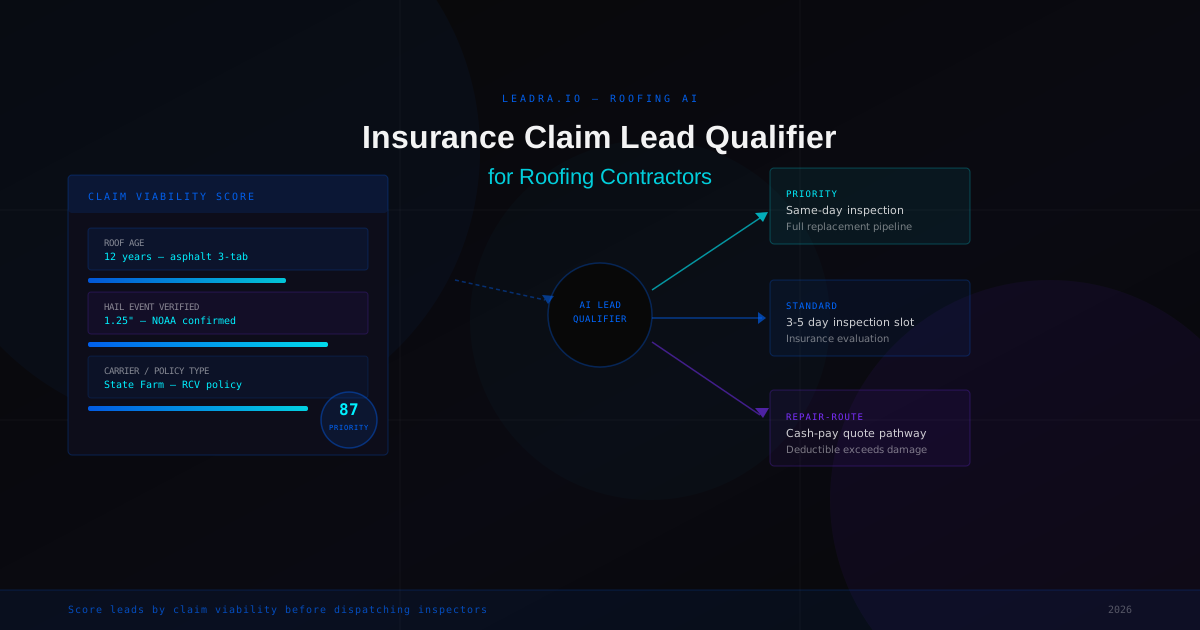
This guide covers what an AI insurance claim lead qualifier actually does for roofing contractors, the six signals it scores, how the qualification workflow runs from inbound call to CRM priority tier, and the results contractors in storm markets like Charlotte, NC are seeing in 2026.
Why Most Roofing Inspection Pipelines Are Full of the Wrong Jobs
After a storm, every homeowner who sees dented gutters or a neighbor getting a new roof calls a roofing contractor. The problem: a significant portion of those callers have roofs that won't qualify for an insurance claim — because the roof is too old, the damage is below the deductible, the carrier has a strict depreciation schedule, or the visible damage is cosmetic rather than functional. Without a qualification filter on the front end, your inspection calendar fills with jobs that won't convert.
According to the Insurance Information Institute, roughly 35-45% of storm-related roofing claims filed after a hail event are denied on the first review — most often due to pre-existing wear, age-related exclusions, or damage below the deductible threshold. That denial rate is even higher for roofs over 15 years old, which make up a substantial share of older Charlotte neighborhoods like Dilworth, Myers Park, and Plaza Midwood.
For a roofing contractor focused on insurance replacement work, the math is simple: every low-viability inspection you run costs time and crew resources that could have gone to a high-probability full replacement. An AI insurance claim lead qualifier doesn't reduce your total call volume — it tells you which calls to prioritize, which to route to a repair pathway, and which are unlikely to convert before your inspector drives. See how AI voice agents handle full storm call volume for roofing companies.
The Inspection Waste Problem
Avg. inspection close rate
22%
Without qualification filter
Claim denial rate
35-45%
Post-hail events (III data)
Cost per wasted inspection
$400
Labor + fuel + time
The 6 Signals an AI Insurance Claim Lead Qualifier Scores on Every Call
An effective AI insurance claim lead qualifier for roofing doesn't ask generic questions — it runs a structured intake protocol built around the same variables an adjuster uses to approve or deny a claim. Here are the six signals that determine the viability score:
Roof age and material.
This is the single highest-weight variable in insurance claim viability. Asphalt shingles have an expected lifespan of 20-25 years — most carriers apply significant depreciation for roofs over 15 years and outright deny replacement claims for roofs over 20 years on standard policies. Metal, tile, and slate roofs have different depreciation curves and are evaluated differently. The AI asks the year of last roof installation and the material type, then cross-references against carrier norms for the zip code.
Storm date and hail size confirmation.
The AI captures the exact storm date and homeowner's address, then runs a background check against NOAA Severe Weather Event data and commercial hail verification databases. If a verified hail event occurred in that zip code on that date, the claim has a documented weather foundation. If the date or size doesn't align with the closest verified storm, it flags the lead for adjuster-level review before scheduling. Hail size matters: quarter-size (1 inch) and above causes functional damage to most shingles; dime-size damage is often cosmetic and harder to claim.
Visible damage indicators — gutters, A/C, skylights.
The AI asks three questions most homeowners can answer without a ladder: Are there visible dents or dings on the gutters or downspouts? Is there dimpling on the A/C condenser unit visible from the ground? Are there any cracked or displaced skylight covers? These three indicators are the first things adjusters check because they confirm hail impact on soft metals at ground level — and correlate strongly with functional shingle damage at the roof deck. A homeowner who reports all three is a high-confidence insurance candidate.
Interior water intrusion.
Active interior leaks — water stains on ceilings, dripping from light fixtures, wet attic insulation — elevate a claim to emergency severity and significantly strengthen the claim file. The AI flags any reported interior intrusion as a priority-one inspection and adds an emergency escalation note to the CRM record. For insurance purposes, documented interior damage means the claim is not just cosmetic — it has measurable consequential loss, which often accelerates adjuster approval.
Insurance carrier and existing policy details.
Carrier behavior varies significantly in storm markets. State Farm, Allstate, and USAA generally follow standard hail damage protocols and approve well-documented claims with appropriate evidence. Some regional carriers apply aggressive depreciation schedules or require multiple adjuster visits. The AI captures the carrier name and, if the homeowner knows it, the policy type (replacement cost value vs. actual cash value — ACV policies pay out far less on older roofs). RCV policies on 10-12 year old roofs from cooperative carriers are the highest-value leads in any storm queue.
Deductible amount vs. estimated repair scope.
The AI asks the homeowner's deductible. If the homeowner says $5,000 and the visible indicators suggest a repair-scope claim of $4,000-$6,000, the claim is economically nonviable — filing only makes sense if the deductible is clearly below the repair cost. The AI estimates repair scope from damage indicators and roof size (the homeowner's address pulls square footage from county assessor data) and flags the deductible-to-scope ratio. Jobs where the deductible likely exceeds the repair value are routed to cash-pay repair quotes rather than insurance inspection scheduling.
How the AI Qualification Workflow Routes Leads in Real Time
The AI qualification system doesn't just score leads — it routes them to the right pathway immediately, so your office never has to manually triage a storm call queue. Here's how the full flow works from first ring to CRM entry:
Inbound call answered by AI voice agent
Every call is answered within 2 rings. The AI identifies itself as your company's inspection coordination team and opens with context: 'We've been getting a lot of calls about the recent storm — are you calling about potential roof damage?' This warm opener increases disclosure and speeds up the qualification intake.
Six-signal qualification intake
The AI runs through the six qualification signals in a natural conversational flow — not a rigid survey. Typical intake takes 4-7 minutes. The AI is trained to handle common homeowner objections ('I don't know my deductible' or 'I'm not sure what kind of shingles I have') with graceful fallbacks that still produce enough data for a provisional score.
Claim viability score calculated
The system calculates a claim viability score (1-100) weighted by roof age, storm verification, visible damage indicators, carrier type, and deductible ratio. Scores are grouped into three tiers: Priority (75+), Standard (45-74), and Repair-route (below 45). Each tier has a defined next action so your office never has to decide what to do with a lead — the routing is automatic.
Lead routed to correct pathway
Priority leads (score 75+) get first-available inspection slots — the AI books directly into your calendar in real time. Standard leads get inspection slots in the next 3-5 business days. Repair-route leads are offered a cash-pay repair quote pathway with a lower-urgency booking or handed off to a repair subcontractor if you don't handle small repairs. Emergency leads (any active water intrusion) override the score and trigger same-day scheduling regardless of tier.
CRM record created with full intake data
Every lead — regardless of tier — gets a CRM record with the full intake: damage notes, carrier, deductible, roof age, viability score, assigned tier, and call recording. When your inspector arrives at a Priority job, they already have the adjuster-relevant data in their phone. No re-collecting information at the front door.
Follow-up sequences deployed by tier
Priority leads get confirmation SMS + day-before reminder + post-inspection claims support outreach. Standard leads get SMS confirmation + 3-touch follow-up if they don't book. Repair-route leads get a quote follow-up sequence. The system handles all three streams simultaneously without manual sorting.
Manual Lead Sorting vs. AI Insurance Claim Qualification: The Real Difference
Most roofing companies sort their inspection pipeline the same way: whoever calls first gets scheduled first. Here's what that approach costs versus an AI qualifier:
| Metric | Manual / FIFO | AI Lead Qualifier |
|---|---|---|
| Inspection-to-close rate | 18-25% average | 38-55% on qualified leads |
| Claim viability known before dispatch | No — discovered at inspection | Yes — scored on first call |
| Insurance intake data | Collected at inspection (too late) | Captured on first call |
| Wasted inspections per storm event | 15-25 on avg. 40-call event | 3-6 on same call volume |
| Carrier intelligence applied | None — adjuster figures it out | Carrier-specific flag per lead |
| Low-viability leads | Mixed into full inspection queue | Routed to repair pathway immediately |
| Revenue per inspection hour | Low — many bad leads dilute it | High — crew time goes to payable jobs |
The revenue-per-inspection-hour metric is the one that compounds. When your crew spends a Tuesday driving three low-viability inspections that produce repair quotes on $1,200 jobs, they're not available for the Priority-scored full-replacement inspection that came in the same morning — the one with an 18-year-old 3-tab shingle roof, quarter-size hail, and an RCV policy at State Farm. That's a $14,000 job that goes to whoever picks it up. AI qualification makes sure it goes to you. See the full AI lead generation system for local service businesses.
Case Study: Charlotte Roofing Contractor Lifts Inspection Close Rate from 24% to 51%
Client Story
A 5-crew roofing operation in North Charlotte had strong storm response — they answered calls reliably and kept a full inspection calendar after weather events. Their problem was downstream: after a significant hail event in early 2026, they ran 48 inspections and produced 12 approved insurance replacement jobs. The remaining 36 were a mix of cash-pay repairs, denied claims, and homeowners who decided not to file. At an average drive time of 35 minutes per inspection in the Charlotte metro, they'd spent roughly 28 hours of crew time on leads that didn't pay.
Leadra.io deployed an AI insurance claim lead qualifier integrated with their existing AI voice agent and JobNimbus CRM. The qualifier scored every inbound call across six viability signals and routed Priority-tier leads to same-day inspection slots. Standard-tier leads filled the next 3-5 day slots. Repair-route leads got a separate cash-pay quote workflow. Emergency leads with active leaks were escalated to the on-call crew lead by SMS within 90 seconds of the call.
On the next comparable storm event — a June 2026 hail event across the Cabarrus County corridor — they handled 52 inbound calls. The AI routed 23 to Priority inspection, 16 to Standard, and 13 to Repair-route or not-worth-filing. Of the 23 Priority inspections, 12 became approved full-replacement insurance jobs. Of the 16 Standard inspections, 5 converted. Total: 17 closed replacement jobs from 39 inspections — a 44% close rate, almost double their prior event's 24%.
Inspections run
Insurance jobs closed
Close rate
Revenue per event
More revenue, fewer wasted inspections, less crew time burned on non-converting leads. The AI qualifier paid for itself in the first week of the first storm event it handled.
The owner's note: "We used to schedule anyone who called and figure it out at the inspection. Now we know the quality of a lead before we drive. The crew stops wasting a Tuesday on a 22-year-old 3-tab with a $5,000 deductible and spends it on the RCV jobs that actually close."
What AI Insurance Claim Lead Qualification Costs for Roofing Contractors in 2026
Pricing scales with call volume, CRM integration depth, and whether the qualifier runs as a standalone layer on top of an existing AI voice agent or as part of a full lead management system:
- —AI qualification scoring on inbound calls (add-on to existing voice agent)
- —Six-signal viability scoring per lead
- —Three-tier routing (Priority / Standard / Repair-route)
- —CRM record creation with score and intake data
- —Emergency lead escalation SMS to on-call crew
Best for: Contractors with an existing AI voice agent who want qualification logic added on top
- —AI voice agent (24/7 call answering) + qualification scoring built in
- —Six-signal intake protocol on every call
- —NOAA/hail verification database cross-reference
- —Real-time calendar booking by priority tier
- —CRM sync (JobNimbus, AccuLynx, Jobber, or Google Sheets)
- —Post-inspection claims support outreach automation
Best for: 3-8 crew operations handling 30-150 storm calls per event with no existing AI voice stack
- —Everything in Full Qualification + Voice System
- —Carrier-specific claim strategy notes per lead
- —Automated adjuster appointment coordination via SMS/email
- —Supplement documentation follow-up sequences
- —Post-storm canvassing outreach for impacted zip codes
- —Monthly close rate and revenue attribution reporting
Best for: Multi-crew operations focused on insurance replacement revenue as primary business model
At $9,000-$14,000 average revenue per insurance replacement job, most roofing contractors recover the full system cost from 1-2 additional closed inspections per storm event. The payback period is typically the first storm of the season. After that, every avoided bad inspection and every upgraded Priority lead conversion is margin the system builds for you automatically.
See the full AI implementation cost breakdown for service businesses to understand how qualification systems fit into a broader AI investment.
How to Set Up AI Lead Qualification Before Storm Season
Qualification AI needs to be trained on your business before the first storm hits — carrier norms in your market, your roof age thresholds, your capacity by priority tier, and your escalation rules. Here's the setup sequence:
1. Define your ideal insurance job profile.
What does your best insurance replacement lead look like? Most contractors want: RCV policy, asphalt shingles under 15 years old, quarter-size or larger hail confirmed, deductible under $3,000, carrier with clean approval history. That profile becomes the 'Priority' template. Everything else falls into Standard or Repair-route. This calibration takes 1-2 hours with your estimator and adjuster coordinator.
2. Map your carrier intelligence.
List the 8-10 carriers you see most often in your market and tag them: claim-friendly, average, or difficult. State Farm and Allstate tend to be cooperative with proper documentation. Some regional carriers require multiple inspections. That carrier intelligence feeds the qualifier's viability scoring so Priority scores adjust upward for cooperative carriers and downward for difficult ones.
3. Connect your CRM and set routing rules.
The qualifier needs to write lead records to your existing CRM — JobNimbus, AccuLynx, Jobber, or a custom setup. Map the priority tiers to calendar queues: Priority leads go to your senior inspector's same-day slots, Standard leads go to the next 72-hour window, Repair-route leads trigger a separate quote workflow. Setup and API connection takes 3-5 business days.
4. Define your emergency escalation protocol.
Active interior water intrusion is always a same-day job regardless of tier. Set the exact escalation trigger language ('water coming in', 'ceiling dripping', 'leak started today') and the escalation action: SMS to your on-call crew lead within 90 seconds, with the homeowner's address and call recording link. Test this escalation in 3-4 dry-fire calls before storm season.
5. Run 10 test calls before the first weather event.
Test with 5 Priority scenarios and 5 Repair-route scenarios. Verify that Priority leads book correctly into your calendar, that Repair-route leads get the correct quote pathway, and that the CRM records contain complete intake data. Fix any routing errors before they happen with real homeowners during a surge.
Full setup — from qualification profile calibration to live CRM integration — takes 7-10 business days. Charlotte roofing contractors in storm corridors like the I-485 belt, Cabarrus County, and Union County should have their qualification system live before spring storm season starts in March and again before fall convective storms hit in September. The cost of not being ready is paid in wasted inspection hours, not monthly subscription fees. Pair qualification with an AI voice agent for complete storm response coverage.
Frequently Asked Questions
What is an insurance claim lead qualifier for roofing companies?
An insurance claim lead qualifier for roofing companies is an AI system that scores inbound storm leads by their likelihood of resulting in a paid insurance claim before you dispatch an inspector. It asks structured questions on the first call — roof age, hail size, visible damage indicators, insurance carrier, deductible amount — and returns a claim viability score. High-score leads get priority booking. Low-score leads get a repair quote pathway or are flagged as unlikely to clear the deductible, preventing wasted inspection drives.
How does AI qualify roofing insurance claim leads automatically?
AI qualifies roofing insurance claim leads by running a structured intake on every inbound call. It captures storm date and zip code (cross-referenced against NOAA hail data), roof age and material, visible damage signals like dented gutters and AC unit impact, interior water intrusion, insurance carrier name, and deductible amount. The system scores each signal and assigns a priority tier — Priority (same-day inspection), Standard (3-5 days), or Repair-route — so your office never manually sorts a storm lead queue.
What roof age and deductible factors determine insurance claim viability for roofing?
Insurance claim viability depends on three core variables. First, roof age: most carriers apply significant depreciation to asphalt shingles over 15 years and deny replacement claims for roofs over 20 years. Second, deductible-to-repair ratio: if the estimated repair is $3,000 and the deductible is $2,500, filing a claim doesn't make financial sense. Third, carrier: some carriers follow standard hail protocols, while regional carriers often apply stricter depreciation schedules. An AI qualifier factors all three before your inspector drives.
How much does AI insurance claim lead qualification cost for roofing contractors?
AI insurance claim lead qualification costs $300-$600/month as an add-on to an existing AI voice agent, or $900-$1,400/month as a full voice plus qualification system. Full pipeline with adjuster coordination automation runs $1,500-$2,500/month. At an average of $9,000-$14,000 per insurance replacement job, most contractors recover the system cost from 1-2 additional closed inspections per storm event.
The roofing companies winning on insurance replacement work in storm markets aren't necessarily running more inspections — they're running smarter ones. An AI insurance claim lead qualifier is the layer between the call and the calendar that ensures your crew's time goes to jobs that convert. Every Priority lead your AI surfaces and books is a replacement job that might have gone to a competitor who answered faster. Every Repair-route lead your AI filters out is an afternoon your crew doesn't spend on a job that clears $1,200.
At Leadra.io, we build AI insurance claim qualification systems for roofing contractors in Charlotte and across the Carolinas. Setup is 7-10 business days. The system runs on your existing phone line and CRM. We can have your qualifier live before the next weather event.
Built for Roofing Contractors
Stop Sending Your Crew to Inspections That Won't Pay
We'll set up your AI insurance claim lead qualifier before the next storm event. Every inbound call scored for claim viability. Priority jobs booked first. Repair-route leads routed automatically. Your crew chases the jobs that close.