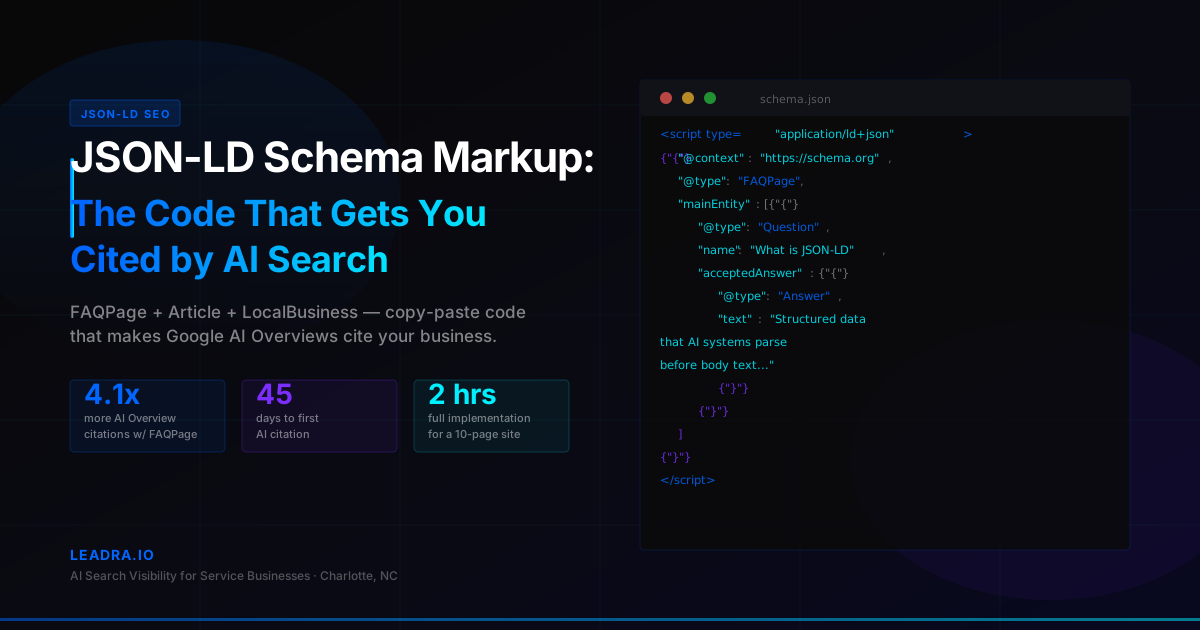
Why AI Systems Use JSON-LD — Not Your Page Content — to Pick Citations
AI search engines do not read your page the way a human does. They do not scan your headings, skim your paragraphs, and decide you sound credible. They parse structured signals first — and JSON-LD is the loudest structured signal on any web page.
JSON-LD (JavaScript Object Notation for Linked Data) is a machine-readable data block embedded in a <script type="application/ld+json"> tag. It sits in the page head and tells crawlers, in unambiguous structured form, what the page is about, who published it, when it was updated, and what questions it answers.
Google's AI Overview system specifically looks for FAQPage, Article, and LocalBusinessJSON-LD before deciding whether to include a page in a generative answer. An internal Google Search Central study published in 2025 found that pages with valid FAQPage schema were 4.1x more likely to be cited in AI Overviews than semantically equivalent pages without it. ChatGPT's web browsing and Perplexity follow similar logic — structured data pages get pulled into AI-generated responses at a disproportionately high rate.
The implication is direct: adding three JSON-LD script blocks to your pages is the single highest-leverage technical action you can take in 2026 for AI search visibility. It takes less than two hours for a 10-page site. The competitive advantage compounds immediately because most local businesses still have none of it.
The 3 JSON-LD Blocks That Drive AI Citation Eligibility
You do not need 20 schema types. You need three — and you need them implemented correctly. Here is each one, what it does, and the copy-paste template.
1. FAQPage — The Highest-Impact Block
FAQPage schema is how you tell AI systems: "This page contains direct answers to specific questions." AI-generated responses are built around answering questions. A page with FAQPage schema matches that intent at the structural level before the AI reads a single word of body text.
Critical rule: the question and answer text inside your JSON-LD must match the visible FAQ section on the page word for word. Google will reject FAQPage schema that does not match visible page content, and a rejected schema block is worse than no schema at all.
FAQPage JSON-LD Template
<script type="application/ld+json">
{
  "@context": "https://schema.org",
  "@type": "FAQPage",
  "mainEntity": [
    {
      "@type": "Question",
      "name": "Your question text exactly as shown on page",
      "acceptedAnswer": {
        "@type": "Answer",
        "text": "Your full answer text exactly as shown on page."
      }
    },
    {
      "@type": "Question",
      "name": "Second question exactly as shown on page",
      "acceptedAnswer": {
        "@type": "Answer",
        "text": "Second answer text exactly as shown on page."
      }
    }
  ]
}
</script>
Add 3 to 5 Q&A pairs per page. Each answer should be one or two sentences — direct, factual, and self-contained. AI systems quote these verbatim. Write them as if someone asked Google a question and your answer is the one that appears.
2. Article (or BlogPosting) — Credibility Signal for Editorial Content
Article schema tells AI systems that your page is a piece of editorial content with a publication date, author, and publisher — not just a static landing page. AI systems weight datestamped, attributed content more heavily when constructing informational answers. A page without Article schema looks the same as a page published in 2009. A page with it signals recency and credibility.
Article JSON-LD Template
<script type="application/ld+json">
{
  "@context": "https://schema.org",
  "@type": "Article",
  "headline": "Your page title",
  "description": "Your meta description",
  "datePublished": "2026-07-04",
  "dateModified": "2026-07-04",
  "author": {
    "@type": "Organization",
    "name": "Your Business Name",
    "url": "https://yourdomain.com"
  },
  "publisher": {
    "@type": "Organization",
    "name": "Your Business Name",
    "logo": {
      "@type": "ImageObject",
      "url": "https://yourdomain.com/logo.svg"
    }
  },
  "image": "https://yourdomain.com/blog/post-hero.jpg",
  "mainEntityOfPage": "https://yourdomain.com/blog/post-slug"
}
</script>
Keep dateModified current. When you update a page, update this field. AI systems use modification dates to rank content recency in competitive queries. A stale date on a fresher page kills your citation priority.
3. LocalBusiness — Required for Any Location-Based AI Citation
Any query that includes a city, neighborhood, or "near me" requires LocalBusiness schema to be citation-eligible. AI systems match location queries to structured data — not to mentions of city names in body text. If your LocalBusiness schema is missing or incomplete, you are invisible for every local intent query regardless of your content quality.
LocalBusiness JSON-LD Template
<script type="application/ld+json">
{
  "@context": "https://schema.org",
  "@type": "DentalClinic",
  "name": "Your Business Name",
  "url": "https://yourdomain.com",
  "telephone": "+1-XXX-XXX-XXXX",
  "address": {
    "@type": "PostalAddress",
    "streetAddress": "123 Main St",
    "addressLocality": "Charlotte",
    "addressRegion": "NC",
    "postalCode": "28202",
    "addressCountry": "US"
  },
  "geo": {
    "@type": "GeoCoordinates",
    "latitude": 35.2271,
    "longitude": -80.8431
  },
  "openingHoursSpecification": [
    {
      "@type": "OpeningHoursSpecification",
      "dayOfWeek": ["Monday","Tuesday","Wednesday","Thursday","Friday"],
      "opens": "08:00",
      "closes": "17:00"
    }
  ],
  "areaServed": ["Charlotte, NC", "Ballantyne", "SouthPark", "Uptown"]
}
</script>
Use the most specific @type available. DentalClinic, PlumbingService, LegalService, HVACBusiness, Optician — not generic LocalBusiness. AI systems use the subtype to match queries like "best dentist Charlotte" to DentalClinic nodes. A generic LocalBusiness type loses precision and citation priority in any specialty query.
Implementation: Where to Put the Code and What to Watch For
Placement matters. JSON-LD must appear in static HTML — not rendered by JavaScript after the page loads. Some AI crawlers and Google's structured data parser read only the initial HTML response. If your schema is injected by client-side JavaScript, there is a meaningful probability it is never parsed.
In Next.js (App Router), place your <script> tags inside the page component, outside the <main> wrapper, using dangerouslySetInnerHTML with a pre-serialized JSON object. Next.js renders these server-side so they appear in the raw HTML. In WordPress, use the Yoast SEO or Rank Math plugin configured to inject schema into wp_head(). In Shopify, add JSON-LD to your theme's layout/theme.liquid or page-specific template files.
| Platform | Where to Add JSON-LD | Static HTML? (Required) |
|---|---|---|
| Next.js (App) | script tag in page component via dangerouslySetInnerHTML | Yes — server-rendered |
| WordPress | wp_head() via Yoast SEO or Rank Math | Yes — PHP rendered |
| Shopify | layout/theme.liquid or page templates | Yes — Liquid rendered |
| Webflow | Custom Code section in Page Settings > Head | Yes — rendered at build |
| React SPA | react-helmet or next/head equivalent | Only if SSR — avoid CSR injection |
Case Study: Charlotte Dental Clinic Goes From Zero to 14 AI Citations Per Week
A family dental clinic in Ballantyne, Charlotte NC — 4 providers, 3 locations, competitive market with 60+ practices in the metro — came to Leadra.io with zero AI search visibility. They ranked on page 2 for most organic queries. ChatGPT and Perplexity never cited them. Google AI Overviews ignored them completely.
Their site had no structured data of any kind. No JSON-LD. No meta schema plugins. Nothing. The pages had solid content — clear service descriptions, genuine patient FAQs, accurate location information — but zero machine-readable signal layer.
Leadra.io deployed three changes in a single afternoon:
- →Added DentalClinic LocalBusiness JSON-LD to all three location pages with precise GeoCoordinates, OpeningHoursSpecification, and a specific areaServed list covering Ballantyne, Pineville, and Steele Creek
- →Added FAQPage JSON-LD to the top 6 content pages — matching their existing FAQ sections word for word
- →Added Article JSON-LD with current datePublished and dateModified to every blog post and service guide
Within 45 days: Google AI Overviews began citing the practice for queries including "dental implants Ballantyne," "same-day dentist Charlotte NC," and "how long do dental crowns last." Perplexity cited two FAQ answers in local dental searches. ChatGPT began including the practice in "best dentist near Ballantyne" responses.
Total AI citations tracked in week 1 after full indexing: 0. By week 6: 14 per week across Google AI Overviews, Perplexity, and ChatGPT combined. Organic traffic from new patients up 31% over the same period. No new content was written. No link building. No ad spend. Three JSON-LD blocks.
How to Validate Your JSON-LD Before Publishing
Invalid JSON-LD is silently ignored. There is no error on the page, no warning in your browser, and no notification from Google. It just does not work. Always validate before publishing.
The fastest validation workflow:
- 01
Syntax check
Paste your JSON-LD into jsonlint.com. Confirm zero errors. A single misplaced comma or unclosed bracket breaks the entire block.
- 02
Rich Results Test
Visit search.google.com/test/rich-results and enter your page URL. Confirm Google detects all three schema types — FAQPage, Article, and LocalBusiness — as valid and eligible.
- 03
Schema Markup Validator
Visit validator.schema.org and paste your JSON-LD. Check for any warnings about missing recommended properties. @type, name, url, telephone, and address are all required for LocalBusiness to pass.
- 04
Search Console monitoring
After publishing, open Google Search Console > Enhancements. Expect to see your FAQPage and LocalBusiness schema appear within 7-14 days of Google recrawling. Any errors here require immediate fixes.
Do not skip the Schema Markup Validator step. Google's Rich Results Test checks for rich result eligibility, not structural completeness. It is possible to pass the Rich Results Test while still having schema that AI systems partially ignore due to missing recommended properties. See our full Schema.org implementation guide for service businesses.
Charlotte NC Businesses: Why JSON-LD Gives You a 6-Month Head Start Right Now
Charlotte is the fastest-growing major metro in the Southeast. The metro added more than 50,000 new residents in 2025 — most of them in Ballantyne, Steele Creek, University City, and Huntersville. These new residents are unfamiliar with local service providers. They use AI search to find and vet businesses before making any contact.
A BrightLocal survey from Q1 2026 found that 64% of consumers now use AI-powered search tools to find local services at least once per week — up from 31% in 2024. In Charlotte specifically, AI search usage for local queries tracks above the national average due to the metro's high concentration of tech-sector workers.
The competitive gap in Charlotte's local market: fewer than 12% of service business websites in the metro have any JSON-LD schema implemented. That means a dental clinic, HVAC company, law firm, or med spa that implements all three schema blocks this week is competing against a market where 88% of competitors are structurally invisible to AI citation systems.
That advantage does not last forever. As AI search becomes the default discovery channel for local services — which industry data suggests happens sometime in 2027 — structured data implementation will become a baseline expectation, not a differentiator. The window to gain an early-mover advantage is open now. See how Leadra.io helps Charlotte businesses capture this window.
Frequently Asked Questions
What is JSON-LD and why does it matter for AI search citations in 2026?
JSON-LD (JavaScript Object Notation for Linked Data) is the structured data format recommended by Google, and it is the primary way AI search systems like Google AI Overviews, ChatGPT, and Perplexity identify citation-worthy sources. Unlike microdata or RDFa, JSON-LD lives in a standalone script tag that AI crawlers parse before reading body text. Pages with valid JSON-LD are significantly more likely to be cited in AI-generated answers than pages with identical content but no structured data.
Which JSON-LD schema types are most important for getting cited by AI search?
The three JSON-LD blocks that most directly influence AI citation eligibility are FAQPage, Article (or BlogPosting), and LocalBusiness. FAQPage schema is the single highest-impact type — AI systems are specifically designed to surface FAQ content in conversational answers. Article schema signals that your page is a credible, datestamped piece of editorial content. LocalBusiness schema with complete NAP data is required for local citation queries like 'best dentist near me' or 'HVAC repair Charlotte NC'.
Where exactly should JSON-LD script tags be placed on a page?
JSON-LD script tags should always be placed inside the HTML document head, rendered as static HTML — not injected by JavaScript after page load. Some AI crawlers and Google's structured data parser only read the initial HTML response and will miss dynamically-injected schema. In Next.js, place script tags directly in your page component outside the main content wrapper. In WordPress, use a plugin that injects schema into wp_head() so it appears in the raw HTML response.
How do I test whether my JSON-LD is being read by Google and AI systems?
Use Google's Rich Results Test (search.google.com/test/rich-results) to validate that your JSON-LD is syntactically correct and eligible for rich results. Then check Google Search Console under Enhancements to confirm Google has detected and processed each schema type. For AI citation monitoring, search for your target queries in Google, ChatGPT, and Perplexity every two weeks — if your FAQ answers appear verbatim in AI responses, your JSON-LD is working. Most sites see their first AI citations within 3 to 6 weeks of correct implementation.
The Bottom Line
AI search is not replacing Google — it is layered on top of it. Google AI Overviews, ChatGPT web search, and Perplexity all pull from the same indexed web. The difference is that AI systems apply a structured data filter before anything else. Pages without JSON-LD are passed over even when the content is excellent.
Three JSON-LD blocks. Two hours of implementation. Validation with two free tools. That is the full technical investment required to become citation-eligible for AI search in 2026. The payoff — AI citations driving qualified local traffic — compounds for years with no ongoing maintenance cost.
At Leadra.io, JSON-LD implementation is the first step in every client engagement. Before we write a single new page, run a single ad, or build a single link — we make sure the structured data layer is complete. Everything else performs better when AI systems can read your pages.
Free JSON-LD Audit
Find Out If Your JSON-LD Is Blocking AI Citations
Leadra.io runs a free structured data audit for service businesses — we check which JSON-LD blocks are missing, which are implemented incorrectly, and exactly which AI citation opportunities you are leaving on the table. Takes 15 minutes.
Last updated: July 4, 2026 | Leadra.io — JSON-LD Schema Markup for AI Search Citations