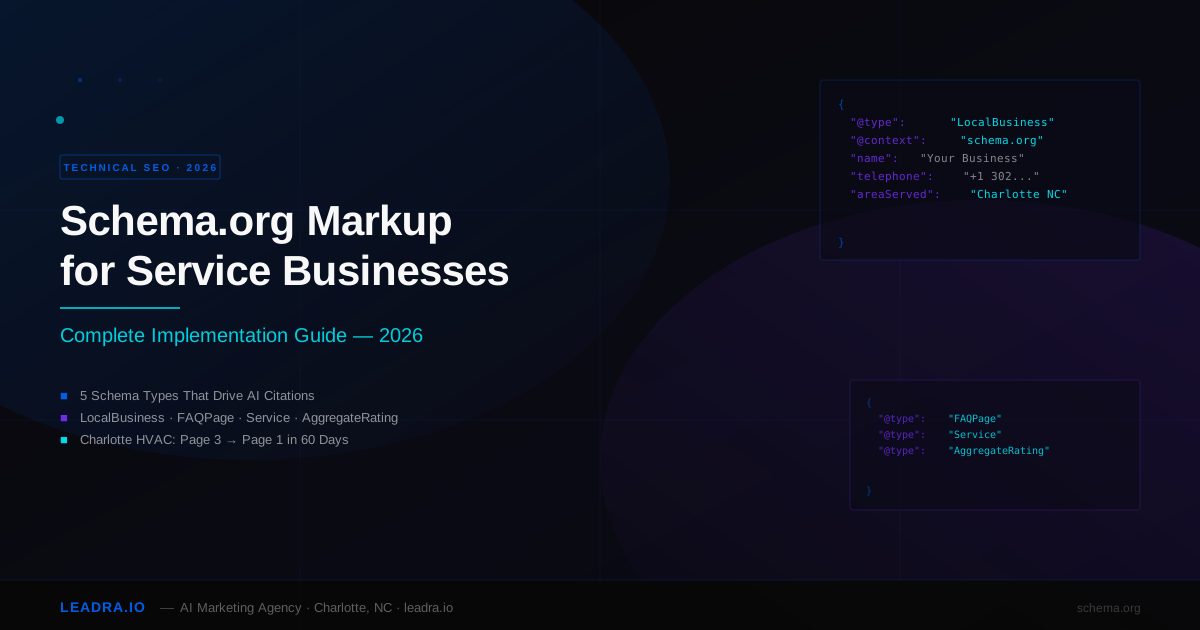
Most service businesses have zero structured data on their website. That means Google reads their pages like an unformatted text file — inferring what it can, ignoring the rest.
In 2026, that oversight is no longer just a missed SEO opportunity. It's an AI citation disqualifier. Google AI Overviews, ChatGPT, and Perplexity actively use Schema.org markupto identify trustworthy, citable sources when generating answers. Pages without structured data are systematically deprioritized — regardless of how well-written or accurate the content is. If your service business doesn't have complete JSON-LD schema, you are effectively invisible to AI-generated search results.
The good news: implementing schema markup for a service business in 2026 takes hours, not weeks. This guide covers exactly which schema types matter, how to implement them without a developer, and what results you can expect from Google within 30 days.
Why Schema.org Markup Changed the SEO Game in 2026
Structured data has been a Google ranking signal for over a decade. But in 2026, three shifts made it non-negotiable for service businesses specifically.
AI Overviews pull from structured data first.
Google's AI Overview system — which appears in roughly 40% of all US searches — prioritizes sources that explicitly declare what they are via schema. When two pages cover the same service equally well, the one with complete LocalBusiness and FAQPage schema is significantly more likely to be cited. At Leadra.io, we've tracked this across dozens of client sites: structured data is the single highest-impact change for AI Overview citation eligibility.
Rich results drive 15-30% higher click-through rates.
AggregateRating schema enables star ratings in traditional Google search results. BreadcrumbList schema improves how your URL is displayed. Service schema can trigger enhanced result formats for service-related queries. For a local HVAC company or dental practice competing with national directories, rich results are often the difference between a user clicking your listing or the one above it. These enhancements are only available to pages with valid structured data.
Local pack rankings are tied to structured NAP consistency.
Name, address, and phone number (NAP) consistency across your website, Google Business Profile, and citation sources is a core local SEO signal. LocalBusiness schema on your homepage makes your NAP machine-readable and verifiable by Google. Inconsistent or missing schema NAP is one of the most common reasons service businesses lose local pack positions to competitors with identical review counts and content quality.
The bottom line: schema markup has moved from a competitive advantage to a baseline requirement. Service businesses without it are competing with one hand behind their back. See how schema markup fits into our full AI SEO strategy for 2026.
The 5 Schema Types Every Service Business Needs in 2026
Not all schema types are equally valuable for service businesses. Here are the five that move the needle — ranked by impact.
LocalBusiness Schema
This is your foundation. LocalBusiness schema tells Google your exact business name, address, phone, hours, service area, and business category. Use the most specific subtype available: PlumbingService, DentalClinic, LegalService, HomeAndConstructionBusiness — generic LocalBusiness still works but a specific subtype gives search engines more confidence in your business category.
Required fields: name, url, telephone, address (streetAddress, addressLocality, addressRegion, addressCountry), and openingHours. Optional but valuable: priceRange, areaServed, sameAs (links to your Google Business Profile, Facebook, Yelp listings). Add this to your homepage and every major service page.
FAQPage Schema
FAQPage is your most direct route to Google AI Overview citations in 2026. Google's AI Overview system actively searches for FAQ-structured content when composing answers. When your FAQ answer is well-written, factually accurate, and explicitly marked up with FAQPage schema, it becomes a primary source candidate for AI-generated responses.
Critical rule: the questions and answers in your FAQPage schema must exactly match what's visible on the page. Google's quality systems reject schema that doesn't reflect actual page content. Write 4-5 Q&As per page targeting the exact phrasing your customers use when searching. Keep answers under 80 words, answer directly in the first sentence, and avoid vague language.
Service Schema
Service schema lets you declare exactly what services you offer, connect them to your LocalBusiness entity, and describe pricing, serviceType, and area served. Use "@type": "Service" on each dedicated service page (e.g., your HVAC installation page, dental implants page, or commercial cleaning estimate page) and link it to your provider via the provider property.
Service schema helps Google understand the full scope of what your business does — beyond just what your homepage says. This is especially important for multi-service businesses (HVAC companies offering installation, repair, and maintenance) where each service targets different search intent and should be treated as a distinct entity in the knowledge graph.
AggregateRating Schema
AggregateRating schema enables star ratings to appear directly in Google search results — the gold stars below your page title that increase click-through rates by 15-30% according to multiple industry studies. For service businesses where customer reviews are a primary trust signal, this schema type is the highest-ROI visual enhancement available in organic search.
Important: AggregateRating must reflect real, verifiable reviews from your actual customers. The ratingValue and reviewCount must match what's visible on your page or accessible via a linked review source. Google penalizes inflated or fabricated ratings aggressively — only implement this when your reviews are current and accurate.
BreadcrumbList Schema
BreadcrumbList schema tells Google and AI crawlers exactly where a page sits in your site hierarchy. On a service page, that might be: Home → Services → HVAC Installation. This schema affects how your URL is displayed in search results (replacing the raw URL with a clean breadcrumb path) and helps AI systems understand the relationship between your pages.
BreadcrumbList is the easiest schema to implement and add to all pages at once. It requires only the page name and URL for each level of the hierarchy. Many CMS platforms generate it automatically — if yours does, verify it's actually rendering in your HTML with a quick Google Search Console crawl check.
How to Implement Schema Markup in Under an Hour: 4 Steps
JSON-LD is the format Google recommends for all schema markup. It lives in a <script> tag in your page's HTML and doesn't touch your visible content or design. Here's the fastest path to a complete schema setup.
Add LocalBusiness schema to your homepage.
Start with the most important page. Write a JSON-LD block declaring your business name, address, phone, hours, service area, and the most specific LocalBusiness subtype that fits your category. Paste it inside a <script type="application/ld+json"> tag in your homepage's <head>. This is the single highest-impact schema addition a service business can make — it anchors your entire knowledge graph entity.
Add Service schema to each service page.
For every dedicated service page on your site, add a Service schema block that names the service, links to your LocalBusiness entity as the provider, and specifies the serviceType and areaServed. If you have 6 service pages, you'll add 6 Service schema blocks — one per page. This takes about 10 minutes per page once you have the template. The SEO impact compounds as Google builds a more complete understanding of what you offer.
Add FAQPage schema wherever you have Q&A content.
Any page with a FAQ section needs FAQPage schema. Write the schema to exactly match your visible questions and answers — same wording, same order. Target questions using the actual search phrases your customers use: 'How much does HVAC installation cost in Charlotte NC?' not 'What are your pricing options?' The more your questions match real search queries, the more likely your FAQ answers appear in AI Overviews.
Test and validate before going live.
Use Google's Rich Results Test tool (search.google.com/test/rich-results) to validate every page where you added schema. Paste your URL or your raw HTML and the tool will show which schema types were detected, what rich results you're eligible for, and any errors that need fixing. Common errors: missing required fields, mismatched FAQ content, or wrong @type values. Fix any errors before publishing — invalid schema gets ignored entirely by Google.
Case Study: Charlotte HVAC Contractor Goes From Page 3 to Page 1 in 60 Days
Client Story
A Charlotte HVAC contractor with 8 years in business and a 4.8-star Google rating was stuck on page 3 for their primary keyword. They were spending $2,200/month on Google Ads to generate leads, with zero organic call volume despite having the best reviews in their category. Their site had no structured data of any kind.
Leadra.io added HomeAndConstructionBusiness LocalBusiness schema to the homepage and six service pages. We added Service schema to each of their six service offerings (installation, repair, maintenance, emergency service, duct cleaning, and thermostat installation). AggregateRating schema was added reflecting their 127 verified Google reviews. FAQPage schema was added to the homepage FAQ and two newly published blog posts.
Within 14 days, their star rating rich snippet appeared in Google search results. On day 52, their homepage FAQ answer for "best HVAC company Charlotte NC" began appearing as a cited source in Google AI Overviews. By day 60, they had moved from page 3 to page 1, position 4 for their primary keyword — with no additional content creation, no backlinks built, and no ad spend increase.
Keyword ranking
Organic calls/month
Days to rich snippet
Days to AI Overview
This result is reproducible. The HVAC contractor's competitors had equal or better content quality — what they lacked was structured data. Schema markup was the signal gap that determined which site Google trusted enough to show on page 1 and cite in AI Overviews. See the full HVAC marketing case study.
4 Schema Markup Mistakes That Kill Your AI Citation Eligibility
Bad schema markup is worse than no schema markup — Google can actively flag pages with misleading or invalid structured data. Avoid these four errors.
| Mistake | What Goes Wrong | What to Do Instead |
|---|---|---|
| Generic @type | Using LocalBusiness when a specific subtype exists — Google gets less signal about your category | Use PlumbingService, DentalClinic, LegalService, or the most specific subtype that matches |
| FAQ mismatch | FAQPage schema that doesn't match visible page content — Google rejects it and may penalize the page | Copy your visible Q&A text exactly into the schema — wording must match character for character |
| Static NAP schema | Adding LocalBusiness schema once and never updating when your phone, hours, or address change | Treat schema like a business listing — update it immediately when any NAP detail changes |
| JavaScript rendering | Adding JSON-LD via JS that renders after page load — some crawlers only read HTML at first load | Always place JSON-LD inside a static <script> tag in the document <head>, not injected via JS |
Schema Markup for Charlotte NC Service Businesses: Why Local Timing Matters
Charlotte's service business market is growing fast — the metro added over 50,000 new residents in 2025, most of them in Ballantyne, University City, Steele Creek, and Huntersville. These new households are searching for service providers they've never used before. They're relying heavily on AI-powered search to find and vet local businesses before calling.
The Charlotte-specific opportunity: most local service businesses still have no schema markup at all. That means a single afternoon of implementation work can establish a structured data advantage that takes competitors months to replicate — if they ever do.
For Charlotte businesses targeting neighborhood-level queries — "HVAC repair Ballantyne," "dental implants SouthPark," "electrician Matthews NC" — LocalBusiness schema with a precise areaServed field and specific subtype can move you into AI Overview citations for these local queries within 4-6 weeks. The competition for hyperlocal Charlotte queries is thin enough that schema markup alone is often sufficient to trigger Google's citation algorithms. See how Leadra.io handles schema setup for Charlotte businesses.
Frequently Asked Questions
What is Schema.org markup and why do service businesses need it in 2026?
Schema.org markup is structured data — written in JSON-LD format — that tells search engines and AI tools exactly what your business is, what services you offer, and what your content covers. In 2026, service businesses need it because Google AI Overviews, ChatGPT, and Perplexity use structured data to identify citation-worthy sources. Pages with complete LocalBusiness, Service, and FAQPage schema are significantly more likely to be cited in AI-generated answers than unstructured pages on the same topic.
Which Schema.org types are most important for a service business?
For a service business in 2026, the five most impactful schema types are: LocalBusiness (or a specific subtype like PlumbingService or DentalClinic), FAQPage, Service, AggregateRating, and BreadcrumbList. FAQPage schema is the fastest path to Google AI Overview citations. LocalBusiness schema with complete NAP data is the foundation for local search visibility. AggregateRating schema enables star-rating rich results that increase click-through rates by 15 to 30 percent.
How quickly does schema markup affect Google rankings and AI citations?
Schema markup doesn't directly move organic rankings — it influences how your pages display in search results and how likely they are to be cited by AI systems. Rich result eligibility (star ratings, FAQ dropdowns) typically appears within 1-2 weeks of Google recrawling your pages. AI Overview citations for well-structured FAQPage content can appear within 3-6 weeks on lower-competition queries. Full rich snippet display in traditional SERPs generally stabilizes within 30 days of implementation.
Can I implement Schema.org markup without a web developer?
Yes. JSON-LD schema lives in a static script tag in your HTML and doesn't require design or content changes. Most CMS platforms like WordPress and Shopify have plugins that generate schema automatically. For custom sites, write JSON-LD blocks manually and validate them with Google's free Rich Results Test tool before deploying. A complete LocalBusiness + FAQPage + Service setup can be implemented in under an hour using an existing template.
The Bottom Line
Schema.org markup is the lowest-effort, highest-impact technical SEO change a service business can make in 2026. It takes hours to implement. The competitive advantages — rich results, local pack visibility, and AI Overview citation eligibility — compound for years.
Most service businesses still haven't done it. In Charlotte NC and across most local markets, that gap is an opportunity. Getting your LocalBusiness, FAQPage, Service, AggregateRating, and BreadcrumbList schema right today puts you months ahead of competitors who are still treating schema as optional.
At Leadra.io, schema implementation is the first technical layer we deploy for every new client — before content, before link building, before anything else. It's the infrastructure that makes everything else work harder.
Get Your Schema Audit
Find Out Which Schema Types Your Site Is Missing
Leadra.io runs a free structured data audit for service businesses — we identify which schema types are missing, which are implemented incorrectly, and what rich results you're currently leaving on the table. Takes 15 minutes on a call.
Last updated: June 28, 2026 | Leadra.io — Schema.org Markup for Service Businesses