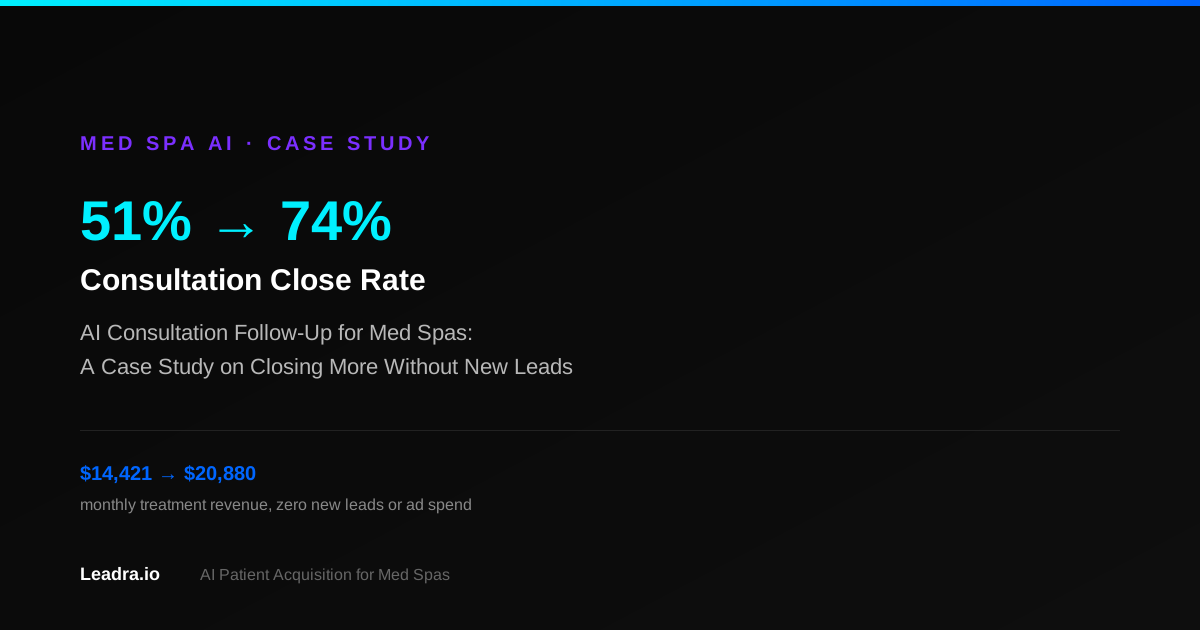
A med spa in the Charlotte metro came to us with a problem that didn't look like a problem at first. Their calendar was full — 41 consultations booked a month, steady ad spend, a strong referral base. But their close rate, the share of consultations that actually turned into a paid treatment, had been stuck at 51% for over a year. Nobody on staff had ever measured it directly. They just knew the calendar was busy and assumed busy meant healthy.
It wasn't healthy. Half the consultations they paid to generate — through ads, through referrals, through their own reputation — walked out the door without buying anything, and nothing happened after that. No recap, no reminder, no financing conversation. The patient's interest just evaporated in the days after the appointment because no one reached back out.
This is the case study of what happened when we built an AI follow-up system focused entirely on the after-consultation window — not on generating more leads, not on booking more appointments, but on closing more of the consultations they were already running. Same lead volume. Same ad spend. Same calendar. Different outcome.
Why a Full Calendar Was Still Losing $34,000 a Quarter
When we pulled 90 days of consultation records, the practice had never actually broken out same-day close rate from total close rate, because total close rate was never tracked at all. Once we built the report, the gaps were obvious.
49 of 122 consultations never closed at all
That's 40% of every consultation booked in the quarter. Not lost to a competitor, not lost to price shock in the room — simply never followed up with after the appointment ended. At the practice's $690 average ticket, that's roughly $34,000 in treatment revenue generated by ad spend and referrals, then abandoned with no further contact.
Follow-up existed, but it depended on memory, not a system
The front desk did sometimes text patients back — when they remembered, when the schedule wasn't too busy, when the patient had left a strong impression. That inconsistency meant follow-up happened for maybe 1 in 5 non-closing consultations, and even then it was usually a generic 'still interested?' text with no specifics about what was discussed.
Cost objections were never addressed with real financing options
In consultation notes, cost came up as a hesitation in 38% of non-closing appointments. The practice did offer a financing partner, but it was only mentioned if the patient asked directly. Most didn't ask — they just said they'd think about it and never came back.
No visibility into which consultations were actually worth chasing
Without a system tracking outcomes, the practice had no way to prioritize follow-up by treatment value. A $3,000 package quote and a $250 touch-up quote got the same (usually nonexistent) follow-up treatment, even though the revenue at stake was wildly different.
None of this was a lead-generation problem. The practice didn't need more consultations — they needed to stop losing the ones they already had. That's a fundamentally different fix than booking automation, and it's the piece most med spas overlook because a full calendar feels like success even when close rate is quietly bleeding revenue.
Setup Timeline: From Audit to a Live Follow-Up System in 8 Days
This is the actual build timeline for this practice. Because the goal was closing existing consultations rather than capturing new inquiries, the setup centered on the follow-up sequence and objection library rather than on lead-response speed.
Audit of the consultation-to-close pipeline
We pulled 90 days of consultation records: what was discussed, what was quoted, and whether it closed same-day, closed later, or never closed. Out of 122 consultations, 62 closed the same day, 11 closed within two weeks after someone from the front desk happened to remember to follow up, and 49 never closed at all. That's a 51% overall close rate, with the 49 no-close consultations representing an estimated $34,000 in treatment revenue the practice had already paid to generate and then let go cold.
Building the follow-up sequence and objection library
We built a four-touch follow-up sequence keyed to what actually happens in a med spa consultation: a same-day recap text with the exact treatment plan and price discussed, a 48-hour message addressing the two most common objections (cost and timing), a 5-day check-in with financing options laid out plainly, and a 12-day final nurture offering a smaller starter treatment as an easier entry point. Each message was written from the actual consultation notes for that patient, not a generic template, and approved by the injector before going live.
Calendar and CRM integration, test sequence
The system was connected to the practice's Boulevard calendar so it could pull consultation outcomes automatically — booked, quoted-no-close, or no-show — and trigger the right sequence without a staff member manually flagging anything. We ran five test consultations through the full sequence end to end before going live, catching one issue where the financing message referenced a plan the practice no longer offered.
Go-live
The system went live tracking every consultation from that day forward. The first recovered sale came three days later: a patient who had been quoted a $2,100 package for lip filler and cheek filler, didn't book same-day citing needing to check with her husband, and booked the full package after the 48-hour follow-up addressed financing directly.
First 30 Days Live
In the first 30 days, the system tracked 38 consultations. 22 closed same-day — roughly in line with the historical baseline. Of the 16 that didn't close on the spot, 9 eventually booked through the follow-up sequence: 5 off the 48-hour message, 3 off the 5-day financing check-in, and 1 off the 12-day starter-treatment offer. That's a close rate of 82% for the month once follow-up was counted, though the practice correctly treated the first month as a ramp period before trusting the number as a new baseline.
90-Day Results: The Actual Numbers
Here are the before-and-after metrics at 90 days. The "before" numbers are the 90-day averages from the audit period. The "after" numbers are the average of months 2 and 3 post-implementation, with month 1 excluded as a ramp period.
| Metric | Before AI | After AI (Month 2–3 Avg) |
|---|---|---|
| Consultations per month | 41 | 40 |
| Same-day close rate | 51% | 58% |
| Total close rate (with follow-up) | 51% | 74% |
| Consultations recovered by follow-up per month | 4 | 16 |
| Average treatment ticket | $690 | $705 |
| Monthly treatment revenue from consultations | $14,421 | $20,880 |
| Revenue added with zero new leads or ad spend | — | $6,459/mo |
| ROI on system cost | — | 14x |
Consultation volume and ad spend held flat throughout the 90-day period. The revenue increase is attributable entirely to the AI follow-up system closing consultations that previously went cold. System cost: $950/month.
4 Things This Case Study Revealed About Consultation Close Rate
The revenue numbers are the headline. But the mechanics behind them are what other med spas can actually apply, whether or not their calendar looks anything like this one.
A full calendar can still be a leaking bucket
This practice wasn't struggling to book consultations. Their ad spend and referral network kept the calendar at 40+ consultations a month, month after month. But nobody was tracking what happened after the consultation ended. Close rate had quietly sat at 51% for over a year because there was no system watching it — just a front desk that occasionally remembered to text someone back.
The 48-hour window mattered more than any other touchpoint
Of the 12 additional consultations recovered per month, 7 closed specifically off the 48-hour follow-up message. That's the point where initial hesitation ('I need to think about it') either turns into a booked treatment or goes cold permanently. A same-day recap kept the plan fresh; the 48-hour message is what actually moved people who were still deciding.
Personalized recap beat generic promo every time
Early versions of the sequence used a general 'don't forget to book!' message. Close rate on that version was barely better than doing nothing. Once messages referenced the exact treatment discussed, the exact price quoted, and the specific concern the patient raised in the room, engagement with the follow-up nearly tripled. Specificity, not persistence, is what closes these.
Financing information needed to arrive before the objection, not after
Cost was the single most common reason patients didn't book same-day. Once financing and payment plan options were included proactively in the 48-hour message — instead of waiting for the patient to ask — close rate on cost-hesitant consultations rose from 22% to 51%. Most patients weren't declining the treatment. They were declining paying for it all at once, and no one had told them they didn't have to.
The practice's office manager put it simply during the 90-day review: "We used to think a full calendar meant we were doing well. Now we know a full calendar was just hiding how much we were losing after people already walked in the door."
That's the pattern we see across most med spa consultation pipelines. Booking volume gets all the attention because it's visible and easy to track. Close rate gets ignored because it requires watching what happens after the appointment — and that's exactly the gap AI follow-up is built to close.
Related Reading
Frequently Asked Questions
What is consultation close rate for a med spa?
Consultation close rate is the percentage of booked, attended consultations that convert into a paid treatment or treatment plan the same day or within a short follow-up window. It's a different metric than booking rate, which only measures how many inquiries turn into a scheduled appointment. A med spa can have a full consultation calendar and still be losing significant revenue if close rate is low — the leak just happens one step later, after the appointment instead of before it.
How does AI improve a med spa's consultation close rate?
AI improves consultation close rate by automating the follow-up sequence that most practices skip: a same-day recap of what was discussed, financing and package options sent while the visit is still fresh, a 48-hour check-in for anyone who didn't book on the spot, and a longer-window nurture for people who need more time to decide. Leadra.io's clients typically see close rate climb 15-25 percentage points once every consultation gets consistent follow-up instead of relying on staff memory and time.
Why do med spas lose treatment sales after a consultation instead of during it?
Most patients who don't book same-day aren't saying no — they're saying not yet. They want to check a partner's opinion, compare pricing, or think about the financial commitment. Without a structured follow-up sequence, that hesitation turns into silence, and the practice never hears back. The sale isn't lost during the consultation. It's lost in the days after it, when no one reaches out at the right moment with the right information.
Is an AI consultation follow-up system worth it if my calendar is already full?
Yes — a full consultation calendar with a stuck close rate is often the highest-leverage place to add AI, because the leads and the ad spend to acquire them already exist. Raising close rate from the low 50s to the low-to-mid 70s, which is achievable with consistent follow-up, can add tens of thousands of dollars in monthly revenue without booking a single additional consultation or spending another dollar on ads.
The Leads Are Already There. The Follow-Up Was the Missing Piece.
The med spa in this case study went from $14,421 to $20,880 a month in consultation-driven treatment revenue. They didn't book more consultations. They didn't spend another dollar on ads. They didn't discount their pricing to make treatments more attractive. They installed a system that followed up on every consultation the way a highly organized, never-forgetful staff member would — every time, without exception.
Most med spas with a busy calendar assume the calendar is proof the business is healthy. It's proof the marketing is working. Whether the business is capturing full value from that marketing is a separate question, answered by a number almost no practice tracks: close rate, including the sales that happen after the appointment, not just during it.
Leadra.io builds and manages AI consultation follow-up systems for med spas, aesthetic clinics, and beauty practices nationwide. We track your close rate, build a follow-up sequence from your actual consultation data, and back it with a results guarantee: if close rate doesn't measurably improve in the first 30 days, you don't pay for month two.
Free Close Rate Audit
Find Out How Much Revenue Is Sitting in Consultations That Never Closed
We analyze your last 90 days of consultations, calculate your real close rate, and show you exactly how much treatment revenue is sitting in the follow-up gap before you commit to anything.
Leadra.io
AI marketing agency — Charlotte, NC · Published August 28, 2026