Nail clients don't drift away slowly like hair clients do. They rebook every two to five weeks, and once that window closes without a fill or a new set, most of them have already found someone else within a month.
That's the part most reactivation advice gets wrong for nail salons. Generic “dormant client” systems, and most salon software built with hair in mind, default to a 90-day inactivity trigger. For a nail client who normally rebooks every three weeks, 90 days isn't a gentle nudge — it's roughly four missed cycles too late. By the time a generic system flags them as dormant, they've typically already settled in with a new tech.
Nail salons that reactivate clients successfully do it on a compressed timeline that matches how often nail clients actually come in — not a one-size-fits-all beauty industry default. Most salons never do this at all, because tracking individual rebooking cycles by hand across a full client list isn't realistic for a front desk that's already juggling walk-ins and the phone.
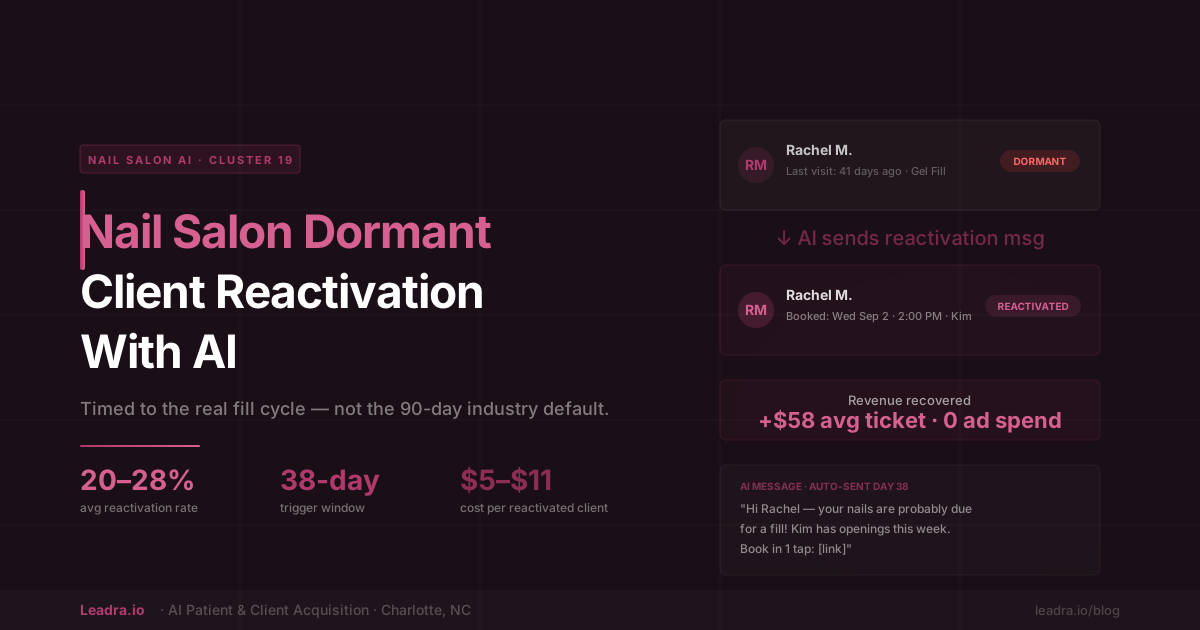
AI dormant client reactivation solves that by tracking each client's own rebooking cadence, flagging them the moment they fall meaningfully behind it, and sending a personalized message with a direct booking link — automatically, with zero manual list work. Salons running this on the correct nail-specific timing see 20-28% of dormant clients rebook, compared to under 5% from occasional manual promos.
Why the 90-Day Standard Fails Nail Salons
Most reactivation tools on the market were built around hair salon cycles, where six to eight weeks between visits is normal and a 90-day dormancy window makes sense. Nail clients move on a completely different clock, and treating them the same way wastes the narrow window where reaching out actually works.
Fill clients rebook every 2-3 weeks
~55% of nail clientsGel and acrylic fill clients are the most frequent repeat visitors in any nail business. When one of them goes three weeks past their usual cycle, that's already a meaningful gap for this group — not a rounding error. Waiting until day 90 to reach out means contacting someone roughly a month after they likely already booked with another tech out of necessity, not preference.
Fresh-set clients rebook every 4-5 weeks
~30% of nail clientsClients who prefer a full new set rather than fills still land inside a predictable window most of the time. A trigger set around 38-45 days catches this group right as they're starting to think about their next appointment, rather than long after they've already found a replacement.
Occasion and seasonal clients rebook irregularly
~15% of nail clientsClients who come in mainly for events, holidays, or vacations don't follow a tight cycle, which makes a fixed universal trigger the wrong tool for this segment. AI reactivation handles this by using a longer window for clients whose own booking history shows irregular spacing, instead of applying the same 38-day rule to everyone on the list.
The practical takeaway: a nail salon reactivation system needs to read each client's actual rebooking pattern from your booking software, not apply a flat 90-day rule copied from hair salon defaults. Getting the timing right is worth more than getting the message wording right — a perfect message sent 60 days too late still loses the client.
This is also why importing a generic marketing automation tool built for e-commerce or general retail rarely works for a nail business. Those platforms track a single “last purchase” date and apply one dormancy rule to the entire list, which treats a fill client and an occasion-only client identically. A system built specifically around appointment-based beauty businesses reads the service type on each visit, calculates that client's personal average gap between visits, and only flags them once they've meaningfully exceeded their own pattern — not an average pulled from unrelated industries.
What Your Dormant List Is Actually Worth
Nail salons carry a larger dormant list than most owners assume, mainly because the fast rebooking cycle means clients fall behind quickly and often. Here's a realistic calculation for a mid-size salon:
Revenue Calculation Example
Because nail clients rebook far more often than hair clients, the annual value of a single reactivated client is disproportionately high relative to the ticket size. A $58 fill client who returns every five weeks is worth over $600 a year — which is why even a modest reactivation rate produces a large return relative to the system cost.
The 3-Touch Sequence Built for the Nail Rebooking Cycle
Here is the sequence Leadra.io deploys for nail salon reactivation. It runs on a compressed 60-day timeline instead of the standard 90-day beauty industry default, because a nail client who's gone 60 days without a fill has typically been gone far longer, relative to their normal cycle, than a hair client at the same mark.
Primary reactivation message
The first message fires the day a client passes 38 days without a fill or new set — the point where a nail client is meaningfully overdue, not just running a little late. It names the client, their usual tech, and their last service, then ends with one link to that tech's live openings. No generic salon-wide blast. The goal is a client reading the text, tapping once, and booking before they talk themselves into trying somewhere new. This first touch alone typically converts 13-18% of clients who reach it.
Second touch with a scheduling angle
Clients who don't respond to the first message get a shorter second text a week later, reframed around convenience rather than the relationship: a specific weekend opening, a same-day slot, or an evening appointment. Many nail clients who drift away do so because their tech's schedule felt hard to catch, not because they wanted to leave — this message directly answers that objection. It adds another 6-10% to the total reactivation rate.
Final check-in before suppression
A last, low-pressure message goes out around day 60 for anyone who still hasn't responded — short, warm, and framed as a check-in rather than a pitch. This catches clients who went through a genuine disruption (moved, had a baby, changed jobs) and are ready to come back but hadn't thought to reach out first. It typically adds 2-4% more, and clients who don't respond after this point are suppressed from further automated outreach so the salon's texts stay relevant to people who actually want them.
Message Example — Day 38 (actual format)
“Hi [First Name] — your nails are probably due for a fill! [Tech Name] has openings this week. Book in one tap: [direct booking link]. — [Salon Name]”
Bracketed fields populate automatically from your booking software. No manual editing per client, per message.
AI Reactivation vs. Manual Outreach: Nail Salon Impact
Most nail salons and booth renters run zero structured reactivation today. Here's how an AI-timed sequence compares to the manual promo blasts some salons attempt instead:
| Factor | Manual / None | AI Reactivation |
|---|---|---|
| Dormancy trigger | Never tracked, or a vague "a while" | Exact day count per client, per service type |
| Time to first outreach | Weeks late, if it happens at all | Day 38 — matched to the nail rebooking cycle |
| Cost per reactivated client | $0 spent, but almost nothing recovered | $5–$11 per rebooked client |
| vs. new client acquisition cost | $60–$110 per new client (2026 avg) | 80–90% cheaper than paid acquisition |
| Message personalization | Group text or nothing | Client name, tech, last service, direct booking link |
| Reactivation rate | Under 5% from occasional promos | 20–28% across a 3-touch, 60-day sequence |
| Front desk time required | Hours of manual list-building per push | Zero — runs per client automatically |
The gap isn't really about willpower or discounting — it's about timing precision. A front desk trying to track 400+ individual rebooking cycles by memory or spreadsheet will always miss the narrow window where a nail client is overdue but hasn't yet committed to a new tech. AI hits that window automatically, per client, every time.
Case Study: Charlotte Nail Studio Recovers 52 Clients in 60 Days
Client Story — NoDa, Charlotte NC
A six-tech nail studio in Charlotte's NoDa neighborhood had a full appointment book on weekends but noticeably quiet Tuesdays and Wednesdays. A client list audit found 214 clients who hadn't booked in over 45 days — well past their typical fill or set cycle. The owner had tried a group text promo once, which got a handful of replies and then stalled out.
Leadra.io connected the AI reactivation system to the studio's Square Appointments account and configured the sequence around a 38-day trigger, matched to the salon's average fill cycle. The system began messaging clients individually as each one crossed their own dormancy threshold, referencing their usual tech by name and linking straight to that tech's open slots — with a bias toward the slower Tuesday and Wednesday openings the studio wanted to fill.
In the first 30 days, 31 clients rebooked. By day 60, the total reached 52 reactivated clients at an average ticket of $61, with a noticeable lift in midweek bookings specifically. No discount was used in any message.
Dormant clients targeted
214
214
Clients reactivated
0
52
Reactivation rate
0%
24%
Revenue recovered
$0
$3,172
System cost: $650/month · Revenue recovered in first 60 days: $3,172 · 60-day ROI: 4.9x. 37 of the 52 reactivated clients booked a second visit within the following 60 days, adding another $2,257 to the extended revenue picture without any additional outreach.
The midweek shift was the part the owner cared about most. Because the reactivation messages linked directly to each tech's actual availability rather than a generic booking page, the system naturally steered a meaningful share of returning clients into the slower Tuesday and Wednesday slots — filling chairs that would otherwise have sat empty without touching the already-full weekend schedule.
Software Integration for Nail Salons and Booth Renters
Nail salon reactivation depends on the system reading real, current booking data — not a weekly export that's already stale by the time it's used. Leadra.io connects directly to the platforms most nail salons and independent booth renters already run on:
Vagaro
Full API — real-time read/write
Booksy
Full API — real-time read/write
Square Appointments
Full API — real-time read/write
GlossGenius
Webhook — 4h sync
Schedulicity
Webhook — 4h sync
Fresha
Webhook — 4h sync
For studios with independent booth renters, the system can run per-tech instead of salon-wide — each renter's dormant client list, timing, and booking link stay separate, so reactivation revenue and client relationships map correctly to the tech who actually earns it.
Every reactivation message also runs through standard SMS opt-in and compliance handling — clients can reply STOP at any point to be removed from automated outreach permanently, and that suppression syncs back into the booking platform so the same client doesn't get re-added on the next sync cycle. This matters more for nail salons than most verticals simply because the higher visit frequency means more touchpoints per client per year, and keeping the list clean protects deliverability for every message the salon sends going forward, not just reactivation texts.
See also: dormant client reactivation for hair salons and salon no-show text message templates and timing for related automation coverage.
Launching Reactivation at Your Nail Salon: 3 Steps
Audit dormant clients by their actual rebooking cadence
Pull every client who hasn't visited in 30+ days from your booking software, then sort by their own typical cycle — fill clients past 35 days, fresh-set clients past 50 days. Count the dollar value using your average ticket. Most nail salons find $2,000-$8,000 in recoverable near-term revenue in a single audit, and it takes under an hour to run against most booking platforms.
Connect your booking platform and set the timing per service type
Leadra.io connects via direct API integration, a 2-3 day setup that requires no technical work from your team. The dormancy trigger is configured per service type — fills, fresh sets, pedicures — rather than one blanket number, and messages are reviewed and approved by you before going live. Most salons approve their templates in a single 20-minute call.
Review the first 30 days and tune the trigger window
Check open rate, reply rate, and confirmed bookings after 30 days. If reactivation feels low, the most common fix is tightening the trigger window further — many nail salons find that starting outreach at day 32-35 instead of 38 improves results, since the ideal window is often narrower than expected. By day 60 the system typically runs without further input, flagging and messaging each client the day they cross their personal threshold.
Frequently Asked Questions
How is nail salon client reactivation different from other salon reactivation?
Nail salon reactivation runs on a much shorter clock than hair or spa reactivation. A typical nail client rebooks every 2-3 weeks for fills or every 4-5 weeks for a fresh set, so a client is meaningfully overdue at 35-45 days — not the 90-day mark most generic reactivation tools default to. AI systems built specifically for nail salons trigger the first outreach at day 38, not day 91, because waiting the standard 90 days usually means the client has already found a new tech.
Why do nail clients stop rebooking with the same tech or salon?
Most nail clients who go dormant did not switch salons on purpose. The largest group simply let their usual rebooking window slip by a week or two and kept putting it off. A smaller group had their regular tech's schedule fill up and booked wherever had an opening instead. Very few left because of dissatisfaction with the manicure or pedicure itself. A short, specific message that references their tech by name and offers a real opening removes both problems in one text.
What nail salon booking software does AI reactivation work with?
AI reactivation systems built by Leadra.io connect to Vagaro, Booksy, Square Appointments, GlossGenius, Schedulicity, and Fresha. The system reads each client's last-visit date directly from your booking software, calculates days since their last fill or set, and fires a personalized message once they cross the salon's dormancy threshold — no spreadsheet or manual client list required.
What does AI dormant client reactivation cost for a nail salon?
AI reactivation for nail salons typically runs $5-$11 per client won back once the monthly system cost is spread across everyone who rebooks through the campaign. Getting a new nail client through Google or Meta ads in most markets in 2026 costs $60-$110 per booking, and new clients often churn while shopping for a tech they like. Reactivated clients already know the salon and rebook at a noticeably higher rate.
Match the Timing to the Cycle, Not the Industry Default
Nail salons lose more reactivation revenue to bad timing than to bad messaging. Waiting for the standard 90-day dormancy mark means reaching out long after a nail client has already rebooked somewhere else out of necessity.
AI dormant client reactivation built around the actual nail rebooking cycle catches clients while they're still genuinely reachable — no ad spend, no manual list work, no discounting required. The system flags each client the moment they fall behind their own pattern and books them back automatically.
Leadra.io builds and deploys these systems for nail salons and booth renters with full booking software integration, per-service timing, and a 90-day results guarantee. If the system doesn't produce measurable reactivation bookings, you don't pay.
Free Dormant Client Audit
See How Many Dormant Clients Your Nail Salon Has — and What They're Worth
30-minute audit. We'll analyze your inactive client list against your real rebooking cycle and show you exactly what the AI sequence looks like before you commit to anything.
Leadra.io
AI marketing agency — Charlotte, NC · Published August 29, 2026