Most OB-GYN practices spend real money generating inbound interest — Google Ads, referral relationships, a strong local reputation — and then lose a meaningful share of that interest because nobody answers after 5 PM, web inquiries sit unanswered overnight, and prenatal or well-woman visits no-show at a higher rate than the practice would like to admit.
The problem usually isn't lead volume. It's what happens to a lead after it arrives. Patients calling an OB-GYN office are often making a time-sensitive decision — a new pregnancy, a symptom that worries them, a plan to switch providers — and they move fast. If a call goes to voicemail or a web form goes unanswered for hours, most patients simply call the next practice on the list.
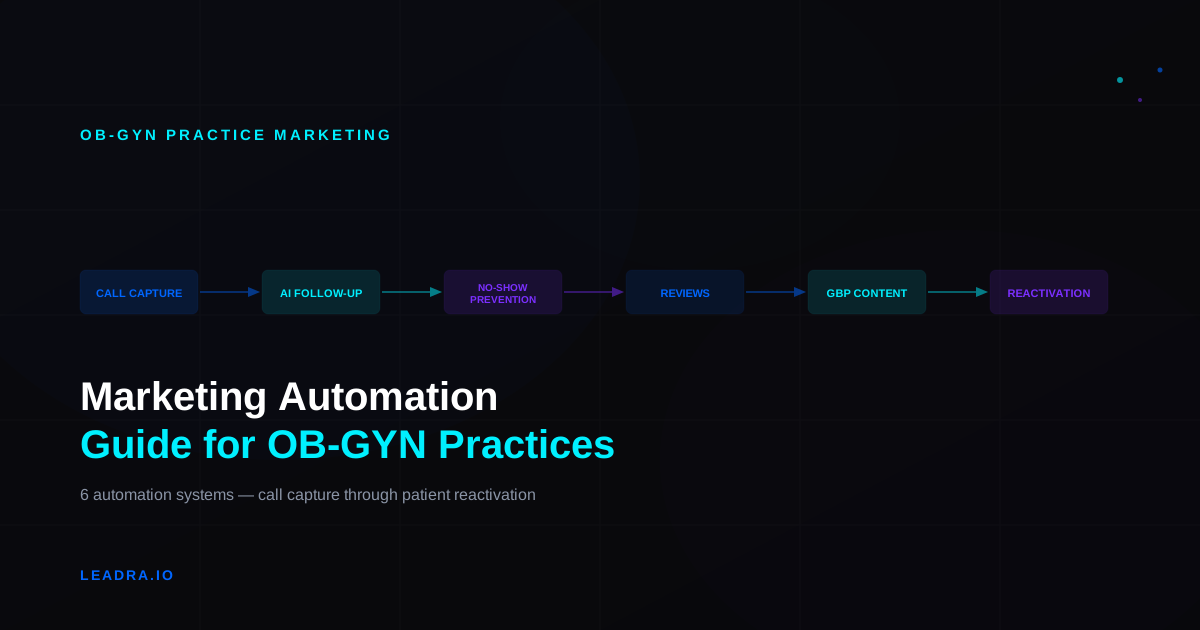
OB-GYN marketing automation fixes this by replacing manual follow-up with systems that run around the clock without staff involvement. This guide covers all six components of a complete automation stack, how each one fits into the patient lifecycle, and how to calculate what a fully deployed system is worth to your specific practice.
At Leadra.io, we build and deploy these systems for OB-GYN and other healthcare practices in Charlotte, NC and nationwide. The pattern shows up consistently: most practices already have enough inbound interest to grow meaningfully — they're just losing a chunk of it between first contact and the first booked visit.
Why Manual Marketing Fails OB-GYN Practices
OB-GYN has a unique combination of high patient intent and high sensitivity — patients are often deciding on a provider for pregnancy, a major life event, or a health concern they want addressed quickly. That combination means slow response times cost more here than in most other specialties: a patient who doesn't reach a live person quickly moves on, and she often takes her referral network with her.
The manual approach to OB-GYN marketing has four recurring failure points that automation addresses directly:
After-hours call misses
A large share of new patient calls — including pregnancy inquiries — arrive outside business hours. These are high-intent callers who are actively comparing providers. Voicemail converts a small fraction of them because they've often already called another practice by the time your front desk calls back.
Slow web inquiry response
The average practice responds to a web form or GBP message hours after it's submitted, sometimes the next business day. By that point most patients have already booked elsewhere or moved on to the next search result.
Prenatal and well-woman no-shows
Without an automated reminder sequence between booking and the visit date, a meaningful share of appointment slots sit empty — representing lost visit revenue plus a gap in continuity of care for prenatal patients specifically.
Zero reactivation outreach
Most practices never proactively contact patients who are overdue for their annual well-woman exam or who delivered and quietly stopped returning for ongoing care. Those patients often end up booking with whoever shows up first the next time they search.
None of these are staffing problems in the traditional sense — hiring one more front-desk person doesn't fix a call that comes in at 9 PM on a Saturday. These are infrastructure gaps, and automation is the only practical way to cover the full 24-hour window at a cost that makes sense for a single-provider or small-group OB-GYN practice.
The 6 Systems in a Complete OB-GYN Marketing Automation Stack
Here's what each component does, the specific failure point it addresses, and what it typically produces once fully deployed.
24/7 AI Voice Agent — Never Miss a New Patient or Triage Call
OB-GYN practices field two very different kinds of inbound calls: routine scheduling and time-sensitive concerns from pregnant patients. A large share of both arrive outside office hours — evenings, weekends, and lunch windows when front-desk staff step away. An AI voice agent answers every call, qualifies it (new patient, existing patient, general question, or urgent symptom), books straightforward scheduling requests directly into the calendar, and immediately routes anything resembling a clinical concern to your on-call line or triage nurse rather than attempting to handle it. Practices that deploy this system consistently recover new-patient calls that would otherwise go to voicemail and convert to a competing practice before the front desk opens the next morning.
60-Second Web Lead Follow-Up
When a prospective patient fills out a contact form or messages your Google Business Profile, response speed determines whether she books with you or the next practice on the results page. Research on lead response time consistently shows contact rates fall sharply once follow-up passes the five-minute mark. Most OB-GYN front desks respond to web inquiries the next business day — a gap that lets the majority of inquiries go cold. An automated web-to-SMS system sends a personalized text within 60 seconds of any form submission, confirms receipt, and offers to schedule directly from the conversation thread, which meaningfully lifts web-to-appointment conversion compared to manual response.
Appointment Confirmation and No-Show Prevention
Prenatal visit adherence is critical to patient outcomes, and well-woman exams are among the easiest appointments for patients to deprioritize when life gets busy. A three-step automated reminder sequence — an instant confirmation SMS after booking, a personalized reminder 48 hours out, and a final reminder the morning of the visit with location and parking details — meaningfully reduces no-shows across both visit types. For prenatal patients specifically, reminders can reference the visit's purpose (routine check, glucose screening, ultrasound) so the appointment feels concrete rather than generic, which improves show-rate further.
Automated Google Review Generation
OB-GYN is a high-trust, high-research local search category — patients searching "OB-GYN near me" or "gynecologist accepting new patients [city]" weigh review count and rating heavily before calling. Practices in the Google Maps 3-Pack capture the majority of local search clicks, and holding that position requires a steady stream of new reviews. Most practices generate only a handful of reviews per month because front-desk staff ask inconsistently at checkout. An automated review request system sends a personalized SMS a few hours after a visit with a direct link to the practice's Google review form, producing a much steadier flow of reviews without adding staff workload.
Google Business Profile Content Automation
Google weights recency and engagement for GBP rankings. Practices that post weekly — sharing patient education on prenatal care, well-woman screening guidelines, and seasonal reminders — outrank practices that post rarely or not at all. Manual GBP posting is one of the first tasks to get dropped when the waiting room fills up. An automated content system publishes several posts per week targeting local, condition-specific search terms, responds to GBP reviews within a day to signal engagement, and flags any negative review for immediate human response.
Dormant Patient and Annual-Exam Reactivation
Every OB-GYN practice has a database of patients who are overdue for their annual well-woman exam or who delivered and never re-engaged for postpartum and ongoing gynecological care. These patients already trust the practice and require far less persuasion than a cold prospect. A reactivation system contacts patients who are approaching or past their annual-exam window, and separately re-engages postpartum patients at appropriate intervals, with a personalized message referencing their care history. Reactivation campaigns like this are consistently one of the highest-ROI components of a full automation stack because the acquisition cost of a returning patient is far lower than a new one.
The Compliance Question: Is This Safe for a Healthcare Practice?
OB-GYN practices handle protected health information, so any automation vendor touching patient communication needs to operate under a signed Business Associate Agreement (BAA) and follow HIPAA-compliant data handling. This is non-negotiable — never connect a marketing or automation tool to patient phone lines, forms, or messaging without confirming a BAA is in place.
A properly configured system is designed with clear boundaries: the AI voice agent and web follow-up handle scheduling, general intake, and appointment logistics. Anything that sounds like a clinical symptom, an urgent pregnancy concern, or a question requiring medical judgment gets routed immediately to a live clinician or your on-call line — the automation never attempts to answer it. Built correctly, these systems reduce the burden on staff without ever standing between a patient and the clinical care she needs.
Implementation Timeline: What the First 90 Days Look Like
Setup takes about one to two weeks. Here's the standard deployment timeline Leadra.io runs with new OB-GYN clients:
Minimal Staff Involvement Required
Your staff provides EHR login credentials and phone system access, plus sign-off on the signed BAA. Leadra.io handles integration, configuration, and testing. The main time commitment from your team is a single onboarding call to define scheduling rules, triage protocols, and messaging tone — after that, the systems run automatically.
How to Calculate the ROI Before You Commit to Anything
Before deploying any automation system, run a quick revenue leak audit on your own practice data. It takes under two hours and gives you a real, practice-specific number instead of a generic industry claim. Here's the framework:
Quantify your missed calls
Pull 30 days of call data from your phone system or EHR call log. Count unanswered calls as a share of total inbound calls, then multiply by your average new-patient visit value to see the monthly revenue at stake.
Check web inquiry response time
Pull your last 30 web form submissions and calculate average response time. The longer the delay beyond a few minutes, the lower your conversion rate drops. Compare your current response time against a sub-60-second benchmark to estimate the gap.
Calculate your no-show revenue loss
Pull your no-show report for prenatal and well-woman visits over the past 90 days. Multiply no-shows by average visit value to see the monthly revenue floor a reminder sequence could recover.
Value your overdue and dormant patient list
Count patients who are overdue for their annual exam or who haven't returned post-delivery. Multiply that count by your average visit value and a conservative reactivation rate to estimate recoverable revenue from a single outreach campaign.
Add up these four numbers and you have a practice-specific baseline for what full automation is worth — built from your own data, before any money changes hands. See also: AI marketing for OB-GYN practices in Charlotte, NC and AI receptionist systems built specifically for OB-GYN practices for deeper dives into specific components of this system.
Frequently Asked Questions
What is OB-GYN practice marketing automation and what does it include?
OB-GYN practice marketing automation is a set of software systems that replace manual front-desk marketing tasks. A complete stack includes a 24/7 AI voice agent that answers and books calls after hours, a web-to-SMS system that follows up online inquiries within 60 seconds, appointment confirmation and no-show prevention sequences for prenatal and well-woman visits, automated post-visit review requests, Google Business Profile content automation, and a patient reactivation system that re-engages patients who are due for annual exams or have gone dormant. Each system runs continuously without staff involvement.
How much does OB-GYN marketing automation cost per month?
OB-GYN marketing automation typically costs between $900 and $4,500 per month depending on practice size and the systems included. A foundational package covering 24/7 call capture, web lead follow-up, and no-show prevention runs $900-$1,900/month. Adding review generation, GBP automation, and patient reactivation brings the cost to $1,900-$3,400/month. A full growth stack with local SEO content automation runs $3,400-$4,500/month. Most practices see the systems pay for themselves within the first two to three months once missed-call recovery and no-show reduction are factored in.
Is AI call handling safe and compliant for an OB-GYN practice?
Yes, when the vendor operates under a signed Business Associate Agreement (BAA) and the system is configured correctly. A compliant AI voice agent for an OB-GYN practice handles scheduling, general intake questions, and appointment logistics — it does not store or transmit protected health information outside of HIPAA-compliant infrastructure, and any conversation touching clinical symptoms is routed to a live clinician or triage line rather than answered by the AI. Always confirm a written BAA is in place before connecting any automation vendor to patient communication channels.
How long does it take to set up marketing automation for an OB-GYN practice?
Setting up OB-GYN marketing automation typically takes 5-10 business days from kickoff to all systems live. The first two to three days cover access setup, EHR integration, and phone routing configuration. The AI voice agent is then trained on scheduling rules, triage protocols, and intake questions specific to obstetrics and gynecology. Web follow-up and no-show prevention activate next, followed by review automation and GBP posting. Patient reactivation launches last, once the dormant patient list has been segmented by visit type and recency.
The Patients Are There — the System Just Isn't Catching Them
Most OB-GYN practice growth problems aren't marketing problems. The search volume is there, referrals are coming in, and the GBP listing is getting views. The problem is what happens between first contact and the first booked visit — and what happens after a patient completes care and quietly stops returning.
A complete OB-GYN marketing automation system closes every gap in that lifecycle: 24/7 call coverage with proper clinical triage routing, 60-second web follow-up, appointment adherence support, consistent review generation, GBP content that drives local rankings, and a reactivation engine that turns your existing patient base into a steady source of returning visits.
Leadra.io builds and deploys these systems for OB-GYN practices with full EHR integration, a signed BAA, and a fast setup timeline. Call +1 (302) 495-9984 or book a free revenue leak audit below.
Free Revenue Leak Audit
See Exactly How Much Revenue Your Practice Is Leaving on the Table
30-minute audit. We'll analyze your call data, web inquiry response times, no-show rate, and dormant patient list — then project the revenue impact of each automation component before you commit to anything.
Leadra.io
AI marketing agency — Charlotte, NC · Published July 18, 2026