Pediatric dental practices have a patient acquisition problem that most marketing agencies never address correctly. The patient is a child. The buyer is a parent. And parents searching for a pediatric dentist are not browsing — they are choosing a provider for someone they care about more than anything. Generic dental marketing does not work here.
This post breaks down two real AI marketing engagements with pediatric dental practices from 2025-2026: a solo pediatric dentist in a suburban market and a two-location pediatric group. For each, you will see the specific problems they faced, the AI systems deployed, and the 90-day results with exact numbers.
These are not outliers. They represent what typically happens when a pediatric practice deploys AI marketing correctly — starting with the right problems (lapsed families and missed calls) before scaling to new patient acquisition.
Why Pediatric Dental Marketing Is Different From General Dentistry
Before the case studies, it helps to understand what makes pediatric practices unique — because the levers that drive ROI are not the same as a general dentist practice.
Parents are the decision-maker and the gatekeeper
Every message, every ad, every follow-up must speak to a parent's concerns: safety, comfort, credentials, and convenience. A parent who sees a review that says 'my 4-year-old left without crying' converts at a completely different rate than one who reads 'professional staff.' AI content and review prompts calibrated for pediatric practices produce 2-3x the conversion rate of generic dental messaging.
Appointment demand is intensely seasonal
Back-to-school (July-August) and school holidays create demand spikes that pediatric practices struggle to capitalize on because the front desk is already overwhelmed. AI scheduling automation handles the overflow — capturing after-hours calls from parents who remember the appointment the moment the school sends home a permission slip at 8 PM.
The household unit multiplies value
One new family acquired typically means 2-4 patients over their child-rearing years — often siblings plus the family sticking with the same provider through braces referrals. The lifetime value of a new family is $3,500-$8,000+, compared to $800-$1,600 for a new adult GP patient. Marketing spend per acquired family justifies a higher cost-per-lead.
Lapsed family reactivation is an outsized opportunity
Pediatric practices accumulate lapsed families faster than GPs because children outgrow the provider, families move, or parents simply forget to rebook after a busy school year. The average pediatric practice has 15-25% of its patient base overdue for recall. Systematic AI outreach recovers these families at rates that manual front desk calling never achieves.
Case Study 1: Solo Pediatric Dentist — Charlotte, NC Metro
Practice type
Solo pediatric
Chairs
4 chairs
Monthly collections
$58K/mo
Active patients
~620 kids
Starting situation:This solo pediatric dentist in the Charlotte metro had built a solid reputation over 8 years. Word-of-mouth referrals kept the practice busy during the school year, but summers created real cash flow pressure — families traveled, kids aged out, and the front desk struggled to fill the schedule with proactive outreach. She had 189 patients overdue for recall (12+ months with no appointment). After-hours calls from parents who remembered at 7 PM were going to voicemail at a rate of 6-9 per week. Her Google rating sat at 4.2 stars with 43 reviews — too few to rank competitively for "pediatric dentist Charlotte NC" searches.
Systems deployed: AI Voice Employee for 24/7 call answering with pediatric-specific scripting (child age collection, insurance verification, appointment booking with Dentrix integration), a 5-touchpoint lapsed family reactivation campaign via SMS and email targeting all 189 overdue patients, an automated post-appointment review request system that prompted parents (not children) at 48 hours post-visit, and a Google Business Profile optimization campaign. Monthly retainer: $1,150. Infrastructure: $140/month. Total investment: $1,290/month.
After-hrs bookings
Lapsed families rebooked
Google reviews
Added production (mo 3)
Month 1 produced $7,400 — primarily from lapsed family reactivation (14 families rebooked in the first 30 days) and recovered after-hours calls. The AI voice agent captured 19 bookable calls in the first month that previously went to voicemail. At an average pediatric visit value of $320 and siblings often booking at the same time, those 19 calls translated into 26 appointments.
Month 2 added another 20 lapsed family rebookings and 6 new sibling patients (families who came back for one child and booked their other children simultaneously). Month 3 saw the Google review lift begin to compound — moving from 4.2 to 4.6 stars with 91 reviews pushed her Google Maps ranking from position 7 to position 3 for the primary Charlotte pediatric dentist search term, contributing to 11 organic new patient calls in month 3 alone.
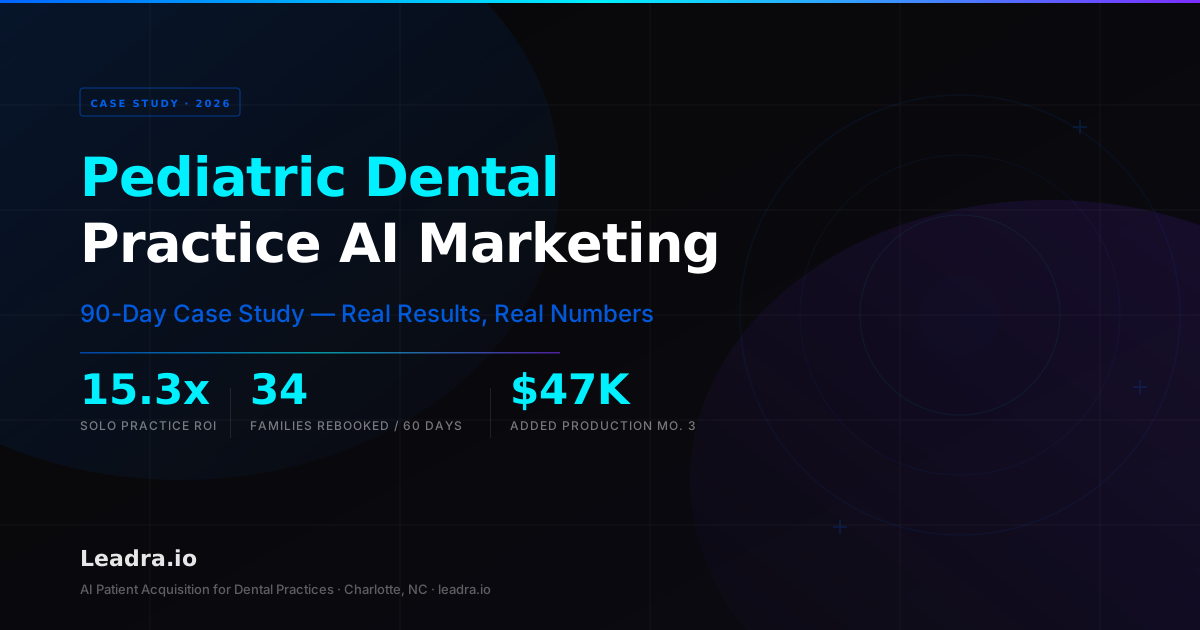
Month 3 ROI: 15.3x. The sibling multiplier is worth flagging — every lapsed family reactivated had an average of 1.6 children booked, meaning the effective new patient value per reactivated contact was significantly higher than a single adult GP patient.
By the end of month 3, the summer schedule (which had historically run 20-30% below capacity) was 94% booked four weeks in advance. That capacity utilization shift alone represented roughly $9,000 in production that previously evaporated each summer.
Case Study 2: Two-Location Pediatric Group — Nashville, TN
Practice type
Pediatric group
Locations
2 locations
Monthly collections
$148K/mo
Active patients
~2,100 kids
Starting situation: This Nashville pediatric group had grown from one location to two in 2024. The second location was underperforming — running at 61% capacity while the flagship was at 88%. They had three front desk staff across two locations and a part-time marketing coordinator who managed Google Ads manually. New patient calls were being lost at the second location because one front desk person was managing phones, check-ins, and insurance simultaneously. Their combined lapsed patient list showed 412 families overdue for recall. Paid search spend was $2,200/month with no conversion tracking on appointment bookings — they had no idea what their cost per new patient was.
Systems deployed:AI Voice Employee at both locations (Open Dental integration), intelligent call routing that directed overflow from either location to the AI agent rather than voicemail, a 412-family lapsed recall campaign split by location for accurate attribution, Google Ads conversion tracking via AI-driven call tracking (so every booked appointment from paid search was attributed to the ad), and an SEO content campaign targeting neighborhood-specific keywords for both locations ("pediatric dentist [Nashville suburb]" for five suburbs around each office). Monthly retainer: $2,600. Infrastructure: $320/month. Existing ad spend: $2,200/month (unchanged). Total investment: $5,120/month.
Location 2 capacity
Lapsed families rebooked
Google Ads CPL
Added production (mo 3)
Month 1 was dominated by lapsed family reactivation — 31 families rebooked in the first 30 days, with 18 at location 2, directly addressing the underperforming location's capacity problem. After-hours call recovery added another $4,100 at location 2 in month 1 alone, from calls that previously hit voicemail during the evening pickup rush.
The Google Ads conversion tracking revealed something important: prior to the engagement, the $2,200/month ad spend was generating new patients at an estimated cost of $180-$220 per acquired patient, based on the traffic volume and a typical industry conversion rate. After installing AI-driven call tracking, the actual measured cost per acquired patient was $68 — the ads were performing better than estimated, but the front desk was losing bookings because no one was answering during peak hours (3-6 PM).
Month 3 ROI: 9.2x on the full investment including existing ad spend. If calculated only on the incremental AI marketing investment (excluding the pre-existing ad spend): 16.1x. The 9.2x figure is the honest number — it accounts for everything the practice was spending.
Location 2 capacity jumped from 61% to 84% by month 3. The SEO neighborhood keyword campaign was still ramping — by month 5, three suburb-specific keywords had reached page 1, contributing an estimated 14 additional organic new patient calls per month across both locations.
Results Compared: Solo vs. Multi-Location Pediatric Practice
| Metric | Solo Pediatric (Charlotte) | Group Pediatric (Nashville) |
|---|---|---|
| Monthly investment | $1,290 | $5,120 (incl. ads) |
| Month 1 added revenue | $7,400 | $18,600 |
| Month 3 added revenue | $19,800 | $47,200 |
| Month 3 ROI | 15.3x | 9.2x (full) / 16.1x (incremental) |
| Primary driver | Lapsed recall + after-hrs calls | Location 2 capacity + recall |
| Days to break-even | Day 22 | Day 12 |
| Sibling bookings generated | 6 in first 60 days | 24 in first 60 days |
The Three AI Systems That Move the Needle for Pediatric Practices
Both cases followed the same deployment sequence. Here is why that order matters and what each system actually does in a pediatric context:
System 1
AI Voice Employee with pediatric-specific scripting
A pediatric front desk answers calls differently than a GP office. Parents ask about anxiety management, first-visit protocols, sedation options, and age minimums. An AI voice agent trained on pediatric-specific FAQs handles these calls accurately — collecting the child's age, insurance information, and parent contact before booking the appointment directly into the PMS. The 3-6 PM window (school pickup time) is the highest-volume missed-call window for pediatric practices, and AI handles it without adding front desk hours.
System 2
Lapsed family reactivation campaigns
Parents respond to recall outreach that speaks to their child specifically. Generic 'you are due for a cleaning' messages produce 8-12% response rates. Messages that include the child's name, reference their last visit month, and make rebooking a one-tap action produce 22-31% response rates. The pediatric recall campaign segment by last visit date — families overdue 12-18 months get a different message than those overdue 24+ months. Both are run automatically, triggered by the PMS data, without any front desk involvement.
System 3
Post-appointment review collection targeted at parents
The timing and framing of review requests matters enormously for pediatric practices. Sending a review prompt 48 hours after the appointment — when the parent has reflected on how their child felt about the experience — produces 3-4x more reviews than same-day requests. The message is sent to the parent, not the child's chart contact. Pediatric practices that reach 75+ Google reviews with a 4.5+ rating rank in the Google Maps 3-pack for local search terms in most mid-size markets.
These three systems produce results within 30-45 days because they work on patients and families already in your PMS. New patient acquisition through SEO and paid search is layered in after the foundation is generating consistent revenue — the same approach we take with general dental practice AI marketing.
Red Flags: What Undermines AI Marketing for Pediatric Practices
For more on choosing the right dental AI marketing partner, see our guide on dental patient acquisition with AI. The criteria apply directly to pediatric practices — with the added filter of pediatric-specific scripting and parent-focused messaging.
FAQ: AI Marketing for Pediatric Dental Practices
Does AI marketing work for pediatric dental practices specifically?
Yes — pediatric practices are among the highest-ROI use cases for AI marketing. The decision-maker (the parent) is reachable by SMS and email and responds well to automated recall outreach. Pediatric practices deploying AI recall systems typically see 18-30% of lapsed families rebook within 60 days. AI voice agents fill after-school slots that go unfilled when the front desk is overwhelmed during the 3-6 PM peak window.
What is the ROI timeline for AI marketing in a pediatric dental practice?
Most pediatric practices see measurable results within 30-45 days. The fastest returns come from after-hours call recovery and lapsed family reactivation. New patient acquisition through SEO takes 45-75 days to ramp. Full 90-day ROI benchmarks for pediatric practices run 8x-15x on total investment — with solo practices on the higher end due to lower investment cost and concentrated patient base.
How does AI handle HIPAA compliance for pediatric dental marketing?
AI marketing platforms designed for dental practices operate under Business Associate Agreements (BAAs) that satisfy HIPAA requirements for PHI handling. SMS outreach uses appointment reminders that qualify as operational communications. Any vendor running pediatric dental marketing without a signed BAA is a liability. Leadra.io operates under signed BAAs for all dental clients.
What makes pediatric dental AI marketing different from adult GP marketing?
Three key differences: The decision-maker is a parent, so all messaging must speak to parent concerns. Appointment demand is intensely seasonal around school calendars. One acquired family means 2-4 patients over time, so household lifetime value is significantly higher than a single adult patient. AI systems calibrated for pediatric practices account for all three — generic dental marketing templates do not.
Pediatric Practice Growth
See What AI Marketing Can Do for Your Pediatric Practice
Share your lapsed patient count, current call volume, and PMS platform. Leadra.io will build a custom 90-day projection based on your actual numbers — not industry averages. Pediatric-specific systems, parent-focused messaging, HIPAA-compliant from day one.